Chemistry Experiments, I, J, K
Last updated 2026-07-13 by Dr John Elfick
Chemistry, I, J, K
12.2.13 Heat iron to form iron (II) oxide
1. Heat an iron nail.
Describe what happens to the metal.
The metal does not melt.
The heated part turns black.
The spirit burner flame is not hot enough to melt the iron.
The part of the metal in the flame becomes covered with oxide.
2. Repeat the experiment by heating fine iron wire.
Describe what happens to the metal wire.
The wire quickly gets red hot and melts.
The iron is so thin that it gets hot enough to melt.
3. Repeat the experiment by heating iron filings.
Drop a finger width of the iron filings in the spirit burner flame or a Bunsen burner flame.
Describe what happens to the iron filings.
Some iron filings burn in the flame, like sparklers.
Very small particles of iron become so hot that they burn.
These particles combine with oxygen gas very fast to form iron oxide.
Fe + O2 → FeO source
12.2.14 Heat iron powder to form oxides
Heated iron powder forms oxides, depending on the temperature and availability of oxygen.
2Fe + O2 → 2FeO source
4Fe + 3O2 → 2Fe2O3 source
3Fe + 2O2 → Fe3O4 source
14.8.14 Prepare iron (II) ammonium sulfate
Iron (II) ammonium sulfate, ammonium iron (II) sulfate, Mohr's salt, (NH4)2Fe(SO4)2(H2O)6
Add 4 mL of concentrated sulfuric acid to 30 mL of deionized water in a conical flask.
Slowly add 5 g of iron then heat to boiling.
Add 10 g of ammonium sulfate and evaporate to two thirds of the original volume.
Add a loose stopper loosely and leave the double salt to crystallize.
This salt is not an alum.
14.8.15 Detect iron in fruit juice using black tea
Add strong black tea to samples of fruit juice, e.g. apple, pineapple, cranberry.
Note the time for a cloudy precipitate of iron compounds to form.
The precipitate may not appear for hours or days and the time for precipitation may depend on the temperature and concentrations of the tea and fruit juice.
Pineapple juice should give the shortest time for precipitation.
The precipitate is formed by a reaction between the ferric, Fe3+, non-haem iron from the fruit juice with the tannins in the black tea.
The non-haem iron is an important component in your diet, but black tea may make this iron indigestible so that we cannot absorb it.
Perhaps we should drink black tea only between meals and not with meals.
The ferrous, Fe2+, haem iron comes mainly from haemoglobin and myoglobin in red meat.
14.8.16 Iron (II) sulfate (ferrous sulfate) with sodium carbonate
Add sodium carbonate (washing soda), solution to iron (II) sulfate solution.
A green precipitate of iron (II) carbonate forms iron (II) sulfate + sodium carbonate → iron (II) carbonate + sodium sulfate source
14.8.17 Iron (II) sulfate (ferrous sulfate) with ammonia
Add drops of dilute ammonia solution to 2 cm of iron (II) sulfate solution in a test-tube and shake the test-tube.
Observe a green-grey precipitate of iron (II) hydroxide.
The precipitate left on the side of the test-tube quickly turns brown, because oxygen from the air turns it into iron (III) hydroxide, ferric hydroxide.
14.8.18 Iron (II) sulfate (ferrous sulfate) oxidation to iron (III) sulfate (ferric sulfate)
Heat iron (II) sulfate solution with a substance rich in oxygen, e.g. hydrogen peroxide.
Boil 2 cm of iron (II) sulfate solution in a test-tube with drops of hydrogen peroxide.
The green colour changes to yellow or brown.
Cool the test-tube under the tap and test the liquid, iron (III) sulfate solution (ferric sulfate) by adding dilute ammonia solution.
A brown precipitate of iron (III) hydroxide (ferric hydroxide) forms.
14.8.19 Iron (III) sulfate (ferric sulfate) reduction to iron (II) sulfate (ferrous sulfate)
Put 2 cm of ammonium iron (III) sulfate solution in a test-tube with an equal amount of dilute sulfuric acid or sodium hydrogen sulfate solution.
Add 2 mL of iron filings or coiled iron wire or steel wool or small pieces of zinc or zinc powder
Heat the test-tube until effervescence starts, because of the formation of hydrogen.
The hydrogen is the reducing agent.
Leave the test-tube to stand.
The brown / yellow colour of the solution vanishes, and when it is pure the solution is light green.
2Fe3+ + Zn → 2Fe2+ + Zn2+ source
Test1: Add dilute ammonia solution.
A dirty green precipitate forms to indicate iron (II) sulfate.
The precipitate does not dissolve in excess ammonia solution.
Test 2: Add dilute sodium hydroxide solution.
A dirty green precipitate forms that does not dissolve in excess sodium hydroxide.
14.8.20 Oxidation of iron (II) salts
1. Use 2 cm of iron (II) sulfate solution in a test-tube.
Add just more than an equal volume of dilute sulfuric acid and three drops of concentrated nitric acid.
Heat until the solution boils.
Leave to cool and add sodium hydroxide solution until a red precipitate of iron (III) hydroxide forms.
6FeSO4 + 3H2SO4 + 2HNO3 → Fe2(SO4)3 + 4H2O + 2NO source
Iron (II) ions are oxidized to iron (III) ions by electron loss.
Fe2+ - e- → Fe3+ source
2. Pass chlorine gas through an iron salt solution.
Brown iron (III) chloride solution forms.
2Fe2+ (aq) → Fe3+ (aq) + e- (oxidation of iron when it loses an electron) source
Cl2 (aq) + 2e- → 2Cl- (aq) (reduction of chlorine when it gains electrons) source
2Fe2+ (aq) + Cl2 (g) → 2Fe3+ (aq) + 2Cl- (aq) source
Chlorine is the oxidizing agent.
Its oxidizing number drops from 0 to -1 when it gains an electron.
Iron is oxidized as it increases from Fe (II) to Fe (III) when it loses an electron.
3. Repeat the experiment by substituting other oxidizing materials, e.g. bromine, potassium permanganate or hydrogen peroxide, for nitric acid in the above experiment.
14.8.21 Burn steel wool
Wear safety glasses and safety apron.
Handle steel wool with tongs.
Small pieces of steel, e.g. pins, needles, nails, will not ignite when heated with a lighter or Bunsen burner, because the surface area / volume ratio is too small.
However, a grinding wheel can be used to break steel into tiny pieces and heat them by friction to form incandescent pieces of iron with large surface / volume ratio, that react with oxygen in the air to form sparks.
Pull out strands of steel wool from a steel wool pad and use them to connect the terminals of a 6 volt battery.
The strands become hot caused by the high resistance of the iron and the surface starts to oxidize until all the strands are converted to iron oxides.
The strands burn brighter and faster if you blow on them to increase the oxygen supply.
4Fe + 3O2 → 2Fe2O3 + energy source
Burn steel wool in air with a Bunsen burner over a heat resistant mat to form black magnetite, FeOFe2O3, that is weakly magnetic. source
14.8.22 Reduction of iron (III) salts
1. Put 2 cm of iron (III) chloride solution in a test-tube.
Pass hydrogen sulfide through the solution until there is no further precipitate of sulfur occurs.
Filter the solution and note the pale green solution.
Test the filtrate with potassium ferricyanide for proof of iron (II) salt.
2FeCl3 + H2S → 2FeCl2 + 2HCl + S (s) source
Iron (III) ions are reduced to iron (II) ions by electron gain.
Fe3+ + e- → Fe2+ source
Sulfide ions are oxidized by electron loss.
H2S < → 2H + + S2- source
S2- - 2e- → S. source
2. Add an equal volume of concentrated hydrochloric acid and pieces of granulated zinc to 3 cm of iron (III) salt solution.
Leave for half an hour then filter.
Test the filtrate with excess of sodium hydroxide solution to show that reduction to iron (II) is complete.
In the presence of acid, zinc atoms ionize and the electrons are accepted by iron (III) ions that are reduced to iron (II) ions.
Zn → Zn3+ + 2e- source
2Fe3+ + 2e- → 2Fe2+. source
14.8.23 Heat iron filings with powdered sulfur
Grey iron (II) sulfide forms, FeS.
It is ferrimagnetic.
8Fe + S8 → 8FeS (direct union of elements to form compounds). source
14.8.24 Prepare iron (II) oxide
Close with a plug of wool a dry test-tube containing 3 cm of iron (II) oxalate.
Heat gently then strongly to convert all the yellow oxalate to black iron (II) oxide.
Remove the plug of wool and sprinkles the iron (II) oxide into an evaporating basin.
The iron (II) oxide spontaneously ignites as it oxidizes to red iron (III) oxide.
FeC2O4 → FeO + CO + CO2 source
Dissolve the particles left in the test-tube in hydrochloric acid.
Test the solution for iron (II) ions.
Iron (II) oxide is a base, but iron (II) salts are prepared with metallic iron and acid.
14.8.25 Heat iron (II) sulfide
FeS2 (pyrite) fool's gold source
Iron (III) oxide and sulfur dioxide forms.
(FeS2 is not iron (IV) sulfide.) source
4FeS2 (s) + 11O2 → 2Fe2O3 (s) + 8SO2 (g). source
14.8.26 Prepare iron (III) oxide
Add excess ammonia solution, NH3 (aq) ("ammonium hydroxide") to an iron (III) salt and filter off the iron (III) hydroxide. source
Heat the filter paper and contents in a crucible to leave red iron (III) oxide, Fe2O3. source
Boil some oxide in concentrated hydrochloric acid and show that it is a base.
14.8.27 Black iron oxide is a mixed base, Fe3O4
14.8.27 Black iron oxide is a mixed base, Fe3O4 source
Cover the bottom of a test-tube with black iron oxide and add 3 cm of concentrated acid.
Heat the solution slowly then filter it.
Divide the filtrate into two parts.
Test one part for iron (III) ions.
Test the other part for iron (II) ions.
Both ions are present.
Fe3O4 + 8HCl → - 2FeCl3 + FeCl2 + 4H2O source
14.8.28 Iron displaces hydrogen from sulfuric acid
Iron displace hydrogen from sulfuric acid to form iron (II) sulfate
Fe (s) + H2SO4 (aq) → FeSO4 (aq) + H2 (g) source
Evaporate the solution to form blue-green crystals of FeSO47H2O, green vitriol. source
In air, iron (II) salts are oxidized to iron (III) salts, so brown iron(III) hydroxide and iron (III) sulfate forms on the blue-green crystals.
14.8.29 Iron displaces hydrogen from hydrochloric acid
Iron displaces hydrogen from hydrochloric acid to form iron (II) chloride.
Fe (s) + 2 HCl (aq) → FeCl2 (aq) + H2 (g) source
Evaporate the solution to form crystals of pale green FeCl24H2O. source
In the air, the iron (II) is oxidized to FeCl3 and Fe2O3. source
14.8.30 Heat hydrated iron chlorides
1. Prepare iron (II) chloride solution by dissolving iron filings in concentrated hydrochloric acid.
Evaporate in a test-tube until crystals appear.
Heat strongly and test the vapour for hydrogen chloride with silver nitrate solution on a glass rod.
Note the residue of iron (III) oxide formed when the iron (II) oxide is oxidized in the air.
FeCl2 + H2O → FeO + 2HCl source
2FeO + O (air) → Fe2O3. source
2. Heat iron (III) chloride in a test-tube.
Test the gas for hydrogen chloride and note the residue of iron (III) oxide.
Hydrolysis has occurred.
2FeCl3 + 3H2O → Fe2O3 + 6HCl. source
14.8.31 Prepare iron (II) sulfate crystals with iron filings
When iron is treated with dilute sulfuric acid hydrogen gas forms and a solution of iron (II) sulfate forms.
Heat half a test-tube of dilute sulfuric acid over a flame, but do not boil the liquid.
Remove the test-tube from the flame and add iron filings on the end of a metal spatula.
A vigorous effervescence occurs, because of the formation of hydrogen.
Test with a glowing splint.
When the action dies down, add more iron filings, and then more, until a total of 4 mL is added.
Put the test-tube on one side for 15 minutes until effervescence has nearly ceased.
Filter the liquid into an evaporating basin.
Make sure that acid is left, by testing with blue litmus paper.
The presence of acid prevents the solution from oxidizing to brown iron (III) sulfate.
To obtain large crystals of iron (II) sulfate, leave the solution undisturbed for a day or two to crystallize out.
Small crystals can form more quickly by evaporating the solution over a flame until only one third of it remains.
If a brown colour appears in the liquid during the evaporation, add a drop or two of dilute sulfuric acid.
When the evaporation finishes, leave the remaining liquid to cool.
Many small crystals of iron (II) sulfate are deposited.
14.8.32 Prepare iron (III) hydroxide and iron (III) oxide
Add 4 cm of dilute ammonia solution to 2 cm of ammonium iron (III) sulfate solution in a test-tube.
Shake the test-tube to mix the liquids.
A brown jelly-like precipitate of iron (III) hydroxide forms.
Filter off the precipitate of iron (III) hydroxide.
Put of the red-brown jelly left in the filter paper on to a clean metal lid or into a metal screw cap.
Hold the lid or cap in a pair of pliers and heat it carefully above a flame.
Steam is produced and a red powder formed.
This is iron (III) oxide, a very pure form of rust.
The same substance forms by heating iron (II) sulfate crystals.
14.15.17 Prepare iron (II) oxide
Close with a plug of wool a dry test-tube containing 3 cm of iron (II) oxalate.
Heat gently then strongly to convert all the yellow oxalate to black iron (II) oxide.
Remove the plug of wool and sprinkles the iron (II) oxide into an evaporating basin.
The iron (II) oxide spontaneously ignites as it oxidizes to red iron (III) oxide.
FeC2O4 → FeO + CO + CO2 source
Dissolve the particles left in the test-tube in hydrochloric acid.
Test the solution for iron (II) ions.
Iron (II) oxide is a base, but iron (II) salts are prepared with metallic iron and acid.
14.15.22 Reduction of iron (III) salts
1. Put 2 cm of iron (III) chloride solution in a test-tube.
Pass hydrogen sulfide through the solution until there is no further precipitate of sulfur occurs.
Filter the solution and note the pale green solution.
Test the filtrate with potassium ferricyanide for proof of iron (II) salt.
2FeCl3 + H2S → 2FeCl2 + 2HCl + S (s) source
Iron (III) ions are reduced to iron (II) ions by electron gain.
Fe3+ + e- → Fe2+ source
Sulfide ions are oxidized by electron loss.
H2S < → 2H + + S2- source
S2- - 2e- → S source
2. Add an equal volume of concentrated hydrochloric acid and pieces of granulated zinc to 3 cm of iron (III) salt solution.
Leave for half an hour then filter.
Pyrites, iron pyrite, fool's gold, FeS2: 35.20.32 source
Pyrrhotite, FeS, iron sulfide: 35.20.34
Reactions of iron salts, Prussian blue: 14.8.1
Reactions of iron: 7.2.2.21
Redox titration, iron (II) sulfate: 15.2.4.5
Reduce iron (III) chloride, SO2: 3.51.3 source
Reduce iron (IlI) salts: 14.8.5
Rusting: 15.3.0
Tests for iron: 12.11.3.20
Tests for iron in cooking water: 19.3.3a
Tests for oxidizing agents: 15.2.8
14.22 Prepare iron compounds
12.19.8.3 Prepare iron (III) chloride
12.15.3.1Prepare iron sulfate with copper (II) sulfate solution
14.15.16 Prepare iron (II) ammonium sulfate
Iron (II) ammonium sulfate, ammonium iron (II) sulfate, Mohr's salt, (NH4)2Fe(SO4)2(H2O)6
Add 4 mL of concentrated sulfuric acid to 30 mL of deionized water in a conical flask.
Slowly add 5 g of iron then heat to boiling.
Add 10 g of ammonium sulfate and evaporate to two thirds of the original volume.
Add a loose stopper loosely and leave the double salt to crystallize.
This salt is not an alum.
14.8.33 Heat iron with sulfur
Heat iron filings with sulfur powder (synthesis reaction).
S8 (s) + 8Fe (s) → 8FeS (s) source
Be careful! The following reactions are vigorous.
Do not use large quantities of the chemicals.
The reaction of iron (II) sulfide with hydrochloric acid will form the poisonous gas, hydrogen sulfide, with an odour of rotten eggs.
Experiments 1. Mix half a metal bottle top of powdered sulfur with the same volume of iron filings.
Heat a small portion of the mixture on the metal bottle top with the cork removed or in a hard glass test-tube.
When the reaction begins, i.e. the mixture starts to glow, stop heating by moving the Bunsen burner to the side.
If the glow stops, heat the test-tube again.
The reaction of a mixture of iron with sulfur gives out so much heat that the mixture becomes red hot.
Note the following different properties of powdered sulfur, iron filings and the iron (II) sulfide: | appearance | colour | hardness | magnetism|.
Iron is magnetic, so is easily removed from a mixture of iron and sulfur, but iron (II) sulfide is not magnetic.
Fe + S → FeS (s) source
2. Use < 10 g total material iron with sulfur in a fume cupboard.
Heat the mixture to start the reaction.
However, be aware that unreacted sulfur may catch fire and produce sulfur dioxide gas to irritate the lungs.
3. Mix uniformly reduced iron powder and powdered sulfur in a weight ratio of seven to four.
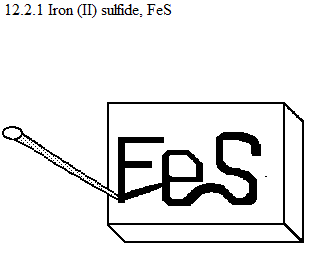
Carve the word "FeS" on a red coloured brick with a knife.
Spread the iron sulfur mixture throughout the word groove and press the powdered mixture solid.
Heat one tip of a glass rod until red hot with an alcohol burner and then immediately dig the hot tip into the mixture at one end of the word groove.
A chemical reaction starts immediately.
The reaction continues violently to release a large amount of heat and meanwhile to develop rapidly a red glow, which looks like a small "fiery dragon".
The heat lost by the reaction is more than the heat needed to start the reaction.
The reaction produces a new black solid substance, iron (II) sulfide, that has different properties from the two reactants, iron and sulfur.
Compare iron powder, powdered sulfur and iron (II) sulfide.
Note their appearance.
Test them respectively with a magnet.
Add in drops hydrochloric acid solution to them respectively.
4. Mix equal amounts of iron filings and powdered sulfur.
Heat the mixture in a crucible or a small tin with sand in the bottom.
The sand prevents the bottom of the tin from melting by spreading the heat.
Heat the mixture strongly until you see a red glow spreading through the mass.
The heat lost by the chemical reaction is more than the heat needed to start the reaction.
The reaction forms a new substance iron (II) sulfide that has different properties from the two elements used to make it.
Compare iron filings, powdered sulfur, and iron (II) sulfide.
Note their appearance.
Test with a magnet.
Add drops of hydrochloric acid.
5. Make a mixture of 7 parts of iron filings with 4 parts of sulfur powder in a sealed plastic bag.
Hold a magnet over the plastic bag to show that the iron filings can be easily separated from the mixture.
Quarter fill an ignition tube with the mixture.
Near an open window or in a fume cupboard heat the end of the ignition tube with a Bunsen burner.
When the mixture glows move the Bunsen burner away, but when the glow stops move the Bunsen burn back again until all the mixture reacts.
Leave the ignition tube to cool, then move the magnet near it.
The magnet can no longer attract iron filings or the iron sulfide in the ignition tube.
14.15.18 Prepare iron (II) sulfate crystals with iron filings
When iron is treated with dilute sulfuric acid hydrogen gas forms and a solution of iron (II) sulfate forms.
Heat half a test-tube of dilute sulfuric acid over a flame, but do not boil the liquid.
Remove the test-tube from the flame and add iron filings on the end of a metal spatula.
A vigorous effervescence occurs, because of the formation of hydrogen.
Test with a glowing splint.
When the action dies down, add more iron filings, and then more, until a total of 4 mL is added.
Put the test-tube on one side for 15 minutes until effervescence has nearly ceased.
Filter the liquid into an evaporating basin.
Make sure that acid is left, by testing with blue litmus paper.
The presence of acid prevents the solution from oxidizing to brown iron (III) sulfate.
To obtain large crystals of iron (II) sulfate, leave the solution undisturbed for a day or two to crystallize out.
Small crystals can form more quickly by evaporating the solution over a flame until only one third of it remains.
If a brown colour appears in the liquid during the evaporation add a drop or two of dilute sulfuric acid.
When the evaporation finishes, leave the remaining liquid to cool.
Many small crystals of iron (II) sulfate are deposited.
14.15.19 Prepare iron (III) ammonium alum
Iron (III) ammonium alum (NH4)2SO4.Fe2(SO4)3.24H2O. source
Dissolve 11. 5 g of iron (II) sulfate in 30 mL of dilute sulfuric acid.
Add 5 mL of concentrated nitric acid and evaporate the solution to 15 mL.
Dissolve 2.7 g of ammonium sulfate in 10 mL of water.
Mix the two solutions and leave to crystallize.
Choose a crystal with a regular shape and allow it to grow in the solution.
Iron (III) alum crystals have an amethyst colour, but break down on standing in air due to the formation of basic iron (III) sulfate.
14.15.20 Prepare iron (III) hydroxide and iron (III) oxide
Add 4 cm of dilute ammonia solution to 2 cm of ammonium iron (III) sulfate solution in a test-tube.
Shake the test-tube to mix the liquids.
A brown jelly-like precipitate of iron (III) hydroxide forms.
Filter off the precipitate of iron (III) hydroxide.
Put of the red-brown jelly left in the filter paper on to a clean metal lid or into a metal screw cap.
Hold the lid or cap in a pair of pliers and heat it carefully above a flame.
Steam is produced and a red powder formed.
This is iron (III) oxide, a very pure form of rust.
The same substance forms by heating iron (II) sulfate crystals.
14.15.21 Prepare iron (III) oxide
Add excess ammonia solution, NH3 (aq) ("ammonium hydroxide") to an iron (III) salt and filter off the iron (III) hydroxide. source
Heat the filter paper and contents in a crucible to leave red iron (III) oxide, Fe2O3 . source
Boil some oxide in concentrated hydrochloric acid and show that it is a base.
26.0.0 Ice
4.41 Cool water, melt ice (Primary)
12.3.1 Cut ice with pressure
11.2.6 Density of ice
37.3.2 Dew point hygrometer
11.4.13 Float ice cubes
5.7.0 "Ice", (abuse of volatile substances)
22.5.18 Ice calorimeter
16.2.10 Ice cream
20.4.1.2 Ice cubes in boiling water, (Second law of thermodynamics)
28.11.1 Ice lens, Water concave lens
3.3.1 Ice melts, de-icers
24.4.5 Lift ice cube with salt
11.2.8 Maximum density of water
23.7.19 Melt ice blocks
3.3.8 Melting point of ice and freezing point of water
28.4.07 Refractive index of ice
16.3.23 Spinning ice skater
6.7.8 Triple point and ice point temperatures of water
34.8.16 Use ice
Chemistry, I
Chemistry, I
Please send comments to: j.elfick@uq.edu.au
Contents
Ice, E
-ide suffix
Ideal gas constant, Universal gas equation
Ideal gas constant, Boltzmann constant
Identification tests for plastics, Burning tests
See diagram 14.05chd: Imipramine
Inhalents, Abuse of volatile substances
Inhalation, Sensitizing substances
Inks, E
Inorganic builders, washing powders
Inorganic chemistry, Elements, Actinium to Zirconium
IRR: Irritating - Non-corrosive, but can damage skin if prolonged contact
Chemistry, J
Chemistry, J
joule, Units of work and energy
Chemistry, K
Chemistry, K
Ka, Strong acids and weak acids
Kahle's insect fixing solution
Indium, In
Indium, In
Indium, Table of the Elements
Indium, RSC
Indium, In, (Greek indikon indigo, because of spectral lines) (supply shortfall), rare, in semiconductors
Indium, granular, In
Indium acetates, bromides, chlorides, fluorides, iodides, nitrates, nitride, oxides, perchlorate, phosphides, sulfates
Indium (III) trifluoromethanesulfonate, C3F9InO9S3 source
Indium (III) tris(trifluoromethanesulfonimide), C6F18InN3O12S6 source
Indium tin oxide, ITO, is used for optically transparent front electrode for each pixel in flat screen televisions, touch screens, solar cells.
Indole
Indole, C8H7N, Amine source
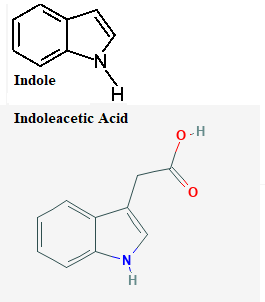
Indole, aromatic, in coal tar, fused benzene and pyrrole rings, toxic if ingested
It is formed from amino acid: | Tryptophan
It has a flowery smell at very low concentrations, but in human faeces intense faecal odour.
It occurs in Jasmine oil, and in Orange blossom.
Ergotamine, indole derivative
Five member heterocycles: 16.2.19
IAA (Indole-3-acetic acid)
IBA (Indole-3-butyric acid)
Indole alkaloids, indolizidine group: 16.6.4
IAA
IAA, Indole-3-acetic acid, 3-indolacetic acid, indol-3-yl-ethanoic acid, C10H9NO2 source
Phenoxyacetic acids can mimic the natural auxin, plant hormone, indole acetic acid and are not destroyed by the plant.
Auxins: 9.3.2 (See 1.)
Marcotting, air layering: 9.4.11
IAA is sold as: "Rooting powders for stem cuttings": 9.5.2, (See: 3.)
IBA
IBA, indole-3-butyric acid
Auxins: 9.1.7.1 (See 4.)
Cuttings: 9.4.5 (See: 4.)
IBA is sold as "Rooting powders for stem cuttings": 9.5.2
Marcotting, air layering: 9.4.11, (See: 1.)
Ilexolide A
Ilexolide A, C35H54O7, is a triterpenoid saponin, cardiac activity, and it occurs in (Ilex pubescens). source
Indomethacin
Indomethacin, C19H16ClNO4, indometacin, anti-inflammatory drug, "Indocid" source
Incarvillateine
Incarvillateine, C42H58N2O8, monoterpene alkaloid, has effect like morphine. source
It occurs in (Incarvillea sinensis) that is used to treat rheumatism in traditional Chinese medicine.
Indophenol
Indophenol, C12H9NO2, phenolindophenol, haematology and histology stain source
Inks
Marbling Inks
Inks include solvent-based ink, water-based ink, ball pen refill, "Biro" or "Bic" refill, Indian ink, toxicity, solvent may be flammable, marbling ink.
Students must not ingest marbling ink used in primary schools.
Indian ink, (Chinese ink), is a mixture of lampblack, carbon black, bone black.
For block printing and screen printing, do not use oil-based solvents, but use water-based screen printing inks, e.g. "Lascaux".
Distil ink: 10.3.3
Prepare Indian ink mounts: 4.7
Prepare invisible ink:3.2.0
Separate by chromatography, mixed inks: 10.2.5
Inosine
Inosine, C10H12N4O5, hypoxanthine, 9-β-D-ribofuranoside, a purine nucleoside, in the anticodon of certain transfer RNA molecules. source
It occurs in brewer's yeast, and it may improve athletic performance.
Inositol
Inositol, C6H12O6, isomer of glucose, Cyclitol Myo-inositol, Scyllo-inositol, Muco-Inositol source
It occurs in cell membrane phospholipids, plasma lipoproteins, the nucleus.
It occurs in humans, and eggs: 13.7 Enjoy eggs, (See: 7.)
Inositol is sold as: Myo-Inositol, 1,2,3,4,5,6-Hexahydroxycyclohexae, meso-Inositol, C6H12O6. source
Invertase
Invertase from baker's yeast, is a yeast extract enzyme.
It catalases sucrose hydrolysis to fructose and glucose (invert sugar).
Invertase is harmful if ingested, irritates eyes, food additive E1103.
It is used as a stabilizer, a food processing aid, and in the production of confectionery foods and artificial honey.
Invertase hydrolyses sucrose into glucose and fructose, yielding a colourless product, unlike acid hydrolysis of sucrose that produces coloured products.
Invertase is sold as "Invertase from baker's yeast (Saccharomyces cerevisiae), practical grade".
Carbon dioxide and fermentation for brewing: 3.8.0
Prepare invert sugar, C12H24O12, HFCS: 3.1.12 source
Iodine, I
Iodine, I
Iodine, Table of the Elements
Iodine, RSC
Iodine, I, (Greek Iōdēs 'violet colour'), halogen, grey-black, violet vapour
Iodine is important for function of the thyroid gland.
Iodine-131, reactor-produced medical radioisotope, half-life 8.02 days, is used to diagnose and treat thyroid diseases.
Radioactive labelled iodine is used to measure percentage uptake of it by thyroid gland (RAI test).
Iodine, I, iodine solid, toxic by all routes, high irritant vapour affects lungs.
Solid crystalline iodine is toxic by all routes of exposure and a highly irritating vapour comes off from the crystals and iodine solutions.
Iodine poses fewer risks in school laboratories than the other halogens, chlorine and bromine.
Do not inhale the acrid iodine vapour.
Iodine, whether as a solid, in solution or a vapour can temporarily stain the skin.
Iodine density at STP = 4.93 g/cm3
Iodine vapour density 9 compared to air, vapour pressure 0.31 mmHg at 25 oC.
Iodine resistivity 1.3E15 μΩ-cm, bp 184C, mp 113 C.
Iodide (iodo), I-, monodentate ligand.
Iodine solid mixture, < 25%, Not hazardous.
Iodine solution, 1% iodine solution, 0.05 M, analytical reagent, 0.1N solution, Iodine indicator solution
Iodine solution, fixative, decolorized by sodium thiosulfate (hypo), so remove iodine stains with sodium thisulfate solution.
Iodine, I, I2, resublimed [COR 1759] is a non-metal forms violet black solid poisonous scales with special smell, the least reactive of the halogens. source
Iodine is most common as iodides, insoluble in water, but dissolves in ethanol and a solution containing I-, 1% in KI, because it forms I3-.
When heated. iodine sublimes to form vapour that irritates the eyes.
Be careful! Iodine may stain the skin.
An intense blue colour is the iodine test for starch.
It is extracted from impurified Chile saltpetre and seaweed.
It is a powerful disinfectant and is dissolved in ethanol to form tincture of iodine.
"Iodine value" is the number of grams of iodine absorbed by 100 g of fat or oil, to indicate the amount of unsaturated acids.
The reactions of iodine with acetaldehyde or antimony metal are violently exothermic.
Use of solid iodine by students should be limited to 0.2 g (the size of about 2 rice grains), per experimental activity.
Experiments
Decolorize iodine solution: 12.6.1
Compare silver chloride, silver bromide and silver iodide: 12.19.6.4
Electrolysis of potassium iodide solution: 15.5.27
Fingerprints with iodine: 12.6.2
Heat copper wire with iodine crystals, (synthesis reaction): 12.2.10.2
Heat iodine crystals: 12.6.3
Iodine extraction: 12.6.4
Iodine clock reaction, hydrogen peroxide, potassium iodide: 17.2.3
Iodate clock reaction, potassium iodate, sodium metabisulfite : 17.2.4
Iodine with aluminium: 13.3.11
Iodine with ammonium hydroxide: 12.6.5, Touch Powder
Iodine with starch: 12.6.6
Iodine value: 12.6.7
Iodine writes on iron: 12.6.8
Persulfate-iodide clock reaction: 17.2.6
Prepare iodine crystals from tincture of iodine: 12.6.9
Separate iodine from kelp: 10.13.2
Prepare iodine compounds
Prepare hydrogen iodide: 12.19.6.1
Prepare iodic acid and potassium iodate: 12.19.6.3
Prepare Gram's iodine solution: 3.11
Prepare iodine solution: 3.12
Prepare Lugol's iodine solution: 3.14
Prepare triodomethane, (iodoform): 16.1.13
Iodine tests
Iodine value: 12.6.7
Tests for amylose and amylopectin: 9.3.4, (See: Tests for starch)
Tests for breakdown of starch to sugars: 9.3.6
Tests for cellulose: 9.3.11
Tests for diastase activity: 9.3.9
Tests for fats and oils: 9.3.11, (See: 6. Wijs' solution)
Tests for glucose and starch, "Testape": 9.5.2
Tests for hydrolysis of starch: 9.5.4, salivary amylase
Tests for iodides: 12.11.12
Tests for starch in potato tuber cells: 9.5.5
Tests for starch, iodine test: 9.5.6
Iodine compounds
Iodoform (tri-iodomethane) CHI3. source
Iodate ion: IO3- source
Iodates, hazards: 3.7.8
Iodide ion: I-, hazards, allergy: 3.7.9
Iodine monochloride, ICl
Iodine pentafluoride, IF5, Iodine trichloride, ICl3, yellow powder, strong disinfectant, toxic by all routes source
Iodoform, CHI3, tri-iodomethane, yellow hexagonal plates, mild antiseptic, toxic if ingested, irritating vapour source
Iodoform, triodomethane (antiseptic), harmful, skin irritant, irritating vapour, test for -COCH3 or -CHOHCH3 source
Iodine monochloride, ICl
Potassium iodide + benzenediaonium chloride (carcinogenic) → iodobenzene (explodes above 200 oC). source
Experiments
Prepare Lugol's iodine solution: 3.14
Pass chlorine through iodine solution: 12.4.12
Separate sodium chloride from iodine: 10.13.1
Prepare Schulze's solution: 7.37
Starch, cornstarch suspension, invisible writing ink: 3.2.14
Starch with water, iodine test: 12.1.42
Table salt and rock salt: 19.1.14
Ingenol mebutate
Ingenol mebutate, C25H34O6, Picato, Ingenol 3-angelate, corrosive, acute toxic, irritant source
It is marketed as Picato ® for topical treatment of actinic keratosis, traditional medicine for skin problems.
It occurs in sap of (Euphorbia peplus).
Ionic, Ions
Ionic, Ions
7.4.37 Ions
12.2.4.01 Ionic equations, double decomposition reactions
11.4.0 Ionic bonding
11.5.0 Movement of ions
18.4.0 Tests for ions in a water sample
Iodine monochloride
Iodine monochloride, ICl, toxic by all routes, avoid vapours, brown-red crystals
I2 + Cl2 → 2 ICl source
iodine crystals + chlorine gas → iodine monochloride, (brown vapour) source
ICl + Cl2 ⇌ ICl3 source
iodine monochloride + excess chlorine ⇌ iodine trichloride
Prepare Wijs solution
Iodine monochloride + glacial acetic acid + iodine crystals, until dissolved → Wijs solution source
Wijs solution is used to determine the iodine value of a fatty acid by titration.
Add glacial acetic acid + iodine crystalsfrom iodine monochloride vial, weigh a specific amount of the iodine monochloride into a flask, and mix well until dissolved. The resulting solution is Wijs solution, which can be used for determining the iodine value of a fatty acid by titration with unsaturated bonds in the fatty acid.
Ionone
Ionone, C13H20O, iraldeine, irisone, monocyclic monoterpene, is an ionone, enone, methyl ketone, health hazard. source
It is used in perfumery and flavouring.
It occurs in rose ketones compounds:
- damascones and damascenones in essential oils,
- rose oil, β-Ionone in scent of roses,
- α-ionone and β-ionone in scent of violets.
Ions
Ions: 5.0.0
Chemical equations and ionic equations, conservation of mass: 11.1.01
Common ion effect: 17.4.0
Electric writing, sodium chloride with litmus paper
Ion exchange resins, deionized water: 2.5
Ionic bonds, electrovalent bonds: 11.2.7, sodium chloride
Ionic equations, double composition reactions: 12.2.4.01
Ionic migration: 33.3.9
Ionization by radioactivity, smoke alarms: 32.3.4.4 (Physics)
Ionization reaction of carbonic acid: 3.9.2
Ionizers for swimming pools: 18.4.8
Migration of ions, speed of ions: 32.3.3.2 (Physics)
Movement of ions: 11.5.0
Prepare salts by chemical reactions: 12.2.0
Radiation ionizing radiation, Geiger counter: 2.9.0
Surfactants in washing powders: 12.6.1
Tests for anions in sewage and tap water: 18.5.2
Tests for ions in a water sample: 18.4.0
Tests for phosphate ions in water: 18.4.1
Water softening using ion exchange resin: 12.2.15
Irgalon
Irgalon, C10H12N2Na4O8, ethylenediaminetetraacetic acid tetrasodium salt, C10H12N2Na4O8, tetrasodium edetate. source
It is antiviral and is used to eradicate biofilms and to treat eye damage.
Iridium, Ir
Iridium, Ir
Iridium, Table of the Elements
Iridium, RSC
Iridium (Latin iris 'rainbow', from colours of its salts)
Iridium powder, AAS solution, yellow-white metal
Iridium-192, reactor-produced medical radioisotope, half-life 73.83 days, wire form, is used to treat head and breast cancer.
Iridium as layer in the earth came from the KT boundary caused by the Chicxulub asteroid impact in Gulf of Mexico over 54 million years ago.
Iridium has very high density 22, 420 kg / m3, and MP 2,446 oC, so is used in crucibles and to harden platinum.
Iridium is possibly the rarest element and it may come from an asteroid.
Iridium (III) acetylacetonate, C15H21IrO6 source
Iridoids
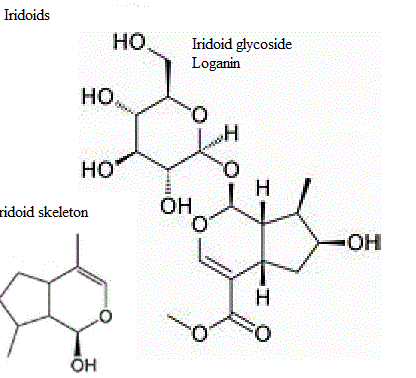
Iridoids are cyclic monoterpenoids.
The iridoid Iridomyrmecin, C10H16O2, occurs in Iridomyrmex ants, in (Actinidia polygama) source
Iron, Fe
Iron, Fe
Iron, Table of the Elements
Iron, RSC
Iron, Fe, natural iron, in ultrabasic rocks, meteorites, flammable powder (ferrum, ferrum reductum), as powder, iron nails, iron wire, iron filings, steel wool
Iron is a magnetic and strong transition metal, 4.5% of the earth's crust, is extracted from iron ores, e.g. haematite, Fe2O3. source
Iron as a grey lustrous powder, is used in metallurgy and as a catalyst.
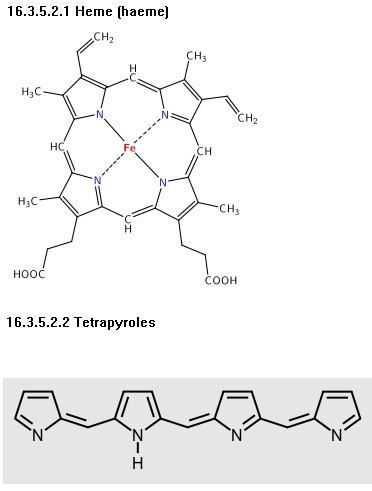
Iron is a micronutrient in haemoglobin for transport of oxygen to tissues and cells, but deficience causes iron-deficiency anaemia.
Pig iron is cast iron, 2-4.3% carbon.
Foundry pig iron, UKEXPORT Limited: "Carbon 3.5-4.6%, Silicon 0.3-3.6%, Manganese 0.05-1.5%, Phosphorous 0.02-0.3%, Sulphur 0.02-0.06%"
Iron iron filings and iron powder are hazardous when mixed with either sulfur, chlorine or bromine, because of the highly exothermic reactions that can occur.
Iron is made into steel by mixing it (alloying), with carbon (mild steel), or with metals, e.g. manganese (armour plating steel), chromium, (stainless steel).
Iron meteorite, iron, iron-nickel alloy, silicates, sulfides minerals
Iron minerals: Greigite, (Fe2+Fe3+2S4) | Haematite, (Fe2O3) | Magnetite, (Fe3O4) | Limonite. (FeO(OH)·nH2O) | Siderite, (FeCO3) source
Goethite, (FeO(OH)) | Chamosite, (Fe2+5Al)(AlSi3O10)(OH)8 | Maghemite, (γ-Fe2O3) source
Atomic number: 26 | Relative atomic mass: 55.847 | RD 7.86 | MP = 1535 oC | BP = 3000 oC | Specific heat capacity: 448 J kg-1 K-1 |
34.5.1 Elements in the Earth's crust
15.1.2 Galvanized iron, galvanized steel
15.1.3 Tin plate
Iron compounds, ferrous Fe2+, ferric Fe3+, ferrate
Experiments
Ammonium iron (II) sulfate or ammonium chloride, invisible writing ink: 3.2.1
Black ink from iron (II) sulfate and oak galls : 3.2.11
Detect iron in fruit juice using black tea: 14.14.2
Dilute sulfuric acid with steel wool: 12.4.11
Direct union of elements to form compounds: 7.4.20, Fe + S
Drink can: 12.2.0, Beverage can
Iron from breakfast cereal: 16.3.5
Halide vapour over hot iron wire forms iron halides: 12.19.2.4
Heat of reaction: 14.12, disposable hand warmers
Heat of rusting: 14.4, heat steel wool
Heat hydrated iron chlorides: 14.15.4
Heat iron filings with powdered sulfur: 14.15.6
Heat iron powder to form oxides: 12.2.14
Heat iron to form iron (II) oxide: 12.2.13
Heat iron with sulfur: 14.15.7
Heat steel wool with iodine crystals: 12.2.2.3
Heat treatment of metals: 34.7.0
Iron (II) sulfate, Secret writing inks: 3.2.5
Iron and zinc with copper (II) sulfate solution: 12.14.12
Iron deficiency in soils: 6.13.5, (Agriculture)
Iron displaces copper in copersulfate solution: 12.2.3.1
Iron displaces hydrogen from hydrochloric acid: 14.8.29
Iron displace hydrogen from sulfuric acid: 14.8.28
Iron from breakfast cereal, (magnetic stirrer) : 16.3.5
Iron in drinking water: 18.7.6
Iron powder heat pack, hand warmers: 14.1.12
Iron with copper (II) sulfate solution: 12.14.13
Iron with sodium hydrogen sulfate: 12.3.13
Iron with sulfuric acid, Temperature and rate of reaction: 17.1.15
Magnetism test: 35.1.10
Ocean Iron Fertilization (OIF): 37.2.12
Oxidation of iron: 6.3.2 (Soils)
Physical changes, magnetize and demagnetize iron wire: 7.1.6.9
Potential difference from combining half cells, zinc and iron: 15.7.1
Reactions of chlorine with steel wool: 12.4.16
Rusting: 15.5.0
Sodiun hydroxide with iron (II) sulfate: 12.2.4.6
Brown ring test for nitrates: 12.2.7, Reactions of nitrates, (See: 3 , iron (II) sulfate)
Stains in swimming pools: 18.1.9
Tests for iron: 12.11.3.20
Tests for iron in cooking water
Iron compounds
Iron compounds, ferrous Fe2+, ferric Fe3+, ferrate, (anion) Fe3O42- source
Black iron oxide is a mixed base: 14.8.27
Wrought iron: 5.1.19H
Chalcopyrite: 35.2.22
Ferricyanide ion, [Fe(CN)6]3− source
Prepare iron compounds:
Iron (II) ammonium phosphate: 12.14.2
Iron (II) oxide: 14.8.24
Iron (II) sulfate crystals with iron filings: 14.8.31
Iron (III) ammonium alum: 12.13.7
Iron (III) chloride: 12.19.8.3
Iron (III) hydroxide and iron (III) oxide: 14.8.32
Iron (III) oxide: 14.8.26
Reduction of iron (III) salts: 14.8.22
Goethite, FeO(OH), hydrous iron oxide: 35.20.17
Greigite, Fe3S4, iron (II, III) sulfide, Ilmenite mibneral, (Geologybr> Haematite: 35.2.37 source
Hydrolysis of iron (III) chloride: 12.10.4
Iron (II) chloride, FeCl2 source
Iron (II) diiron (III) oxide, Fe3O4, ferrosoferric oxide, triiron tetroxide, black magnetic iron oxide, ferric oxide, magnetite source
Iron (II) nitrate, Fe(NO3)2, ferrous nitrate, oxidant, Fe(NO3)2, 6H2O source
3 Fe + 8 HNO3 + 12 H2O → 3 Fe(NO3)2(H2O)6 + 2 NO source
Iron (II) oxide, FeO, ferrous oxide, iron oxide, black oxide of iron, ferrous iron (II) oxide, E172
Iron (II, III) oxide, Fe3O4 (FeO.Fe2O3), magnetite: 35.20.23 source
Iron (III) ammonium sulfate, iron alum: 12.2.15
Iron (III) chloride, FeCl3 source
Iron (III) chromate, ferric chromate, toxic by all routes, carcinogenic, avoid inhaling fine particles
Iron (III) ferrocyanide, C18Fe7N18, Prussian blue source
Iron (III) hydroxide, Fe(OH)3, ferric hydroxide source
Iron (III) nitrate, Fe(NO3)3 source
Iron (III) oxide, Fe2O source
Iron (III) phosphate, FePO4, ferric orthophosphate, ferric phosphate, iron (III) orthophosphate, snail bate, toxic if ingested source
Iron (III) sulfate, Fe2(SO4)3, yellow, hygroscopic source
Iron (III) sulfate hydrate, Fe2(SO4)3.xH2O, ferric sulfate, hydrated ferric sulfate, toxic if ingested source
Iron (III) sulfate technical, Fe2(SO4), 3.9H2O, For 0.1 M solution, 56 g in 1 L water source
Iron (III) sulfate, acid sulfate, Fe2(SO4)3.H2SO4.8H2O source
14.8.16 Iron (II) sulfate (ferrous sulfate) with sodium carbonate
14.8.17 Iron (II) sulfate (ferrous sulfate) with ammonia
14.8.18 Iron (II) sulfate (ferrous sulfate) oxidation to iron (III) sulfate (ferric sulfate)
14.8.19 Iron (III) sulfate (ferric sulfate) reduction to iron (II) sulfate (ferrous sulfate)
14.8.20 Oxidation of iron (II) salts
Ferric compounds, iron(III), Fe3+
Ferric compounds, iron(III), Fe3+
Ferric ammonium sulfate (FAS), iron alum, ammonium iron (III) sulfate, NH4Fe(SO4)2·12 H2O source
Ferric citrate trihydrate, C6H11FeO10, iron(III) citrate trihydrate, orange-red, (ferric + citric acid complexes) Ferric orthophosphate, iron phosphate, FeH2O5P, iron (III) phosphate hydrate, is used to kill snails. source
Ferric alum, K2SO4.Fe2(SO4)3.24H2O source
Ferric hydroxide colloid 7.8.9
Ferric sulfate, iron (III) sulfate, Fe2(SO4)3.(H2O)n, (ferric sulphate) source
It is used at more than 600 of England's wastewater treatment sites to remove phosphorus, which can have a devastating effect on river life if discharged long with wastewater.
Prepare ferric tannate with tea leaves 9.1.8, (Experiment)
Ferrous compounds
"Ferrous ammonium sulfate", Mohr's salt Iron ammonium sulfate
Ferrous ammonium phosphate, (FAP), is used for iron fortification of foods.
Ferricyanide, Ferricyanide ion, [Fe(CN)6]3−
Ferricyanide, Ferricyanide ion, [Fe(CN)6]3− source
Ferricyanide ion, [Fe(CN)6]3−, hexacyanoferrate(III), e.g. potassium ferricyanide, K3[Fe(CN)6] source
Ferrocyanide ion, [Fe(CN)6]4−, e.g. potassium ferrocyanide, K4Fe(CN)6 source
Ferrocyanides, [Fe(CN)6]4-, hazards 3.7.6 source
Blueprints and diazo prints 2.2.1
Decomposition of ferricyanides 3.7.7
Ferricyanides, hazards 3.7.5
Ferrocyanides, hazards 3.7.6
Potassium ferricyanide, K3Fe(CN)6 source
Prussian Blue, Ferric ferrocyanide, Fe4[Fe(CN)6]3 source
Reactions of iron (II) salts and iron (III) salts 14.8.1
Tests for glucose concentration, ferricyanide test 19.1.27
Prussian Blue, Ferric ferrocyanide, Fe4[Fe(CN)6]3
Prussian Blue, Ferric ferrocyanide, Fe4[Fe(CN)6]3 source
Ferric ferrocyanide, Prussian Blue, Fe4[Fe(CN)6]3, ferric hexacyanoferrate(II), deep blue pigment produced by oxidation of ferrous ferrocyanide salts. source
It can exist in either colloidal or water-soluble form, and an insoluble form.
Ferric hexacyanoferrate is used for treatment of heavy metal poisoning, e.g. thallium and radioactive isotopes of caesium, because it is a chelating agent.
The resulting complex is not absorbed in the gastrointestinal tract, but is eliminated in the faeces.
Prussian blue as a semipermeable membrane: 9.1.8
Prepare crystal blossoms: 3.1.2, Prussian blue
Reactions of iron (II) salts and iron (III) salts, Prussian blue 14.8.1 (See 3.)
Ferrites
A ferrite compound is made by heating iron (III) oxide + metallic elements.
They can be used to make permanent magnets or ferrite cores for microwave devices, e.g. MnZn ferrites.
Also, an allotrope of pure iron is called a ferrite.
Ferritin, NCBI Gene 2512, Symbol FTL
Ferritin, NCBI Gene 2512, Symbol FTL
Ferritin is a protein produced in mammalian metabolism which serves to store iron in the tissues.
Gene 2512 encodes the light subunit of the ferritin protein.
Ferritin is the major intracellular iron storage protein in prokaryotes and eukaryotes, is composed of 24 subunits of the heavy and light ferritin chains.
Variation in ferritin subunit composition may affect the rates of iron uptake and release in different tissues.
A major function of ferritin is the storage of iron in a soluble and nontoxic state.
Defects in this light chain ferritin gene are associated with several neurodegenerative diseases and hyperferritinemia-cataract syndrome.
The FTL gene provides instructions for making the ferritin light chain, which is one part (subunit) of a protein called ferritin.
Ferritin is made up of 24 subunits formed into a hollow spherical molecule.
The 24 subunits consist of numbers of the ferritin light chain and another subunit called the ferritin heavy chain, produced from another gene.
The proportion of the two subunits varies in different tissues.
Ferritin stores and releases iron in cells, with each ferritin molecule holdin up to 4, 500 iron atoms inside its spherical structure.
This storage capacity allows ferritin to regulate the amount of iron in cells and tissues, and the iron is needed for the body to produce red blood cells.
12.2.15Iron alum
12.2.15Iron alum
Iron alum, ferric ammonium sulfate (FAS)
Ammonium iron (III) sulfate, NH4Fe(SO4)2.12H2O, iron (III) ammonium sulfate, ferric ammonium sulfate (FAS), iron alum, Toxic if ingested source
Ammonium iron (III) sulfate forms violet crystals that dissolve in water to form a brown acid solution.
Icariin
Icariin, C33H40O15, ieariline, a kaempferol flavonol glucoside, glycosyloxyflavone. methyl ether, phytoestrogen, antioxidant. source
It is used as an oriental aphrodisiac, and a bone density conservation agent.
It occurs in horny goat weed, (Epimedium grandiflora), and in Chinese herbal medicine Herba Epimedii (yinyanghuo).
Imidacloprid
Imidacloprid, C9H10ClN5O2, neonicotinoid insecticide, is used in agriculture as foliar and seed treatments, for indoor and outdoor insect control. source
It is the most popular neonicotinoid.
It has been found to be highly toxic to bees and other beneficial insects.
It is also toxic to upland game birds, is generally persistent in soils and can leach to groundwater.
It cause disruptions in mobility, navigation, and feeding behaviour of bees.
Indantrione hydrate
Indantrione hydrate, C9H12O4, 1,2,3-Indantrione hydrate source
A test for proteins or amino acids, forms characteristic blue colour on heating.
Indigo
Indigo, C16H10N2O2, indigotin, indigo blue, is an hydroxyindole, natural dye and synthetic, dark blue powder with copper lustre. source
It is used to dye blue jeans.
It occurs in (Couroupita guianensis) and (Isatis tinctoria).
The colour indigo is labelled in the rainbow, but its position in the electromagnetic spectrum is not sure.
Some people say that Isaac Newton invented the colour indigo, because he wanted 7 colours, but what he labelled indigo was actually blue.
Iridin
Iridin, C24H26O13, isoflavone, flavonoid, glycosyloxyisoflavone, hydroxyisoflavone, monosaccharide derivative, toxic source
It occurs in poisonous plants, in Orris, (Iris florentina), Iridaceae.
Irisolidone
Irisolidone, C17H14O6, (a 4'-methoxyisoflavone), anti-inflammatory, anti-platelet aggregation, hepatoprotective source
It may be used to treat ethanol-induced gastritis, inhibits (Helicobacter pylori), antiproliferative against amelanotic melanoma cells.
Irisxanthone
Irisxanthone, C20H20O11, a C-glycosyl compound, xanthone, polyphenol, aromatic ether source
Ammonium ion(II) sulfate
Ammonium ion(II) sulfate, (NH4)2Fe(SO4)2.6H2O, Mohr's salt source
Mohr's salt has pale blue-green monoclinic crystals or granules, in air slowly oxidizing and efflorescent, RD 1.86, store in dark place.
Ammonium iron (II) sulfate, For 0.1 M solution, 39.2 g in water, add 5 mL concentrated H2SO4 in 1 L water. source
Ammonium iron (II) sulfate or ammonium chloride, Secret writing inks: 3.2.1
Prepare ammonium Iron(II) ammonium sulfate, Mohr's salt: 14.8.14
For 0.5 M solution, 196 g in 1 L water + 10 mL concentrated H2SO4, dilute to 1 litre, 0.1 M solutions are used to test cations. source
Iron (II) compounds can be oxidized by air, however, acidified solutions are stable.
Iron (II) chloride
Iron (II) chloride, FeCl2, iron chloride, ferrous chloride, deliquescent source
Pass chlorine through iron (II) chloride solution: 12.4.13
Iron (II) chloride (hydrated), FeCl2.2H2O, green source
Iron (II) chloride tetrahydrate, FeCl2.4H2O, blue-green, iron chloride, ferrous chloride source
Iron (III) chloride hexahydrate, FeCl3.6H2O, ferric chloride hexahydrate (FeCl3, ferric chloride anhydrous), iron chloride, iron trichloride, flores martis, black-brown, catalyst source
A 20% solution is used for printed circuit board etchant, but use eye protection and gloves.
Iron (III) chloride hexahydrate, 0.1 M electrochemistry solution is harmless.
Iron (II) sulfate
Iron (II) sulfate, Iron (II) sulfate-7-water, iron (II) sulfate heptahydrate, FeSO4.7H2O, harmful source
Iron (II) sulfate, FeSO4.H2O, ferrous sulfate, white solid, is toxic if ingested. source
Iron (II) sulfate-7-water, FeSO4.7H2O, iron sulfate, hydrated ferrous sulfate, melanterite mineral source
Iron (II) sulfate-7-water, FeSO4.7H2O, iron (II) sulfate 7H2O, iron (II) sulfate heptahydrate, hydrated, ferrous sulfate, harmful source
Iron (II) sulfate-7-water, iron (II) sulfate (VI)-7-water, green vitriol, copperas, blue-green, melanterite
Heat iron (II) sulfate-7-water crystals: 3.6.2
Iron (II) sulfate-7-water, For 0.1 M solution, 27.8 g in 1 L water + 1 mL conc. H2SO4 to clear source
Iron (II) sulfate oxidation to iron (III) sulfate: 12.1.3
Iron (II) sulfate with sodium carbonate: 12.1.1
Iron (II) sulfate with ammonia: 12.1.2
Iron (III) sulfate reduction to iron (II) sulfate: 12.2.8
Prepare iron (II) sulfate crystals with iron filings: 12.1.5
Prepare sulfuric acid with iron (II) sulfate: 12.2.4
Redox titration for weight of iron (II) sulfate in capsule of iron supplement: 15.2.4.5
Reduce iron (III) chloride with sulfur dioxide: 3.51.3
Sodium hydroxide with iron (II) sulfate 12.2.4.6
Iron (II) sulfate, Iron (II) sulfate heptahydrate, FeSO4.7H2O, ferrous sulfate heptahydrate, green vitriol, copperas, wood preservative, inks, green crystals source
It dissolves in water to form neutral solution, crystals turn brown if exposed to air when oxygen of the air converts iron (II) sulfate into brown iron (III) sulfate.
Keep crystals stored in a sealed container.
Prepare a solution of iron (II) sulfate by shaking the powdered crystals with cold water.
Green vitriol was used in industry to make ink.
Iron (II) sulfide
Iron (II) sulfide, toxic if ingested (with acids forms toxic hydrogen sulfide), FeS
Iron (II) sulfide with hydrochloric acid will form the poisonous gas hydrogen sulfide, H2S, odour of rotten eggs. source
Iron (II) sulfide, FeS2, pyrite, iron pyrite, iron sulfide: 35.20.32 source
Heat iron (II) sulfide: 14.8.8
The 1-3% "sulfur" in coal is usually iron (II) sulfide (pyrite): 12.6.0.2
Iron (III) chloride
Iron (III) chloride, FeCl3, ferric chloride anhydrous, ferric chloride hexahydrate, toxic by all routes source
Ferric chloride 43% solution, Ferric chloride 60% solution
Iron (III) chloride, For 0.1 M solution, 27 g in 1 L water + 20 mL HCl
Iron (III) chloride hexahydrate, FeCl3.6H2O, iron (III) chloride 6H2O, ferric chloride hexahydrate, toxic source
Etchants: 7.9.20.1 (See: 3.)
Iron (III) chloride
Iron (III) chloride, Iron (III) chloride hexahydrate, FeCl3.6H2O, (FeCl3, ferric chloride anhydrous), flores martis, black-brown, catalyst source
A 20% solution is used for printed circuit board etchant, but use eye protection and gloves, iron (III) chloride hexahydrate, 0.1 M electrochemistry solution, harmless.
Iron (III) chloride, like common alum, may be used for stopping bleeding from small cuts.
Iron (III) ferrocyanide
Iron (III) ferrocyanide, Prussian blue, C18Fe7N18 source
Lapis lazuli: 35.20.55
Prepare crystal blossoms: 3.54.9
Prussian blue as a semipermeable membrane: 9.168
Reactions of iron (II) salts and iron (III) salts, Prussian blue: 14.8.1
Prussian blue
Prussian blue, iron (III) ferrocyanide, C18Fe7N18, Fe7(CN)18(H2O)14-16, ferric ferrocyanide, Turnbull's blue, paint pigment, engineer blueprint, laundry blue source
It is a dark blue synthetic pigment, colloidal or water-soluble form.
It is used as histology stain for iron, sequestering antidote for some heavy metal poisons, e.g. thallium and caesium radioisotopes.
Prussian blue as "washing blue" is added to clothes washing to to make yellowing cotton sheets appear white and as a blue rinse to dye the hair of old ladies.
Prussian blue dye is made by oxidation of ferrous ferrocyanide salts, by adding iron (II) sulfate to potassium ferrocyanide, with the addition of iron (III) chloride.
Prussian blue can be distilled to yield prussic acid, hydrocyanic acid, HCN, which is very poisonous.
Iron (III) hydroxide
Iron (III) hydroxide, Fe(OH)3 source
Antimony, Reactions: 12.2.1
Ferric hydroxide, iron (III) hydroxide: 7.8.7.2
Group III Insoluble hydroxides: 12.11.7.3
Hydrolysis of iron (III) chloride: 12.10.5
Iron (II) sulfate with ammonia: 12.1.2.
Prepare iron (III) hydroxide: 12.1.7.
Reactions of iron (II) salts and iron (III) salts, Prussian blue: 14.8.1.
Iron (III) nitrate
Iron (III) nitrate, Fe(NO3)3. source
Iron (III) nitrate nonahydrate, Fe(NO3)3.9H2O, oxidizing, toxic, skin irritant, is explosive with combustibles. source
Iron (III) nitrate, nonahydrate, ferric nitrate (nonahydrate), For 0.1 M solution, 40.4 g in 1 L water.
Irone
Irone, C14H22O, a methyl ketone, alpha-irone occurs in field pansy, (Viola arvensis) and in orris, (Iris florentina). source
Iron (III) oxide
Iron (III) oxide, Fe2O3, ferric oxide, iron (III) oxide hydrated, Fe2O3.xH2O, toxic dust, iron sesquioxide, ferric sesquioxide, red iron oxide, red ferric oxide, red iron oxide, haematite, hematite, magnetite, brown red powder, yellow-brown pigment, red ochre, burnt ore, burnt ochre, jewellers' rouge polish, Venetian red, crocus powder. source
It is used as source of iron, mixed with red clay to improve liver functions.
Iron (III) oxide hydrated, Fe(OH)O, ferric hydroxide oxide, catalyst
Iso compounds
"Iso" shows that the compound is an isomer.
Isoamyl acetate, amylacetic ester, toxic by all routes
Isoamyl alcohol, C5H12O, 3-methylbutanol, isopentyl alcohol, toxic, colourless liquid, choking alcohol odour, floats on water source
Isobutane, methyl propane, methylpropane, C4H10 source
Isobutanal, methyl propanal, methylpropional, 2-methyl-1-propanal, highly flammable
Isocyanurates, stabilized chlorine: 18.2.12
Isoleucine (Table of amino acids)
Isopropanol, isopropyl alcohol
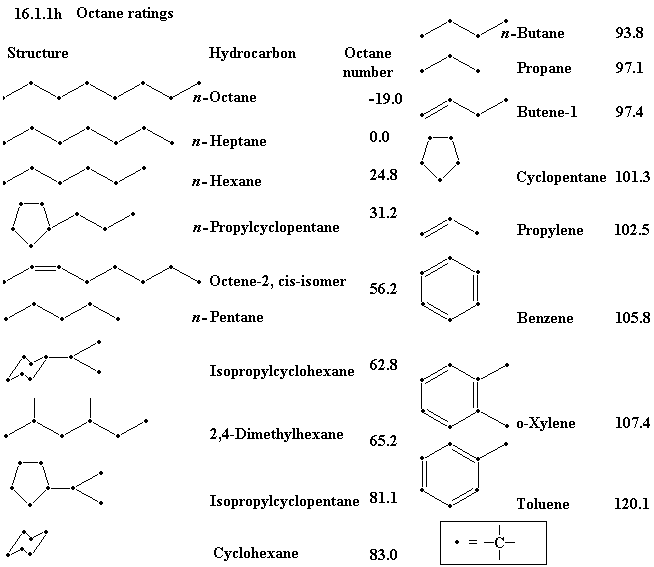
Isopropyl ether CH3)2CHOCH(CH3)2, diIsopropyl ether, highly flammable, harmful
Isoquinoline group of alkaloids: 16.3.21
Isothiocyanates: 16.11.0
Isothiocyanate (isothiocyanato), N=C=S-, monodentate ligand
Isobutanol
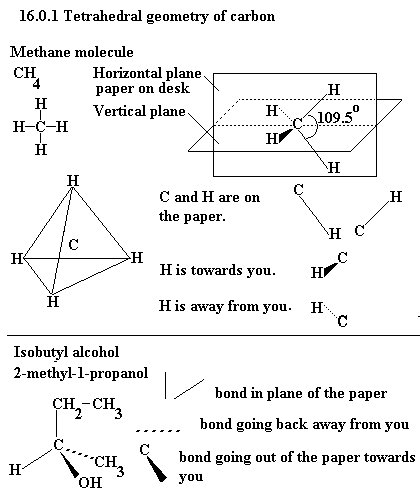
Isobutyl alcohol, Solution < 25%, Not hazardous
Isobutrin
Isobutrin, C27H32O15, anthocyanin, (Tetrahydroxychalcone diglucoside), beta-D-glucoside, monosaccharide source
It is hepatoprotective, and anti-inflammatory.
It occurs in flame-of-the-forest (Butia monosperma).
Isoscutellarein
Isoscutellarein, C15H10O6, (8-Hydroxyapigenin), a tetrahydroxyflavone, as glycosides source
It occurs in Pinguicula, Stachys, and in Veronica.
Isocyanuric acid
Isocyanuric acid, C3H3N3O3, tricarbamide, s-triazinetriol, sodium dichloroisocyanurate, granules, trichloroisocyanuric acid tablets source
It is used as a chlorine stabilizer for swimming pools, administered as sodium dichloroisocyanurate granules or trichloroisocyanuric acid tablets.
Isoflavones
Isoflavones, C15H10O2, phytoestrogens, (Isomer of flavone), occurs almost only occurs in Fabaceae, oestrogenic activity, e.g. Psoralea. source
Isoflavonesis are related to isoflavonoids, phytestrogens and antioxidants.
Soy isoflavones may prevent breast cancer.
Isoflavones occur in legumes, soybeans, and in pistachios.
Astragaloside 4, C41H68O14, anti-inflammatory, occurs in (Astragali radix). source
Daidzein, C15H10O4, Dihydroxyisoflavone, occurs in soybean, occurs in tofu, anti-inflammatory, anti-microbial, antioxidant. source
Equol, the main active product of daidzein metabolism produced by microflora. occurs in the gut.
It is a biomarker for the consumption of soy beans and other soy products, antineoplastic, phytoestrogen.
Betavulgarin
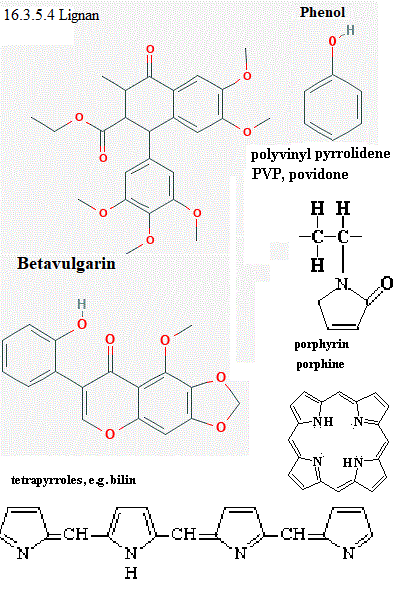
Betavulgarin, antifungal, C17H12O6, (Isoflavonoid), (2'-Hydroxy-5-methoxy-6, 7-methylenedioxyisoflavone), an hydroxyisoflavone source
It occurs in (Beta vulgaris).
Genistein
Genistein, C15H10O5, Prunetol, (a 7-Trihydroxyisoflavone), genisterin, phytoestrogenic isoflavone, antineoplastic, from soy product, induces apoptosis, antioxidant, antiangiogenic, immunosuppressive, anti-inflammatory, anti-atherosclerosis, biomarker for soy consumption source
It is an antitumor, and lessens cardiovascular diseases.
It has antihelmintic activity, the active ingredient in (Felmingia vestita) against worms, liver fluke, pork trematode and poultry cestode.
It occurs in tofu, fava beans, soybeans, kudzu, lupin, (Salvia hispanica), and (Glycine soja).
. Genistin, C21H20O10, genistine, isoflavone, occurs in soya and in kudzu. source
Glycitein, C16H12O5, isoflavone, O-methylated isoflavone, has weak oestrogen activity. source
It occurs in soybean, (Centrosema haiense), (C. Pubescens), and in (Glycine max).
Glycitin, C22H22O10 source
Puerarin, C21H20O9, isoflavone, occurs in kudzu,is used to reduce alcohol withdrawal anxiety. source
Isoflavanes, C16H10O6 source
Isoflavanes, C15H14O, occurs in (Lonchcarpus laxiflorus), Fabaceae. source
Irilone is an hydroxyisoflavone, immunomodulator, antineoplastic agent, organic heterotricyclic compound.
It occurs in herbs and spices, and in red clover (Trifolium pratense).
Pterocarpans, occurs only occurs in Fabaceae, e.g. Phaseolin, C20H10O4, phytoalexin. source
It occurs in French bean, (Phaseolus vulgaris), Fabaceae, and in the stems of (Erythrina subumbrans).
Isopimpinellin,
Isopimpinellin,
Isopimpinellin, C13H10O5, (5,8-Dimethoxypsoralen), is a coumarin source
psoralen, acute toxic, irritant, tuberculostatic, toxicity of Schistosoma, antifungal, piscicidal
It occurs in Pimpinella, Angelica, Heracleum, Luvunca fruit, Flindersis, lime oil (Citrus aurantifolia), and in seeds of parsnip (Pastinaca sativa).
Isorhamnetin,
Isorhamnetin,
Isorhamnetin, C16H12O7, (3-Methylquercetin), isorhamnetol, is a monomethoxyflavone, anticoagulant, dietary flavonoid, antioxidant. source
It prevents endothelial cell injuries, and is a drug used against esophageal cancer.
It occurs in human plasma, Plectranthus, and kale.
Isoprene units
Isoprenoids are compounds from isoprene, often showing repeated occurrence of isoprene units
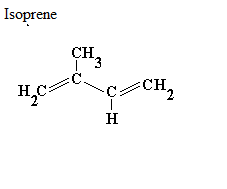
Isoprene, C5H8, (2-methyl-1,3-butadiene), CH2=C(CH3)CH=CH2, isopentadiene, unsaturated pentahydrocarbon, colourless, flammable, health hazard, volatile, inflammable, faint hydrocarbon odour, insoluble in water, less dense than water source
Isoprene occurs in many foods, human breath and isoprene emission may protect plants from heat stress.
Isoprene forms the structural unit of natural and synthetic rubbers.
The 5-carbon isoprene units, the monomers, in natural products have a four carbon chain and a one carbon branch at C2, i.e. [C(CC)CC].
Isoprene is obtained by distillation of caoutchouc or gutta-percha.
In plants, it is used in the formation of isoprenoids, fat-soluble vitamins, carotenoids.
Isoprenes contribute to flavours and fragrances of essential oils.
Isoprene vapour may irritate eyes, skin and mucous membranes.
Isopropyl alcohol
Isopropyl alcohol, (CH3)2CHOH), isopropanol, propan-2-ol, toxic by all routes, flammable, has an irritating pungent odour.
It is called rubbing alcohol (IPA) (conc. from 70% to 99%).
It is used in skin cleaning swabs, chromatography solvent or reactant, alcohol burner fuel, car fuel additive "ISO-HEET".
Propanol, isomers: propan-1-ol, propan-2-ol: 16.1.3a
Isosakuranetin
Isosakuranetin, C16H14O5, citrifoliol, naringenin 4'-methyl ether, is a flavanone, a dihydroxyflavanone. source
It occurs in (Artemisia campestris), Prunus, satsuma orange, Citrus hybrid, and in (Monarda didyma).
Isotopes
Astatine, Halogens, Group 17: 1.6.0
Atomic mass, atomic weight: 5.1.01
Mole, amount of substance: 5.1.0
Properties of elements: 7.2.2.1
Isovaleric acid
Isovaleric acid, C5H10O2, (CH3)2CHCH2CO2H, β-methylbutyric acid, (3-methylbutanoic acid), is a fatty acid, and colourless liquid. source
It has a cheesy sweaty smell or underarm smell or foot smell, produced by skin bacteria metabolizing leucine.
The bad smell in wine caused by Brettanomyces yeasts to be reduced with sulfur dioxide, but it is allowed in some English ales.
Isovaleric acid esters have pleasant smells, and are used in perfumes.
It occurs in valerian, (Valeriana officinalis), Caprifoliaceae.
Jasmolone
Jasmolone, C11H16O2, a secondary alcohol, occurs in pyrethrum (Chrysanthemum cinerariaefolium) source
Jasmone
Jasmone, C11H16O, cis-jasmone, a pale yellow liquid, is the volatile part of jasmine flower oil. source
It has two isometric forms: cis-janmone from natural oil and trans-jasmone from synthetic oil.
It has a distinctive exotic smell.
It occurs in citrus, peppermint oil, green tea, and Bergamot orange.
Janus Green
Janus Green B, C30H31ClN6, Janus Green G, C26H23ClN6. source
If oxygen present, it is oxidized to blue, if oxygen absent, it is reduced to pink.
It is used to stain mitochondria.
Jasmonic acid
Jasmonic acid, C12H18O3, plant hormone, causes tuber formation in potato and yam. source
Javelle water
Javelle water, aqueous solution of potassium or sodium hypochlorite, is a disinfectant and bleaching agent.
Jelly
Gels, gelatin
Jelly beans, Separate food colours in coloured sweets, e.g. jelly beans, "Smarties": 10.2.2.7
Song: "I like Aeroplane Jelly".
Gelatin, gelatine
Paraffin, kerosene
Prepare glycerine jelly: 2.1.
Prepare jelly with fresh pineapple and tinned pineapple: 19.1.13.
Tests for pectin in jelly and jam: 16.7.9.0
Jenner's Stain
Jenner's Stain, C21H9Br4KO5, methylene blue eosinate, eosinmethylene-blue, methyl eosin source
It is used to cause a dark blue stain of a nucleus.
Justicidin
Justicidin A, C22H18O7, lignan, piscicidal, cytotoxic. source
Justicidin B, Dehydrocollinusin, C21H16O6, lignan, piscicidal. source
They occur in (Justicia procumbens), oriental water willow, shrimp plant.
It is used to treat fever, asthma, edema, cough, jaundice, urinary tract infection and as a fish-killer.
It occurs in India and widespread, Acanthaceae.
Kadsurenone
Kadsurenone, C21H24O5, denudatin B, lignan, benzofuran source
It inhibits platelet activating.
It occurs in stem of (Piper futokadsura), (Piper hancei), and (Piper kadsura).
Kadsurin
Kadsurin A, C21H24O6, Ananolignan A, a tannin source
It occurs in stem of (Piper futokadsura).
Kaempferol
Kaempferol, C15H10O6, flavonol, chromogenic agent for antimony, gallium, indium, antioxidant and oestrogenic activity source
It inhibits bone resorption, is a possible anti-cancer, and is used to treat cardiovascular disorders
It occurs in ferns, angiosperms, vegetable foods, (Aloe vera), apples, onions, leeks, citrus fruits, grapes, red wines, (Ginkgo biloba), St. John's wort, apricots, blueberries, blackberries, arugula, asparagus, green and oolong tea, cocoa, broccoli, cabbage, kale, beans, endive, tomatoes, strawberries, (Equisetum arvense), (Moringa oleifera), and (Sophora japonica).
Karwain,
Karwain,
Kawain, C14H14O, karvan, gonosan, 2-pyranone, aromatic ether, spasmolytic, local anaesthetic, anti-inflammatory, antimicotic, anti-oedemic source
It occurs in kava, (Piper methystichum), and in (Alnus sieboldiana).
Keratin
Keratin, C47H77N13O15, is a fibrous protein occurring in hair, wool, feathers, hooves and horns, imbedded in a matrix that makes them strong and elastic. source
Keratins are structural fibrous proteins containing sulfur and held together by disulfide bonds.
Sulfides at slightly alkaline pH can split disulfide bonds between keratin molecules.
The solution is buffered with thioglycollic acid then neutralized with hydrogen peroxide so that it sets again with hydrogen sulfide given off.
The hydrogen sulfide causes the strange smell coming from women's hairdressing salons where "permanent waves" are produced.
Hydrogen peroxide bleaches melanin in hair and softens the hair cortex, thus weakening it.
In humans, 54 functional keratin genes exist and are expressed in specific patterns.
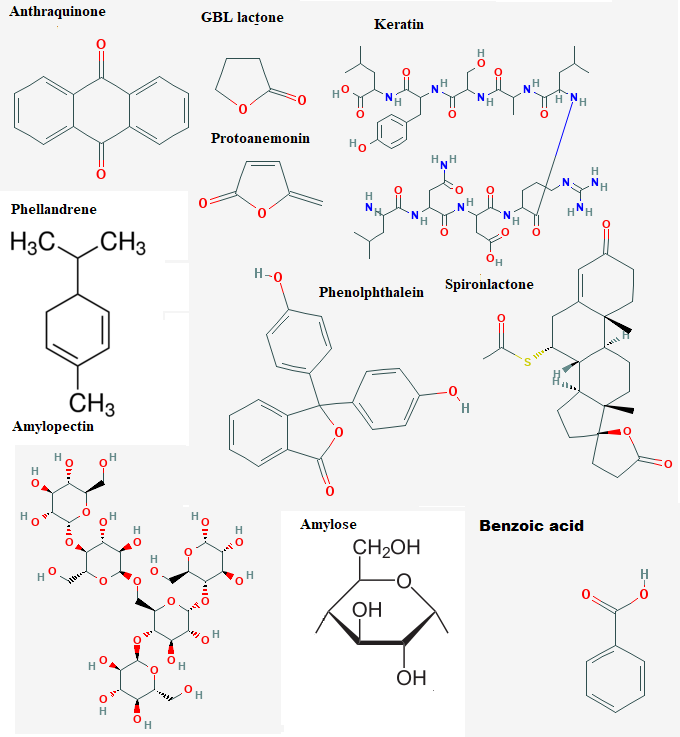
Hair and hair products, keratin: 19.1.1 (Cosmetics)
Fibrous and globular proteins: 16.6.0, (See: 1.)
Keratan sulfate
Keratan sulfate, acidic mucopolysaccharide, glycosaminoglycan, long unbranched polysaccharides, has repeating disaccharide units.
It occurs in cornea, bones, cartilage.
Keratan sulfate is a glycosaminoglycan, a linear polysaccharide of the repeating disaccharide unit N-acetylglucosamine-galactose.
In joints, it also acts as a shock absorber due to its highly hydrated nature.
There are several classes of keratan sulfate, in the cornea, in cartilage and in the brain.
Normally, the body degrades glycosaminoglycan as a natural turnover.
Keratan sulfate proteoglycan is obtained from bovine cornea.
Ketobutyric acid
Ketobutyric acid, α-ketobutyric acid, propionyl formic acid, CH3CH2COCOOH source
Ketobutyric acid, β-ketobutyric acid, acetoacetic acid, CH3COCH2COOH source
Ketones
Ketones, (=CO) (-one), e.g. propanone (acetone) CH3C=OCH3 source
Ketones have a carbonyl group C=O), bonded to two carbon atoms in the form R2C=O, but neither R may be H.
Ketones contain the ketone group (-CO-).
Propanone (acetone, CH3COCH3, and butanone (CH3COC2H5, methyl ethyl ketone), are the simplest saturated ketones (R1COR2). source
Ketones group, Suffix: -one, so ketone names end with "-one".
Ketones cannot be detected with Tollens' test or Fehling's test.
Ketones have a hydrogen atom attached to the carbon atom attached to the carbonyl group, C=O.
2-propanone, acetone, (C3H6O), CH3COCH3 source
2-butanone, methyl acetone, (C4H8O), CH3CH2COCH3 source
2-pentanone, ethyl acetone, (C5H10O), CH3CH2CH2COCH3 source
2-hexanone, propylacetone, (C6H12O), CH3CH2CH2CH2COCH3 source
2-heptanone, butylacetone, (C7H14o), CH3CH2CH2CH2CH2COCH3 source
Jasmone, C11H16O source
Pentan-2-one, methyl propyl ketone, toxic by all routes, highly flammable
Pentan-3-one, diethyl ketone, toxic by all routes, highly flammable
Tests for ketones: 19.5.1
Krypton
Krypton Table of the Elements
Krypton, RSC
Krypton, Kr, (Greek kruptos 'hidden'), non-metal, colourless, odourless, noble gas
Kr2 extracted from liquid air, 0.0001% of the air, is used in photoionization detector (PID) lamps and is mixed with other gases in fluorescent lamps.
Krypton forms few compounds.
Atomic number: 36, Relative atomic mass: 83.80, RD 2.16 (121 K), MP = -157 oC, BP. = -152 oC
Specific heat capacity: 247 J kg-1 K-1
This page was generated automatically from the original page on John Elfick's School Science Lessons website. If something looks wrong, please check the original.