Chemistry Experiments, E
Last updated 2026-10-14 by Dr John Elfick
Chemistry, E
E0, Reduction potential, Standard electrode potential of metals
Ehrlich's haematoxylin
Quick links — A–Z index
Expired air resuscitation, (Adult)
Expired air resuscitation, (Children)
Electrical safe practice and procedures
Empirical formula of magnesium oxide
Ethanediol, ethylene glycol, anti-freeze
Ethanethiol, C2H6S source
Eutectic and dystectic mixtures
Exothermic and endothermic reactions
Expired air resuscitation, Adult
Expired air resuscitation, Infant
Expose different salts to the air
5.7.9.2 Emergency contraceptive pills
ECPs are for emergencies, e.g. unprotected sexual intercourse, broken condoms, date rape, and forced sexual intercourse.
They should not be used as a regular form of female contraception.
In some countries, ECPs are called EHCs, emergency hormonal contraceptives.
The two main ECPs are: 1. Progestin, a synthetic version of progesterone, C21H30O2, and 2. Mifepristone, C29H35NO2. source
16.3.2.6 Prepare ethanal with potassium manganate (VII)
Add one drop of 1% potassium manganate (VII) to five drops of ethanol and ten drops of dilute sulfuric acid.
Heat gently.
The purple colour disappears as potassium manganate (VII) solution is reduced to manganese (II) sulfate.
Note the odour of an acetaldehyde.
CH3CH2OH + (O) → CH3CHO + H2O source
2KMnO4 + 3H2SO4 + 5CH3CH2OH → K2SO4 + 2MnSO4 + 8H2O + 5CH3CHO source
16.3.2.7 Prepare ethanal with potassium dichromate.
Add two drops of 0.1 M potassium dichromate solution to two drops of ethanol and ten drops of dilute sulfuric acid.
Heat gently.
The orange potassium dichromate solution turns green showing the presence of Cr3+.
The reaction forms ethanal then ethanoic acid (acetic acid).
Note the odour of an acetaldehyde.
C2H5OH + (O) → CH3CHO + H2O source
ethanol + (oxygen) → ethanal + water source
CH3CHO + (O) → CH3COOH source
ethanal + (oxygen) → ethanoic acid source
K2Cr2O7 + 4H2SO4 + 3CH3CH2OH → K2SO4 + Cr2(SO4)3 + 7H2O + 3CH3CHO source
Ecdysone
Ecdysone, 20-Hydroxyecdysone, 20E, C27H44O7 source
Ecdysone is a steroid hormone that regulates the processes of moulting or ecdysis in insects.
Increasing numbers of human dietary supplements containing ecdysteroids, in (Ajuga turkestanica), are marketed as "natural anabolic agents".
Ecdysone occurs in (Ajuga turkestanica), (Cyanotis vaga), (Rhaponticum carthamoides), (Asparagus filicinus), (Trichobilharzia ocellata), and in many ferns.
It may provide a defence against insects by interfering with insect moulting.
Rhaponticum carthamoides, maral root, Asteraceae
Efflorescent
Efflorescent substances have crystals containing water of crystallization.
However, it may lose some of that water by evaporation when exposed to the air and begin to form a powder.
In the underground cellar of a house, "efflorescence" refers to when dissolved salts rise to the surface and crystallize out of the ground or on the walls.
Efflorescent chemicals include the following:
Copper (II) sulfate CuSO4.5H2O) (in dry air) source
Iron ammonium sulfate Fe(NH4)2(SO4).6H2O source
Lead acetate CH3COO)2Pb.3H2O (slow) source
Magnesium sulfate MgSO4.7H2O source
di-sodium orthophosphate Na2HPO4.12H2O source
Sodium sulfate decahydrate Na2SO4.10H2O source
Sodium tetraborate decahydrate (borax) | Na2B4O7.10H2O (in dry air) source
Zinc sulfate ZnSO4.7H2O source
Sodium carbonate effflorescence: 12.1.23
Einsteinium
Einsteinium, Es, radioactive actinide element
Einsteinium, Table of the Elements
Einsteinium, RSC
Elemene
Elemene, C15H24, sesquiterpene (four isomers: alpha-, beta-, gamma-, delta-), floral aroma, are possibly anticancerous. source
It occurs in (Rhizoma zedoariae).
Elements
Elements: 7.4.21
Elements in food: 19.3.4
Gold, RSC
Assay value of precious metals: 6.5.3
Direct union of elements to form compounds: 8.0.0
Elements: 7.4.21
Elements combine with oxygen gas when heated in air: 7.4.22
Elements in food: 19.3.4
Elements in the Earth's crust: 34.5.0
Elements in the Sun: 36.5.3
Free element metals: 2.6.0
Periodic table: Table 1
Pure substances and impure substances: 7.2.0
Transition elements: 1.12.0
Elemolic Acid
Elemolic Acid, triterpenoid, alpha-Elemolic acid, (3-Hydroxytirucallic acid), C30H48O3. source
It occurs in herbs and spices, in elemi resin from Canarium, flavouring agent.
Emulsions
Emulsifiers, food additives
Emulsifying agents, (Agriculture)
Emulsifying agents, (Cooking and pharmacy)
Enantiomers
Enantiomers, pair of optical isomers, e.g. D-ribulose and L-ribulose
Endosulfan
Endosulfan, C9H6Cl6O3S, insecticide source
Aromatic halogen compounds: 16.2.96
Epicatechin
Epicatechin, C15H14O6, (EC), flavonoid, is a catechin, antioxidant, polyphenol, enantiomer of a (+)-epicatechin. source
It occurs in the tea plant (Camellia sinensis), and in the beautiful Brazilian tree, (Cecropia hololeuca).
It is a local medicine.
Epicatechin gallate
Epicatechin gallate, C22H18O10, (ECG), flavonoid, is a gallate ester, catechin, polyphenol, antioxidant, anticancer, and 59% of the catechins in green tea. source
It occurs in the tea plant (Camellia sinensis), anchico (Parapiptadenia rigida), and in the woodland peony, (Paeonia obovata).
Epigallocatechin
Epigallocatechin, C15H14O7, (EGC), bioflavonoid, is an hexol, antioxidant, and a polyphenol. source
It occurs in the tea plant (Camellia sinensis), (Eschweilera coriacea) in the Amazon rainforest, and Brewer's yeast (Saccharomyces cerevisiae).
EGCG Epigallocatechin gallate (EGCG), Bioflavonoid
Epigallocatechin gallate, C22H18O11, is a gallate ester, polyphenol, flavan, antineoplastic antioxidant, and a neuroprotective agent. source
It occurs in the tea plant (Camellia sinensis), (Eschweilera coriacea), and in the Amazon rainforest.
Epomediol
Epomediol, C10H18O3, terpenoid, "Clesidren", is used to treat itching, and liver disorders. source
It occurs in fennel (Foeniculum vulgare), Apiaceae.
Ergosterol
Ergosterol, C28H44O, ergosterin, a phytosterol, ocurs in yeast and in wood-rotting fungi, and forms vitamin D2. (ergocalciferol) in UV light. source
Ergosterol endoperoxide
Ergosterol-5,8-peroxide, C28H44O3, peroxyergosterol, is anti-malarial and a Kenya folk medicine. source
It occurs in (Ajuga bracteosa), (Ajuga remota), and in the fungus (Eurotium chevalieri).
Eriodictyol
Eriodictyol, C15H12O6, eriodictiol, a tetrahydroxyflavanone source
It occurs in (Camellia sinensis), and in (Prunus serrulata var. pubescens).
Eosin
16.3.21 Eosin
Prepare eosin solution, tetrabromofluorescein: 7.18
Prepare Giemsa stain: 7.19
Prepare Scott's blueing solution: 3.22
Prepare Wright's stain: 7.29
Reactions of bromine, Br2: 12.19.9.1 source
Epiprogoitrin
Epiprogoitrin, C11H19NO10S2, is an hydroxyglucosinolate, and is soluble in water. source
Epiprogoitrin is the major thioglucoside of seed of (Crambe abyssinica), and occurs in oil of (Crambe abyssinica), Brassicaceae.
It also occurs in the seeds of (Eutrema yunnanense), Brassicaceae, in China.
Epoxymurin
Epoxymurin-A, C35H62O3, a polyketide, antitumour, occurs in the bark of soursop (Annona muricata). source
Epoxy
Epoxy embedding medium is used for electron microscopy.
'Araldite' polymer, epoxy resin, C13H18O2: 3.8.7 source
Epoxy resin, fibreglass: 1.3
Epoxy resin polymers: 3.4.3.1
Epoxy compounds, (O atoms in CCO ring, -C-O-C- in epoxides), Epoxy resin polymers, thermoset plastics
Oxygen directly linked to two adjacent bonded carbon atoms forming a triangle.
Epoxides contain an oxygen atom linked to two carbon atoms as part of a three-member cyclic ring, e.g. the cyclic ether ethylene oxide.
C2H4O is also called oxirane. source
Epoxy hardener, e.g. diethylenetriamine / methyl isobutyl ketone ketamine mixture, but fumes may be toxic if heated.
Epoxy resins are the uncured resins used for fibreglass and may contain isocyanate residues that are strong irritants to the eye nose and respiratory organs.
Epoxy resins are easy to ignite, orange yellow smoky flame, burns after removing flame, has acrid smell.
Commercial: "Araldite" polymer is an epoxy resin.
Commercial: (Epoxy hardener, H180 FAST, H180 SLOW, Epoxy resin DER353)
Equilibrium
Equilibrium occurs in reactions with matched forward and reverse rates, so the mixture composition appears unchanging.
Equilibrium symbol in this website is < → or ⇌ . source
Erbium
Erbium, Table of the Elements
Erbium, RSC
Erbium, Er, (Ytterbi, Sweden), erbium oxide, Er2O3, is a pink powder. source
It is used in optical fibre walls, occurs with yttrium, and is used in television screen red colour, in ink of European Union banknotes (Euro), for anti-counterfeiting.
Eriocitrin
Eriocitrin, eriodictioside, C27H32O15, eriodictyol glycoside, a flavanone-7-O-glycoside, called "lemon flavonoid" or "citrus flavonoid", plant pigment, bitter taste. source
It is used in lipid-lowering dietary supplements.
It occurs in Citrus and Myoporium.
Erythrose
Erythrose, C4H8O4, D-Erythrose, trihydroxybutanal, irritant, is an enantiomer (mirror image) of a L-erythrose. source
Erythrose, Erythrulose, Aldoses and ketoses: Table
Erythrosin, acid-base indicator
Erythrulose
Erythrulose, C4H8O4, tetrulose, glycero-tetrulose, trihydroxybutan-2-one, is a ketotetrose, a primary and secondary alpha-hydroxy ketone. source
Esomeprazole
Esomeprazole, C17H19N3O3S, Nexium, is a medication to treat excess HCl in stomach, heartburn, inhibitor of gastric acid secretion, a histamine antagonist, used as its sodium or magnesium salt for treatment of gastro-oesophageal reflux disease, available without a prescription, widespread use. source
Esters
Esters, e.g. propane C3H8, ethanoic acid CH3COOH, ester = propyl ethanoate CH3COO(C3H7 source
Esters, derivatives of fatty acids: 16.5.0
Esters, List of esters: 1.12
Glycerides, esterification of glycerol: 16.1.4
Prepare ethyl acetate: 16.4.2
Prepare esters: 16.3.9
Reactions of esters: 16.5.0
Esterification
Forming an ester, reaction of organic acid with an alcohol
Carboxylic acid (acid catalyst), ester + water
R: O: OH → (R-OH) R: O: OR + H2O (Fischer esterification) source
The reverse process is ester hydrolysis, e.g. saponification, the making of soap from fat.
Glycerides, esterification of glycerol: 16.1.4
Ethanal
Ethanal, C2H4O, acetaldehyde, ethyl aldehyde, acetic aldehyde, ethyl aldehyde, acetic aldehyde, UN 1089 source
Acetaldehyde, ethanal, toxic if ingested, highly flammable
Acetaldehyde, Solution < 1%, Not hazardous
It is used in the manufacture of perfumes, aniline dyes, plastics, synthetic rubber, phenolic and urea resins, air deodorizers, flavouring and food preservative.
It is a clear colourless fuming liquid, with a pungent, fruity odour.
Vapours are heavier than air can travel distances and cause flash back from combustion sources.
Heated to decomposition emits acrid smoke and toxic fumes of carbon monoxide and carbon dioxide.
Metaldehyde, ethanal tetramer
Prepare ethanal with potassium dichromate: 16.3.2.7
Prepare ethanal with potassium manganate (VII): 16.3.2.6
Tests for aldehydes, Tollens' test: 9.3.3
Ethanol
Ethanol, C2H5OH, "alcohol", ethyl alcohol: 16.6.6 source
Alcohol abuse: 5.5.3H
Alcohol alizarin test: 16.1.4
Alcohol test: 16.1.3
Alcoholic fermentation: 9.1.1
Alcohols, List of alcohols: Alcohols
Breath test for alcohol: 15.2.11
Burn fake money: 8.3.4
Carbon dioxide and fermentation for brewing: 3.8.0
Cleaning agents, solvents: 2.20.4
Degrees proof: 6.2.4
Ethanol safety: 16.1.3.1a
Polyhydric alcohols: 19.1.7
Prepare absolute alcohol: 32
Prepare alcohol using immobilized yeast cells: 4.3.8
Prepare ethanol solution for molecular biology: 2.7
Methylated spirits: 16.2.9.7H
Reaction of ethyl alcohol with bleaching powder: 16.1.10
Separate a mixture of ethanol and water: 10.6.1
Tests for alcohols: 16.1.3.1.1a
Ethanol
Absolute alcohol, pure ethanol fixative, 800 px alcohol
Ethanol, ACS reagent, 99.5% (200 proof), absolute, Ethyl alcohol, CH3CH2OH source
Ethanol (Alcohol) Sensor, measure ethanol during fermentation or in sample.
Ethanol, ethyl alcohol, ethyl alcohol, methyl carbinol, methyl carbinol, spirit vini meth, alcohol, grain alcohol, fermentation alcohol
Ethanol, rectified spirit, (4.43% water, BP 78 oC), constant boiling mixture = 95.6% ethanol and 4.4% water, 95% rectified spirits
Ethoxyphenylurea
Ethoxyphenylurea, C9H12N2O2, 4-Ethoxyphenylurea, dulcine, sucrol, valzine, is an artificial sweetener, X 250 times sweeter than sugar. source
It was an important sweetener of the early 20th century, unlike saccharin so no bitter aftertaste, but it is not a natural product.
It was formerly believed safe for human consumption and used for diabetics, but it was removed from the market in 1954.
Ethylene
Ethylene, (ethene), C2H4 source
Ethylene oxide, a cyclic ether, Epoxy, epoxy resin: 16.9.8
Ethylene, (ethene), Prepare
Birefringent clear plastics, polyethylene terephthalate (PET): 27.189
Plant growth regulators: 9.1.7.0, (ethylene generators)
Stain removal, tetrachloroethylene, 19.4.5, (Treatment 2.)
Synthetic fatty alcohol ethoxylate, ethylene oxide: 12.6.12
Vinyl ethylene, Butadiene
Ethylene glycol
Ethylene glycol, C2H6O2, CH2OH)2, CH2OHCH2OH, ethanediol, ethane-1,2-diol, (monoethylene glycol, MEG), EG source
"EG", "glycol", glycol alcohol, ethylene dihydrate, is the most common antifreeze, and is used in motor car and small aeroplane cooling systems.
Ethylene glycol, Solution < 25%, Not hazardous colourless, odourless, viscous, syrup-like liquid, dihydroxy alcohol, dissolves in water, flash point 111-121 oC.
Short term exposure from oral intake can cause vomiting, relative sweetness 1.3, poisonous.
Permittivity, dielectric constant, ethylene glycol 37
Ethylene glycol is widely manufactured as an antifreeze, coolant, hydraulic fluid, and for manufacture of dynamite and resins.
Potassium permanganate is spontaneously flammable on contact with ethylene glycol.
An antifreeze depresses freezing point and raises boiling point.
Ethylene glycol is toxic, so use other antifreezes, e.g. propylene glycol C3H8O2, a non-toxic antifreeze, or glycerol C3H8O3, or methanol CH3OH. source
Propylene glycol, propane-1,2-diol, C3H8O3, is a "Non-toxic antifreeze", but it should not be ingested. source
Dihydric alcohols, "glycol": 16.6.5
Ethers
Ethers group: (-O-), in organic compound
Ethers: 16.1.6
Diethyl ether, C2H5OC2H5, anaesthetic "ether" source
16.1.7, Ethyl cellulose
Polyethers: 3.7.15
Ethoxyethanol
Ethoxyethanol, C4H10O2,, 2-ethoxyethanol, ethylene glycol monoethyl ether, ethyl cellosolve source
It is a colourless liquid, organic solvent, sweet odour, which dissolves in water and organic solvents.
It is used as a solvent, in surface coatings, varnish removers, printing inks, duplicating fluids, wood stains, and epoxies.
It is an irritant when breathed in or by passing through the skin, possible teratogen, (cause birth defects).
Ethoxyethanol acetate, 2-ethoxyethanol acetate, C6H12O3, ethylene glycol monoethylether acetate, ethyl cellosolve acetate source
It is a clear, colourless, volatile liquid, with a mild sweet odour.
Used in automobile lacquers to retard evaporation and impart high gloss, solvent for oils, resins, wood stains, leather and cosmetic ingredients.
Used in the semiconductor industry, irritant when breathed in or by passing through the skin.
Ethyl
Ethyl acetate, C4H8O2, CH3COOC2H5, ethyl ethanoate source
Ethyl acetoactonate, C6H10O3, CH3COCH2COOC2H5, (ethyl 3-oxobutanoate): 16.5.01 source
Ethyl alcohol, C2H5OH, Ethanol, "alcohol", ethyl alcohol source
Ethyl amine, CH3CH2NH2, Ethylamine, ethanamine, aminoethane, monomethyamine source
Ethyl ammonium chloride, C2H8ClN, Ethylammonium chloride, Ethyl benzene, C8H10 source
Ethyl benzoate, C9H10O2, toxic if ingested, Flammable source
Prepare ethyl butyrate (pineapple oil): 16.4.3
Ethyl carbamate ester, CO(NH2)O(C2H5
Ethyl cellosolve, C4H10O2, (2-ethoxyethanol), "Cellosolve", primary alcohol, solvent cleaner that dissolves many substances source
Ethyl cellulose, C20H38O11: 16.1.3.5 source
Prepare ethyl chloride, chloroethane: 16.4.1
Ethyl cinnamate, C11H12O2 source
Ethyl cyanoacrylate, "Superglue": 16.2.4.7
Ethyl ether, C2H5O(C2H5, diethyl ether
Ethyl iodide, C2H5I, iodoethane, toxic by all routes, highly flammable source
Ethyl isobutyl ketone, C7H14O source
Ethyl ethanoate, CH3COO(C2H5, ethyl acetate
Ethyl lactate, C5H10O3 source
Ethyl mercaptan, CH3CH2SH, Ethanethiol: 16.9.2 source
Ethyl propionate, C5H10O2, ethyl propanoate, used in fruity rum flavours, in apple, pineapple-like odour source
Ethylamine, CH3CH2NH2 source
Ethylbenzene, C8H10 source
Ethene, (ethylene), C2H4 source
Ethylhexylglycerin, C11H24O3, skin care, deodorizer source
Ethyloctanal, C10H20O, 4-ethyloctanal, aldehyde, food additive, male goat smell, pheromone source
Ethyl cyanoacrylate
Ethyl cyanoacrylate, C6H7NO2, ethyl 2-cyanoacrylate, "Superglue", "Krazy Glue", Toxic by all routes source
BE CAREFUL! Do not squirt in the eye!
It is a chemical compound of cyanide.
Ethylhydroxyhexanoate
Ethyl 3-hydroxyhexanoate, C8H16O3, ethyl beta-hydroxycaproate, ethyl ester of 3-hydroxyhexanoic acid source
It is used as a food flavourant, in alcoholic beverages cognac and Scotch whisky, in orange juice, orange peel, grapefruit, pineapple, purple passion fruit.
Ethyl cinnamate
Ethyl cinnamate, C11H12O2, 3-phenylpropenoate, cinnamic acid ethyl ester, toxic, Flammable, in oil of cinnamon, fruity odour source
Ethyl ethanoate
Acetates, Ethanoates
Experiments
12.3.9 Acids with salts
17.3.5 Ethyl acetate with sodium hydroxide:
16.4.2 Prepare ethyl acetate:
Ethyl acetate
Ethyl ethanoate, CH3COO(C2H5), ethyl acetate, ethanoic acid ethyl ester, flammable, toxic, irritant, colourless flammable liquid, explosion hazard.
It is slightly soluble in water, but soluble in most organic solvents, and has a pleasant fruity odour.
It is used in solvents for varnishes, lacquers, dry cleaning, stains, nitrocellulose nail polish, nail polish remover, wines and naturally-fermented products.
Ethyl acetate, colourless liquid, fruity odour, BP 77 oC, (medicine, lacquer solvent)
Ethyl lactate
Ethyl lactate, C5H10O3, L-ethyl lactate, ethyl L-lactate, ethyl-2-hydroxypropionate, 2-hydroxypropionic acid ethyl ester, lactic acid ethyl ester source
It is a monobasic ester from lactic acid and ethanol, colourless liquid, mild smell, butter-like taste, water soluble, biodegradable "green" solvent.
It is used as a water rinsable degreaser, and occurs in alcoholic beverages, vinegar, bread, roasted chicken, cabbage, and peas.
Ethylamine
Ethylamine, CH3CH2NH2, ethanamine, aminoethane, monomethyamine, simple aliphatic amine, colourless liquid, B.P. 17 oC, ammonia smell, toxic if ingested, irritant, corrosive to skin and eyes, vapour heavier than air, heated closed container may rupture violently. source
Ethyl amine, Solution < 20%, Not hazardous
Ethylbenzene
Ethylbenzene, C8H10, EB, ethylbenzol, phenylethane, colourless liquid solvent, petrol odour, flammable, combustible source
It forms irritant vapours heavier than air.
Used to produce styrene and other chemicals, e.g. cellulose acetate.
Used in asphalt, naphtha, synthetic rubber, fuels, paints, inks, carpet glues, varnishes, tobacco, insecticides, automotive and aviation fuels.
Ethylene oxide
Ethylene oxide, C2H4O, toxic by all routes, Not permitted in schools source
Ethylene oxide, 1,2-epoxyethane, ETO, ethene oxide, dimethylene oxide, oxacyclopropane, oxane, oxiran, oxyfume, amprolene
It is used to produce ethylene glycol, (automotive antifreeze coolant), sterilize hospital equipment.
C2H4O + water → ethylene glycol, C2H4O)nH2O, (n = about 140), HOCH2CH2OH, HO(C2H4O)nH, CH2OHCH2OH, C2H6O2 source
Ethane-1,2-diol, 1,2-ethanediol, colourless, flammable gas, irritating, sweet ether-like odour, highly reactive, dissolves in water, carcinogen, toxicity to aquatic life.
Ethylenediamine
Ethylenediamine, C2H4(NH2)2, C2H8N2, H2NCH2CH2NH2, (1,2-diaminoethane), ligand, chelating agent, toxic by all routes, corrosive source
Ethylenediamine, 1,2-diaminoethane, Solution < 1% Not hazardous
It is a clear colourless liquid, smells like ammonia, corrosive to tissue and produces toxic oxides of nitrogen during combustion.
It is used in large quantities to make many other chemicals and pharmacological excipients.
Eucalyptus oil
Eucalyptus Myrtaceae
Eucalyptus oil comes mainly from (Eucalyptus globulus).
Steam distillation of eucalyptus leaves: 10.3.10
Eucalyptol: Cineole
Eucalyptol, C10H18O, 1,8-cineole, cyclic ether, monoterpene, paint stripper, adhesive solvent, sticky spot remover, flavouring, fragrance, mouth wash. source
Eucalyptol is anti-inflammatory, and it releases vapours for medical use.
Eucalyptus oil, flammable liquid, inhalation harmful, pharmaceutical grade contains at least 70% cineole.
Use eucalyptus oil to remove chewing gum from child's hair, to remove grease stains from suede shoes, to turn stuck nuts and bolts.
Use eucalyptus oil + methylated spirits + soap flakes solution to prevent woollen garments shrinking.
Use eucalyptus oil, rubbed in before washing, to remove lipstick stains.
Europium
Europium, Table of the Elements
Europium, RSC
Europium, Eu, (Greek Eurōpē), lanthanide element, future supply shortfall, is used for blue and red phosphorescence in LEDs.
Europium (with Terbium and Yttrium) is used in television screens.
Eugeniin
Eugeniin, C41H30O26, a lactone, beta-D-glucoside, antiviraly, antifungal, antineoplastic source
It occurs in clove, (Eugenia caryophyllata), dried flower buds.
Clove essential oil has antimicrobial, antifungal, antiviral, antioxidant, anti-inflammatory and anticancer properties.
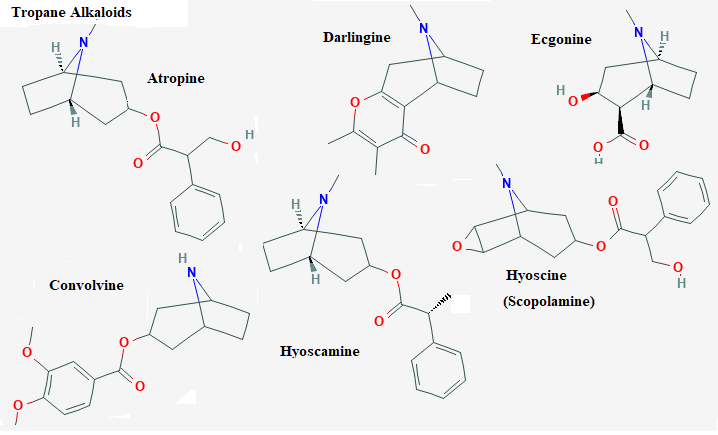
Ecgonine
Ecgonine, (C9H15NO3), tropane alkaloid source
Ecgonine, tropaine derivative, cocaine group, 2-hydroxy monocarboxylic acid, metabolite of cocaine and precursor to cocaine, a controlled substance.
It occurs in leaves of cocaine (Erythroxylum coca).
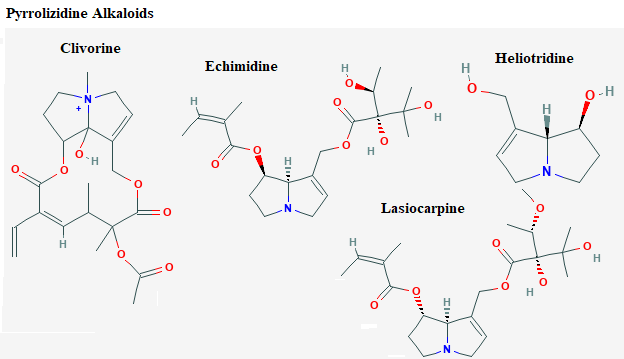
Echimidine
Echimidine, (C20H31NO7), pyrrolizidine alkaloid source
Echimidine, 2-Butenoic acid, pyrrolizine, acute toxic, heptatonic.
It occurs in honeys of: (Echium plantagineum), and (Echium pininanam).
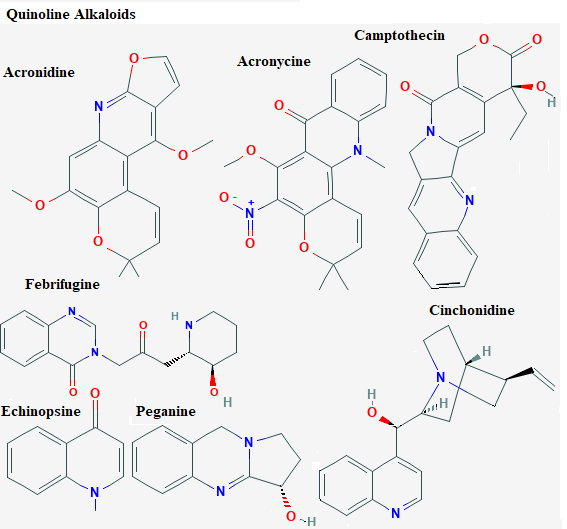
Echinopsine
Echinopsine, (C10H9NO), quinoline alkaloid source
Echinopsine, (1-Methyl-4-quinolone), has simple quinoline structure.
It occurs in (Echinops niveus), (Echinops ritro),and in (Echinops echinatus).
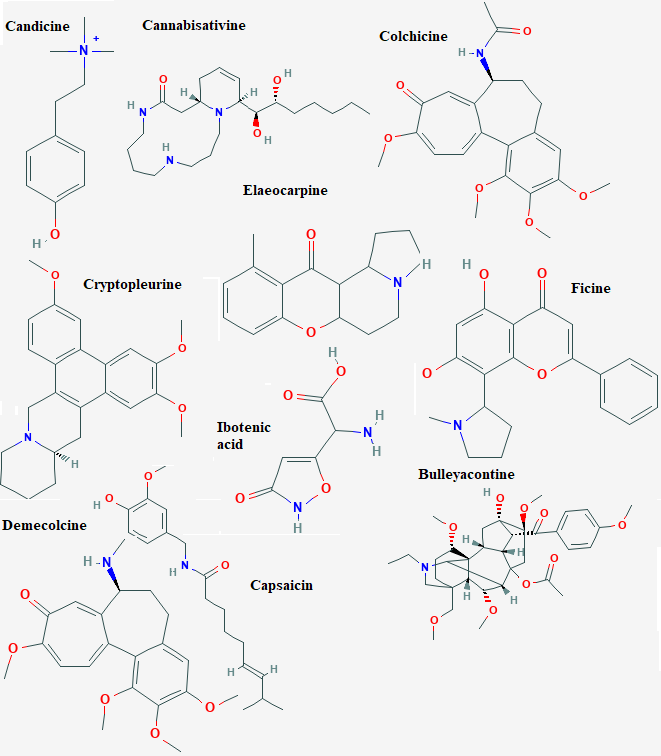
Elaeocarpine
Elaeocarpine, (C16H19NO2), isoelaeocarpine, an indolizidine alkaloid source
It occurs in leaves of (Elaeocarpus polydactylus).
Elatine
Elatine, (C38H50N2O10), diterpenoid alkaloid, elatin, dicarboximide, pyrrolidinone, benzoate ester, is a folk medicine for neurological disorders, with similar effects to Methyllycaconitine. source
It occurs in (Delphinium shawurense).
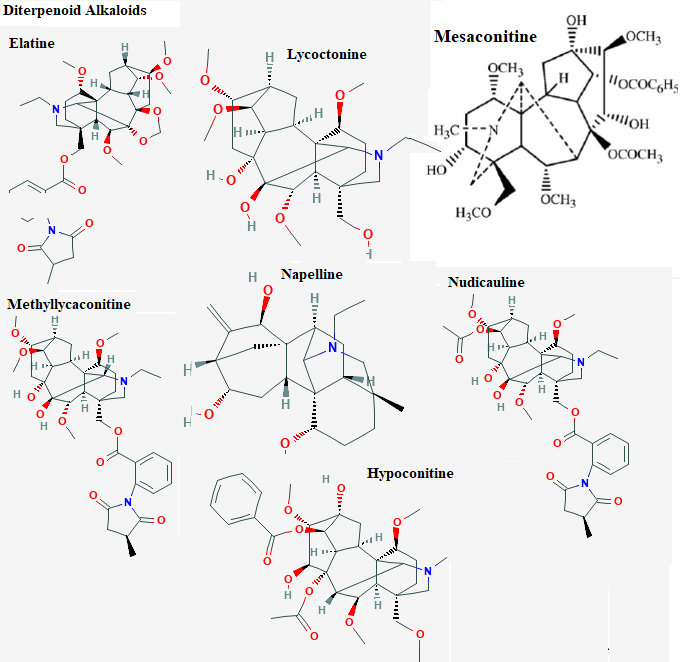
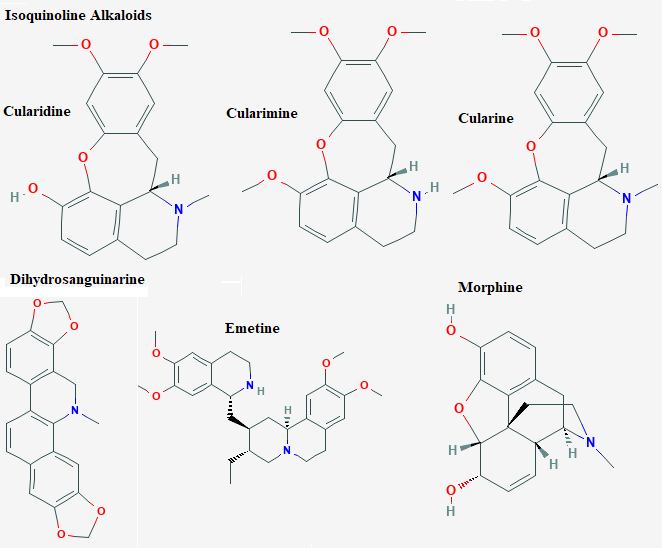
Emetine
Emetine, (C29H40N2O4), isoquinoline alkaloid, emetin, cephaeline methyl ether, methyl cephaeline, isoquinoline derivative, ipecacuanha alkaloid source
It is used as amoebicide, emetic, inhibits protein synthesis by blocking ribosome movement along the mRNA strand.
It may cause cardiac, hepatic, or renal damage, violent diarrhea, and vomiting.
It is the principal alkaloid of "ipecac", from the ground roots of (Uragoga ipecacuanha), or (Cephaelis ipecacuanha), Rubiaceae.
It occurs in ipecac (Carapichea ipecacuanha), (Hedera helix) and in (Alangium longiflorum).See diagram Isoquin3: Emetine
Ephedrine
Ephedrine, (C10H15NO), is a protoalkaloid. source
Ephedrine, is an alkaloid with nitrogen in the side chain (protoalkaloid), beta-phenylethylamine derivative alkaloid, hydroxylated form of phenethylamine sympathomimetic, bronchodilatory and anti-hypertensive, activates post-synaptic noradrenergic receptors, alpha-adrenergic agonist, and beta-adrenergic agonist
May increase release of norepinephrine (noradrenaline), used to treat asthma, heart failure, rhinitis, and urinary incontinence, and depression.
It has been less used with use of more selective agonists.
It occurs in (Ephedra sinica).
9.8.21, Ephedra, Gnetophyta Division, Ephedraceae
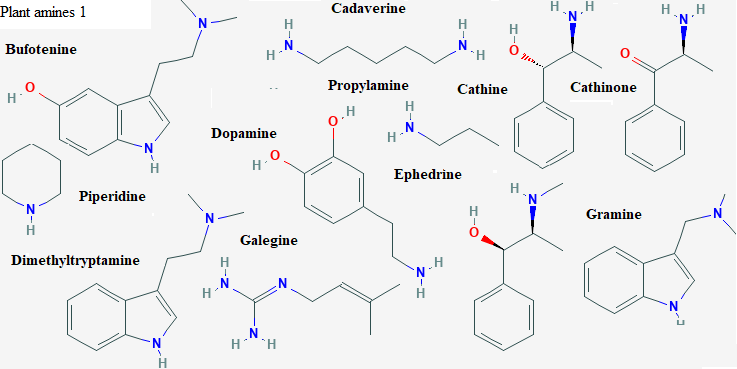
Pseudoephredine is an isomer of ephedrine.
Ergine, (C16H17N3O), Indole Alkaloid
Ergine, (C16H17N3O), Indole Alkaloid source
Ergine, Lysergic acid amide, Lysergamide, (LSA), ergoline alkaloid, South American folk medicine, hallucinogen.
Ergine occurs in (Rivea corymbosa), Hawaiian baby woodrose (Argyreia nervosa), and in (Ipomoea ricolo).
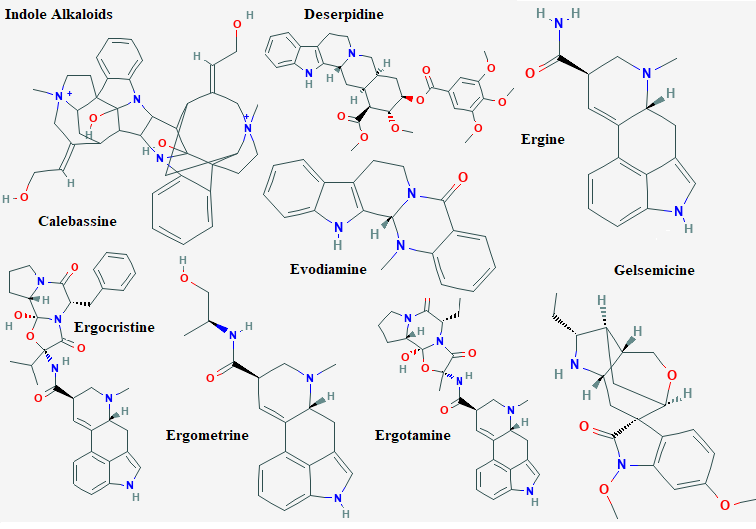
Ergocristine
Ergocristine, (C35H39N5O5), indole alkaloid, acute toxic, natural ergot alkaloid, prevents implantation and lactation. source
Ergocristine occurs in ergot (Claviceps purpurea), (Scolochloa festucacea), and in (Calamagrostis arundinacea).
Ergometrine
Ergometrine, (C19H23N3O2), indole alkaloid, monocarboxylic acid amide. source
Ergometrine causes contraction of uterine and vascular smooth muscles, is used to cause contractions of uterus if vaginal bleeding after childbirth.
Ergometrine is made from rye ergot fungus or lysergic acid, can be used to make lysergic acid diethylamide (LSD) so it is a regulated substance.
Ergometrine occurs in (Jacquemontia tamnifolia) and in Acremonium.
Ergotamine
Ergotamine, (C33H35N5O5), semiterpenoid indole alkaloid, ergot alkaloid, vasoconstrictor, analgesic. source
Ergotamine is used as oxytocic agent and in treatment of migraine disorders, activates serotonin receptors on intracranial blood vessels.
Ergotamine reduces blood flow in cerebral arteries, binds to alpha-adrenergic receptors to stimulate vascular smooth muscle and cause vasoconstriction.
Ergotamine inhibits pro-inflammatory neuropeptide release, used to treat bleeding after childbirth.
Ergotamine occurs in ergot of Central Europe.
Erythroidine
Erythroidine, (C16H19NO3), isoquinoline alkaloid, isoquinoline derivative, erythrina alkaloid, alpha-Erythroidine, neuromuscular blocker like curare, beta-Erythroidine, delta-lactone source
Erythroidine is a neuromuscular blocker, hypnotic, respiratory depressant, muscle relaxant, organic heterotetracyclic indole alkaloid.
Erythroidine occurs in coral tree, Erythrina.
Dihydro-Beta-Erythroidine, (DHbetaE), (C16H21NO3), organic heterotetracyclic compound, alkaloid like curare, nicotinic antagonist. source
Dihydro-Beta-Erythroidine occurs in Erythrina seeds.
Ethanolamine
Ethanolamine, (NH2CH2CH2OH), Primary Amine + Primary Alcohol source
Ethanolamine, (NH2CH2CH2OH) (usually called monoethanolamine, MEA) (2-aminoethanol) source
Ethanolamine is a toxic, flammable, corrosive, colourless, viscous liquid, odour like ammonia, weak base.
Ethanolamine is harmful by ingestion, inhalation or if absorbed through the skin, corrosive eye, skin and respiratory irritant.
Ethanolamine is used to produce detergents and many other chemical products.
Monoethanolamine is head group for phospholipids in biological membranes, formed by decarboxylation of serine.
[HOCH2CH(CO2H)NH2] → (NH2CH2CH2OH) + (CO2) source
serine → monoethanolamine + carbon dioxide. source
Evodiamine
Evodiamine, (C19H17N3O), indole alkaloid, anti-inflammatory, interferes with metastasis formation of new blood vessels. source
It occurs in (Tetradium ruticarpum), (Vepris soyauxii) and in Cryptocarya.
Eudesmanolide
Eudesmanolide, C15H20O3, telekin, sesquiterpene lactone. source
It occurs in Japanese bigleaf magnolia.
Eudesmol
Eudesmol, C15H26O, alpha- and beta-eudesmol, beta-selineneol, woody odour, sesquiterpenoid alcohol. source
It occurs in (Atractylodes lancea), neuromuscular block.
Evodone
Evodone, C10H12O2, monoterpenoid, occurs in (Gladiolus italicus), (Clinopodium ashei), and (Euodia hortensis). source
EXP, (safety)
EXP, (safety)
EXP: can explode due to flame, shock or friction, Hazard Classification
Environment
EDTA, C10H16N2O8, ((HOOCCH2)2NCH2)2, Ethylenediaminetetraacetic acid, is a colorless crystalline solid, which is slightly soluble in water. source
It is used in chemical analysis, to make detergents and cleaning compounds, and an anticoagulant.
It is used in pharmaceutical manufacturing and as a food additive to increase food storage.
It is used in chelating agents that sequesters polyvalent cations.
It may be listed on ingredient labels as “calcium disodium EDTA” or “disodium EDTA”.
It is a threat to the environment.
This page was generated automatically from the original page on John Elfick's School Science Lessons website. If something looks wrong, please check the original.