Chemistry Experiments, B
Last updated 2026-10-13 by Dr John Elfick
Chemistry, B
Beneficiation: (ore → metal + gangue) source
Black powder, gunpowder, potassium nitrate + sulfur + charcoal
Bufalin, C24H34O4, cardiac glycoside, (in toad venom) source
Quick links — A–Z index
Banned chemicals, Not permitted in schools
BAP solution, P
Barber's insect-fixing solution, P
Barium, E
Basal agar, P
Basalt, E
Base, drug abuse, "Speed and base"
Base units, SI, The 7 base units
Basic oxides, E
Bauxite, E
Beauty and skin care products, E
Beef extract, E
Beer, E
Beer-Lambert Law, Total dissolved solids in water
Belousov-Zhabotinskii clock reaction
Benzoic acid, E
Benzopyrene, Reactions of benzene
Biochemistry terms and organic chemistry terms
Bismuth, Bi, E
Bitumen, Asphalt
Bitumen, Fractional distillation of crude oil
Biuret test, Test for proteins
Biuret, C2H5N3O2 source
Bixin, C25H3 source
Blackboard chalk, school chalk
Blast furnace, Separate by different methods
Bleach, E
Blue bottle experiment, Test for glucose oxidation
Bluestone, Copper (II) sulfate
Boiling chips, anti-bumbing granules
Borax, E
Boracic acid, E
Boron, E
Breakdown, E
Breath test, E
Brewing, Yeasts, E
Bricks, Test for strength of mud, clay and sand bricks
Briggs-Rauscher oscillating reaction, H2O2 clock reaction source
Brimstone, Sulfur, S
Brine, Sodiun chloride
British liquid measures, Imperial units, (Measurement)
Brittle,Heat treatment od razor blades
Brix, sucrose concentration
Bromelain, E
Bromine, Br
Bronze, E
Brookite, TiO2 source
Burn, burners, E
Butyl. E
12.2.02 boric acid crystals
Use 5 g of boric acid crystals.
Pour some into 2 cm boiling water in a test-tube and leave to dissolve.
Continue adding crystals and heat to boiling until all crystals dissolved.
Leave to cool to see fine white crystals form.
12.3.4 Boric acid, ionization reaction
1. Orthoboric acid, trioxoboric acid (III) acid, boracic acid, sassolite, H3BO3 is a weak acid. source
It has white to colourless triclinic crystals, MP 169 oC, and occurs in volcanic steam vents, and is slightly soluble in cold water.
It is used to make borosilicate glass, in buffer solutions, detergents and in pharmacy, e.g. "boracic powder" for eye infections.
Action of continuous heat: boric acid, H3BO3 → metaboric acid + water, H2B4O4 → tetraboric acid (pyroboric acid) H2B4O7 → source
Boric oxide (anhydrous boron (III) oxide) B2O3. source
Boric oxide is an intermediate oxide, as is aluminium oxide, with weak acidic and basic properties.
Borax is hydrated sodium borate.
Experiment
When borax is heated, it fuses to form clear glass that can dissolve metal oxides to give characteristic colours of the borax bead test.
Ionization reaction, Ka = 6.0 × 10⁻¹⁰
H3BO3 + H2O → H3O+ + H2BO3- source
H3BO3- → H+ + H2BO3- source
H2BO3- → H+ + HBO32- source
HBO32- → H+ + BO32-. source
Babbitt's metal
Babbitt's metal, alloy for bearings (Sn 5-90%, Sb 7-10%, Cu 1.5-6%, Pb 5-48%)
Baicalein
Baicalein, C15H10O5 source
Baicalein, flavone, (5,6,7-Trihydroxyflavone), trihydroxyflavone, aglycone of Baicalin, antioxidant
It occurs in Baikal skullcap, (Scutellaria baicalensis), Lamiaceae.
Baicalin
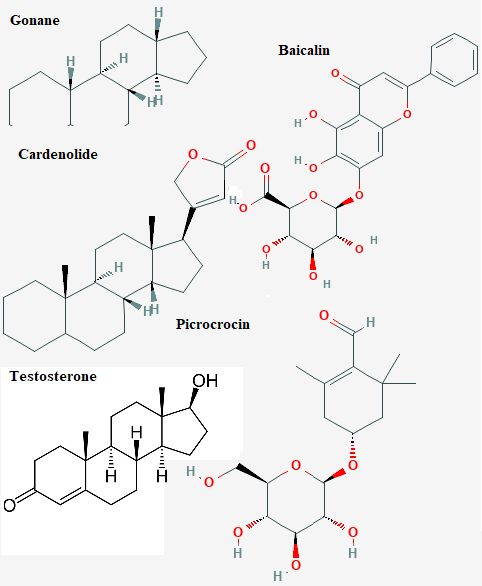
Baicalin, C21H18O11, flavone glycoside, (the glucuronide of the flavone Baicalein) source
It occurs in leaves of Blue skullcap (Scutellaria lateriflora).
It occurs in Chinese medicinal herb Huang-chin, root of (Scutellaria baicalensis), and in bark of (Oroxylum indicum).
Baking powder
Baking powder, dry leavening agent: bicarbonate + weak acid + cornstarch buffer
Baking soda, NaHCO3, bicarbonate of soda, sodium bicarbonate, sodium hydrogencarbonate, "sodium bicarb", "bicarb soda", "bicarbonate", "bicarb", (Na+ + HCO3−) source
Experiments
Baking powder: 19.1.9, (See 8.)
Baking powder: 3.3.4
Dancing naphthalene mothballs: 3.3.2
Decomposition of hydrogencarbonates: 3.7.8
Dilute acids with sodium hydrogencarbonate: 12.4.13
Hydrolysis of sodium hydrocarbonate: 12.10.6
Heat sodium hydrocarbonate: 12.15.7
Prepare baking powder: 19.1.12
Prepare self-raising flour: 19.1.9, Wheat and flour, (See: 7.)
Prepare carbon dioxide: 3.4.0
Prepare "volcanos" with baking soda: 12.15.8
Simulated boiling, sodium hydrocarbonate: 3.4.7
Soda-acid fire extinguisher: 3.3.1
Tests for bicarbonates: 12.11.4
Baking powder
Formerly, bakers added sodium bicarbonate and sour milk, lactic acid, to bread dough to make bread rise as carbon dioxide gas bubbles formed during baking.
Later, dry cream of tartar, K(C4H5O6, from the wine industry was substituted for sour milk to make a dry mixture.
Later, calcium acid phosphate, CaHPO4, was substituted for cream of tartar. source
Nowadays, corn-starch or rice flour is added to keep the mixture dry.
Legally, baking powder is a mixture of sodium bicarbonate, NaHCO3, with cream of tartar, tartaric acid, acid phosphate or sodium aluminium phosphate. source
However, it can be or any combination of the mixture, but without any farinaceous (wheat) substance, so it can be labelled "gluten free".
It must yield >10% of carbon dioxide and may contain permitted colouring substance.
Baking powder contains compounds called food aerators, to be added to dough to make it rise during cooking as bubbles of carbon dioxide gas form.
Baking powder can be used as a substitute for yeast, which is used in sour dough.
Phosphoric acid is weakly acidic and has low toxicity, so some baking powders contain NaH2PO4 and NaHCO3 for the leavening action of the acid-base reaction. source
Baking powder components
The "baking powder" bought in shops often contains the following four components:
1. A leavening agent as a sources of carbon dioxide (dry solids).
* Baking soda (sodium bicarbonate, sodium hydrogen carbonate, NaHCO3, reacts with an acid, e.g. lactic acid, from sour milk, to form carbon dioxide. source
The heat from the oven helps the decomposition of sodium hydrogen carbonate to form carbon dioxide.
* or ammonium hydrogen carbonate.
For example, Borwick's Baking Powder" contains wheat flour, acid sodium pyrophosphate (disodium dihydrogen diphosphate) Na2H2P2O7 sodium bicarbonate E500. source
2. A solid acid that reacts with the sodium bicarbonate only when moist, e.g. tartaric acid or hydrogen carbonates, (cream of tartar, potassium hydrogen tartrate")
3. Phosphates to replace cream of tartar
- Acid phosphates, e.g. calcium hydrogen phosphate (calcium acid phosphate, CaHPO4 sodium dihydrogen phosphate V (sodium dihydrogen orthophosphate)
- Phosphate aerators, e.g. food additive E450 Diphosphates (Sodium and potassium phosphates) food additive E541, sodium aluminium phosphate, basic (emulsifier, acidity regulator)
4. Rice flour or cornflour to keep the mixture dry
If baking powder contains 36% phosphate aerators, it could contain about 10% aluminium.
5. Baking powder must be stored dry
Mix the leavening agent baking soda, sodium bicarbonate, with acidic ingredients to make it work in cooking.
However, baking powder contains baking soda and a powdered acid, so it can work without other acidic ingredients.
For example, "Anchor" brand Baking Powder, Fremantle, Western Australia
Ingredients, Wheaten cornflour, baking powder (mineral salts 339, 341, 450, 500)
6. Baking powder acid components
Baking powders contain a solid crystal acids, baking soda alkali and ground dry starch desiccant and bulking agent.
The sodium hydrogen carbonate reacts immediately when moist to form carbon dioxide.
Single acting baking powders contain sodium bicarbonate, and coated MCP.
They are activated by moisture, so bake immediately after mixing.
Double acting baking powders contain sodium bicarbonate, MCP and SAS.
They react in two phases and can stand for a while before baking.
Double action baking powder contains baking soda, a "high temperature acid", e.g. cream of tartar, and corn-starch or potato starch drying agent.
Each component acid has a different pattern of carbon dioxide production:
- Cream of tartar, potassium hydrogen tartrate, K(C4H5O6)
- Tartaric acid, C4H6O6, HO2CCH(OH)CH(OH)CO2H
- Cream of tartar, potassium bitartrate, potassium hydrogen tartrate, KC4H5O6
- Monocalcium phosphate, MCP, Ca(H2PO4)2.H2O
- Sodium acid pyrophosphate, SAPP, disodium pyrophosphate, disodium dihydrogen diphosphate, Na2H2P2O7
- Sodium aluminium sulfate, SAS, soda alum, sodium alum, NaAl(SO4)2.12H2O, Na2SO4.Al2(SO4)3.24H2O
- Sodium aluminium phosphate, SALP, NaAlPO4, E541
- Dimagnesium phosphate, DMP, MgHPO4.3H2O
- Dicalcium phosphate dihydrate, DCPD, CaHPO4.2H2O, dicalcium phosphate
Experiments
1. Put baking powder into water and note whether carbon dioxide gas forms.
2. Put sodium bicarbonate into water and note whether carbon dioxide forms.
3. Put baking powder in a test-tube containing vinegar (acetic acid, ethanoic acid) or lemon juice (citric acid) and note whether carbon dioxide forms.
4. Make self-raising flour.
Mix two teaspoons of Anchor baking powder to one cup of Anchor Lighthouse plain flour.
Sift several times.
Use a dry teaspoon.
Barium, Ba
Barium, Ba
Barium, Table of Elements
Barium, RSC
Barium, Ba, (Greek barus 'heavy'), alkaline earth metal, Highly toxic if ingested or by skin contact.
Barium ion, Ba2+, Barium meal, barium sulfate radio-opaque mixture for X-ray examination of alimentary tract.
Barium is brittle and expensive, used to absorb high energy particles, burns with green colour in fireworks.
It occurs in minerals barytes, BaSO4, and witherite, BaCO3. source
It forms poisonous compounds, oxidizes in air and reacts with ethanol.
Barium sulfate is used for a contrast medium for X-ray examination of intestines.
Surface coating of barium hydroxide corrosive to the eyes.
The reaction of barium with water produces flammable hydrogen gas.
Barium is very difficult to cut.
Atomic number: 56, Relative atomic mass: 137.33, RD 3.51, MP = 725 oC, BP = 1640 oC.
Specific heat capacity: 192 J kg-1 K-1.
Barium toxicity: 4.2
Tests for barium: 12.11.3.13
Barium compounds
Barium carbonate, BaCO3 source
Barium chloride, BaCl2, barium chloride dihydrate, barium chloride anhydrous source
Barium chromate, BaCrO4 source
Barium hydroxide, Ba(OH)2 source
Barium hydroxide monohydrate, Ba(OH)2.H2O source
Barium oxide, BaO, baryta, heavy spar, flux for craft, optical crown glass, cathode ray tube, lubricating oil
Barium peroxide, BaO2, barium dioxide, bleaching agent source
Barium sulfate, (VI), BaSO4 source
Barium sulfide, Harmful if ingested, Solution < 25% Not hazardous
Baryta, barium oxide or barium hydroxide
Barytes, BaSO4, barite, heavy spar, mineral source
elsian, BaAl2Si2O8, barium feldspar source
Witherite, BaCO3, barium carbonate source
Reactions of barium compounds: 12.4.1
Barium carbonate, BaCO3
Barium carbonate, BaCO3 source
Barium carbonate (HARM 1564), witherite, in lead ore veins, Solution < 25%, Not hazardous
Barium carbonate pigment (White 10) is a pigment of significant toxicity.
Barium carbonate, is used for craft, barium oxide flux, Low cost, from pottery supply stores.
Barium carbonate, Dimorphism, aragonite: 35,6,2
Barium chloride
Barium chloride, BaCl2, Harmful if ingested (HARM 1564), barium chloride-2-water, BaCl2.2H2O source
Barium chloride dihydrate, BaCl2.2H2O, colourless, rhombic, odourless crystals or white granules, m.p. 925 oC source
Barium chloride, AAS Solution, For 0.1 M solution, 24.4 g in 1 L water
Common ion effect: 17.5.4
Barium chloride, Solution < 1%, Not Hazardous, analytical reagent
Experiments
1. Add calcium sulfate solution to barium chloride solution.
Heat the solution and leave to cool.
Note the white precipitate of barium sulfate that is insoluble in water.
Ba2+ + SO42- → BaSO4 (s) source
2. Add ammonium carbonate solution to barium chloride solution.
Note the white precipitate of barium carbonate.
Ba2+ + CO32- → BaCO3 (s) source
3. Add ammonium oxalate solution to barium chloride solution.
Note the white precipitate of barium oxalate that is soluble in dilute hydrochloric acid, but insoluble in acetic acid.
Ba2+ + C2O42- → Ba(C2O4)(s) source
4. Add potassium chromate solution to barium chloride solution.
Note the yellow precipitate of barium chromate.
Ba2+ + CrO42 → BaCrO4 (s) source
Barium chromate
Barium chromate, BaCrO4, yellow powder, S.G. 4.49, insoluble in water, Extremely toxic if ingested, carcinogenic source
Barium chromate, Solution < 1%, Not Hazardous
Barium chromate, for craft, pyrotechnics, paint pigment, corrosion control, safety matches
Barium chromate pigment (Yellow 31), extremely toxic and carcinogenic
Barium hydroxide
Barium hydroxide, Ba(OH)2, barium hydroxide octahydrate, barium hydroxide hydrated, Ba(OH)2.8H2O, baryta water, caustic baryta, Harmful if ingested source
Barium hydroxide, Solution < 1%, Not Hazardous
Ba(OH)2, barium hydroxide solution, (baryta water) source
Ionization of barium hydroxide: 12.13.7
Barium nitrate
Barium nitrate, Ba(NO3)2, nitrobarite, oxidizing, white solid, toxic, accelerates burning of combustinle materials may explode if heated source
Barium sulfate (VI)
Barium sulfate (VI), BaSO4, barytes, barite, heavy spar, blanc fixe pigment extender in paints source
Barium sulfate (VI), barium white, blanc-fixe, fixed white, permanent white, barytes, heavy spar
Barium sulfate, almost insoluble in water, heavy white precipitate, X-ray contrast meal, soil analysis, lake paint
Barium sulfate pigment (White 21) is a pigment of significant toxicity.
Bases
Bases, properties of bases, alkalis: 12.1.0
Hardness in water, water hardness: 12.2.0
Prepare dilute bases: 5.4.8
Prepare acids, dilute acids and bases (Safety instructions): 3.4.10
Bases
A base or an alkali is a good electrolyte, that turns red litmus blue and has a slippery feel.
Bases with water form hydroxide ions, OH-.
Bases react with hydrogen ions, H+.
A base is a proton acceptor (H+). (Bronsted-Lowry definition).
Basic oxides
Basic oxides react with water to form a base.
Basic oxides react with an acid to form a salt and water.
Basic oxides + acid → salt + water source
MgO (s) + H2SO4 (aq) → MgSO4 (aq) + H2O (l) source
Basic oxides are oxides of metals.
Basic oxides are usually insoluble in water.
Soluble basic oxides + water → alkaline solution source
Basic oxides do not react with bases.
Experiments
Alkalis with basic oxides, copper oxide: 12.1.6
Dilute acids with basic oxides: 12.4.3
Reactions of oxides: 12.13.0
Separate to metals by reduction of metal oxides: 10.10.0
Bauxite
E173 Aluminium (from bauxite) (colour, metallic) (Banned in some countries), (excess unsafe)
Aluminium, properties: 13.0.0
Aluminium oxide: 13.1.10
Aluminium hydroxide (1-water), bauxite (antacids) 500 g
Bauxite: 35.2.11
Bauxite: 10.10.0
Bauxite digestion: 13.2.2
Portland cement: 34.2.2
Beef
Beef extract, powder, desiccated beef, culture medium for microbiology, "Bacto", (not "Bovril", a yeast extract)
17.7.16, Hydrogen peroxide with catalase in raw beef liver
Beer
12.2.0, Beverage can, Beer can
Foams: 7.8.10
Fermentation: 4.1.9, (Safety)
Ginger beer "plant": 9.7.2, (Biollogy)
Isohumulone: 16.2.3
Yeast, fermentation, brewing. beer: 16.7.3
1 barrel (beer cask) = 32 imperial gallons
Smilax regelii, Smilacaceae, sarsaparilla, Honduras sarsaparilla, (sarsaparilla soft drink and root beer), herbal medicine
Sodium metabisulfite, sterilizing Campden tablets, used for home beer-making and wine-making, food preservative
Beeswax
Beeswax, C15H31COO(C30H61, (white beeswax)
Beeswax, Local Purchase, is used for best quality wax candles and applications to floors.
5.5.8 creams and ointments
E901, Beeswax, glazing agent
9.2, Egg preservation, (See: 8.)
16.6.2a, List of fixed oils
19.1.16, Glazing agents, food additives
8.1.24 beeswax candles
Benzfuran
Benzfuran, C8H6O, coumarone, from processed coal, in coumarone-indene resin plastic, citrus coating. source
Benzonitrile
Benzonitrile, C6H5CN, almond odour, harmful if ingested source
It occurs in (Arctostaphylos uva-ursi).
Benzoin
Benzoin, organic chemical, ketone, (C14H12O2). C6H5COCH(OH)C6H5 source
It is used as a colour additive for marking fruit and vegetables.
Benzoin resin, "gum benzoin", "gum Benjamin", but it is not a polysaccharide "gum".
It contains benzoic acid, C6H5COOH, not benzoin, C14H12O2, and it is used in perfumes and folk remedies. source
It occurs in Styrax.
Benzophenone
Benzophenone, C13H10O, C6H5)2CO, diphenyl methanone, harmful if ingested, can cause cancer, the simplest benzophenone source
It is a photosensitizing agent, and other benzophenones are sunscreens.
Behenyl alcohol
Behenyl alcohol, C22H46O, 1-docosanol, long chain primary aliphatic alcohol, antiviral activity. source
It is used for non-prescription topical treatment of recurrent herpes simplex (cold sores).
It occurs in Populus and Hypericum.
Benomyl
Benomyl, C14H18N4O3, was previously a widely-used fungicide, Benlate, DuPont ceased production in 2001 source
Benzamide
Benzamide, C6H5CONH2, C7H7NO, alkaloid source
harmful if ingested, off-white colour crystals, slightly soluble in water.
It occurs in Berberis, Sarcomelicope and Houttuynia.
Bergamotene
Bergamotene, C15H24, sesquiterpene, polycyclic olefin, contains volatile oils, pale green clear liquid, woody odour, but not used for fragrance or flavour. source
It occurs in Kumquat (Citrus japonica), Key lime (Citrus x aurantifolia), Citron (Citrus medica), Carrot (Daucus carota), and in Bergamot (Monarda didyma).
Bezoar
A bezoar is any mass accumulating in the gastrointestinal system, e.g. a food bolus.
Stones found in the stomach or gall bladder of animals were formerly set as jewels.
Behenic acid
Behenic acid, C22H44O2, 1-Docosanoic acid, is a straight-chain very long-chain saturated fatty acid. source
It occurs in ben oil from drumstick tree, (Moringa oleifera), Moringaceae.
BCIP-dipotassium salt
BCIP-dipotassium salt, C8H4BrClNO4PNa2, bromochloroindolyl phosphate, used in chromogenic enzyme experiments source
Benzalkonium chloride
Benzalkonium, C22H40N+, ('Zephiran') source
Benzalkonium chloride, C13H22ClN, benzethonium chloride, Phemeride, Quatrachlor, Hyamine, BAK, aromatic ether, chloride salt, corrosive, acute toxic source
It is a synthetic quaternary ammonium salt, antiseptic, disinfectant, antibacterial, antiviral, antifungal, odourless white crystals or powder, very bitter taste, 1% solution in water slightly alkaline.
catatonic surfactant, in pharmaceutical and personal care products, surfactant, (in trade name, Zephiran)
Zephiran, C27H42NO2.Cl or C27H42ClNO2 or, (C6H5CH2N(CH3)2R, (where R = mostly n-(C12H25), benzethonium chloride, antiseptic. source
Benzaldehyde
Benzaldehyde, C6H5CHO, benzenecarbaldehyde, Harmful by all routes source
Aromatic aldehydes and ketones: 16.2.7
Benzaldehyde, Solution < 25%, Not hazardous
Cyclic aldehydes, Prefix, formyl-, Suffix, -carbaldehyde, attached to benzene, benzaldehyde
Cinnamic acid, C9H10O2 source
It occurs in True cinnamon, (Cinnamomum verum), Lauraceae
Uroblilinogen, test
Benzene
Benzene, C6H6, benzol, benzine, sweet smell, highly flammable Extremely toxic by all routes, carcinogenic, Not permitted in schools source
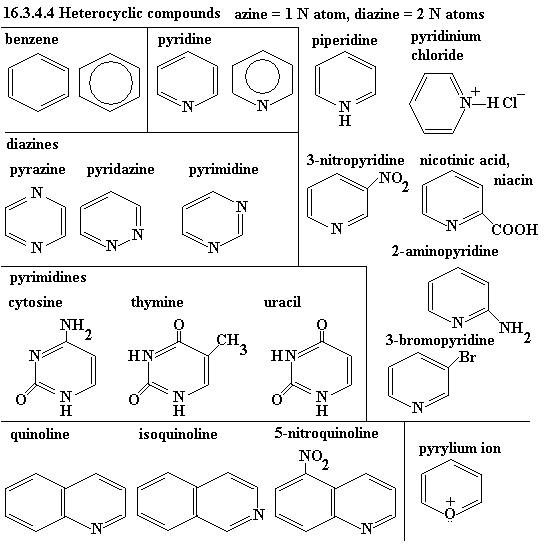
See 16.6.14: Pyrogallol, Benzene-1,2,3-triol
Benzene-1,3,5-triol, Phloroglucinol:
Benzene, Arenes: 16.5.0
Halogenation of benzene: 12.4.6.1
Experiments
Reactions of chlorine with benzene: 12.4.6.0
Reactions of benzene: 16.5.3
Size of carbon atom in stearic acid molecule: 11.3.5
Benzoic acid
Benzoic acid, C6H5COOH source
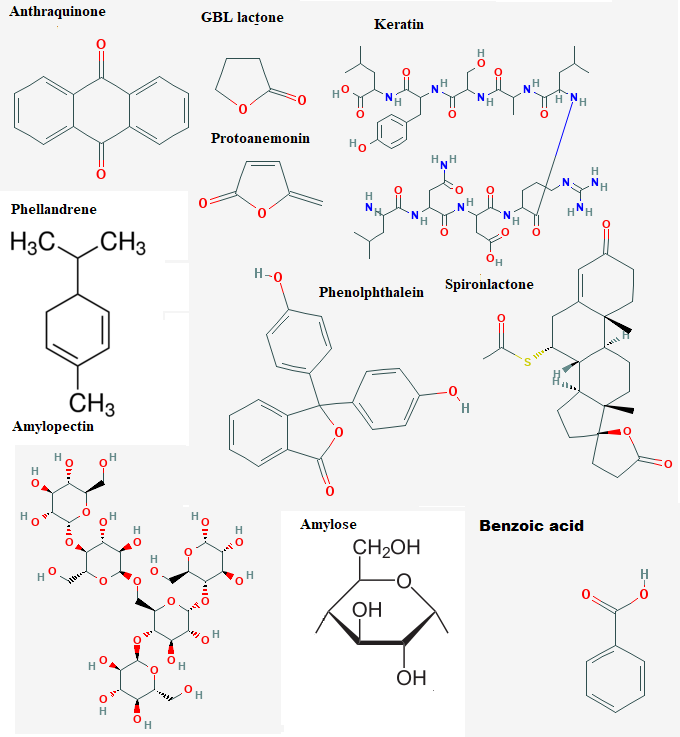
See diagram: E210, Benzoic acid
Aromatic acids: 16.2.5
Crystal growth with overhead projector: 24.10.8
Extraction of caffeine and benzoic acid from soft drinks: 9.2.3
Isolation of benzoic acid in lemonade: 9.1.9
Gum benjamin tree, (Styrax benzoin), Styracaceae, benzoin gum resin called "Benzoin Sumatra" from tapped bark.
Primary ingredient of benzoin resin is benzoic acid, not benzoin, C14H12O2. source
Benzoyl chloride, C6H5COCl
Benzoyl chloride, C6H5COCl source
Benzoyl group C6H5CO-, benzenecarbonyl group source
Benzoyl chloride, benzenecarbonyl chloride, Highly toxic by all routes, flammable, highly corrosive
Benzoyl chloride, reacts violently with some metals, e.g. iron
Benzoyl peroxide, C14H10O4
Benzoyl peroxide, C14H10O4 source
Benzoyl peroxide, dibenzoyl peroxide, Harmful skin contact, flammable, Not permitted in schools
Benzoyl peroxide, Solution < 20%, Not hazardous
Benzyl acetate, C9H10O2
Benzyl acetate, C9H10O2 source
Benzyl, benzyl group, C6H5CH2- source
Benzyl acetate, ester from benzyl alcohol + acetic acid, in essential oils of Jasmine, (Jasmium officinale)
It occurs in Ylang ylang, (Cananga odorata), Annonaceae
It is used in cosmetics, attracts bees, and organic solvent.
Benzyl alcohol, C6H5CH2OH
Benzyl alcohol, C6H5CH2OH source
Benzyl alcohol, "BnOH", C6H5CH2OH, phenylmethanol, phenyl carbinol, colourless, solvent, pleasant odour source
Benzyl alcohol, harmful if ingested
Benzyl alcohol, Solution < 20% Not hazardous
Benzyl bromide, C7H7Br
Benzyl bromide, C7H7Br source
Benzyl bromide, α-bromotoluene, Highly toxic by all routes, bromotoluene
Benzyl bromide, Solution < 20% Not hazardous
Benzyl chloride, α-chlorotoluene, Highly toxic by all routes
Benzyl chloride, Solution < 20% Not hazardous
Benzyl penicillin sodium salt, penicillin G, antibiotic
Berkelium, Bk
Berkelium, Bk
Berkelium, Table of the Elements
Berkelium, RSC
Berkelium, Bk, (Berkeley University, USA, where first made), radioactive actinoid
Beryllium, Be
Beryllium, Be
Beryllium, Table of the Elements
Beryllium, RSC
Beryllium, Be (Greek bērullos 'beryl'), (glucinium), lightest alkaline earth metal
Pure beryllium is a hard, brittle, silvery metal.
Beryllium metal exposed to air forms a protective oxide coating, similar to aluminium.
Beryllium reacts with strong acids and strong bases, and forms shock sensitive mixtures with chlorinated solvents, e.g. carbon tetrachloride and trichloroethylene.
Beryllium metal, flakes, powder, Highly toxic, Not permitted in schools
Beryllium slowly oxidizes in air, tastes like sugar, beryllium powder destroys lung tissue, toxic compounds.
Beryllium chunks, Beryllium standard for AAS, Beryllium ICP/DCP standard solution
Beryl, Be3Al2(SiO3)6, beryllium aluminium silicate, beryllium ore, green beryl is emerald and blue-green beryl is aquamarine. source
Emerald, Be3Al2(SiO3)6, natural emeralds always contain weakening inclusions, but not if produced from seed crystal. source
Beryllium chloride, fluoride, nitrate, phosphate, and sulfate all soluble in water, insoluble, e.g. beryl, beryllium oxide.
Beryllium-copper alloy has high strength, and good thermal and electrical conductivity.
Beryllium chloride, BeCl2, white to faintly yellow powder, deliquescent, Toxic, Not permitted in schools. source
Beryllium oxide, BeO, beryllia, bromellite, white powder, very good heat conductor and good electrical insulator
Betagarin, C18H16O6
Betagarin, C18H16O6 source
Betagarin, a flavanone, a dimethoxyflavanone, anti-fungal, a phytoalexin
It occurs in fungus infected sugar beet, (Beta vulgaris).
Beta-sitosterol, C29H50O
Beta-sitosterol, C29H50O source
Beta-sitosterol, phytosterol like cholesterol, oestrogenic activity, inhibits proliferation of human leukemia cells reducing serum cholesterol levels
It is used for natural prostate health. reduce the growth of human prostate and colon cancer cells.
It occurs in human leukemia cells, vegetable oils, nuts, and in avocado
Betulinic acid
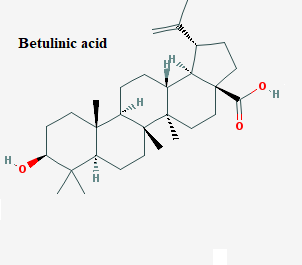
Betulinic acid, C30H48O3, pentacyclic triterpenoid, mairin, lupatic acid, betulone, isobrucein, anti-inflammatory, antimalarial, anti-HIV. source
It induces apoptosis through induction of changes in mitochondrial membrane, cytotoxic against non-melanoma tumor cell types, has a cardiovascular role.
It occurs in white birch bark (Betula alba), Ber tree (Ziziphus mauritiana), (Triphyophyllum peltatum), (Diospyros leucomelas). and in (Syzygium formosanum).
Bird lime
Birdlime, bird lime, comes from the inner bark of holly mistletoe or elm branches, boiled, then evaporated, to form a sticky substance.
It is used to trap small birds, but its use is illegal in many countries.
Birdlime is not "lime", calcium oxide.
In the South Pacific region, the latex of the breadfruit plant (Artocarpus altilis) was formerly used as birdlime to catch birds.
Bilobol
Bilobol, C27H50O2Si2, a 5-alkenylresorcinol, phenolic lipid, like Urushiol it is a strong skin irritant. source
Bismuth, Bi
Bismuth, Bi
Bismuth, Table of the Elements
Bismuth, RSC
Bismuth, Bi (Latin bismutum), bismuth mineral, natural bismuth has, cubic crystals.
The most common isotope (Bismuth-209) is radioactive and has one of the longest half-life.
Bismuth is harmful if ingested.
Granular fine particles are easily ignited, easily fusible natural bismuth, "hopper crystals", in staircase crystalline patterns.
Iridescent artificial bismuth crystals have a hollow centres, and MP 271 oC.
Pink-white metallic crystals, from bismuthinite mineral Bi2S3 and niccolite, cobaltite, are rare in the earth. source
It is very diamagnetic, so may levitate with strong magnets.
It has low thermal conductivity, high electrical resistance, burns in air with blue flame and emits yellow fumes, expands when freezes.
It is used in low melting point alloys for fire safety equipment, thermocouples, magnetic flux measurement, nuclear reactors coolant.
Low toxicity so used in cosmetics and medicines, e.g. bismuth subsalicylate, active ingredient in "Pepto-Bismol", for peptic ulcers.
It is used in paints, dyes, pewter, and "dragon's eggs" fireworks, and as a posible non-toxic alternative to lead.
Atomic number: 83, Relative atomic mass: 208.98, RD 9.78, MP = 271.3 oC, BP = 1560 oC.
Specific heat capacity: 123 J kg-1 K-1.
Bismuth
Bismuth compounds
Bismuth (III) chloride, BiCl3, bismuth chloride, bismuth trichloride, is harmful if ingested. source
Bismuth chloride, For 0.17 M solution, 53 g in 1 litre of dilute HCl, 1 part concentrated HCl to 5 parts water.
Bismuth (III) nitrate pentahydrate, BiN3O9.5H2O source
Bismuth nitrate, Bi(NO3)3.5H2O, For 0.083 M solution, 40 g in 1 litre of dilute HNO3, 1 part concentrated HNO3 to 5 parts water. source
Bismuth oxide, Bi2O3, bismuth (III) oxide, bismuth (V) oxide, bismite mineral, bismuth ochre, Harmful ingested source
Bismuth (III) subsalicylate, C7H5BiO4 source
Black tongue can be seen commonly amongst people who consume "Pepto-Bismol" drug, which consists of bismuth subsalicylate, a dark color-imparting chemical.
Although it is originally bright pink in colour.
This is not harmful, however, the black colored tongue itself may look frightening!
Bismuthinite, bismuth trisulfide, bismuth sulfide crystal, mineral
Bismutite, bismuthyl carbonate, bismuth subcarbonate, Bi2(CO3)O2, mineral source
Hydrolysis of bismuth chloride: 17.5.6
Radioactive decay of Bismuth-214: 7.3.5
Reactions of Bi compounds: 12.5.1
Tests for bismuth, Heat: 12.12.11.3.8, (See 3.)
Tests for bismuth, Thiourea: 12.11.3.14
Bimetalism
Bimetalism is an historical system of two metals, e.g. gold and silver, to be used as legal tender at a fixed ratio between them.
Bisabolol
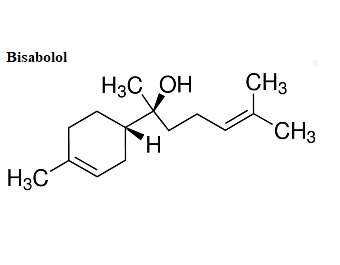
Bisabolol, C15H26O, sesquiterpene (bisabolane), natural monocyclic sesquiterpene alcohol, essential oils from leaves alpha-bisabolol are used for skin healing. source
It occurs in leaves of (Hymenocrater yazdianus), and is extracted from Chamomile (Matricaria chamomilla).
Bixin
Bixin, C25H30O4, xanthophyll carotenoid pigment, diterpene, yellow to pink, causes, allergic-type reactions, hyperactivity, head banging, skin irritation. source
It is used as body paint, fabric dye pigment, soluble in fats and alcohols, insoluble in water.
Annatto food additive | peppery aroma and flavour.
Annatto is a natural food colouring, but linked with food-related allergies, "all natural" or "no artificial colours", Annatto, (Roucou).
derivative of achiote trees, tropical Americas, aroma and flavour slightly peppery with some nutmeg.
It occurs in seeds of the achiote tree, lipstick tree (Bixa orellana), and in the spice blend "Sazn".
Butan-1-ol
Butanol, C4H9OH, isomers: | 1-butanol | sec-butyl alcohol | isobutanol | tert-butyl alcohol | source
. 1-butanol, butyl alcohol, C4H9OH, C4H10O, CH3(CH2)3OH, CH3CH2CH2CH2OH. source
It is a primary alcohol, a short-chain primary fatty alcohol, flammable, irritant and it is used as a solvent.
It occurs in human gut microbes, and in Vitis and Cichorium.
Biochar, C
Biochar, C
Biochar is charcoal produced from plant matter to be stored in the soil to remove carbon dioxide from the atmosphere.
Biochar is carbon said to to increase water capture, pH balance, soil microbe content.
It is used in Australia is to provide digestive assistance for livestock animals’ feed efficiency and sequestering animals’ carbon-laden manures using dung beetles.
The beetles may naturally improve soils’ ability to hold water and support pasture growth, potentially reducing the need for additional fertiliser and irrigation.
Biphenyl
Biphenyl, (1,1-biphenyl), C12H10, C6H5C6H5, phenylbenze, xenene, colourless, most thermally stable organic source
It is a clear colorless liquid, pleasant odour. insoluble in water.
It occurs naturally in coal, crude oil, and natural gas.
It is used as an antimicrobial food preservative, and was used as a fungicide for citrus crops, but caused eye and skin irritation and toxic effects on the organs.
Bleach
Bleach flowers with sulfur dioxide: 13.10.5
Bleaches, disinfectants, deodorizers: 12.5.2
Detergents in washing powders: 12.5.3
Bleaches in detergents: 12.3.5.3.2
Bleaching agents: 19.1.5
Bleaching powder: 12.4.6
Calcium hypochlorite, Ca(OCl)2 source
Prepare chlorine with bleaching powder: 12.4.1.1
Reaction of ethyl alcohol with bleaching powder: 16.1.10
Sodium chlorate, NaClO3 source
Sodium hydrogen sulfite, sodium bisulfite, NaHSO3 source
Sodium hypochlorite, NaClO
Tests for chlorine: 3.40.1, (See: 1. Bleaching test for chlorinr)
Bohrium, Bh
Bohrium, Bh
Bohrium, Table of the Elements
Bohrium, RSC
Bohrium, Bh, (Neils Bohr, 1885-1962, Denmark), radioactive, transuranic, produced from high energy atomic collisions
Borax
Borax, (Na2B4O7.10H2O), disodiumtetraborate-10-water, E285, sodium tetraborate decahydrate source
The sold borax is partially dehydrated di-sodium tetraborate, colourless mineral, white powder, odourless.
Its monoclinic crystals or granules, rd 1.73, mp 75 oC, are efflorescent in dry air, anhydrous at 320 oC
It is mildly toxic,so avoid ingesting and skin contact.
Borax is soluble in water and glycerol, very slightly soluble in alcohol and insoluble in acids.
Sodium tetraborate decahydrate, Na2B4O7.10H2O, powder, granules source
Borax is used in buffer solutions, fire retardants, metallurgy flux, washing powders, bath cleaning, fungicide, insecticide, detergent booster.
Borax is used in the furniture industry as a polish.
Sodium tetraborate borax preservative is not allowed in most countries, because it is toxic and may cause skin problems.
Borax and sugar mixture is used with cut lemon over ant trails to deter ants.
Borax di-sodium tetraborate (III)-10-water Local Purchase.
E285 (preservative, not allowed in most countries), Harmful if ingested.
Sodium tetraborate decahydrate, For 0.1 M solution, 38 g in 1 L water.
Low cost, from supermarkets as borax, borax-bead test preparations for metal ions.
Clean silver plate with borax and soap solution.
Borax is used in buffer solutions, fire retardants, metallurgy flux, washing powders (laundry booster), bath cleaning, fungicide, insecticide, detergent booster.
Borax used a lot in the furniture industry as a polish.
Sodium tetraborate borax preservative is not allowed in most countries, because it is toxic and may cause skin problems.
Borax and sugar mixture is used with cut lemon over ant trails to deter ants.
Borax di-sodium tetraborate (III)-10-water Local Purchase.
Experiments
Borax, Experiment
Borax mineral: 35.2.14
Bases in the kitchen and laundry: 19.3.1
Bath cleaning: 19.3.2
Tests for borax / turmeric adulteration of food: 19.1.32
Borax bead test for metals
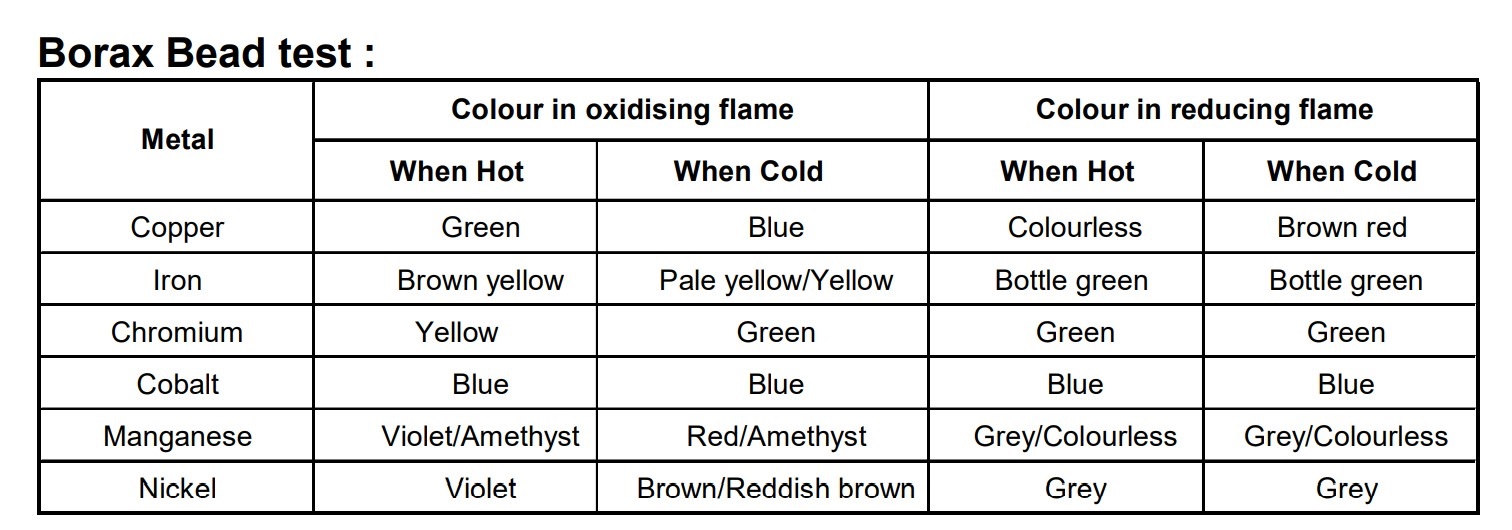
Heated borax fuses to form clear glass that can dissolve metal oxides to give characteristic colours of the borax bead test.
The test depend on the colours of metal oxides in metallic salts and minerals when heated.
Coil the end of a platinum wire to prepare a loop big enough to curl around a match stick.
Heat the loop in a Bunsen burner flame then dip the hot loop in borax powder, Na2B4O7.10H2O. source
Heat the attached borax in the hottest part of the flame
The borax swells to lose water of crystallization, then shrinks and fuses to form a transparent bead filling the loop of the platinum wire.
Dip the bead in water then in a very small amount of the metal salt that sticks to the bead.
Heat the bead and metal salt in either the outer oxidizing flame or inner reducing flame of the Bunsen burner.
The colour of the bead depends on:
whether using the outer colourless oxidizing flame or the inner blue reducing flame,
the type of flame used,
whether the bead is examined bead hot or cold,
the degree of saturation if using solutions,
the temperature of the bead when examined,
and the concentration of the solution if a solution of salt is used instead of the solid salt.
Other procedures
Use a white ceramic tile of saucer instead of platinum wire and microsmic salt, instead of borax.
[Microsmic salt, sodium ammonium hydrogen phosphate, (Na(NH4)HPO4.4H2O) from urine] Use sodium carbonate, Na2CO3, for the bead test, but the colours may be different. source
For most metals not listed below, the flame is colourless.
Table 12.11.3.1
| Solid metal salt | Oxidizing flame | Oxidizing flame | Reducing flame | Reducing flame |
| . | Hot | Cold | Hot | Cold |
| Chromium | yellow to emerald-green | green | green | green |
| Cobalt | deep blue | blue | blue | blue |
| Copper | light blue-green | blue | . | red-brown |
| Gold | rose-violet | rose-violet | red | violet |
| Iron | brown when hot yellow when cold | yellow | green | green |
| Manganese | violet | amethyst | . | . |
| Nickel | violet to brown | red-brown | grey | grey |
| Tungsten | pale yellow | . | green | blue |
Boric acid, H3BO3
Boric acid, H3BO3 source
Boric acid, ionization reaction: 12.3.4
Decomposition of boric acid: 3.7.2
Prepare boric acid crystals: 3.1.2
Boric acid, boracic acid, Toxic if ingested
Boric acid, orthoboric acid, trioxyboric (III) acid, colourless, odourless, white to transparent, triclinic crystals, m.p. about 160 oC
If heated, boric acid decomposes to anhydride B2O3 and occurs near fumaroles. source
It is sold in pure form as a powder, as eye medicine, disinfectant, insecticide, E284.
Use boric acid to prepare children's clothing flame retardants.
Common names, Boric acid, "cockroach killer".
Boric acid, orthoboric acid, trioxoboric acid (III) acid, boracic acid, sassolite, H3BO3, weak acid, weakly acidic hydrate of boric oxide, odourless white solid, MP 171 °C, astringent, mild antiseptic, antifungal, antiviral, used to treat of yeast infections and cold sores, white to colourless triclinic crystals. source
It occurs in volcanic steam vents, slightly soluble in cold water.
It is used to make borosilicate glass, used in buffer solutions, detergents and in pharmacy, e.g. "boracic powder" for eye infections.
Action of continuous heat: H3BO3 → HBO2 metaboric acid + water source
Experiment
Boric acid dissolves in hot water.
Leave to cool and see fine white crystals form.
Bornane
Bornane, C10H18, bornylane, monoterpene, crystalline, saturated, "parent compound" of borneol and camphor It occurs in (Cinnamomum camphora). source
Borneol
Borneol, C10H18O, bicyclic monoterpene, Borneo camphor, white lump, strongly aromatic camphor-like odour, spicy cooling scent, pungent, bitter, tastes slightly cold. source
It is used in perfumes, traditional Chinese medicine, antipyretic, analgesic, anti-inflammatory, and is denser than water.
It is used to treat "obstruction of orifices", heat syndromes, pain, throat swelling, mouth sores, ear and eye infections, analgesia, anaesthesia.
It occurs in camphor laurel, rosemary, mint, ginger, (Artemisia vulgaris), (Dryobalanops aromatica), (Blumea balsamifera), (Coriandrum sativum), andin (Hyssopus officinalis).
Bornyl acetate
Bornyl acetate, C12H20O2, is the acetate ester of borneol, C10H18O, and it occurs in odour of pine needles essential oil. source
Bornyl acetate, Isobornyl acetate, endo-2-Camphanyl ethanoate, C12H20O2, acetate ester of borneol, food additive, flavouring, de-odourizing. source
Boron, B
Boron, B
Boron, Table of Elements
Boron, RSC
Boron, B (Persianbūra borax), non-metallic, occurs as brown amorphous powder or black crystals.
Highly toxic by all routes, so keep demonstration lump, not powder, in sealed glass container.
Pure boron is prepared by pyrolysis of boron hydrides and halides, or reduction of boron chloride or bromide with hydrogen.
Boron is inert in its crystalline form, and is unaffected by boiling hydrochloric acid or hydrofluoric acid.
Finely powdered boron is slowly oxidized by hot concentrated nitric acid.
Hot concentrated oxidizing agents only very slowly attack boron.
Boron is used in heat resistant glassware, (Pyrex, see below), soap, pesticides, cosmetics, leather products, cement products.
It is not an abundant element, does not occur in nature, and is mainly found in borates, e.g. borax and kernite.
It is a non-metal or metalloid, yellow-brown network solid, brown amorphous form and black metallic form.
It has metallic lustre, very hard (9.3 Mohs' scale) and strong semiconductor, found in minerals, e.g. tourmaline, and associated with volcanic activity as borates.
It is used in control rods for nuclear reactors and in green flares.
It is used in heat-resistant glassware (Pyrex), soap, pesticides, cosmetics, leather products, cement products.
Use boric acid to prepare children's clothing flame retardant.
Atomic number, 5, Relative atomic mass, 10.81, RD 2.34 (amorphous form), MP. = 2300 oC, b.p. = 2550 oC
Specific heat capacity, 123 × 103 J kg-1 K-1
Borosilicate, silica SiO2 + boric oxide B2O3 source
Boron carbide does not mix with water and it is highly resistant to most chemical action including attack by hot hydrofluoric, nitric or chromic acids.
It is decomposed by molten alkalis at red heat, does not burn in oxygen flame.
Boron nitride, BN, white solid material, in hot produced hot pressed form low porosity, easily machined, anisotropic electrical and mechanical properties, because of its platy hexagonal crystals and their hot press orientation, high thermal conductivity, low thermal expansion, high electrical resistance, not toxic.
It is easily machined, chemically inert, insoluble in water.
It is used in electronic parts, microwave tubes, low friction seals, high temperature furnace fixtures and supports.
BN is stable in inert and reducing atmospheres up to 2000 oC, and in oxidizing atmospheres to 850 oC.
Pure BN material contains no binders and is used for extremes of temperature and where purity is important.
Boron oxide, B2O3, boron trioxide, crystals, slightly soluble cold water, soluble hot water, finely ground reacts vigorously with water to form boric acid. source
It has an amorphous form soluble in alcohol, glycerol and acids, and is prepared by fusing boric acid.
Boron tribromide, BBr3, decomposed by water or alcohol to produce hydrobromic acid source
Boron trichloride, BCl3, is decomposed by water or alcohol to produce hydrochloric acid and oily liquids with powerful irritant and corrosive action. source
Use boracic acid and sugar mixture to kill cockroaches
Experiments
Boron deficiency in soils: 6.13.1
Boron deficiency: 14.8.3, Bumpy fruit, Papaya
Boron toxicity: 4.3H
Tourmaline, contains Boron
Borosilicate glass, Pyrex: 7.9.10
Carborane, contains boron
Prepare boric acid crystals: 12.2.02
Decomposition of boric acid: 12.2.2.6, (See: 1.)
Boric acid, ionization reaction: 12.3.4
Tests for borates: 12.11.5
Borosilicate glass, Pyrex
Borosilicate glass, Pyrex
Addition of borate allows the formation of a glass that melts at a lower temperate than silica, and expands less on heating than soda glass.
Also, it is more plastic over a wider temperature range, e.g. Pyrex and glass wool.
So borosilicate glass has a very low coefficient of thermal expansion and a softening temperature above 800 oC.
The composition may be 70% silica, 10% boron oxide and some sodium, potassium and calcium oxides.
The chemical composition of the Pyrex used in laboratory glassware may be different from the Pyrex used in kitchenware.
Pyrex is sold as, Mixing bowls, Pyrex, glass 1 litre, Casserole dish, freezer and dishwasher safe, 2 litre.
Bracteatin, C15H10O7
Bracteatin, C15H10O7 source
Bracteatin, anthocyanin, a phenol and a 1-benzofuran
Bracteatin glucoside causes yellow colour of Snapdragon
Brass, Bronze
Brass, Bronze
Bronze, experiment
Brass, experiment
Clean bronze coins: 15.1.5
Copper: 35.2.25 Copper alloys: 5.1.0H
Corrosion of alloys, restore bronze coins: 15.3.14
Brass properties
Brass is mainly alloys of Cu and Zn, but Al, Fe, Mn, Ni, Sn, and Pb may be added.
Brass filings Local Purchase
A brass worker, or a heating pan containing hot coals, is called a brazier.
Calorimeter Block: Brass 1Kg
Bronze, Copper-tin alloys for coins, bells, gears Low Cost purchase
Bronze is mainly alloys of copper and tin, but some bronze may not contain tin, e.g. aluminium bronze, manganese bronze, and the bronze in "copper" coins.
The first bronze made in the ancient world was probably copper combined with arsenic, and may have been quite toxic.
Breakdown, large molecules to small molecules
Breakdown, large molecules to small molecules
Breakdown ethanol to ethene, (ethylene): 7.6.1
Breakdown starch to sugars: 7.6.2
Breakdown polymers to small molecules: 3.4.4.0
Breakdown of polymers with heat: 3.3.2
Breakdown starch during germination: 9.4.1
Breakfast cereal
E300 Ascorbic acid (in fruit and synthetically from glucose) (vitamin C) (antioxidant, preservative) (in breakfast cereals)
Energy from breakfast cereal: 9.1.5
Iron from breakfast cereal: 16.3.5
Use breakfast cereal powder for itching, moisturizing facial paste, chapped hands, baked chicken coating.
Breath test
Breath test for alcohol using breath analyser: 15.2.11
Breath test for alcohol using potassium dichromate: 15.2.3
Tests for carbon dioxide in the breath with limewater: 9.1.18
Brilliant dyes
Brilliant blue CI, 42655 | Brilliant blue G (CI, 42655 | Brilliant blue R (CI, 42660 | Brilliant cresyl blue (CI, 51010 | Brilliant crystal scarlet (CI, 26905 | Brilliant green (CI, 42040 | Brilliant red (CI. 18105 | Brilliant yellow (CI. 24890 |
Brilliant yellow, acid-base indicator
Synthetic food colours approved for use in Australia: 19.1.24
E133 Brilliant blue FCF (Banned, some countries) (colour, blue) (Health risk, asthma, hyperactivity) It is used in dairy products, sweets as aluminium solution or ammonium salt.
Brilliant Blue, FD and C Blue No. 1, is commonly used blue dye, in food, textiles, leathers, and cosmetics in USA.
It can enter the bloodstream via the skin or through the digestive tract and may inhibit cell respiration
Bullatacinone
Bullatacinone, C37H66O7, an oligosaccharide, antitumour source
It occurs in bark of (Annona bullata)
Burn, burning, burners
Burn, burning, burners
Burn butane bubbles: 19.4.7
Burn candles: 8.1.0
Burn carbohydrates, fats and proteins: 9.1.1
Burn magnesium ribbon in oxygen: 13.3.4
Burn magnesium and weigh the products: 7.6.3
Burn methane: 16.5.1.2
Burn money: 8.3.4
Burn naphthalene crystals: 12.8.2
Burn substances in chlorine: 12.4.8
Burn steel wool: 11.3.1
Burn steel wool, change in weight11.3.2
Burn steel wool and weigh the products: 7.6.4
Burn sulfur in oxygen: 11.3.3
Burning sugar cube: 17.3.12
Burning tests for fabrics: 4.0.0
Butadiene, C4H6
Butadiene, C4H6 source
Butadiene, (1,3-Butadiene), C4H6, CH2, CHCH,CH2, vinyl ethylene, colourless gas, mild aroma like petrol, and is not soluble in water. source
However, it is soluble in most organic solvents
(conjugated diene, cis form in Diels-Alder reaction), from petroleum processing of petroleum.
Butadiene is used for production of synthetic rubber, plastics, acrylics in automotive tyres, hoses, belts, seals, gaskets, fungicides, latex adhesives nylon carpet backing, pipes, conduits, electrical components.
Butanoic acid, C3H7COOH
Butanoic acid, C3H7COOH source
Butanoic acid, butyric acid (COR 2820), n-butyric acid, ethylacetic acid, methylethylketone
Butanoic acid, Solution <5%, Not hazardous
Butanoic acid: 16.1.5
Butyric acid fermentation: 9.1.2
Butanone, C4H8O
Butanone, C4H8O source
Butanone, ethyl methyl ketone, methyl ethyl ketone (MEK), sweet odour, Toxic, Flammable
Butanone and acetone, CH3COCH3, are the simplest saturated ketones (R1COR2), from some trees, car exhausts, irritant, used as a solvent. source
Butanone, Solution < 20% Not hazardous
Butenedioic acid, C4H4O4
Butenedioic acid, C4H4O4 source
Butenedioic acid, C4H4O4, fumaric acid, trans-butenedioic acid, HOOC-CH=CHCOOH, cis and trans forms source
Butenedioic acid, cis form, maleic acid, cis-butenedioic acid, cis-butane-1,4-dioic acid, HOOCCH=CHCOOH, Toxic if ingested
Butenedioic acid, trans form, trans-butenedioic acid, fumaric acid, Toxic if ingested
Butenedioic acid, Solution < 20% Not hazardous
Colourless crystalline solid, dicarboxylic acid, in Krebs cycle, causes cancer, threat to environment, combustible, but difficult to ignite.
It is used in paints, plastics, food processing and preservation.
Butein, C15H12O5
Butein, C15H12O5 source
Butein, Anthocyanin, a tetrahydroxychalcone, antioxidant, antineoplastic, It occurs in (Toxicodendron vernicifluum), (Dahlia pinnata), (Butea monosperma), and in Coreopsis
Butin, C15H12O5
Butin, C15H12O5 source
Butin, (7,3',4'-Trihydroxyflavanone), antioxidant, protection against mitochondrial dysfunction
It occurs in seeds of (Vernonia anthelmintica), in Dalbergia, and in (Acacia mearnsii).
Butyl
Butyl group, CH3−CH2−CH2−CH2−, [-(C4H9], CH3(CH2)3-, from butanes source
Butyl bromide: 12.18.4
Butyl butanoate, n-Butyl butanoate, butyl butyrate, C8H16O2, Flammable source
Butyl glycol: 16.1.3c
12.1.11, Butyl chloride rainbow reactions
12.1.11, Butyl chloride rainbow reactions
12.1.11, Butyl chloride rainbow reactions
Experiments
1. Make a pH 12 solution by adding 10 drops of 0.1 M NaOH to 100 mL water, in a 250 mL beaker.
Add universal indicator to produce a distinct colour.
Start with universal indicator.
Use a second 250 mL beaker to mix by pouring the solution back and forth between the two beakers or put a magnetic bar into the solution.
Start the stirrer motor at a fast rate.
Add 15 drops of t-butyl chloride (2-chloro-2-methylpropane) to the solution and begin mixing.
Observe any colour changes.
After 40 seconds add universal indicator and observe any colour changes.
The full range of colour changes (purple, blue, cyan, emerald-green, lime-green, yellow, orange, orange-red, take about two minutes.
The changes in the middle are more rapid than the changes at either extreme.
Use different indicators to show different colour changes and different induction times.
2 two solutions, 0.1 M 2-chloro-2 methylpropane (t-butyl chloride) in ethanol (1 g per 100 mL) and 0.01 M sodium hydroxide.
Put 5 mL 0.1 M C4H9Cl in a test-tube. source
In another test-tube put 5 mL 0.1 M NaOH, 10 mL water and two drops of any one of the following indicators.
Mix the solutions back and forth once and observe for the colour change that occurs after an induction period.
With equal volumes 0.01 M sodium hydroxide and 0.1 M C4H9Cl the colour changes with universal indicator were: source
| Purple to blue (on mixing) | blue to green (after 12 seconds) | green to yellow (after 15 seconds) | yellow to orange (after 25 seconds total) |
Cooling the solutions greatly slows the reaction, increasing the induction period, e.g. with iced water, the methyl red change took more than 50 seconds.
This page was generated automatically from the original page on John Elfick's School Science Lessons website. If something looks wrong, please check the original.