Chemistry Experiments, G
Last updated 2026-10-13 by Dr John Elfick
Chemistry, G
Geranic acid, C10H16O2, pheromome, honeybee source
Graphic file formats, (Image file formats), JPEG, GIF, PNG
Greenockite, CdS, cadmium sulfide mineral
Quick links — A–Z index
Gel, E
Gelatin, E
Glacial acetic acid, Ethanoic acid
Glauber's salt, Sodium sulfate
Glowing splint test for oxygen gas
Gold, Au
3.32 Prepare gases at standard conditions, ammonia to wood gas
Large concentration of helium can asphyxiate, change of pitch of voice due to increased velocity of sound.
Gases that boil or sublime at or below 25 °C and 1 atm pressure
Prepare gases with gas generating apparatus: 13.3.0
Prepare ammonia gas: 3.0
Prepare butane: 16.6.4.1
Prepare carbon dioxide: 3.4.0
Prepare carbon monoxide: Do not prepare carbon monoxide
Prepare chlorine: 12.4.1.0
Prepare ethane: 16.6.1.1
Prepare ethene: 16.4.3, ethylene
Prepare ethyne: 16.4.6.1, acetylene
Prepare gases from coal: 16.1.2
Prepare gases from wood: 3.99.0
Prepare hydrogen chloride gas: 13.3.14
Prepare hydrogen: 13.3.15
Prepare hydrogen sulfide gas: 13.3.16
Prepare methane: 16.5.1.1
Prepare methyl chloride gas: 16.4.8
Prepare nitric oxide: 13.3.18
Prepare nitrogen: 13.3.20
Prepare nitrogen dioxide: 13.3.19
Prepare nitrous oxide: 13.3.22
Prepare ozone: 13.5.0
Prepare sulfur dioxide by burning sulfur: 13.10.3
Prepare trichloromethane: 16.1.8, (chloroform)
Prepare sulfur dioxide: 3.51.0
Prepare wood gas and wood tar by heating sawdust: 16.5.2
3.99.0 Prepare gases from wood
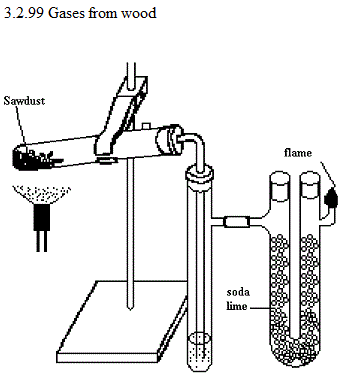
Put wood shavings or sawdust in a clamped Pyrex test-tube or hard glass test-tube.
Connect the clamped test-tube to another test-tube standing in water and which has an outlet for the gas.
Heat the hard glass test-tube gently then strongly, until almost red-hot.
Ignite the wood gas coming from the jet.
The black residue is charcoal, carbon.
3.99.01 Prepare dimethylamine
Saponification of dimethylformamide
(CH3)2NC(O)H + NaOH → (CH3)2NH + HCOONa
dimethylformamide + sodium hydroxide. → dimethylamine + sodium formate source
9.1.1 Prepare flour glue
Flour glues may be edible, but they are not approved foods.
They are safe for use by children, but children should not be encouraged to consume them.
Combine 1 cup flour, 1.5 cups water, 1 / 3 cup sugar, 1 teaspoon vinegar. Remove any lumps and keep in a closed container.
9.1.2 Prepare milk glue
Combine 1 cup water, 8 teaspoons powdered milk, 4 teaspoons vinegar, removes curds with a sieve.
Remove limps then combine with 1 teaspoon baking soda solution.
9.1.3 Prepare wallpaper paste
Combine 1 cup flour, 3 teaspoons alum, water to form appropriate consistence, 10 drops oil of cloves as preservative.
Remove any lumps and keep in a closed container.
9.2.0 Glues and pastes, in plastic containers
1. Aerosol spray adhesive, sensitive spray glue, for binding textile, fabrics, paper, cardboard, flat PVC, foils, urethane / rubber foams, cork, pictures, photograph mounting, 330 g can
2. "Bostik" kids paste, non-toxic, with brush, 250 mL bottle
3. "Bostik" clear gum, non-toxic, bonds paper and cardboard, 5 litre
4. "Bostik" kids PVA, non-toxic, non-staining dries clear easily wash off clothes, 1 kg, 5 litre bottle
5. "Clag" paste, non-toxic, easy to apply with brush applicator, for cut and paste and papier mache, dries after 10-20 minutes, 150 g, 300 g, 5 kg bottle.
6. "Clag", celmix, non-toxic adhesive powder, for finger painting, thickeningPVA, hardboard sealer, 500 g container
7. "EC Mix-a-paste", non-toxic, multipurpose adhesive powder, 500 g
8. "EC Mix-it", instant papier mache, just add water, 2 kg pack
9. "EC" Tintex craft paste, non-toxic, non-staining, cellulose powder, adhesive for papier mache or gelling base for finger paint, 500 g tin
10. PVA glue, witches hat lid, kids school glue, non-staining, non-toxic, general classroom use, 250 mL bottle
11. PVA glue, Helmar, professional woodworking glue, 5 litre bottle
12. "UHU" craft glue, PVA, non -toxic, quick setting, washable adhesive, for hobby, arts and craft, general all purpose water resistant, 33 mL
13. "UHU", WOW glue stick, Goes on Purple, coloured overlay, dries clear, safe non-toxic, acid free, washable PVP glue stick, suits young children, 36 g
Accessories
14. Double -sided tape, high tack, acid and solvent free, 6 mm wide ×50 m roll
15. Glue brushes, flat, 15 mm wide, pack / 24
16. Paste spreaders, plastic paddles, 130 mm, pack / 24
17. "Sellotape" sticky dots, removable, clear double sided pack / 64, 1600
12.1.5 Glycerine with borax solution, colour change
In test-tube 1, dissolve 2 mL of borax in half a test-tube of water and add two drops of phenolphthalein solution.
The liquid turns a rose red colour.
In test-tube 2 dissolve one drop of glycerine in 2 cm of water.
Add the test-tube 2 glycerine solution, drop by drop, to the test-tube 1 borax solution until the red colour disappears.
Heat test-tube 1 and the red colour reappears.
Cool test-tube 1 and the red colour disappears.
This heating and cooling effect can be repeated.
Repeat the experiment using sugar solution instead of glycerine.
12.1.6 Glycerine oxidation, Oxidation of glycerine
Add drops of hydrogen peroxide and a small crystal of iron (II) sulfate to 5 g of glycerine in a test-tube.
Hold the test-tube in a paper holder and heat the mixture over a flame.
A vigorous reaction occurs as the glycerine is oxidized to glyceraldehyde.
Add a blue precipitate from the reaction of copper hydroxide with copper sulfate solution and sodium hydroxide solution.
Heat the test-tube and a yellow precipitate that turns red of copper (I) oxide Cu2O, cuprous oxide) forms. source
12.1.7 Heat glycerine with sugar to form carbon
Put into a dry test-tube 5 g of glycerine and an equal amount of sucrose sugar.
Heat the test-tube over a flame.
A black mass of carbon forms in the test-tube.
12.7.2 Tests for glucose and sucrose, copper hydroxide
Heat a glucose solution with copper hydroxide solution.
A precipitate of copper (I) oxide (Cu2O, cuprous oxide), forms that gradually turns to red. source
This test reaction does not occur with sucrose.
12.7.3 Tests for glucose in apples and sweets
Cut four pea size pieces of apple and put them into a test-tube with 5 mL of sodium carbonate (washing soda), crystals.
Add 2 cm of water.
Hold the test-tube in a paper holder and heat it over a flame.
When the liquid begins to boil, continue the heating for four minutes.
A red-brown solution gradually forms that then gradually darkens until it is almost black.
Note the faint smell of burnt sugar.
This test reaction does not occur with sucrose.
Repeat the test with barley sugar and "Glucodin".
12.7.4 Tests for glycerine
Commercial "glycerine" is about 95% glycerol.
Glycerine, glycerin, is a product containing at least 95% glycerol, C3H8O3, CH2OH-CHOH-CH2OH, glycerin, 1,2,3-propanetriol source
The terms glycerine, glycerin, glycerol may have no precise meaning in different countries and in different products.
Experiment
Heat drops of glycerine in a dry test-tube with powdered sodium hydrogen sulfate, (sodium bisulfate).
Acrolein, C3H4O, ethylene aldehyde, vapour forms with a penetrating acrid smell of burnt fat in burning cooking oil. source
Do not inhale the gases from heated glycerine!
Glycine
Glycine, C2H5NO2, NH2CH2COOH, L-Glycine, aminoacetic acid (Gly), aminoethanoic acid, smallest and simplest amino acid source
Glycine, (Table of amino acids)
Glycine, DNA codons
Leucine, See: a1,(Experiments)
Glycine and its sodium salt (flavour enhancer) E640, Glycine max , soya bean, soybean, vegetable, [soybean oil], Fabaceae: 19.2.11
Amino acids: 16.3.6.1.0
Separate amino acids by paper chromatography: 10.2.2.5
12.7.5 Glycerine with borax solution
In test-tube 1, dissolve 2 mL of borax in half a test-tube of water and add two drops of phenolphthalein solution.
The liquid turns a rose red colour.
In test-tube 2 dissolve one drop of glycerine in 2 cm of water.
Add the test-tube 2 glycerine solution, drop by drop, to the test-tube 1 borax solution until the red colour disappears.
Heat test-tube 1 and the red colour reappears.
Cool test-tube 1 and the red colour disappears.
This heating and cooling effect can be repeated.
Repeat the experiment using sugar solution instead of glycerine.
13.1.0 Gases by name, Ammonia to Xenon
The gases listed below are gases at STP and are the gases mentioned in this website.
See: Gas, Molecular weight, Density, (Table 1)
See: Packaging gases, propellants, food additives
Acid rain, NOx
Ammonia, NH3 source
Argon, Ar
Bromine, Br
Butane, C4H10 source
Carbon dioxide, CO2 source
Carbon disulfide, CS2 source
Carbon monoxide, C≡O
Chlorine Cl2 source
Coal gas, (50% hydrogen gas)
Ethane, C2H6 source
Ethene, (Ethylene), C2H4 source
Ethyne, (Acetylene), C2H2 source
Fluorine, F
Helium, He
Heptane, C7H16 source
Hexane, C6H14 source
13.3.4, Hydrogen gas, H2 source
Hydrogen bromide, HBr
13.3.2, Hydrogen chloride gas, HCl
Hydrogen sulfide gas, H2S source
Krypton, Kr
Methane, NH3 source
Neon, Ne
Nitric oxide gas, NO
Nitrogen gas, N2 source
Nitrogen dioxide gas, NO2 source
Nitrogen triiodide, NI3 source
Nitrous oxide gas, N2O source
Oxygen, O2 source
Ozone, O3 source
Pentane, C5H12 source
Phosgene gas, COCl2 source
Propane, C3H8 source
Radon, Rn
Sulfur dioxide, SO2 source
Sulfur trioxide, SO3 source
TrichloroethaneH, C2H3Cl3 source
TrichloromethaneH, chloroform, CHCl3 source
Xenon, Xe
13.3.0 Prepare gases with gas generation apparatus
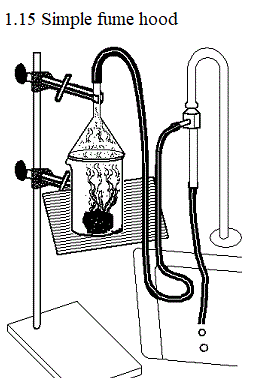
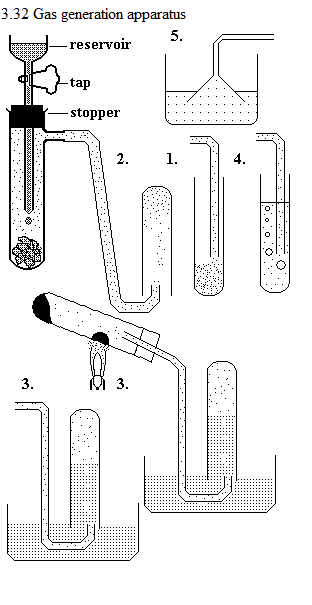
Be careful! Prepare poisonous gases only in a fume hood or fume cupboard, e.g. preparation of chlorine, hydrogen chloride, sulfur dioxide.
Collect more dense gas by upward displacement of air (downward delivery), if molecular mass > 28.8.
The more dense gas sinks down into, and displaces, the less dense air upwards, e.g. preparation of carbon dioxide, nitrogen dioxide.
Collect less dense gas by downward displacement of air (upward delivery), if molecular mass < 28.8.
The less dense gas rises into, and displaces, the more dense air downwards, e.g. preparation of hydrogen, ammonia.
Use a borosilicate test-tube that is not cracked.
Clamp the test-tube to a stand.
Put the solid reagent in the sidearm test-tube and the liquid reagent in the reservoir.
Add the liquid reagent very slowly drop by drop.
Keep the reservoir tap closed and the reservoir full to prevent gases blowing back.
Grease the stopper and insert it so that if an accidental sudden increase in pressure occurs, the stopper blows out of the test-tube.
Use rubber tubing to collect the sidearm to a delivery tube that leads into the receiving test-tube.
Discard the first gas coming out of the delivery tube, because it is mostly air.
Never allow a flame near the gas as it comes out of the delivery tube.
Some air probably remains in the receiving test-tube.
Use the gas bubbler to collect over water insoluble gases with similar density to air.
Some water vapour remains in the receiving test-tube.
Gases can also be collected in balloons, inflatable footballs, and plastic bags.
Collect insoluble gas, or not very soluble gas, of any density over water, i.e. by downward displacement of water. (water displacement), e.g. preparation of oxygen.
Fill one third of the water trough.
Fill a test-tube with water by placing it on its side in the water trough.
Put your thumb over the end of the test-tube and invert it.
Fix the end of the gas delivery tube inside or under the test-tube.
If the gas is slightly soluble in water its solubility will be less in warmer water.
Some gases dissolve in water to produce heat and form an acid solution, e.g. HCl, SO2, NO, NO2. source
Some gases dissolve in water to form a basic solution, e.g. NH3. source
Collect soluble gases in water (aqueous solution), e.g. Cl2. source
When the gas preparation equipment uses downward displacement of water (Diagram 3.) or collection in water (Diagram 4.), water may be forced back into the equipment by atmospheric pressure i.e. "sucked back", and break hot glassware or dilute reactants.
To prevent sucking back, use an inverted glass filter funnel.
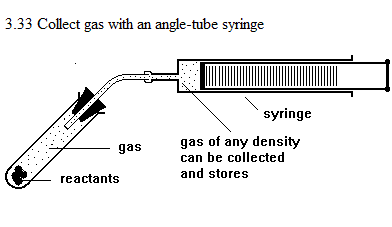
Collect gas with an angle tube syringe that can collect and store gas of any density.
16.6.5 Dihydric alcohols, glycols
The dihydric alcohols, glycols, diols, have two hydroxyl groups on different carbon atoms, e.g.:.
1.Ethane-1,2-diol, ethylene glycol, ethanediol, "glycol", 1.2-dihydroxyethane
(C2H4O)nH2O, CH2OHCH2OH, BP 197.5 oC, car radiator antifreeze, coolant, in hydraulic fluids, paint and plastic solvent, sweet taste, but poisonous source
2. Butane-1,4-diol, C4H10O2, HO(CH2]4OH, tetramethylene glycol source
CH2CH2 (oxidation) → CH2OCH2 (+ water) → HOCH2CH2CH2CH2OH source
ethene (oxidation) → epoxyethane (+ water) → ethane-1,2-diol (glycol, antifreeze) source
3. Propane-1,2 diol, propylene glycol, C3H8O2, CH3CHOHCH2OH, colourless, tasteless, odourless, solvent for pharmaceuticals source
16.6.11 Nitrocellulose, gun cotton
This preparation is too dangerous to be done in schools.
Potassium nitrate is dissolved in concentrated sulfuric acid to produce a dangerous vapour, then cooled in an ice and salt mixture, then cotton balls are added.
Later more sulfuric acid is added, then the cotton balls are removed and placed in sodium bicarbonate solution until no more bubbles form, then dried.
Gunpowder, black powder: potassium nitrate + sulfur + charcoal
16.6.121 Gypenoside
Gypenoside XVII, C48H82O18, a beta-D-glucoside, a disaccharide derivative, occurs Panax source
Gadolinium
Gadolinium, Table of the Elements
Gadolinium, RSC
Gadolinium, Gd, (Johan Gadolin , (1760-1852, Finland), chips, foil, ingot, mesh, rare earth, was identified 1880, from gadolinite.
Gadolinium is paramagnetic and it is used in magnetic recording discs and tapes, in MRI contrast agents and green phosphors.
Gadolinium (III) chloride, anhydrous, powder, beads
Galactinol
Galactinol, C12H22O11, sugar alcohol, an alpha-D-galactoside, monosaccharide derivative, important for carbohydrate metabolism, was first found in sugar beet. source
It occurs in (Beta vulgaris) juice, Fagus, and in Cucumis
Galactitol
Galactitol, C6H14O6, dulcitol, sugar alcohol, from metabolic breakdown product of galactose, ( lactose + lactase → glucose + galactose), slightly sweet taste, neurotoxin, hepatotoxin in galactosemia or galactose intolerance genetic disorder source
It occurs in family Celastraceae.
Gallium, Ga
Gallium, Table of the Elements
Gallium, RSC
Gallium, Ga (Latin Gallia France, Roman region including present day France and surrounding territory), blue-white metal, conchoidal fracture
It is used in LEDs, and is found in in bauxite and zinc ores.
The discovery of gallium in 1875 by François Lecoq de Boisbaudran, France, was possibly the first element to predict existence of the periodic table.
He also discovered Samarium, Sm, and Dysprosium, Dy.
Gallium is brittle then melts at 298K, 29.77 oC, so "joke spoons" made of Gallium dissolve in a hot cup of tea!.
Gallium arsenide, GaAs, semiconductor, is used in diodes, field effect transistors, integrated circuits, compact disc players, because it transforms electric current directly into laser light, and used for ultra-high radio frequencies, fast electronic switching, lasers (DH laser), in ink that contributes to luminescence of Euro bank notes.
| Gallium (III) acetylacetonate, C15H21GaO6 | Gallium (III) bromide, GaBr3 | Gallium (II) chloride, GaCl2 | Gallium (III) fluoride, GaF3 | Gallium (III) iodide, GaI3 | Gallium (III) nitrate hydrate, GaN3O9.xH2O | Gallium (III) oxide, Ga2O3 | Gallium (III) sulfate hydrate, Ga2O12S3.xH2O | Gallium (III) sulfide, Ga2S3 | Tetrabutylammonium tetrachlorogallate, C16H36Cl4GaN | Tris(dimethylamido)gallium (III), C12H36Ga2N6 | source
Gallocatechin
Gallocatechin, (GC), C15H14O7, bioflavonoid, flavan-3-ol, polyphenolic compound, in green tea, is a free radical scavenger. source
Gallocatechin gallate, C22H18O11, bioflavonoid, occurs in green tea. source
Galangin
Galangin, C15H10O5, flavonol, induces cell destruction, anti-oxidative and free radical scavenger activities. source
It occurs in (Alpinia galanga), (Alpinia officinarum), and (Heliochrysum aureonitens).
Galangin 3-methyl ether, (3-Methylgalangin), (7-Dihydroxy-3-methoxyflavone), a dihydroxyflavone
It occurs in herbs and spices, and in Galanga root.
Garbanzol
Garbanzol, C15H12O5, trihydroxyflavanone, secondary alpha-hydroxy ketone, an antimutagen source
Geosmin
Geosmin, C12H22O, a sesquiterpenoid. bicyclic alcohol, earth smell, muddy fish smell, after rain smell, cut grass smells from Streptomyces and (Calothrix cyanobacterium). source
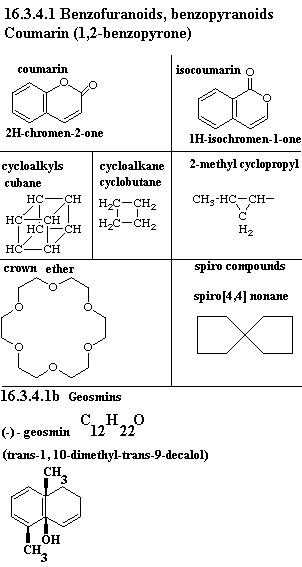
1. The degraded sesquiterpene geosmin, C12H22O, a bicyclic alcohol, causes the "earth smell" of moist soil, produced by (Streptomyces antibioticus) and (Streptomyces coelicolor). source
The "earth smell", "rain smell", noticed after rain and in wet rugby dressing rooms, causes the earthy taste of beetroot, and "off tastes" in water and wine.
Blue-green algae in water can also produce geosmin.
In Australia, when heavy rain occurs after a long period of dry weather, a bad taste, "off taste", may develop in the drinking water caused by the high concentration of geosmin washed into water supply dams.
Actinomycetes bacteria grows in damp soil, but produces survival spores during hot weather.
During the first rainfall, wind suspends the spores in the air as an aerosol causing the "after the rain smell", from | Geosmin C12H22O |. source
The smell occurs after breathing in tiny particles of soil containing the bacteria.
2. Another explanation for the after rain smell is that volatile chemicals in the air spaces between soil particles are washed out by the rain and become relatively concentrated just above the soil.
Some people call the earth smell "petrichor", and say that is caused by plant oils that become adsorbed to clay minerals to produce an argillaceous odour.
Some people say they can smell ozone in the smell before rain and this may be true after severe lightning from thunderstorms.
3. Geosmin causes the earthy taste of beetroot and off-flavours in wine and drinking water.
4. Geosmins are produced by blue-green algae and anaerobic bacteria when they die.
Geosmins may cause the muddy smell of fish, e.g. catfish, carp and mullet.
Geosmins break down in acid solutions, so fish is generally eaten with lemon juice.
Guaiacol
Guaiacol, C7H8O2, 2-methoxyphenol, yellow aromatic oil, disinfectant, expectorant, dental pulp anaesthetic, induces cell proliferation source
It is used to prepare synthetic vanillin.
It occurs in wood smoke by pyrolysis of lignin, in wood creosote, and in Guaiacum
Gamboge
Gamboge, yellow dye, formerly for illustrations, poor light fastness, poisonous, sap of Garcinia hanburyii , Clusiaceae
Garum
Garum, liquamen, sauces made in ancient Greece and Roman Empire from fermented fish intestines
Gases
Gases (Chemistry)
#GasesH">Gases (Chemistry)
Chemical vapours and smelling chemicals: 3.4.4
Fume cupboards, fume hoods: 2.2.4
Gas or vapour inhalation, EAR, CPR: 3.4.8
Gas, Molecular weight, Density, (Table 1):
Gases, states of matter, solid (s), liquid (l), gas (g) aqueous solution (dissolved in water) (aq)
Gas, Molecular weight, Density
Gas-pak: 2.2.6
Gas bags: 13.3.1
Gas constant, R, gas equation (PV = nRT): 20.3.8
Gas discharge tubes, Cathode ray tubes: 38.8.1
Gas expansion, Charles's law: 20.2.0
Gas inhalation, vapour inhalation, EAR, CPR: 3.4.8
Gas installations and inspections: 2.2.5
Gases by name, Ammonia to Xenon: 13.1.0
Hazards of gases: 3.8.0
Packaging gases, propellants, food additives
Prepare gases at standard conditions: 3.32, Ammonia to wood gas
Prepare gases with gas generation apparatus: 13.3.0
Separate by heating, gases dissolved in water: 3.25
Solubility of gases: 20.3.4 Henry's law and decompression sickness, "the bends"
Standard temperature and pressure, STP, density of gases: 20.0.6
Saturation vapour pressure, SVP: 12.3.1
Saturation vapour pressure over water: 12.3.2
Tests for gases and vapours: 1.0.0
Tests for gases collected in a respirometer: 9.1.19
Tests for gases from burning hydrocarbons: 16.4.6.0
Tests for gases with hot concentrated sulfuric acid:12.11.3.6
Tests for gases, Lighted splint tests: Tests
Tests for gases with hot concentrated sulfuric acid
Volume of gas dissolved in tap water: 7.7.13.1
Gases by name
Bunsen burner gas: 22.1.4
Butane gas, C4H10, compounds source
16.4.1 Butane
Carbon dioxide: 16.4.2
Carbon monoxide: 16.4.3
16.4.4 Ethane, C2H6 source
16.4.5 Ethene, (ethylene), C2H4 source
16.4.6 Ethyne, (acetylene), C2H2 source
Greenhouse gases, (Experiments)
16.4.8 Hexane, C6H14 source
16.4.7 Heptane, C7H16 source
Laboratory gas, piped gas, "lab gas", Household gas
LPG gas, LP-gas, liquefied petroleum gas, compressed gas, bottled gas
Methane, natural gas, safety
16.4.9 Octane, C8H18 source
16.4.10 Pentane, C5H12 source
Propane gas, C3H8 source
16.4.11 Propane, C3H8 source
Water gas, mixture of carbon monoxide and hydrogen gas, forms when steam passes over hot coke or carbon
Producer gas, air gas, similar to water gas, formed by passing air and steam over hot carbon
Gelatin
Gels, gelatine, gelatin, puragel, "Aeroplane jelly"
Gelatine, E441 (if contain SO2 may cause allergies) source
Sold as: Gelatin Type A from Porcine Skin Gelatin Type B, (testing for proteins)
Amorphous, yellow to colourless, transparent, tasteless, material, brittle when dry, from collagen protein produced by boiling animal tissues, e.g. skin and ligaments
It is used in glue, jelly crystals, e.g. puragel, photographic emulsions, adhesives
Also, gelatin dynamite and blasting gelatin, underwater explosives, containing nitroglycerine and cellulose nitrate
Hydro gels, water absorbent polymers
Use jelly to style hair and grow seeds to see root structure.
Cooked collagen changes into gelatine: 19.2.8.5
Diffusion through a colloidal gel: 9.1.5
Gels: 7.8.5
Make jelly with fresh pineapple and tinned pineapple: 19.1.13
Prepare nutrient gelatin solution: 3.18
Prepare glycerine jelly solution: 6.3
Tests for pectin in jelly and jam: 16.5.8
Germanium, Ge
Germanium, Table of the Elements
Germanium, RSC
Germanium, Ge (Latin Germinus Germany), grey-white metalloid, crystalline, brittle, lustrous, metalloid, discovered by Clemens Winkler, Germany, in 1886, produced from. germanium silver ore argyrodite, germanite mineral, coal, and flue dusts
Germanium and germanium oxide, GeO2, is used in semiconductors, (the first solid state amplifier, transistors), in alloys, infrared glass, catalysts, e.g. for PET plastic, fluorescent lamp phosphors, infrared source
detectors, lenses.
Germanium (IV) chloride, GeCl4, germanium tetrachloride, Toxic by all routes, Highly corrosive, violent reaction with water, colourless, fuming liquid acidic smell source
Germanium ethoxide
Germanium Std (ICP / DCP)
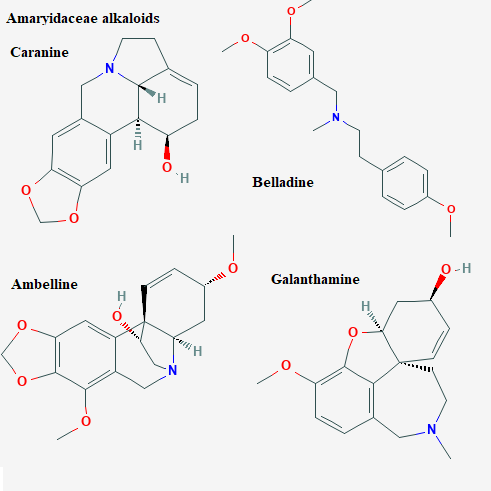
Galanthamine
Galanthamine, (C17H21NO3), Benzazepine, Amaryllis alkaloid, oral cholinesterase inhibitor, It is used to treat Alzheimer's disease, analgesic, inhibits cholinesterase activity, herbal medicine nervous diseases, used to reverse the muscular effects of gallamine triethiodide (Flaxedil) (C30H60N3O3) and tubocurarine (C37H41N2O6+). source
It occurs in Galanthus, Amaryllis belladonna, Hymenocallis leucojum, Lycoris squamigera, Narcissus, Pancratium, Ungernia, and Galanthus species.
Glass
Borosilicate glass, Pyrex: 7.9.10
Electrical conductivity of molten glass at high temperature: 32.3.2.7
Glass balls (all sizes), Glass beads (all sizes)
Glass cleaning, potassium dichromate solution:
Glass cutting, tubing, cleaning: 2.3.0
Glass knife, (ceramic impregnated with diamond dust)
Glass transition temperature (Tg), chewing gum, cotton: 3.4.0
Gutta percha polymer, natural polymer, mainly trans-1.4-polyisoprene, latex of Palaquium oblongifolium )
Glass wool: 3.6.4 (Safety)
Glasses, (Safety glasses)
Prepare coloured glass: 7.4.4, (See: 3.)
Silicon, Silica, (glass): 7.4.0
Teach manipulative skills: 3.2.4 (Safety)
Test-tubes, glassware and microscope slides: 3.6.6 (Safety)
Fibre glass
Fibre glass resin, epoxy resins, uncured resins, may contain isocyanate residues, strong irritants to eye nose / respiratory organs
Gentamicin
Gentamicin, C21H43N5O7, is an amminoglycoside, from fermentation of Micromonospora purpurea or Micromonospora echinospora source
It inhibits protein synthesis, antimicrobial against strains of Pseudomonas, Proteus, Staphylococcus, Streptococcus, however it may damage the kidneys.
Gentamicin C, aminoglycoside from Gram-negative bacteria, prevents protein synthesis, growth of mycoplasma.
Gentamicin sulfate is a broad spectrum antibiotic.
Gentisic acid
Gentisic acid, C7H6O4, (2,5-dihydroxybenzoic acid), hydroquinonecarboxylic acid, a phenolic acid, lipoxygenase inhibitor source
It is a crystalline powder, anti-inflammatory, antirheumatic, antioxidant, antibacterial, antiviral It occurs in humans, Citrus roots and leaves, (Vitis vinifera) peels, (Helianthus tuberosus) tubers, and (Eucalyptus grandis).
Geraniol
Geraniol, C10H18O, lemonol, monoterpenoid, colourleess to pale yellow oily iquid, sweet fragrant rose odour, anticancer, it occurs in citronells, lemongrass, lavender, coriander, lemon balm, basil, Damascene rose, and chinese pepper (Lanthoxylum simulans). source
Germacrenel
Germacrene, C15H24, a sesquiterpene, in the essential oil of rosemary. source
It occurs in leaves of the Mexican linaloe tree (Bursera linaloe), mitsuba (Cryptotaenia japonica), hymenocrater, (Hymenocrater yazdianus), and in purple dead-nettle, (Lamium purpureum).
Ginkgoic acid
Ginkgoic acid, C22H34O3, ginkgolic acid, a hydroxybenzoic acid source
Ginkgolic acid inhibits HIV infection in human PBMC cells.
Glazes
Pottery glazes were formerly metal oxides, e.g. lead oxide and cadmium oxide, often heavy metals.
Most glazes nowadays have the metal oxide fired with silica to form sintered glass.
Glazes for school use must contain no cadmium and < 0.1% lead dry weight.
Glazes are sold as "school glazes".
Glepidotin
Glepidotin A, C20H18O5, (8-Prenylgalangin), a trihydroxyflavone, Glepidotin A, B and C in Glycyrrhiza lepidota source
Glucan
Glucan, C6H10O5)n, D-glucose monomer polysaccharide, linked by glycosidic bonds source
It is sold as:
1. Glucan from cell wall of baker's yeast, Saccharomyces cerevisiae, 2. β-D-Glucan, from barley (1,3)-β-D-glucan (BG), is a biomarker for candidiasis, 3. β-1,3-Glucan, Paramylon, from Euglena gracilis.
Some α-glucans:
Chrysolaminarin, β-1,3-glucan, in phytoplankton
Laminarin, Laminaran, β-1,3- and β-1,6-glucan, in brown algae, (Laminaria digitata), oarweed
Lichenin, β-1,3- and β-1,4-glucan, in lichen reindeer food
Pleuran, β-1,3- and β-1,6-glucan, from the oyster mushroom, (Pleurotus ostreatus)
16.7.11 Yeast, fermentation, brewing, beer
Zymosan, β-1,3-glucan, found on yeast
Glucogallin
Glucogallin, C13H16O10 beta-Glucogallin, glucogallic acid, galloyl beta-D-glucose, a gallate ester, in Rumex, in Rheum, in Paeonia source
Gluconic acid
Carbohydrates, carbohydrate acids: 16.3.1.1
E574 Gluconic acid (anti-caking agent, sequestrant), Food additive
Oxidation of glucose, blue bottle experiment: 9.3.10
SCOBY, Symbiotic Colony Of Bacteria and Yeast: 4.3.1
Glucose
Glucose, C6H12O6, "D-(+)-Glucose", dextrose, glucose syrup, grape sugar, dextrose monohydrate, d-glucose, blood sugar, glucose, anhydrous, glucose (for babies), "Glucodin" source
Glucose is called grape sugar, because of its occurrence in grapes.
In table syrup, black treacle, ripe apples and cheap sweetening material for confectionery and sweets, e.g. barley sugar.
Glucose is only half as sweet as sucrose, sugar, but is more easily digested.
It is manufactured by boiling starch with dilute sulfuric acid.
Glucose is a carbohydrate, the hydrogen and oxygen being in the same proportion as in water.
Common names: Corn syrup, "Karo" syrup
Dextrose Monohydrate
E575 Glucono δ-lactone (acidity regulator, raising agent)
E576 Sodium gluconate (Banned in some countries) (acidity regulator, sequestrant)
E578 Calcium gluconate (acidity regulator, firming agent)
E1102 Glucose oxidase (enzyme, acidity regulator)
Glucose, Monosaccharides: 16.3.1.3
Amylase (fermentation): 4.5.1
Glucose fermentation: 9.1.4
Glycaemic index (GI): 9.1.1
Heat different foods: 9.128
Hydrolysis of starch by salivary amylase (ptyalin): 9.5.4
Lactic acid: 16.2.4
Lactase: 4.5.2
Left-handed and right-handed structural forms, D-sugars and L-sugars: 16.3.1.3.1
Monosaccharides: 16.3.1.3
Non-enzymatic browning, caramelization: 119.2.3.2
Oxidation of glucose, blue bottle experiment: 9.3.10, (See: 2.)
Reducing sugars: 9.3.6
E420 Sorbitol, Sorbitol syrup, (from glucose in berries or synthesized, (artificial sweetener, bulking agent, humectant)
Split lactose from milk or whey using immobilized lactase: 4.4.4
Prepare glucose
Prepare glucose with starch: 16.7.15
Prepare glucose with sugar: 16.7.18
Prepare glucose nutrient agar solution: 9.2.31
Prepare glucose nutrient agar: 9.2.16
Prepare glucose with starch: 16.7.15
Prepare glucose with sugar: 16.7.18
Tests for glucose
Tests for glucose: 19.5.8
Tests for glucose and fructose with Fehling's reagent: 9.5.4
Tests for glucose and sucrose, copper hydroxide: 12.7.2
Tests for glucose and starch, "Testape": 9.5.2
Tests for glucose, blood glucose, glucose tolerance: 19.1.26
Tests for glucose, Clinitest tablet: 19.1.24
Tests for glucose, Clinistix strip: 19.1.25
Tests for glucose concentration, ferricyanide test: 19.1.27
Tests for glucose concentration, ferricyanide test: 19.1.26
Tests for glucose, blood glucose: 19.1.26
Tests for glucose, glucose oxidase test: 19.1.29
Tests for glucose, glycosylated haemoglobin test: 19.1.30
Tests for glucose in apples and sweets: 12.7.3
Tests for glucose, Nelson-Somogyi test: 19.1.27
Tests for glucose, Nelson-Somogyi test: 19.1.28
Tests for glucose, Tollens' test: 9.3.3
Tests for glucose, urine test: 19.1.31
Tests for glucose, urine test, Diastix strip: 19.1.33
Glue
Gluco-chemicals
Glucoalyssin, C13H25NO10S3, flavour component, occurs in Chinese cabbage, pak choi, turnip source
Glucoaubrietin, C15H21NO10S2, occurs in Tropaeolaceae source
Glucobarbarin, C15H21NO10S2 source
Glucoberteroin, C13H25NO9S3, flavour component, occurs in horseradish>, radish. source
Glucobrassicanapin, C12H21NO9S2, flavour component, occurs in brown mustard, horseradish, swede, turnip, sea rocket. source
Glucobrassicin, C16H20N2O9S2, occurs in Brassica, Raphanus species, and most cruciferous plants. source
Glucocapparin, C8H15NO9S2, occurs in horseradish, radish, cauliflower. source
Glucocheirolin, C11H21NO11S3, flavour component, occurs in crucifer seeds, occurs in horseradish, cauliflower, swede, turnip. source
Glucoconringiin, C11H21NO10S2, occurs in Conringia species. source
Glucocleomin, C12H23NO10S2, occurs in Cleome. source
Glucoerucin, C12H23NO9S3, flavour component, in seed of salad rocket, occurs in Brussels sprouts. source
Glucoiberverin, C11H20NO9S3, flavour component, occurs in Chinese cabbage, cabbage, cauliflower, horseradish, radish. source
Gluconapoleiferin, C12H21NO10S2, occurs in Brassica. source
Glucoiberin, C11H21NO10S3, occurs in cabbage, broccoli, occurs in Brussels sprouts. source
Glucolepidiin, C9H17NO9S2, flavour component, pungent like garlic, occurs in horseradish, garden cress. source
Glucolimnanthin, C15H21NO10S2, volatile and pungent, occurs in Limnanthes species. source
Gluconapin, C11H19NO9S2, occurs in rapeseed, brown mustard, black mustard, horseradish, wasabi (Eutrema japonicum). source
Gluconasturtiin, C15H21NO9S2, tingles tongue, water cress aroma, occurs in watercress, white mustard, garden cress, brown mustard. source
Glucoputranjivin, C10H19NO9S2, pungent, occurs in white mustard, brown mustard, wasabi Chinese cabbage, Brussels sprouts. source
Glucoraphenin, C12H21NO10S3, flavour component, occurs in radish seed. source
Glucosibarin, C15H20KNO10S2. source
Glucosisymbrin, C10H19NO10S2, occurs in Moringaceae. source
Glucotropaeolin, C14H19NO9S2, Benzyl glucosinolate, occurs in Cardamine cordifolia, and Lepidium virginicum. source
Glucoraphanin, C12H23NO10S3, occurs in young sprouts of broccoli, Brussels sprouts, cauliflower, red cabbage, radish, cabbage. source
It is a precursor to sulforaphane, anti-cancer, anti-microbial.
glucoraphanin + myrosinase → sulforaphane C6H11NOS2 source
Gluconic acid, C6H10O7 source
Gluconobacter, Make wine from grape juice and vinegar from wine: 4.2.4
E575, glucono δ-lactone.
Aloenin
Aloenin, C19H22O10, Aloearbonaside, bitter glucoside, occurs in Candelabra aloe, in skin care osmetics. source
Apterin, Coumarin, C20H24O10 source
Arctiin, anti-tumour, antiviral, glucoside of Arctigenin, C21H24O3, Arctium lappa, burdock source
Betanin, C24H26N2O13 source
Cycasin glucoside, C8H16N2O7 source
Fraxin, C16H18O10 source
Icariin, C33H40O15 source
21.0 Linamarin, C10H17NO6 source
Piceid, C20H22O8 source
Picrocrocin, C16H26O7 source
Quercitrin, C21H20O11 source
Rhamnazin, C17H14O7 source
Rhamnetin, C16H12O7 source
Rhaponticin, C21H24O9 source
Salicin, C13H18O7 source
Myrosinase, (Enzyme)
Myrosinase, (Enzyme)
Myrosinase enzyme, also called: glucosinolase, thioglucosidase, thioglucoside glucohydrolase.
Myrosinase enzyme is a singrinase and a sinigrase.
glucosinolate + myrosinase → toxic compounds to deter grazing. source
glucosinolate + myrosinase → glucose + isothionate source
glucosinate + myrosinase → thiocynates (SCN-), and nitriles (R-C triple bond N) source
Glucotropaeolin
Glucotropaeolin, C14H19NO9S2, Benzyl glucosinolate, an aralkylglucosinolic acid, a benzene source
. It is a flavour component and a breakdown hydrolysis product, and the precursor of benzyl isothiocyanate, C8H7NS source
It is a strongly antibacterial, and antifungal.
It occurs in Cardamine cordifolia, Lepidium virginicum, nasturtium, garden cress, Indian cress, horseradish>, Papaya dry latex.
Glucuronic acid
Glucuronic acid, C6H10O7, D-Glucopyranuronic Acid, Glucuronate, (GlcA), Uronic acid, first isolated from urine source
It occurs in many gums, gum arabic, Xanthan, Kombucha tea, animal liver.
It is formed by the oxidation of the C-6 carbon of glucose, and it can detoxify some drugs and toxins.
Glutaric acid
Glutaric acid, C5H8O4, COOH(CH2)3COOH, Pentanedioic acid, an alpha omega-dicarboxylic acid, colourless crystals or white solid, corrosive, used to make polyamides and polyesters, irritates skin and eyes, may be associated with acidosis, dehydrogenase deficiency, brain damage, macrocephaly source
Gluten
Gluten, wheat starch and gluten (in wheat, barley, rye, gluten is gliadin + glutenin), gluten intolerance
Gluten proteins affect the baking quality of wheat by giving dough water absorption capacity, cohesivity, viscosity and elasticity.
Gluten proteins are divided into aqueous alcohol soluble gliadins and insoluble glutenins.
Gliadins are mainly monomeric proteins with molecular weights 28, 000-55, 000, and classified into alpha/beta-, gamma- and omega-types.
Disulphide bonds may be present as intrachain crosslinks.
Glutenins are aggregated proteins linked by interchain disulphide bonds, with molecular weights from 500, 000 to > 10 million.
After reduction of disulphide bonds, the resulting glutenin subunits are soluble in aqueous alcohols as with gliadins.
Glutenin subunits are divided into the high-molecular-weight subunits.
(MW=67, 000-88, 000) and low-molecular-weight subunits (MW=32, 000-35, 000).
Gliadin causes elasticity and tenacity, or toughness, to the gluten, and the glutenin gives it strength.
Gliadin, L-glutamine, C5H10N2O3, molecular weight 631.687 g/mol, a prolamine, from gluten of wheat and rye, toxic factor is associated with coeliac disease. source
Gluten powder, wheat starch, wheaten cornflour
Endospermic and non-endospermic seed: 9.109 (See: 2.2)
Experiments
Prepare lactic acid with sourdough: 4.2.3 (See: Gluten)
Tests for carbohydrates, Molisch's test: 9.3.7
Tests for starch with Fehling's solution: 9.142.3. (See: 4.)
Tests for wheat starch for gluten: 16.6.2
Glutinosone
Glutinosone>, C14H20O2, occurs in Peruvian tobacco, (Nicotiana glutinosa), only after infection by tobacco mosaic virus. source
Glycan
A glycan is usually O-glycosidic linkages of monosaccharides.
Examples of glycans:
Cellulose is composed of β-1,4-linked D-glucose molecules
Chitin is composed of β-1,4-linked N-acetyl-D-glucosamine molecules
Glyceraldehyde
Glyceraldehyde, C3H6O3, is sold as: DL-glyceraldehyde, D-(+)-glyceraldehyde source
Left-handed and right-handed structural forms, D-sugars and L-sugars: 16.3.1.3.1
Monosaccharides: 16.3.1.3
Test for reducing sugars: 9.3.6
Glycerol
Glycerol, glycerin, glycerine, is a product containing at least 95% glycerol, C3H8O3, 1,2,3-propanetriol. source
The terms glycerine, glycerin, glycerol may have no precise meaning in different countries and in different products.
Glycerol, glycerin, glycerine, C3H8O3, CH2OH-CHOH-CH2OH, 1,2,3-propantriol, propane-1,2,3-triol, trihydric alcohol, antifreeze source
Glycerol, trihydroxypropane 1,2,3-propanetriol, glycyl alcohol, glycerol USP, is oily so harmful if spilled on floor.
Glycerol for lubricating rubber stoppers, mounting medium for temporary microscope slides.
Glycerol, clear, viscous, colourless odourless syrupy fluid that readily absorbs moisture, propane-123-triol, propane-1,2,3-triol, glycerin jelly, BP. 290 oC, and decomposes, RD 1.26, absorbs water from air, miscible, soluble in water and alcohol, sweet taste and no smell and has no action on litmus paper.
Glycerol is used in cosmetics, toothpaste, shampoo, loosens stains, medical uses, manufacture of explosives and shaving cream.
It is a by-product of the manufacture of soap.
Glycerol was discovered by K. W. Scheele, 1779, who heated olive oil with lithage.
Use glycerine smeared in ice cube trays to avoid trays sticking to freezer shelf.
Use glycerine added to the final wash rinse to stop woollen garments stretching.
Use glycerine to lubricate household mincing machines.
Use glycerine, rubbed in before washing, to remove lipstick stains.
Glycerol-phthalic anhydrides, thermoset: 3.8.8
Glycerol, trihydric alcohols, glycerol: 16.1.3.0.2
Glycerine jelly, adhesive, microscope slides: 2.1
Glycerine oxidation: 12.1.6
Glycerine with borax solution: 12.1.5
Glycerine with cobalt chloride solution: 12.1.8
Glycerol-phthalic anhydrides: 3.8.8
Glycerides: 16.3.3.0.5
Heat glycerine with sugar to form carbon: 12.1.7
Prepare glycerine jelly: 2.1
Tests for glycerine: 12.7.4
Tests for glycerol: 12.5.11
Tests for glycerine: #12.7.4H">12.7.4
Experiments
12.1.8. Glycerine with cobalt chloride solution
12.1.8. Glycerine with cobalt chloride solution
Dissolve 5 g of cobalt chloride crystals in 2 cm of water in a test-tube then add 5 g of glycerine.
Heat the test-tube to see the red colour of the liquid turning to a violet colour.
Cool the test-tube to see the red colour return.
Glycogen
Glycogen, (C6H1005)n, animal starch, liver starch, is a branched polymer of glucose synthesized by animal cells for energy storage. source
Glycogen is constructed mostly of α14 glycosidic bonds with branches created through α16 glycosidic bonds.
Glycogen is prepared from rabbit liver and from blue mussel, (Mytilus edulis).
Glycogen, starches, amylum: 16.3.1.5
Anatomy and physiology of meat: 19.3.2
Prepare Carnoy's solution: 4.8
Glycosides
See: Glycosides
1. Alcoholic glycosides, salicin occurs in Salix.
* Aldehyde glycosides, vanilla pod, glucovanillin, cinnamon bark cinnamic aldehyde
Anthocyanidins (aglycones of the glycoside anthocyanins), e.g. Cyanidin
2. Flavonoid glycosides
- Iridoid glycosides, monoterpenes
- Isothionate glycosides, wild mustard
- Lactone glycosides, sweet clover, red clover
- Phenolic glycosides, arbutin (bearberry), Uva Ursi
- Steroidal glycosides, cardiac glycosides
- Steviol glycosides (aglycone steviol), Stevia, has 2 primary glycosides: stevioside, rebaudioside A.
- Thioglycosides (contain sulfur), Sinigrin precursor to allyl isothiocyanate, mustard oil
3. List of glycosides by name:
Acetyldigoxin, cardiac glycoside
Acolongifloroside, cardiactive glycoside
Agnuside, iridoid glycoside
Aloe-emodin, anthraquinone glycoside
Alvonal MR, cardiac glycoside
Aloin, barbaloin, anthraquinone glycoside
Amarogentin, secoiridoid glycoside
Amikacin, aminoglycoside
Amygdalin, cyanogenic glycoside
Apiin, diglycoside
Arbutin, glycoside
Asiaticoside, triterpene glycoside
Baicalin, flavone glycoside
Bufalin, C24H34O4, cardiac glycoside, (in toad venom) source
Calotropin, cardiac glycoside
Cascarosides, C27H32O14 hydroxyanthracene glycoside source
Convallatoxin, C24H42O10, cardiac glycoside source
Cornin, (Verbenalin), C17H24O10, iridoid glycoside source
Deslanoside, cardiac glycoside
Dhurrin, C14H17NO7, cyanogenic glycoside source
Digitoxin, C41H64O13, cardiac glycoside source
Digoxin, C41H64O14, cardiac glycoside source
Echinacoside, C35H46O20, glycoside source
Gentamicin, C21H43N5O7, amminoglycoside source
Gentiopicrin, C16H20O9, secoiridoid glycoside source
Hesperidin, C28H34O15, flavanone glycoside source
Hypericin, C30H16O8, Anthraquinone glycoside source
Lanoxicaps, (Digoxin) C41H64O14, cardiac glycoside source
Lanatoside C, C49H76O20, cardiac glycoside source
Linamarin, C10H17NO6, cyanogenic glycoside source
Lotaustrain, C11H19NO6, cyanogenic glycoside source
Mangiferin, C19H18O11, glycoside source
Metildigoxin, C42H66O14, digitalis glycoside source
Naringin, flavonoid glycoside
Netilmicin, C21H41N5O7, aminoglycoside source
Oleandrin, C32H48O9, cardiac glycoside source
Ouabain, C29H24O12, cardiac glycoside source
Phillyrin, C27H34O11, lignan source
Physcion, C16H12O5, anthraquinone source
Proscillaridin A, C30H42O8, cardiac glycoside source
Prunasin, C14H17NO6, cyanogenic glycoside source
Pseudohypericin, C30H16O9 source
Rutin, glycoside
Rebaudioside, C44H70O13, glycoside source
Rhamnazin, C17H14O7, flavonol glycoside source
Rhamnetin, C16H12O7, flavonol glycoside source
Rosarin, C20H28O10, cinnamyl alcohol glycoside source
Scillaren A, C36H52O13, cardiac glycoside source
ShatavarinIV, C45H74O17, asparanin B source
Sisomycin, C19H37N5O7, aminoglycoside source
Sophoricoside, C21H20O10, isoflavone glycoside source
Stevioside, C38H60O18, steviol diterpene glycoside source
Strophanthin, C36H54O14, cardioactive glycoside source
Verbascoside, C29H36O15, glycoside source
Gold
Gold, Table of the Elements
Gold, RSC
Carat: Carat
Gold, Au, natural gold, for medical use: 35.2.35, (Geology)
Gold leaf electroscope: 31.145
Golden, (Experiments)
Ores and ore bodies: 35.5.0, (Geology)
Gold properties:
Gold, Au (old English golde ), yellow, resists corrosion, transition series metal, malleable, ductile
Gold beads, evaporation slug, foil, powder, nanopowder, rod, sponge, wire, microrods, nanorods, nanowires
Gold, Au (aurum) is a yellow, lowest metal in the reactivity series, so most unreactive transition metal, is found in nature as free element form.
Gold is available as gold leaf and is used in coin alloys, electrical components, dentistry alloys, jewellery and as a monetary standard.
Jewellery rings are not usually made from pure gold, because they would scratch easily.
White gold is usually gold alloyed with white metals, e.g. silver, palladium, manganese, nickel, which makes the gold ring whiter.
Yellow gold, the most popular alloy, is usually gold alloyed with zinc or copper, 18 K or 14K, for engagement or wedding rings, making it malleable and easier to work, but easily scratched or dented.
Gold alloyed with copper only, makes the gold ring redder, but with zinc and copper makes the gold ring harder.
No reaction with dilute HCl or H2SO4, air, water or concentrated oxidizing acids, e.g. HNO3 or H2SO4. source
Reacts with aqua regia, "royal water", that dissolves gold, the "king of metals" to form AuCl4. source
Atomic number: 79, Relative atomic mass: 196.967, RD 19.3, m.p. = 1063 oC, BP = 2970 oC
Gold catalysts:
Acetonitrile, C2H3N, (2-biphenyl)di-tert-butylphosphine], gold(I) hexafluoroantimonate, C22H30AuF6NPSb source
Bis[chlorogold(I)], 1,1-bis(diphenylphosphino)ferrocene, C34H28Au2Cl2FeP2 source
Chloro[(1,1-biphenyl-2-yl)di-tert-butylphosphine]gold(I), C20H27AuClP source
Chlorocarbonylgold(I), CAuClO
Chloro(dimethylphenylphosphine)gold, C8H11AuClP source
Dichloro(DPPE)digold(I), C26H24Au2Cl2P2 source
Gold (III) bromide, AuBr3 source
Gold (I) chloride, AuCl
Gold (III) chloride, AuCl3 source
Gold (III) chloride trihydrate, HAuCl4.3H2O source
Gold (I) iodide, AuI
Prepare goldenrod indicator, electric writing: 5.6.3.3
Methyl(triphenylphosphine)gold(I), C19H18AuP source
Sodium tetrachloroaurate(III) dihydrate, AuCl4Na.2H2O source
Trichloro(pyridine)gold(III), C5H5AuCl3N source
Tris(triphenylphosphinegold)oxonium tetrafluoroborate, C54H45P3OAu3BF4 source
Golden
Attract water to a comb: 31.41, (See: 3. "Golden Syrup".
Cellophane as a semipermeable membrane: 9.165, (See: 3. "Golden syrup".)
Density of different liquids: 11.4.6.2, (See: 1.0 "Golden syrup".)
Goldenrod indicator, electric writing: 5.6.3.3
Goldenrod oil, (Solidago canadensis), Asteraceae
Goldenseal, (Hydrastis canadensis), Ranunculaceae
Touchstone, gold streak: 35.1.15
Ormolu
Ormolu looks like gold by coating brass with copper zinc tin alloy called gilt brass.
Ormolu was gilded bronze using gold-mercury amalgam, but dangerous procedure, so nowadays electroplated with gold.
It is used for ormolu-decorated mantlepiece clocks, furniture, porcelain
Greenhouse gases
Composition of the atmosphere and greenhouse gases: 37.2.2
Greenhouse effect in a model greenhouse: 37.2.6a
Global warming and climate change: 37.1.3
Test for carbon dioxide as a greenhouse gas: 3.5.1
Guanine
Guanine, C5H5N5O, (2-Amino-6-hydroxypurine), constituent of nucleotides, occurs in nucleic acids, unsaturated planar bicyclic molecule. source
It was first found in sea birds, which excrete guano, which is used as a fertilizer.
In DNA and RNA, stretches of guanine bases are reported to form stable four stranded helices.
Guanine, DNA and RNA: 9.4.0, (See 3.)
Guanine, Nucleic acid nitrogenous bases: 3.0.0
Guanosine, C10H13N5O5, (guanine + D-ribose) source
Gums
Resins and gums: 3.0.0
Gum arabic: 16.3.2.9
Gum guar, Gum locust bean, Gum tragathanth, Gum mastic, used as chewing gum and Greek food flavouring, from Pistacia lenticus , Anacardiaceae
Gum rosin includes: colophony, Greek pitch, used on violin bows and ballet shoes
Gummi bears: 15.4.12, (gummi fruit), with potassium chlorate
Guttapercha
Gutta percha, a diene polymer
Stereoisomers:
- Gutta percha, trans-1,4-polyisoprene, crystallizes
- Latex or natural rubber, cis-1,4-polyisoprene, amorphous and non-crystalline
It is hard and non-brittle, and becomes soft and impressible at 100 oC.
It is obtained from milky latex of the Getah Perca tree (Malay) (Palaquium gutta).
It was used for golf balls, but is now used only for root-canal endodontics, and locally-made handles for knives and walking sticks.
GABA
Gamma-Aminobutyric acid, C4H9NO2, inhibitory neurotransmitter, brain relaxant, anti-seizure, anti-anxiety source
This page was generated automatically from the original page on John Elfick's School Science Lessons website. If something looks wrong, please check the original.