Chemistry Experiments, Potasium
Last updated 2026-10-14 by Dr John Elfick
Potassiun, K
3.9.1 Prepare potassium nitrate from manure
1. The mineral form of potassium nitrate, nitre, saltpetre (UK), saltpeter (US) cannot be made in any considerable quantity in less than six or eight months.
Use rotted manure ("black earth"), old mortar or wood ashes mixed with straw.
Each week, add the richest kinds of liquid manure, e.g. urine, dung water, water from privies, cesspools, drain to keep the heap moist, but not wet.
Drain off any superfluous liquid to a tank to be used in later watering the heaps.
Turn the whole heap turned over every month to hasten the process of nitrification.
During the last few months of the process, heaps must be kept moist by water only.
As the heap ripens, the nitre is brought to the surface by evaporation, as a white efflorescence, detectable by the taste.
A more accurate method is by leaching a small quantity of the earth, and boiling to dryness, and weighing the salt.
2. Repeated leaching with water to produce a ley is used to get as strong a solution as possible, and extract most of the nitre.
After the sixth leaching, the earth is considered as sufficiently exhausted.
These leys can be put upon fresh earth until the solution is of sufficient density to bear an egg, when it then contains about a 500 g of salt to 4 litres of liquid.
3. The ley contains, nitrate of potash (nitre, potassium nitrate), nitrate of lime, nitrate of magnesia, sodium chloride and potassium chloride.
To convert all other nitrates into nitrate of potash, add wood ashes.
The potash of the ashes takes all the nitric acid of the other nitrates, forming the nitrate of potash (nitre).
The lime and magnesia are precipitated as an insoluble sediment.
TAlso, the ashes can be mixed with the nitrified earth and leached together or the saltpetre ley filtered through wood ashes, or the ley of ashes added to the saltpetre ley.
4. Put the ley in a boiler.
The ley still contains common salt (sodium chloride), and other impurities.
However, nitre, is much more soluble than common salt in boiling water, but much less soluble in cold water.
As the boiling proceeds and the solution becomes more concentrated, the common salt is precipitated in small crystals as a sandy sediment to be raked out.
Remove organic matter rising as scum.
Leave the boiler to cool when the concentration has reached almost the point of saturation.
This point is determined by letting fall a drop of the boiling liquid upon a cold metallic surface so that, if it crystallizes quickly, it is time to stop the boiling.
As the ley cools, most of the nitre separates as crystals, which sink to the bottom.
Remove the crystals and return the mother liquor to the boiler, or used in watering the heaps.
The crude saltpetre still contains 15-20% of impurities, mainly sodium chloride, potassium chloride and organic matter.
5. Refining
Starting with saturated solution of nitre, add glue that seizes upon the organic matter and rises as scum to be removed.
Continue the boiling until the liquid is clear, then cool and constantly stir until most of the nitre is deposited in very fine, needle-like crystals, called saltpetre flour.
Wash off all adhering mother liquor.
The nitre is now dried by gentle heat and constant stirring, and may be considered quite pure, and fit for the manufacture of gunpowder!
6. Analysis
1. A saturated solution of any salt will not dissolve any more of that salt, but will freely dissolve other salts.
2. Nitre mixed with charcoal and heated is converted into carbonate of potash, but common salt is not affected.
However. if saltpetre is mixed with charcoal alone and then heated the reaction is violent and explosive.
To moderate the violence, the saltpetre is mixed with common salt, which does not interfere with the reaction.
Use one part crude saltpetre, four parts common salt, and one-half part charcoal, heated in an iron spoon, until reaction ceases.
The nitre is now changed into carbonate of potash to be dissolved in water and filtered.
The quantity is estimated by the quantity of sulfuric of known strength necessary to neutralize it completely.
3. A strong hot solution of nitre crystallizes on cooling, and that the temperature at which crystals begin to deposit depends upon how much nitre is in the solution.
In a saturated solution of nitre, one hundred parts by weight of water at 32F contains 13.32 parts of nitre.
12.8.3 Prepare potassium permanganate
1. Potassium permanganate, dark purple crystals, blue metallic sheen, specific gravity 2.7, melting point 240 oC, soluble in water, sulfuric acid and acetone
It is used as an oxidizing agent, a disinfectant, as an anti-algal agent, in metal cleaning, in tanning, bleaching, and as a preservative for fresh flowers and fruits.
2. Put 10 g of potassium hydroxide on a sand tray and heat gently to melt.
Add 1 g of potassium chlorate, mixing with a glass rod.
Add 7.5 g of manganese dioxide very gradually and continuing to stir.
When all has been added heat to bright red heat for fifteen minutes.
Leave to cool, break off the melt and grind to a fine powder in a mortar.
Transfer the powder to a 500 mL flask, add 200 mL of water and heat on a gauze.
During the boiling pass carbon dioxide into the solution.
At first the solution is green and contains potassium manganate:.
6KOH + 3MnO2 + KClO3 → 3(K2MnO4 + KCl + 3H2O source
Later it becomes purple potassium permanganate:.
3(K2MnO4 + 2CO2 → 2KMnO4 + MnO2 + 2(K2CO3) source
After boiling for ten minutes let cool and pour off through glass wool in a filter.
Wash the flask and return the filtrate to it.
Boil for a further ten minutes while carbon dioxide passes through, withdraw a drop of solution and place on a filter paper.
If the drop has a green centre continue the process until complete.
Finally cool and filter.
Transfer the solution to a large evaporating basin and evaporate until crystals appear, then set aside to crystallize.
12.14.01 Potassium safety
Potassium metal is banned in many school systems.
Potassium reacts violently with water to form hydrogen gas that may ignite or explode.
Destroy potassium safely with 2-methylpropan-2-ol.
Potassium forms a crust of yellow oxide that may explode when cut.
Use sodium or lithium instead of potassium.
12.14.1 Prepare potash alum
Potash alum, (K2SO4.Al2(SO4)3.24H2O source
Aluminium sulfate can form a double salt with the sulfate of a monovalent metal.
With potassium sulfate it forms potash alum, (K2SO4.Al2(SO4)3.24H2O. source
In other alums where Na or (NH4) = X, they have the formula: X2SO4.Al2(SO4)3.24H2O. source
In other alums, the sulfate of other trivalent metals, Y, are substituted for aluminium sulfate, and they have the formula:.
X2SO4.Y2(SO4)3.24H2O, i.e. X+.Y3+.2SO42-.12H2O. source
The molecular weight of potassium sulfate = 174.
The molecular weight of hydrated aluminium sulfate Al2SO4.8H2O = 666. source
So equi-molecular weights of these sulfates = 174: 666 = 1.45 g : 5.6 g.
Crystal-growing competitions to grow the best single crystal of potash alum are judged on: clarity, colourlessness, straight edges, smooth faces, and regular shape.
12.14.2 Prepare potash alum
1. To prepare potash alum, dissolve 1.45 g of potassium sulfate in 15 mL of water.
Dissolve 5.6 g of aluminium sulfate crystals in 20 mL of hot water.
Mix the two solutions and leave until the next day.
Select a crystal with a regular shape and let it to grow in the solution.
Dissolve the rest of the crystals in the minimum of water and leave to form new crystals.
2. Dissolve 1 g of potassium hydroxide pellets in 40 mL of water and add upwards of 1 g of aluminium foil.
When action ceases, excess magnesium must be left over.
2l + 2KOH + 2H2O → 2KAlO2 + 3H2) source
Pour off the liquid and slowly add dilute sulfuric acid to it until litmus paper shows the solution is slightly acidic.
Heat the solution to evaporate it to a small volume, then leave to cool.
Filter off the crystals, then wash and dry them.
2KAlO2 + 4H2SO4 → (K2SO4 + Al2(SO4)3 + 4H2O source
potassium aluminate + sulfuric acid → potash alum + water source
12.14.5 Chrome alum
Chrome alum, KCr(SO4)2, chromium(III) potassium sulfate, potassium chromic sulfate, a potassium double salt of chromium. source
It has widespread occurrence and is usually mined as chromite ore, FeCr2O4. source
Chromium is most toxic in its +6 oxidation state (chromium(VI), because it can enter cells.
owever, the trivalent chromium, (chromium(III), is necessary for sugar and lipid metabolism in humans.
Chrome alum usually occurs as chromium (III) potassium sulfate dodecahydrate, KCr(SO4)2·12(H2O), and it is similar to potash alum. source
Chrome alum crystals are soluble in water to form an violet-blue acid solution, about pH 3.
It is used in dyeing and in tanning leather.
Chrome alum experiments: 12.8.8
Prepare chrome alum: 12.8.10
Experiments
1. Boil a dilute solution of chrome alum in a test-tube
The violet-blue colour of the solution turn green, but when allowed to cool and stand, the violet-blue colour returns.
2. Add washing soda solution, Na2CO3.10H2O, to a violet-blue solution of chrome alum in a test-tube. source
A light green gelatinous precipitate of the hydrogen carbonate forms or a light blue precipitate forms with bubbles of carbon dioxide.
Add drops of hydrogen peroxide to the test-tube and boil the contents.
A yellow solution of sodium chromate forms.
Filter paper wetted with the yellow solution turns green in sulfur dioxide gas.
3. Add dilute ammonia to a solution of chrome alum.
A light green precipitate of chromium hydroxide forms.
This precipitate, like aluminium hydroxide, has a great attraction for dyes and is used as a mordant to make dyes stick to cloth.
Add small amount of ammonia.
Cr(H2O)63+ → Cr(H2O)3(OH)3) source
Blue chrome alum → light green neutral complex of chromium hydroxide source
Add excess ammonia that replaces water as a ligand.
Cr(H2O)3(OH)3 → Cr(NH3)63+ source
Light green chromium hydroxide → violet hexaamminechromium (III) ion source
(in test-tube violet over green precipitates)
4. Oxidize chromium (III) ions to chromium (VI) ions
Chromium ions in solution, [Cr(H2O)6]3+ source
Add excess sodium hydroxide solution to hexaaquachromium (III) ion solution to form green hexahydroxochromate (III) ion solution.
Cr(H2O)63+ → Cr(H2O)3(OH)3) source
Heat with hydrogen peroxide solution to form bright yellow chromate (VI) ion solution.
14.23 Combustion of potassium nitrate
1. Draw a line on newspaper or duplicating paper or paper towel with a glass rod or cotton bud dipped in potassium nitrate solution, then leave the paper to dry.
Put the paper in a safe place on a fire resistant surface.
Light a match, blow out the flame and touch one end of the potassium nitrate line with the glowing end of the match.
A flame races along the line as the potassium nitrate and paper near it burns.
Use potassium nitrate solution to write their own name or the name of their school on paper, then see the name burst into flame.
2. Wash clean string in soapy water to dissolve away any preservative.
Rinse the string in running water then leave the wet string in a potassium nitrate solution.
The end of the dried string can be ignited to make a fuse.
15.2.4.1 Potassium permanganate (VII) oxidizes iron (II) to iron (III)
Add potassium permanganate solution and drops of dilute sulfuric acid to iron (II) sulfate solution.
The manganate (VII) ions (MnO4-) are reduced to manganese (II) ions (Mn2+). source
The iron (II) ions (Fe2+) are oxidized to iron (III) ions (Fe3+).
MnO4- (aq) + 8H+ (aq) + 5e → Mn2+ (aq) + 4H2O (l) source
5Fe2+ (aq) → 5Fe3+ (aq) + e- source
MnO4- (aq) + 8H+ (aq) + 5Fe2+ (aq) → Mn2+ (aq) + 4H2O (l) + 5Fe3+ (aq) source
Under alkaline conditions, MnO2 is precipitated, a reaction used in water treatment. source
MnO4- + 2H2O + 3e- → MnO2 + 4OH- source
15.2.4.2 Potassium permanganate (VII) oxidizes glycerol
Put 3 g of fine crystal potassium permanganate on a coffee in lid on sand.
Make a hole in the centre of the potassium permanganate and pour 1 mL glycerol (propane-1,2,3-triol) into the hole.
Boil then cool the glycerol first if it has already absorbed water.
Observe a bright pink flame and steam given off.
Dissolve the residue in water and note a green solution [Mn (VI)] and brown solid [Mn (IV)].
15.2.4.3 Potassium permanganate liberates chlorine from hydrochloric acid
Do this experiment in a fume cupboard.
Add potassium permanganate solution to 2 cm of concentrated hydrochloric acid solution in a test-tube with damp filter paper over the edge of the opening.
Chlorine gas is given off.
Be careful! The damp filter paper becomes bleached.
2MnO4- (aq) + 16H (aq)+ + 10Cl- → 2Mn2+ (aq) + 8H2O (l) + 5Cl2 (g) source
10Cl- (aq) - 10e- → 5Cl2 (chloride ion oxidized) source
2MnO4- (aq) + 16H+ (aq) + 10e- → 2Mn2+ (aq) + 6H2O (l) (permanganate ion reduced) source
15.2.4.4 Acidified potassium permanganate (VII) reactions
Potassium permanganate (VII) is an oxidizing agent in titrations.
1. Prepare acidified potassium manganate (VII) solution by mixing 10 mL of 0.02 M potassium manganate (VII) solution with 20 mL of dilute sulfuric acid.
It is an oxidizing agent and irritating to the skin and eyes.
Wash any splashes off the skin.
It should be diluted further to give a pale pink solution to ensure that decolorization occurs readily.
For disposal, add sodium metabisulfite with stirring to the acidified potassium manganate (VII) solution residue until the solution is colourless.
Flush to foul water drain.
2. Put potassium manganate (VII) solution in the burette.
Put the other solution in the receiving flask, acidified with dilute sulfuric acid, not hydrochloric acid.
Potassium manganate (VII) becomes colourless as it drops into the solution in the receiving flask until at the end point a slight trace of permanent pink solution
indicates excess of manganate (VII) ions.
The half equation for manganate (VII) ions in acidic solution:
MnO4- (aq) + 8H+ + 5e- → Mn2+ (aq) + 4H2O (l) source
3. Acidified potassium manganate (VII) solution oxidizes:
3.1 Iron (II) ions to iron (III) ions
Fe2+ (aq) → Fe3+ (aq) + e- source
5Fe2+ (aq) + MnO4- (aq) + 8H+ (aq) → 5Fe3+ (aq) + Mn2+ (aq) + 4H2O (l) source
3.2 Hydrogen peroxide solution to oxygen
H2O2 → O2 + 2H+ + 2e- source
3.3 Ethanedioic acid to carbon dioxide (using much heat)
(COOH)2 → 2CO2 + 2H+ + 2e- source
3.4 Sulfate (IV) ions [sulfite ions] to sulfate (VI) ions [sulfate ions]
SO32- + H2O → SO42- + 2H+ + 2e- source
However, potassium manganate (VII) solution cannot be used in solutions containing ions it can oxidize, e.g. Cl-, Br-.
Potassium
Potassium, Table of the Elements
Potassium, RSC
Potassium, K (Dutch potasch, potasschen 'potash') (Latin kalium, K), metal, potassium rod stored in mineral oil,
AAS solution, toxic if ingested or contacts skin
Potassium is a soft and shiny white alkali metal, highest metal in the reactivity series so does not occur in the free state.
Potassium is about 2.5% of the earth's crust, is available in the laboratory as pieces of the metal in liquid paraffin and is used widely in chemistry.
Potassium is the " K" in the common fertilizer NPK, usually as (K2O). source
It reacts with dilute HCl or H2SO4 to form H2 and metal ion, reacts with concentrated oxidizing acids, HNO3 or H2SO4 to produce high oxidation number ions, source
and sulfur dioxide SO2 or nitrogen dioxide, NO2. source
Potassium reacts with cold water and reacts with air to form peroxides.
Potassium has less concentration in extra cellular fluids than in intracellular fluids, where it is the primary cation.
Potassium ions are lost in sweat along with sodium ions.
Potassium metal is banned in many school systems.
Potassium reacts violently with water to form hydrogen gas that may ignite or explode.
Destroy potassium safely with 2-methylpropan-2-ol.
Potassium forms a crust of yellow oxide that may explode when cut.
For school science experiments, use sodium or lithium instead of potassium.
Atomic number: 19, Relative atomic mass: 39.0983, RD 0.86, MP = 63.7 oC, BP = 774 oC
Specific heat capacity: 753 J kg-1 K-1
Potassium compounds
Potassium deficiency in soils: 6.12.5
Tests for potassium: 12.11.3.25, sodium perchlorate
Tests for potassium: 12.11.3.1.1, tetraphenylborate test
Potssium safety
Potassium safety: 12.14.01
Potassium toxicity: 4.12
Storing sodium and potassium: 3.7.9
Storing sodium chlorate and potassium chlorate: 3.7.10
Potassium compounds
Poisons and First Aid: 1.0, (See: Potassium compounds)
Reaction of potassium nitrate with water: 14.18
Solubility in water of different salts: 3.6.9 (Table, See: potassium chloride, potassium iodide)
Soft drinks, carbonated drinks, fizzy drinks, sports drinks: 3.10.0
Potassium acetate, (Acidity regulators): E261
Potassium adipate, C6H8K2O4, K2C6H80, dipotassium hexanedioate, E357, (acidity regulator, buffer) source
Potassium alginate, (Vegetable gums): E402
Potassium alum, "alum"
Potassium aluminium silicate: E555
Potassium amide, Highly toxic, Violent reaction with water, Not permitted in schools
Potassium ascorbate, (KC6H7O6): E303 source
Potassium benzoate, (C6H5COOK), preservative: E212 source
Potassium borohydride, (BK), white solid, reacts violently with water, toxic
Potassium citrate, K3C6H5O7, hygroscopic, deliquescent: E332 source
Potassium cobaltcyanide, C6CoK3N6, potassium hexacyanocobaltate source
Potassium cyanate, KCNO, toxic if ingested, but not as toxic an cyanides, used as a herbicide, Not permitted in schools.
Potassium cyanide, KCN, Extremely poisonous, Not permitted in schools
Potassium dihydrogen phosphate, (KH2PO4), potassium dihydrogen orthophosphate (V) (in baking powder, buffering agents, nutrient solutions) source
Potassium dihydrogen phosphate, potassium phosphate monobasic, For 0.1 M solution, 13.6 g in 1 L water, toxic if ingested
Potassium disulfite, (K2S2O5), potassium pyrosulfite, potassium metabisulfite source
Potassium fluoride, KF, irritates skin, eyes, mucous membranes, toxic by ingestion, used in insecticides, solder flux and etching glass, Not permitted in schools
Potassium fumarate, C4H2K2O4, #E366 food acid source
Potassium hexacyanocolbaltate, C6CoK3N6, potassium cobaltcyanide, toxic if ingested source
Potassium hydrogen oxalate, C2HKO4, odourless white solid, sinks in water, in many plants, not metabolized, excreted in the urine, used as an analytical reagent source
Potassium hydrogen phosphate, (Experiments)
Potassium hydrogen sulfite, KHSO3, potassium bisulfite: E326 source
Potassium phosphate dibasic, K2HPO4. dipotassium hydrogen phosphate, toxic if ingested, used as a buffer: 5.4.3 source
Potassium hydrogen phthalate, C8H5KO4 .harmful, primary standard to prepare volumetric base solutions, alkali solutions source
Potassium hydroxide, (Experiments)
Potassium iodate, (Experiments)
Potassium iodide, (Experiments)
Potassium lactate, C3H5KO3, .E326 source
Potassium malates: E351
Potassium metabisulfite, .K2O5S2: E224 source
Potassium monoxide, "potash", (K2O), potassium monoxide equivalent in NPK fertilizer, but not (K2O) itself source
Potassium nitrate, (Experiments)
Potassium oxalate, potassium ethanedioate, potassium ethanedioate-1-water, toxic fumes if heated
Potassium oxalate, .C2K2O4, Solution / mixture < 5%, Not hazardous source
Potassium perchlorate, Prepare
Potassium perchlorate crystals, Prepare
Potassium periodate, KIO4, ACS reagent source
Potassium permanganate, (Experiments)
Potassium peroxymonosulfate, swimming pool: 18.4.15
Potassium phosphate dibasic, harmful if ingested, skin irritant
Potassium phosphates: E340
Potassium propionate: E283
Potassium pyrosulfate, potassium disulfate, (K2S2O7), catalyst, the (S2O72-) ion looks like a dichromate ion source
Rochelle salt, (KNaC4H4O6.4H2O) source
Potassium sorbate, (C6H7KO2): E202, Potassium sulfate source
Potassium superoxide, (KO2), oxidizing agent, oxygen source source
Potassium tartrate, argol, (K2C4H4O6): E336 source
Potassium tetraborate, potassium tetraborate tetrahydrate, (K2B4O74H2O), solvent of metallic oxides, lubricant source
Potassium tetrachloropalladate, potassium tetrachloropalladium, (Cl4KPd) source
Potassium thiocyanate, (KSCN)
Potassium triiodide, (KI3), iodine water, Lugol's solution, (aqueous KI solution + dissolved (I2, I2KI) source
4.0. Prepare potassium compounds
4.0. Prepare potassium compounds
Prepare chlorine with hydrochloric acid / potassium manganate (VII): 12.4.1.2
Prepare chrome alum: 12.8.10
Prepare crystal clusters: 3.1.3, (See: 2.)
Prepare ethanal with potassium dichromate: 16.3.2.7
Prepare ethanal with potassium manganate (VII): 16.3.2.6
Prepare invisible inks: 4.19, (See: 2.)
Prepare iodic acid, HIO3, and potassium iodate, KIO3: 12.19.6.3. source
Prepare oxygen gas with potassium chlorate and manganese dioxide: 12.12.3/a>
Prepare oxygen gas with potassium manganate (VII): 12.12.4
Prepare potash from ash: 6.9.16
Prepare potash alum: 12.14.1
Prepare potassium bromide: 12.19.9.5
Prepare potassium dichromate: 12.8.6
Prepare potassium nitrate from manure: 3.9.1
Prepare potassium perchlorate: 12.19.8.5.
Prepare potassium permanganate: 12.8.3
Prepare potash alum: 12.14.2
Prepare potash from ash: 6.9.16
Potassium minerals
Amazonite, microcline, KAlSi3O8, blue-blue/green crystals source
Biotite mica4, (Geology)
Illite, KAl4(Si, Al)8O20(OH)4, KAl4(Si, Al)8O18.2H2O, most common clay mineral source
Langbeinite, K2Mg2(SO4)3, may be in "potash fertilizers" source
Alkaline feldspars, Group 1. Microcline, KAlSi3O8, (Geology) source
Alkaline feldspars, Group 2. Moonstone, K(SiAl)4O8, (Geology) source
Moonstone, K(SiAl)4O8, (Geology) source
, (Geology)
Potash
Potash, potassium oxide, K2O source
"Potash" was the name given to the potassium salts remaining when wood was burnt completely and all the carbon converted to carbon dioxide.
Then the ashes were dissolved in water boiling in iron pots, so "pot-ash".
The potash could be boiled with fat to make produce soap.
Potash was used as a valuable. but cheap, plant fertilizer.
Plant nutrients from plant ash: 9.4.0
Prepare potash alum: 12.14.2
Prepare potash from ash: 6.9.16
Prepare soap: 12.4.0
Potassium alum
Potassium alum, aluminium potassium sulfate, Al2(SO4)3.(K2(SO4).24H2O, "alum" source
Alum; 13.1.16
Artificial gemstones, potassium sulfate: 12.10.1
Fireproof cloth: 3.5.10
Potassium bromate
Potassium bromate, KBrO3, toxic, skin irritant, powerful oxidizing agent, explosive mixture with combustibles source
Solution < 0.1%, Not hazardous
Flour treatment agent, effective after making dough: E924
Potassium bromate with propanedioic acid, double autocatalytic reaction, oscillating reaction: 17.3.9
Prepare iodic acid, HIO3, and potassium iodate, KIO3: 12.19.6.3 source
Potassium bromide
Potassium bromide, Kbr, toxic if ingested, colourless, white, cubic crystals or granules, RD 2.75, MP 730 oC
(used in photography, formerly used as a sedative and was supposed to be put in tea of soldiers to control sexual urges).
Potassium bromide is used to prepare bromine water.
For 0.1 M solution, use 12 g in 1 L water.
Potassium carbonate
Potassium carbonate is a white salt, soluble in water, but insoluble in ethanol, to form a strongly alkaline solution.
Commercially it is made by the absorbent reaction of potassium hydroxide with carbon dioxide.
Potassium carbonate has a large capacity to absorb moisture.
Potassium carbonate, anhydrous, "potash" (pearl ash, industrial potassium carbonate), salt of tartar, white, odourless granules, RD. 2.29, MP 891 oC (anhydrous is hygroscopic, cakes in moist air): E501
For 0.1 M solution of potassium carbonate, use 13.8 g in water, (soap making, glass making, sourdough).
Potassium carbonate dihydrate, K2CO3.2H2O source
Potassium carbonate, (K2CO3), (anhydrous or hydrated), skin irritant, toxic if ingested source
Lactic acid with potassium carbonate: 16.2.4, (See: Experiment)
Potassium chlorate
Potassium chlorate, KClO3, potassium perchlorate, Berthollet's salt, (Claude Berthollet 1748-1822) source
It is colourless, white, odourless, monoclinic crystals, RD 2.32, MP 368 oC, then decomposes, explodes in contact with sulfur compounds.
It is used in explosives, fireworks and weed killers.
Do NOT use potassium chlorate to prepare oxygen with manganese dioxide catalyst!
Not permitted in schools
Chlorates, hazards (potassium chlorate and manganese dioxide): 3.7.2
Combustible solids, potassium chlorate: 3.5.10
Concentrated sulfuric acid with potassium chlorate, KClO3: 12.19.8.4 source
Decomposition of chlorates, potassium chlorate: 3.7.4
Gummi bears (gummi fruit) with potassium chlorate: 15.4.12
Heat potassium chlorate, manganese dioxide catalyst: 17.3.6
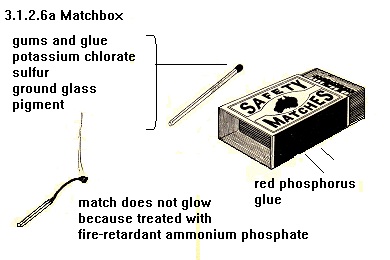
Matches, Safety matches
Potassium chlorate, KClO3, potassium chlorate (V), potassium perchlorate, chlorate of potash, spontaneous combustion, oxidizing, storage safety problem. source
Potassium chlorate and potassium persulfate as oxidizing agents: 15.4.13
Potassium chlorate in pyrotechnic flash powders: 15.4.14
Sparklers: 15.4.15
Storing sodium chlorate and potassium chlorate: 3.4.13.10
Sugar with potassium chlorate, spontaneous combustion: 8.2.1
Matches. Safety matches
Matches. Safety matches
Matches, safety matches: Matches, potassium chlorate
Potassium chloride
Potassium chloride, KCl, Sylvite, mineral, muriate of potash fertilizer, white, odourless, bitter taste, cubic crystals or powder,
slightly hygroscopic, diet salt substitute, toxic if ingested, extracted from waters of Dead Sea, sold as "lite salt"
Low cost: from supermarkets as "sodium free salt", from garden supply stores as potassium fertilizer
E508 Potassium chloride, KCl
Muriate of potash, KCl: 9.2.9
Potassium chromate
Potassium chromate, K2CrO4 source
Coloured precipitates, double decomposition reactions: 12.2.4.02
Potassium chromate, Highly toxic if ingested, carcinogenic, sensitizes skin
Potassium chromate, Solution < 0.5% Not hazardous
Potassium chromate, (K2CrO4, lemon yellow crystals, MP 975 oC, alkaline aqueous solution source
Potassium chromate, as with other chromium (VI) salts, may be carcinogenic, so handle it with care.
However, when used in dilute solution, near neutral pH, it is relatively safe.
When mixed with acid, chromate ions, CrO42-, first form dichromate ions, Cr2O72-, then chromic acid, H2CrO4. source
Solutions containing chromic acid are powerfully oxidizing and highly corrosive.
Do NOT use the cleaning mixture called "chromic acid", prepared by dissolving a metal chromate or dichromate in concentrated sulfuric acid.
This cleaning mixture is NOT permitted in schools, because it is dangerously corrosive to skin and eyes.
It is probably no more effective as a cleaning agent than strong detergent solutions or a suitable solvent.
The reactions of potassium chromate and dichromate with S, C, Mg, Al and P are dangerous. and are NOT permitted in schools!.
Potassium chromium sulfate
Potassium chromium sulfate, KCr(SO4)2.12H2O, K2SO4.Cr2(SO4)3.24H2O, chrome alum, chromium alum, alum and mordant, toxic if ingested source
Properties of chrome alum: 12.14.5
Potassium dichromate
Potassium dichromate, (K2Cr2O7), potassium bichromate (VI), toxic, Corrosive, Oxidizing, Not permitted in schools source
Potassium dichromate ACS reagent (Poison, OXD 1479), potassium dichromate (VI)
Potassium dichromate, orange-red crystals, toxic, Corrosive, Oxidizing
Potassium dichromate, For 0.1 M solution, 29.4 g in 1 L water
Low cost: from pottery supply stores, may be called "potassium bichromate"
Potassium dichromate, (K2Cr2O7, potassium bichromate, red prussiate of potash, ferro prussiate, bichrome, orange to red, odourless, source
monoclinic crystals or granules, RD 2.69, MP 398 oC, strong oxidizing agent, toxic and fire risk from oxidation
It was formerly used mixed with sulfuric acid to clean laboratory glassware, but nowadays this procedure NOT permitted in schools.
Oxidation reactions involve the reduction of solutions of chromate or dichromate ions that cause colour changes from yellow or orange to pale green or colourless.
The reactions with the formation of an insoluble metal chromate give brightly coloured precipitates.
Do NOT attempt to isolate these precipitates, because they are carcinogenic.
It is best to prepare these precipitates in the smallest quantities that allow them to be seen.
Do NOT use potassium dichromate solution to colour water for demonstrations.
It is used in machines to breath test for alcohol.
Experiments
Coloured precipitates, double decomposition reactions: 12.2.4.02
Diffusion in liquids: 10.1.2
Separate iodine from kelp: 10.13.2
Tests for alcohol, breath tests using potassium dichromate: 15.2.11
Glass cleaning with potassium dichromate solution
Potassium dichromate as an oxidizing agent: 15.4.16
Potassium dichromate solution: 2.3.9
Prepare potassium dichromate: 12.8.6
Prepare ethanal with potassium dichromate: 16.3.2.7
Reactions of dichromates, potassium dichromate: 12.5.3
Solubility and temperature, solubility of salts in water: 3.6.7
Solubility of potassium dichromate and temperature: 7.7.8
Glass cleaning
Glass cleaning with potassium dichromate solution
Glassware should be clean and dry before use.
When an experiment is completed, the students should discard leftover materials, and rinse all glassware in water.
Cleaning is best done immediately after use to prevent the staining of work surfaces and the hardening of materials on the glass.
Be Careful! Strong cleaning solvents should be used by the teacher, NOT by students!
Potassium hydrogen sulfate
Potassium hydrogen sulfate, KHSO4, potassium bisulfate, Toxic if ingested, corrosive to skin and eyes, SO2 formed when heated source
Potassium ferricyanide
Potassium ferricyanide, potassium hexacyanoferrate (III), toxic if ingested
Decomposition of ferricyanides, potassium ferricyanide: 3.7.7
Potassium ferricyanide (III), (K3Fe(CN)6.3H2O, (powder (K3Fe(CN)6), red prussiate, potassium hexacyanoferrate (III), potassium, ferric cyanide, RD 1.89. source
It forms attractive ruby red monoclinic crystals, which heat decomposes then melts.
It is used in redox experiments, chemical analysis uses characteristic colour reactions, heating with concentrated sulfuric acid forms carbon monoxide gas It is used in dyeing, etching blueprint paper, case-hardening, fertilizer.
Potassium ferricyanide is Highly toxic, boiling with dilute acids forms cyanide gas.
Potassium ferricyanide with concentrated ammonia solution may explode!
Potassium ferrocyanide
Potassium ferrocyanide, (K4Fe(CN)6.3H2O, potassium ferrous cyanide, potassium hexacyanoferrate (II), potassium hexacyanoferrate (II)-3-water, yellow prussiate of potash, prussiate of potassium source
Environment danger, toxic if ingested, yellow monoclinic crystals or powder, RD 1.85, efflorescent, anhydrous at 100 oC.
Direct heating of the solid forms cyanogen gas
It is used to detect Fe3+ ions and as a case hardening agent.
Highly toxic, heating with concentrated sulfuric acid forms carbon monoxide gas.
Highly toxic, boiling with dilute acids forms cyanide gas, (CN)2.
Be Careful!, Highly toxic, mixtures with nitrite salts are explosive.
Potassium hydrogen carbonate
Potassium hydrogen carbonate, KHCO3), potassium bicarbonate (impure potassium bicarbonate "American saleratus"), colourless, odourless, white granules source
It is used in buffers, baking powder, aerated waters, antacid medicines, carbon dioxide fire extinguishers, some detergents, laboratory reagent.
Potassium hydrogen carbonate occurs as calcinite mineral.
Potassium hydrogen tartrate
Potassium hydrogen tartrate, (KHC4H4O7), cream of tartar, potassium bitartrate, HOOC(CHOH)2COOK, KO2CCH(OH)CH(OH)CO2H source
potassium L-tartrate monobasic, potassium hydrogen L-tartrate, tartaric acid monopotassium salt, potassium hydrogen L-tartrate, tartaric acid monopotassium salt,
potassium bitartrate, potassium hydrogen tartrate, tartar, acid potassium tartrate
Argol, tartar
Argol, tartar
Potassium hydrogen tartrate is a white crystalline acid salt, purified form of brown crystals argol from deposits in wine vats, used in baking powder.
Potassium hydrogen tartrate, acid potassium tartrate, white crystalline acid salt, purified form of brown crystals argol,
It is used in baking powder, and is obtained from deposits in wine vats, also the "crust" in "crusted port", which has finally fermented in the bottle).
Common names: Cream of tartar, Potassium hydrogen tartrate (KHC4H4O7), potassium bitartrate. source
Beeswing
Beeswing is the filmy, veined "crust" in old port, which has finally fermented in the bottle.
Common names: Cream of tartar, Potassium hydrogen tartrate (KHC4H4O7), potassium bitartrate. source
Potassium hydroxide
Potassium hydroxide, KOH, caustic potash, lye, potash, white pellets, KOH "sticks" or rods in water, lumps, flakes, sticks.
It is very deliquescent and absorbs CO2and SO2 from air better than sodium hydroxide, because more soluble. source
It is used to prepare soft soap and alkaline storage cells.
Heat from dissolving in water, potassium lye, damages eyes and body tissues, RD 2.044, MP 380 oC: E525.
Potassium hydroxide, KOH, solid, flake, pellets, 1 M analytical reagent, caustic potash
Potassium hydroxide, as a solid or concentrated solution is extremely corrosive to the skin and eyes.
Always wear safety glasses when handling potassium hydroxide, even with dilute concentrations.
If potassium hydroxide enters the eye, rinse the eye instantly with water.
Solutions of potassium hydroxide on the skin feel soapy, because fats in the skin are broken down to form anions of fatty acids, e.g. stearate, palmitate and oleate.
which give the solution a slippery feel.
When potassium hydroxide dissolves in water, a large amount of heat is released.
It sometimes causes the solution to boil violently if it has NOT been stirred!
So always stir solutions in that potassium hydroxide is dissolving to dissipate heat and to provide a uniform concentration throughout the solution.
Potassium hydroxide solutions boil at a higher temperature than pure water.
It is hygroscopic, so keep it in a sealed plastic container.
It is more corrosive to eyes than acids.
Potassium hydroxide, KOH, caustic potash, potash lye, Extremely corrosive to skin, eyes
Potassium hydroxide, Solution > 4M (24%), Extremely corrosive to skin, eyes
Potassium hydroxide, Solution < 4M (24%), Extremely corrosive to skin, eyes
Potassium hydroxide, Solution > 1M (6%), Extremely corrosive to skin, eyes
Potassium hydroxide, Solution < 1M (6%), Corrosive to skin, eyes
Potassium hydroxide, Solution > 0.1M (0.5%), Corrosive to skin, eyes
Potassium hydroxide, Solution < 0.1M (0.5%), Not hazardous
Potassium hydroxide 2 M solution, dissolve 110 g of KOH sticks in 1 L water
Prepare alkalis: 5.4.3
Prepare potassium hydroxide with chlorazol black solution: 4.12
Prepare iodic acid, and potassium iodate: 12.19.6.3.
Prepare potash alum: 12.14.1.
Prepare soap: 12.4.0.
Reactions of chlorine with alkalis, bleaching powder: 12.4.15
Respiration is a form of combustion: 8.2.4.
Potassium hydrogen phosphate
Potassium hydrogen phosphate, (K2HPO4), dipotassium hydrogen phosphate (V), microbiology chemical, food additive, culture nutrient source
Micro-organisms and water pollution: 4.3.13
Prepare solutions of known concentration: 5.4.0, (See Dipotassium hydrogen orthophosphate in table).
Buffer reagent, phosphate buffer reagent (potassium hydrogen phosphate): 3.6
Potassium iodide
Potassium iodide, KI, colourless solution, white crystals or granules, RD 3.12, MP 698 oC, slightly deliquescent
in moist air, bitter taste, separated from potassium iodate by fractional crystallization, becomes yellow when iodine lost to air
It is used in chemical analysis, photography, additive to prepare iodized "table salt" to treat iodine deficiency, e.g. goitre.
It is used in tincture of iodine medicine, solvent for iodine to form the brown triiodide ion I3-, KI3 (aq). source
It is used as a test for starch.
It is used to detect presence of Pb2+ ions, when yellow precipitate of lead iodide forms.
If KI solutions become yellow from iodine formation, add sodium hydrogen sulfite solution to make solution colourless again.
Potassium iodide, KI, Potassium iodide paper, Potassium iodide powder pillows
Potassium iodide, For 0.1 M solution, 16.6 g in 1 L water
Potassium iodide crystals, KI, photography, ingredient of iodized "table salt"
Iodine clock reaction, hydrogen peroxide, potassium iodide: 17.2.3
Potassium iodide with hydrogen peroxide, reverse colour change: 17.3.10
Coloured precipitates, double decomposition reactions: 12.2.4.02
Electrolysis of potassium iodide solution, electrolytic writing: 15.5.23
Potassium iodide with potassium iodate: 17.1.10
Prepare iodine solution: 3.12
Tincture of iodine, I2 source
Potassium iodate
Potassium iodate, white, monoclinic crystals or granules, slightly deliquescent, RD 3.89, MP 560 oC, oxidizing agent (ingredient of iodized "table salt", analytical reagent), store out of light.
Potassium iodate is the potassium salt of iodic acid.
It may ignite combustibles or organic compounds and produce toxic fumes.
It has a violent reaction with aluminium, magnesium, carbon, sulfur, phosphorus.
A violent reaction occurs with sodium bisulfite if water added.
Potassium iodate forms toxic fumes with concentrated sulfuric acid.
Potassium iodate, KIO3. potassium iodate (V) powder, potassium iodate (VII), potassium periodate, toxic, may ignite with combustibles or organic compounds. source
Prepare iodic acid, and potassium iodate: 12.19.6.3
Table salt and rock salt: 19.1.22
Potassium nitrate
Potassium nitrate, KNO3, "saltpetre", (US saltpeter) (occurs as nitre, niter, Bengali saltpetre), colourless, odourless, trigonal or rhombic crystals or white granules, source
RD 2.11, MP 333 oC, strong oxidizing agent that decomposes at 400 oC to lose O2 source
It is used as nitrate of potash fertilizer, fireworks, food preservative, explosives, e.g. gunpowder), food preservative E252.
Potassium nitrate is a powerful oxidizing agent and forms explosive mixtures with most combustible materials.
Potassium nitrate has relatively low toxicity, and can be safely used in aqueous solution.
Do NOT mix potassium nitrate with charcoal, sulfur, red phosphorus or active metals, e.g. Na, powdered Al, Mg, cyanides, sulfides, thiosulfates, ammonium salts, acetates, household sugar or combustible material,, because these mixtures may be explosive.
The demonstration of explosives is NOT permitted in schools.
If testing production of oxygen from heated solid and lighted splint is accidentally dropped into molten salt, an explosion may occur.
Gunpowder (black powder, black gunpowder), is a mixture of potassium nitrate, charcoal and sulfur, the explosive propellant formerly used in firearms.
It is now superseded for firearms by "smokeless powder", a mixture of potassium salts.
Saltpetre, saltpeter, is used as a stump remover, agricultural fertilizer, and meat preserver.
Potassium nitrate, KNO3, nitre (US niter), saltpetre (US saltpeter), formerly sodium carbonate, potassium nitrate (V), nitrate of potash source
Potassium nitrate, colourless crystals or white powder, Preservative E249
For 0.1 M solution, 10.l g in 1 L water, Oxidizing
Ammonium nitrate cold pack: 14.2.4
Black powder, gunpowder, potassium nitrate + sulfur + charcoal
Reactions of ammonium salts and potassium salts with water: 14.2.1
Combustible solids: 3.5.10
Combustion of potassium nitrate: 14.23
Decomposition of nitrates: 3.30.4
Low cost: from garden stores as potassium nitrate or "saltpeter" fertilizer, from pottery stores, test reagents
Micro-organisms and water pollution:
Prepare potassium nitrate from manure: 3.9.1
Potassium nitrate with water: 14.2.5
Prince Rupert's Drops, tempered glass, toughened glass: 34.5.2.9
Refrigerants: 14.2.7
Solubility and temperature, solubility of salts in water: 3.10
Solubility of different salts and temperature: 7.7.5
Potassium nitrite
Potassium nitrite, potassium nitrite (III), toxic if ingested
Potassium nitrite, Solution < 1%, Not hazardous
Potassium nitrite, KNO2, white to yellow deliquescent solid, MP 440 oC, explodes above 600 oC source
It is used to detect presence of amino groups inorganic compounds.
It reacts with acids to form toxic nitrogen dioxide gas, that reacts with oxygen in the air to form highly toxic nitrogen dioxide gas.
Potassium perchlorate
Potassium perchlorate, KClO4, toxic, skin irritant, violent explosive mixture with combustible, Not permitted in schools source
"Blaster Balls", potassium perchlorate + sulfur, exothermic reaction, (toy product)
Potassium perchlorate should not be used or stored in a school science laboratory.
Prepare potassium perchlorate: 12.19.8.5
Potassium permanganate
Potassium permanganate, KMnO4, potassium manganate (VII), Condy's crystals (OXD 1490), Condy's crystals, toxic if ingested source
Purple-black rhombic crystals with metallic sheen, RD 2.7, pink-purple solution when dissolved in water.
Heat decomposes crystals with a distinct sweet bitter taste.
Used as a common strong oxidizing agent and disinfectant, also as a chemistry analytical reagent, MnO4- ion. source
Potassium permanganate is a powerful oxidizing agent that forms dangerously combustible or even explosive mixtures with oxidizable or combustible materials.
For example: red phosphorus, cyanides thiosulfates acetates, sugar, charcoal, sulfur, phosphorus, ammonium salts, active metal powders, organic compounds.
The solid is also spontaneously flammable on contact with glycerine, ethylene glycol and other organic compounds.
It forms violently explosive manganese heptoxide on mixing with concentrated sulfuric acid.
Oxygen gas is formed on heating the solid, but toxic fine particles of manganese oxides are produced simultaneously.
So if the reaction occurs in a test-tube, place a plug of glass wool in the end of the tube to trap these toxic fine particles.
Do NOT use sulfuric acid for drying oxygen gas from decomposition of potassium permanganate, because the acid could mix with the salt and react explosively.
For preparing oxygen gas, it is safer to use hydrogen peroxide and potassium permanganate, or hydrogen peroxide with manganese dioxide catalyst.
If using potassium permanganate to prepare chlorine gas by reaction with hydrochloric acid, the solid must be is covered with a layer of water.
Do NOT prepare chlorine gas by reaction of potassium permanganate with sulfuric acid!
Acidified solutions are used as an oxidant in organic chemistry for the oxidation of aldehydes or alcohols.
Neutral solutions are used to distinguish between alkanes and alkenes.
Dilute aqueous solutions of potassium permanganate are relatively harmless and have been used medicinally for mouthwashes and bactericides.
Potassium manganate (VII) is NOT a primary standard, so make up an approximate concentration and titrate it against a known concentration of ethanoic acid.
Potassium manganate (VII) crystals are so dark, it is difficult to see if all have dissolved when making up a solution.
Bottles of potassium manganate (VII) solution may have a brown precipitate around the top of manganese (IV) oxide.
It is formed when manganate (VII) ions react with water in the air.
It is used to stain wood and furniture.
For water treatment, used for oxidation of Fe2+ → Fe3+, and Mn2+ → Mn4+, remove tastes and odours, source
disinfectant control nuisance organisms, control DBD (dielectric barrier discharge), of ozone.
Used as topical fungicide and antiseptic.
Solution of 1 g per litre controls powdery mildew and black spot plant diseases.
However, pink staining causes problems.
Potassium permanganate, Solution < 25%, Not hazardous.
Low cost: from aquarium suppliers as crystals or aqueous solution, in test reagents, water purification suppliers.
Acidified potassium permanganate (VII) reactions, oxidizing agent in titrations: 15.2.4.4
Colour change of diluted potassium permanganate: 11.3.1
Ethanedioic acid-2-water (oxalic acid) with potassium manganate (VII), autocatalysis: 17.3.3
Potassium manganate (VII) oxidizes iron (II) to iron (III): 15.2.4.1
Potassium manganate (VII) oxidizes glycerol to carbon dioxide and water: 15.2.4.2
Potassium manganate (VII) solution liberates chlorine from hydrochloric acid: 15.2.4.3
Potassium permanganate, Condy's crystals (Agriculture): 4.3.6
Movement of ions, potassium permanganate solution: 11.2.1
Oxidation of glycerol by potassium permanganate: 12.5.9
Permanganates, hazards: 3.7.12
Prepare chlorine with hydrochloric acid / potassium manganate (VII): 12.4.1.2
Prepare ethanal with potassium manganate (VII): 16.3.2.2
Prepare oxygen gas with potassium manganate (VII): 3.49.2
Prepare potassium permanganate: 12.8.3
Reduce potassium manganate (VII) with hydrogen sulfide: 13.3.5
Reduce potassium manganate (VII) with sulfur dioxide: 3.51.4
Tests for alcohols, potassium manganate (VII): 16.1.3.1.1a
Tests for saturated hydrocarbons, acidified potassium manganate (VII) solution: 9.4.9.0
Movement of ions: 11.5.4, potassium permanganate solution
Colour change of diluted potassium permanganate: 11.3.3
Potassium persulfate
Potassium persulfate, (K2S2O8), potassium peroxydisulfate, toxic, skin irritant, white crystalline solid, mixture with combustibles burns fiercely. source
The, solid decomposes on standing below 100 oC
Potassium sodium tartrate
Potassium sodium tartrate, C4H4KNaO6), potassium sodium tartrate-4-water, sodium potasium L-tartrate source
Piezoelectricity (voltage produced by mechanical stress to crystals): 32.1.2.1
Hydrogen peroxide with potassium sodium tartrate, cobalt (II) chloride catalyst, visible activated complex: 17.3.1.4
Rochelle salt
Rochelle salt, KNaC4H4O6.4H2O, potassium sodium tartrate tetrahydrate, Seignette salt, source
Seidlitz powder is a double salt of tartaric acid
It has a saline cooling taste as a laxative, and the large deliquescent monoclinic crystals are piezoelectric and used in "crystal" phonograph pickups.
Rochelle salt: E337
Prepare Fehling's solution: 9.5.1
Tests for proteins, biuret test: 9.4.2
Potassium sulfate
Potassium sulfate, K2SO4, sulfate of potash fertilizer, .white crystalline powder, prepared with potassium carbonate or potassium hydroxide with sulfuric acid. source
Potassium sulfate, For 0.1 M solution, 17.4 g in 1 L water: E515
For chlorine-sensitive plants. use sulfate of potash as source of potassium iron fertilized instead of potassium chloride
Prepare artificial gemstones, (potassium sulfate, aluminium sulfates): 12.10.1
Potassium sulfide
Potassium sulfide, K2S, highly toxic if ingested, releases hydrogen sulfide gas, preservative, antioxidant. source
Potassium sulfide, liver of sulfur, sulfurated potash, red-yellow to brown-red, deliquescent, analytical reagent and epilatory, dusts may explode
It is used as a depilatory, for hair removing.
An alkaline mixture of mainly potassium polysulfides turns silver black.
Potassium thiocyanate
Potassium thiocyanate, KSCN, potassium isothiocyanate, potassium sulfocyanate, toxic if ingested
Potassium thiocyanate, colourless prisms, RD 1.89, MP about 173 oC, deliquescent
Potassium thiocyanate, dilute solutions, Not hazardous
Thiocyanate (thiocyanato), S-CN-, monodentate ligand
This page was generated automatically from the original page on John Elfick's School Science Lessons website. If something looks wrong, please check the original.