Chemistry Experiments, N
Last updated 2026-07-14 by Dr John Elfick
Chemistry, N
Nitrite ion: NO2- source
Nitro, ( -NO2) source
12.8.1 Naphthalene evaporation
It is most unusual for a solid substance to evaporate away when left out in the air, but it happens with naphthalene.
Leave one or two naphthalene mothballs on a watch glass or saucer outside in the open air.
Examine the mothballs some days later and note that they are smaller, because of evaporation.
In a week they may disappear completely.
Naphthalene sublimes near 70 oC, below its melting point 80.26 oC.
12.8.2 Burn naphthalene crystals
Like all hydrocarbons, naphthalene burns readily.
Crush a naphthalene mothball and put of the powder into a metal screw cap.
Hold the latter in a pair of pliers or pincers and heat it over a flame.
The white powder melts then ignites.
It burns with a very smoky flame, because of the high percentage of carbon in naphthalene (94%).
12.8.3 Prepare naphthalene crystals from mothballs.
1. Put four or five mothballs into a beaker and place a funnel in the top of the jar.
Stand the beaker in a saucepan containing water (2 cm deep).
Heat the water until it begins to boil and then remove the saucepan from the flame.
In minutes, beautiful starry crystals are deposited on the sides of the beaker and funnel.
If you remove the funnel and blow it gently, the crystals float off into the air and glisten brightly as they slowly fall.
Instead of a funnel, use a glass plate over the jar.
In this experiment, the mothballs do not melt, but change straight into vapour that condenses again on the cooler part of the beaker and funnel.
This change is called sublimation.
It is similar to the sublimation of ammonium chloride.
On a hot summer day, mothballs can be made to sublime merely by leaving them in a beaker on a window sill where sunlight falls on the jar.
Starry crystals again form.
2. Grow naphthalene crystals of a different shape.
Dissolve two salt spoonfuls of the powdered substance in half a test-tube of methylated spirit by shaking (do not heat methylated spirits).
Leave the solution in an evaporating basin on a shelf to evaporate.
Naphthalene crystals form as pearly plates.
12.8.4 Naphthol
Naphthol, C10H8O, 1-naphthol, C10H7OH, α-naphthol, 1-hydroxynaphthalene, naphthalene-1-ol source
Naphthol, C10H7OH, 2-naphthol, b-naphthol, β-naphthol, naphthalen-2-ol, white solid, antioxidant in rubber products, antiseptic, tests for primary amines, toxic if ingested, may be carcinogenic source
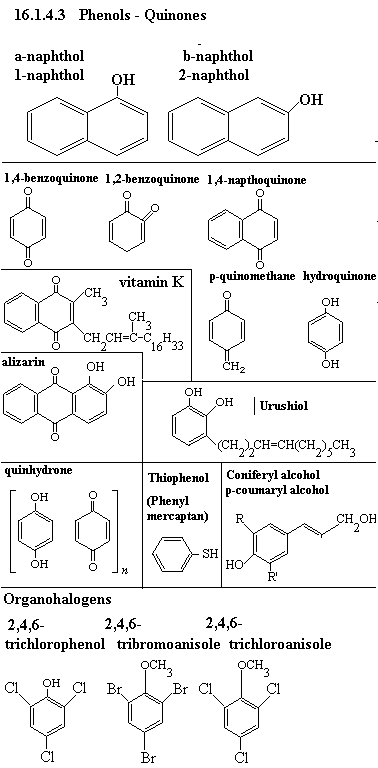
9.3.7: Tests for carbonates, Molisch's test (α-naphthol test).
Napthols
1-naphthol C10H7OH, a-naphthol, alpha-naphthol, naphthalen-1-ol, tests for carbonates. source
2-naphthol C10H7OH, b-naphthol, beta-naphthol, naphthalen-2-ol, white solid, antioxidant in rubber products, antiseptic, tests for primary amines. source
12.8.4 Reactions of nickel compounds
1. Heat some nickel carbonate in a hard glass test-tube and note the green brown residue of nickel (II) oxide
Heat the nickel (II) oxide in a crucible and black nickel (III) oxide, Ni2O3, forms source
Dissolve nickel (III) oxide in dilute sulfuric acid to give green nickel (II) sulfate
2Ni2O3 + 4H2SO4 → 4NiSO4 + 4H2O + O2 source
2. Add sodium hydroxide solution to nickel sulfate solution
Note the light green precipitate of nickel (II) hydroxide, that is stable in air and is soluble in ammonium hydroxide to give a blue solution of a complex ion
Ni2+ + 2OH- → Ni(OH)2 (s) source
3. Heat a solution of nickel chloride made by dissolving nickel carbonate in hydrochloric acid
Nickel chloride crystals are stable when heated
12.8.20 Nickel
Nickel, Table of the Elements
Nickel, RSC
Nickel, Ni, as foil, powder, is a transition metal that resists corrosion.
"Nickel", (German Kupfernickel, kupfer 'copper', nickel 'naughty goblin'. who causes no copper in mineral).
Nickel powder is toxic by inhalation, especially for pregnant women, keep wet to avoid ignition, Ni-Al alloy, Nickel-iron cell, Edison cell, NIFE cell, secondary cell.
It is obtained from ores containing NiS and is available as sheet.
It is used in shiny coin alloys, nickel plating, and in "silver" cutlery stamped "EPNS" (electroplated nickel silver), that has a shiny metal protective coating.
It reacts with dilute HCl or H2SO4 to form H2 and metal ion and reacts with concentrated oxidizing acids, HNO3 or H2SO4 to produce high oxidation number ions, and sulfur dioxide SO2 or nitrogen dioxide, NO2. source
It reacts with steam to give the oxide and hydrogen gas.
Heated powder forms oxide.
The "nickel" coin in the U.S. is made of a nickel-copper alloy.
Atomic number: 28, Relative atomic mass: 58.69, RD 8.90 g cm-3| MP = 1453 oC, BP = 2730 oC
Specific heat capacity: 439 J kg-1 K-1
Nickel compounds:
Ni-Al alloy,
Nickel-iron cell, Edison cell, NIFE cell, secondary cell.
Nickel compounds, most nickel salts are sensitizers
Nickel (II) carbonate, basic hydrate, nickel carbonate pigment, Toxic if ingested, allergic reaction, use only < 2g of wet solid
Nickel (II) carbonate, Low cost: from pottery supplies stores
35.2.50 Nickel
35.2.51 Nickeline, niccolite
Millerite, NiS: 35.2.77
Nickel-cadmium battery, NiCad battery: 33.1.8.5
Nickel-metal hydride battery. (NiMH): 33.1.8.6
15.1.4 Nickel plating
Nickel deficiency in soils: 6.13.8
Nickel toxicity: 4.11
Copper-nickel alloys: 5.1.8
Experiments
Tests for nickel, dimethylglyoxime: 12.11.3.24
12.8.22 Nickel (II) chloride
Nickel (II) chloride, NiCl2 source
Nickel (II) chloride, nickel chloride pigment, Toxic if ingested, carcinogenic, allergic reaction, use only < 2 mL of 0.1 M solution
Nickel (II) chloride-6-water, NiCl2.6H2O, nickel (II) chloride hydrated, green crystals, nickel chloride, nickel chloride AAS Solution source
Nickel (II) chloride, nickel chloride, For 0.1 M solution, 24 g in 1 L water
12.8.23 Nickel (II) nitrate
Nickel (II) nitrate, Ni(NO3)2 source
Nickel (II) nitrate, nickel (II) nitrate hexahydrate, nickel nitrate, Toxic if ingested, allergic reaction, use < 2 mL of 0.1M per activity, explosive with organics
Nickel (II) oxide, nickel oxide pigment, green glaze for craft, Highly toxic if ingested, carcinogenic to lungs
12.8.24 Nickel (II) sulfate
Nickel (II) sulfate, NiSO4 source
Nickel (II) sulfate, NiSO4.6H2O, nickel (II) sulfate heptahydrate, Toxic if ingested, allergic source
Nickel (II) sulfate, nickel sulfate, green crystals, blue salts
Nickel (III) oxide, black glaze, for craft
Nickel-cadmium battery, NiCad battery: 33.1.8.5
Nickel-metal hydride battery. (NiMH): 33.1.8.6
12.8.25 Nicotine
Nicotine, C10H14N2, an isoquinoline alkaloid, is a arasympathomimetic drug that stimulates the parasympathetic nervous system. source
It is colourless, poisonous and addictive, stimulant, nicotinic agonist.
It is addictive, because increases flow of neurotransmitter dopamine in the brain, mimics the affects of acetylcholine.
Electronic cigarettes may cause nicotine overdoses.
Smoking tobacco is associated with lung cancer and heart disease.
Neonicotinoid insecticides are related to nicotine.
Recent bans on neonicotinoid pesticides in Europe attest to the growing concerns surrounding pesticide use and honeybee decline.
Nicotine hydrogen tartrate salt dihydrate, C10H14N2.2C4H6O6.2H2O source
Nicotine occurs in Nicotiana tabacum, Asclepias syriaca, Lycopodium species, Sedum acre
The cheap insecticide of cigarette butts in water is NOT allowed in school gardens!
alpha-nicotine. Pyridine derivative, Nicotinic acid → nicotine) source
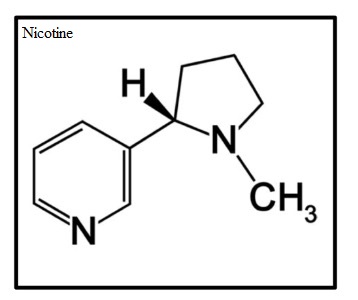
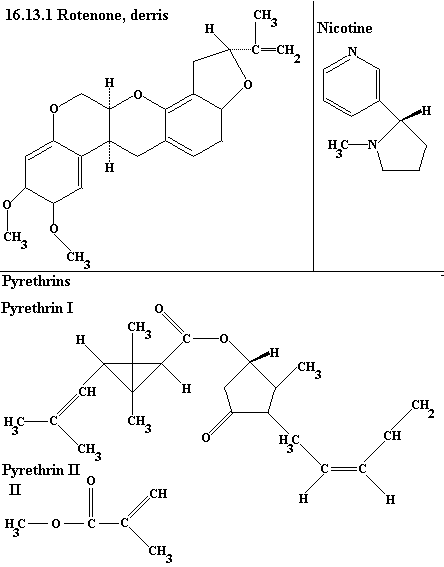
Neonicotinoid insecticides: 16.1.0
Nicotine spray: 4.7.3, (Agriculture)
Nicotine, tobacco smoking & chewing: 5.5.21
Tests for cigarette smoke: 16.5.6
Tobacco plant, (Nicotiana tabacum), Solanaceae
Smoking, Anatomy of a cigarette, by Lexi Krock, NOVA Online, USA (Flash)
12.8.26 Ninhydrin
Ninhydrin, C9H6O4, C6H4(CO)2C(OH)2, white-yellow crystals or powder, an aromatic ketone, toxic to skin and mucus membranes. source
It is used to identify peptide bonds in protein determinations, ammonia and amines, by reactions to form deep blue or purple derivatives.
9.3.7 Fingerprints
10.2.9 Tests for ammonia or amino acids or proteins with ninhydrin
12.8.28 Nitrates, Nitrites
Nitrate ion: NO3- source
Nitrate (nitroso), O-NO2-, monodentate ligand source
Nitrite (nitrito), O-N-O-, monodentate ligand
Nitrite (nitro), N-O2-, monodentate ligand source
Nitrate nitrogen soil test: 6.10.5
Nitrites (NO2-): 16.7.7 source
Decomposition of nitrates: 3.7.13
Nitrates, hazards: 3.7.10
List of nitrates: 1.19
Tests for nitrates: 12.11.13, the brown ring test
Tests for nitrates / nitrites with dipsticks: 19.5.2
12.8.29 Reactions of nitrates
The oxide N2O5 is unstable above 0oC and forms nitrogen dioxide. source
1. Add concentrated sulfuric acid to sodium nitrate and heat gently.
Be careful! Nitric acid vapours form with some decomposition causing brown fumes of nitrogen dioxide.
The nitric acid condenses as oily drops on the cooler parts of the test-tube.
NaNO3 + H2SO4 → NaHSO4 + HNO3 source
4HNO3 → 2H2O + 4NO2 + O2. source
2. Add three small pieces of copper to sodium nitrate solution and just cover with concentrated sulfuric acid.
(Be careful!) Heat gently the mixture slowly until brown fumes of nitrogen dioxide form.
Cu + 2NaNO3 + 3H2SO4 → 2NaHSO4 + CuSO4 + 2H2O + 2NO2 (g). source
3. Brown ring test for nitrates
Shake crystals of iron (II) sulfate with 2 cm of water.
Add sodium nitrate and shake the mixture again until all dissolves.
Pour concentrated sulfuric acid carefully down the side of the test-tube to form a 1 cm deep layer under colloidal iron (II) sulfate solution.
Note the brown ring at the junction of the two liquids.
4. Reduce nitrate to ammonia
Add 3 small crystals of sodium nitrate to 3 cm of dilute sodium hydroxide solution.
After the sodium nitrate dissolves add aluminium or zinc powder.
Heat the solution and test for ammonia.
Repeat the experiment with Devarda's alloy replacing the aluminium or zinc powder.
(Devarda's alloy = 45% Al, 50% Cu, 5% Fe).
12.8.31 Nitrile
Nitrile, organic functional group, -C=N
Nitrile rubber, copolymer of acrylonitrile and butadiene
Nitriles: 16.7.6
Nitrile chemical-resistant gloves
Protective clothing and equipment: 3.2.2
12.8.32 Nitrobenzene
Nitrobenzene, C6H5NO2, oil of mirhan source
Aromatic Nitro compounds: 16.2.10H
Nitrobenzene, C6H5NO2, mononitrobenzene, pale yellow, oily liquid, unpleasant almond odour, poisonous, RD 1.2, BP. 211 oC source
Highly toxic by all routes of exposure, possibly carcinogenic
Avoid inhaling vapour and skin contact, so use small quantities < 25 mL or g in a well-ventilated area.
Nitrobenzene may be explosive when heated.
A solution / mixture < 0.1% is NOT hazardous.
12.8.33 Nitrogen
Nitrogen, Table of the Elements
Nitrogen, RSC
Atomic number: 7, Relative atomic mass: 14.0067, RD 0.808 (77 K), MP = -210 oC, BP = -196 oC.
Specific heat capacity: 1.04 × 10³ J kg-1 K-1.
See: 12.4.0 Gas, Molecular weight, Density, (Table 1)
Nitrogen, N, (Greek nitron nitre, KNO3 | genos kind of) source
Nitrogen, Liquid nitrogen (LN2, LIN, LN), UN number 1977, diatomic liquid so N2 as in gas. source
Nitrogen gas, N2, is colourless, odourless, tasteless, neutral and an unreactive gas. source
Nitrogen does not support combustion, but magnesium and calcium will continue to burn in nitrogen to form nitrides
Nitrogen is manufactured by fractional distillation of air
Air contains about 78.8% of nitrogen.
Use eye and face protection when using compressed nitrogen gas.
Do not use nitrogen in small enclosed spaces with limited ventilation.
Liquid nitrogen is used to freeze tissues for microscopic examination, it can cause frostbite or cold "burns", so wear gloves and eye / face protection.
Nitrogen, is a non-metal gas at room temperature and pressure, and forms oxides
E931 Nitrogen, (used in freezing, packaging, freeze drying)
Atmospheric nitrogen cannot be used directly by the body
Ammonium nitrite is unstable so the reaction of saturated solutions of sodium nitrite with ammonium chloride can be used to prepare nitrogen
Be careful! This reaction can explode without warning
Experiments
Specific heat capacity: 1.04 × 10³ J kg-1 K-1.
Acid rain and nitrogen oxides, NOx: 12.8.11
Carbon / nitrogen ratio, C/N ratio: 9.14.3 (Agriculture)
Prepare nitrogen gas: 13.3.20
Denitrifying bacteria, denitrifiers, denitrification: 8.5.7
Dinitrogen monoxide, Nitrous oxide
Dinitrogen tetroxide, Nitrogen dioxide
Tests for dinitrogen oxide, nitrous oxide, N2O: 13.3.23 source
Decomposition of manganates: 3.7.11
Nitrogen cycle: 6.9.17, (Agriculture)
Nitrogen deficiency in soils: 6.12.3, (Agriculture)
Nitrogen, (E931), used for freezing, packaging, freeze drying): 13.3.20 .
Nitrogen-fixing bacteria: 8.5.17, (Agriculture)
Nitrogen compounds, two or more nitrogen atoms: 16.2.5.0
Nitrogen gas generated in a motor car air bag: 12.8.35
Nitrogen pollution: 18.4.14
Nitrogen reacts with metals: 12.8.36
Reactions of nitrates, NO3-: 12.11.2.0 source
Reactions of nitrites, NO2-: 12.11.1 source
Tests for nitrogen content in food, Kjeldahl method: 16.5.7
Tests for nitrogen content in food, soda lime test: 9.3.15
12.8.35 Nitrogen gas generated in a motor car air bag
A gas generator containing a mixture of sodium azide, NaN3, potassium nitrate, KNO3 and silica, SiO2 is ignited electrically. source
This ignition allows a slow detonation so that nitrogen fills the air bag.
2NaN3 → 2Na + 3N2 (300 oC) source
10Na + 2KNO3 → K2O + 5Na2O + N2 source
12.8.36 Nitrogen reacts with metals
Lithium is the only element that reacts with nitrogen at room temperature.
6Li (s) + N2 (g) → 2Li3N (s) source
Magnesium and other alkali metals react with nitrogen at high temperature to form nitrides.
3Mg (s) + N2 (g) → Mg3N2 (s) source
12.8.39 Nitrous acid with amines
nitrous acid + amines → ionic salt in aqueous solution source
nitrous acid + amines → diazonium ion + chloride ion source
HNO2 + R-NH2 → R-N+N + Cl- source
nitrous acid + phenylamine → benzenediazonium chloride + Cl- source
HNO2 + C6H5NH2 → C6H5N2Cl + 2H2O source
Diazonium ion, C6H5N2+, forms unstable salts source
Alkyl diazonium ions are unstable and rapidly decompose, but aryldiazonium ions are more stable if kept in solution below 10 oC,
but as solids they are explosive.
12.8.40 Nitrous oxide
Nitrous oxide, N2O, dinitrogen oxide, dinitrogen monoxide, E932, greenhouse gas, colourless, sweet-tasting, soluble in water source
It is noncombustible, but accelerates burning in a fire, so heated containers may rupture violently.
It is used as an inhalation anesthetic, in pressure food packaging, aerosol spray propellant, aerating agent for canisters of 'whipped' cream, rocket fuel.
It has narcotic effects when inhaled, causes hysteria, so was called 'laughing gas'.
It is non-toxic, but use a fume cupboard
37.2.2 Composition of the atmosphere and greenhouse gases (See 4. Nitrous oxide)
12.4.0 Density of gases, Nitrous oxide (Table)
19.1.20 Packaging gases, propellants, food additives, E932
13.3.22 Nitrous oxide
12.8.41 Nitrous oxide sniffing
13.3.22 Prepare nitrous oxide
13.3.23, Tests for nitrous oxide
12.8.41 Nitrous oxide sniffing
Pure nitrous oxide, N2O, is often used to charge whipped cream dispensers, cuts off oxygen to the brain when inhaled, resulting in fainting and, in extreme cases, death. source
Users get a euphoric high that lasts for about 20 seconds and they may become addictive to sniffing nitrous oxide.
It is similar to "laughing gas", which has been used in medical procedures since the l9th century.
The gas in the cartridges known colloquially as "nangs" is potent and users may combine alcohol and cannabis with the nitrous oxide to give a better "high".
The cartridges are cheap and may be available in convenience stores as "Cream bomb", "Soda bomb", "Soda whippper", "Cream charger", "Whipped cream dispenser".
However, many supermarkets had removed these gas cartridges from their shelves.
Also, such chargers may explode, causing injury
12.8.42 Nitric oxide
Nitric oxide, nitrogen monoxide, NO
12.4.0H Density of gases, nitric oxide, NO, (Table)
Experiments
12.8.43 Catalytic conversion of nitric oxide
11.1.4 Copper cycle reactions (See 1.)
13.3.8 Dilute nitric acid with copper
13.3.18 Prepare nitric oxide
12.11.1 Reactions of nitrites
12.8.43 Catalytic conversion of nitric oxide
When the petrol and air mixture ignites in motor car engines, nitrogen and oxygen combine to form poisonous nitrogen oxide
In a three-way catalytic converter fitted to a high performance motor car engine using unleaded petrol,
carbon monoxide and unburned hydrocarbons (Hcarb) combine with nitrogen monoxide over a platinum-rhodium catalyst to form harmless gases.
2CO (g) + 2NO (g) → 2CO2 (g) + N2 (g) source
Hcarb (g) + NO (g) → CO2 (g) + H2O (g) + N2 (g) source
Hcarb (g) + O2 → CO2 (g) + H2O (g) source
Prepare trichloromethane (chloroform): 16.1.8
12.8.47 Nitric acid
Nitric acid itself formerly made from sodium nitrate, but is now manufactured from the nitrogen of the air
Aqua fortis, formerly nitric acid, with HCl removes base metals from gold
Aqua fortis (strong water), former name for nitric acid, was used to dissolve all metals except gold, so it became the test for gold and test that a gold sample was pure gold, called the acid test
Nitric acid (concentrated), HNO3, is a yellow fuming corrosive liquid that dissociates into ions even in concentrated solution source
Concentrated nitric acid is a strong oxidizing agent
Dilute nitric acid is a strong acid that reacts with metals as an acid or an oxidizing agent
Nitric acid is a clear, colourless, fuming, unstable, corrosive, poisonous liquid
For nitric acid, use only glass equipment, and attach corks and rubber tubing rapidly
Nitric acid is both a strong acid and a powerful oxidizing agent
It produces severe acid burns, and can explode when mixed with many combustible materials
The vapour of concentrated nitric acid is strongly irritating to the lungs
Spillage of concentrated nitric acid outside a fume cupboard will require evacuation of the area until fumes dissipate
Use sodium bicarbonate to neutralize spills
Avoid skin contact with nitric acid
Prolonged contact with nitric acid causes severe chemical burns
Nitric acid turns the skin yellow, because of the nitration of aromatic amino acids, tyrosine, tryptophan and phenylalanine, in the protein of the skin
After a few days, the yellow layer peels off
Wear a face shield when doing any experiments, e.g. pouring, which could result in splashing of the liquid
Concentrated nitric acid can explode when mixed with methylated spirit, ethanol, methanol and other combustible materials
The reaction of nitric acid with alcohols is especially violent
Concentrated nitric acid boils and decomposes at 83 oC
The product of the reaction between concentrated nitric acid and cellulose (cotton, paper, wood) is very explosive
Store concentrated nitric acid in the acid bay of the store room
Dilute nitric acid may be stored safely in preparation rooms
Do not store nitric acid near acetic acid
The molar mass of HNO3 is 63.01 g / mol source
The "acid test" was originally the nitric acid test for gold, because only gold would not dissolve in it.
Nitric acid dissociates into ions, even in concentrated solution, with almost complete dissociation, 93%
Nitric acid can react as an oxidizing agent with carbon.
Carbon is oxidized to carbon dioxide and nitric acid is reduced to nitrogen dioxide and water.
C (s) + 4HNO3 (aq) → CO2 (g) + 4NO2 (g) + 2H2O (l). source
Nitric acid
Grades of nitric acid: 12.8.48
Prepare nitric acid: 13.3.17
Nitric acid with copper, (Dilute nitric acid): 13.3.8
Nitric acid with copper. (Concentrated nitric acid): 13.3.9
Nitric acid with metals, (Dilute nitric acid): 13.3.11
Nitric acid with sulfuric acid, (Concentrated acids): 13.3.12
Concentrated nitric acid as oxidizing agent: 15.2.5.0
Dilute nitric acid with carbonates and bicarbonates: 13.3.7
Dilute nitric acid with metal oxides: 13.3.10
12.8.48 Grades of nitric acid
Nitric acid, concentrated, 16M, 95%, 130 mL of concentrated solution for 1 litre of 2 M solution
Nitric acid, > 16 M (70%), fuming nitric acid (95%), Highly toxic by all routes, explosive mixture with alcohols and organics, highly corrosive, skin irritant.
Use nitric acid in fume cupboard or small quantity in well-ventilated area
It is sold as: Nitric acid, ACS reagent, 90.0%, CAS Number 7697-37-2, HNO3 source
Nitric acid, corrosive if left on clothes
Nitric acid, Neutralize spilled acid with with dilute ammonia solution, then test part affected with red litmus paper until it turns blue
Nitric acid, < 16 M (70%), > 4M (24%), concentrated nitric acid (68%) Highly toxic
Nitric acid, > 4M (24%), >2 M (1%), corrosive and skin irritant, dilute solutions < 1% only, Harmful if ingested
Nitric acid, < 0.2m (1%), Not hazardous
Nitric acid grades:
Nitric acid puriss, p.a., ACS reagent, fuming, 99.5%
Nitric acid reagent grade, fuming, >90%
Nitric acid red, fuming, HNO3 >90 % source
Nitric acid reagent grade, >90%
Nitric acid ACS reagent, 90.0%
Nitric acid, ACS reagent, 70%
Nitric acid 70%, AR grade
Nitric acid 70%, purified by redistillation, 99.999% trace metals basis
Nitric acid 65%, Trace SELECT Ultra, for ultratrace analysis
Nitric acid 69.0%, Trace SELECT, for trace analysis
Nitric acid puriss, (p.a.), ACS reagent, ISO, 69%
Nitric acid puriss, 64-66%
Nitric acid purum, (p.a.), 65% (T)
Nitric acid concentrate for 1L standard solution, 1.0 M HNO3 (1.0N) source
1. Anhydrous nitric acid, 100% nitric acid, density 1.513 g / mL, approximately 24 M, colourless liquid, 1.5222 g / cm3, BP 83 oC.
2. White fuming nitric acid, WFNA (called "100% nitric acid").
Concentration close to anhydrous nitric acid, < 2% water, < 0.5% dissolved NO2. source
It does not contain N2O4. source
(Red fuming nitric acid, RFNA, contains 13% dinitrogen tetroxide, N2O4, and 3% water, was used as a rocket propellant.). source
3. Fuming nitric acid, > 95%
Relative density 1.5, BP 83 oC, miscible with water, strong oxidizing agent, yellow colour from the atmosphere
Light causes photolytic decomposition of the colourless pure acid to form dinitrogen tetroxide that colours the acid yellow-brown.
The acid darkens in light, so it is stored in dark glass bottles.
Concentrations > 86% are commonly called "fuming nitric acid" or "boiling nitric acid".
4HNO3 → 2H2O + 4NO2 + O2(72 oC) source
NO2 dissolves in the nitric acid to form fuming nitric acid, 16M, the most concentrated grade at STP. source
4. Reagent grades, 70% reagent grades, e.g. "70% ANALAR" solution"
< 16 M, oxidizing acid, minimum assay 69%, relative density 1.41
Concentrated acid 70% by weight is very hygroscopic
5. Nitric acid to reacts with copper to form brown nitrogen dioxide.
Cu (s) + 4HNO3 (aq) → Cu(NO3)2 (aq) + 2NO2 (g) + 2H2O (l)>br> 6. If concentrated, nitric acid of commerce has a relative density of 1.41 and mass per cent HNO3 = 69%. source
Compute the molal concentration of HNO3 source
Mass of one litre of concentrated nitric acid = 1410 g, of which (0.69)(1410 g) = 972.9 g HNO3 / L, the balance is water. source
So 972.9/63.01 = 15.44 mol / L is the molar concentration.
7. Concentrated nitric acid (Technical grade), 68%
Approximately 15 molar, relative density 1.42, the maximum boiling azeotrope (constant boiling mixture), 68% nitric acid, 32% water, at 120.5 oC
Strong oxidizing agent, so metals dissolve in it and nitrogen oxides are formed.
Nonmetals react to form the oxo acid or oxide.
8. Dilute nitric acid, < 4 M (24%)
2.0 M and 1.0 M volumetric solutions
Use 1% (> 2M) acid to demonstrate metal activity and acid on carbonates.
9. Prepare nitric acid by action of sulfuric acid on sodium nitrate.
Prepare dilute acids.
Use safety goggles and nitrile chemical-resistant gloves.
10. If technical nitric acid (70% w/w) has a molarity = 15.4 moles / L.
1 litre contains 15.4 moles, so 1 mole is contained within = 1 litre / 15.4 moles.
1 mole = 0.0649 Litres = 64.9 mL.
Mass of 64.9 mL of technical nitric acid: = 64.9 mL × 1.41g / mL = 91.5 g, where 1.41g / mL is the density of the technical nitric acid, 70% w/w.
Add 64.9 mL, or 91.5 g, of technical nitric acid to water, make up to 1L, to prepare 1 M solution of nitric acid.
Nitric acid 2 M, Dilute 129.8 mL of 15.4 M acid (70% w/w, 1.41 g / mL) to 1 litre of water.
Nitric acid 3 M: Dilute 194.7 mL of 15.4 M acid (70% w/w, 1.41 g / mL) to 1 litre of water.
11. Dilute nitric acid < 0.2 M (1%) Not hazardous
Technical solutions used by tradesman to clean bricks are very weak solutions.
12. [12.5.02 Ionization of nitrous acid]
Ka = 4.5 × 10⁻⁴
HNO2 + H2O < → H3O+ + NO2- source
13. Nitrosamines, produced by nitrous acid with secondary amines, can be formed in the gut when nitrites react with amino acids.
12.8.49 Nihonium, Nh
Nihonium, Table of the Elements
Nihonium, RSC
12.8.50 Nobelium, No
Nobelium, Table of the Elements
Nobelium, RSC
Nobelium, No, (Alfred Nobel, 1833-1896, Sweden, invented dynamite, bequested Nobel prizes), radioactive actinide
12.8.51 Non-metals
Metals, non-metals, transition metals: 7.3.0
Carbon dioxide, acidic oxides, (non-metal oxides): 12.13.6
Dilute acids with non-metals, carbon, sulfur: 12.4.12
Metalloids: 2.8.0
Patterns in the periodic table: 1.10.2, (See: 4.)
Properties of non-metals: 7.3.2
Reactions of non-metals with water: 12.14.9
12.8.52 Nonalactone
Nonalactone, C9H16O2, γ-Nonanoic lactone, nonano-1,4-lactone, aldehyde C18, coconut aldehyde source
It is widely used in perfumes and flavours, tastes like desiccated coconut.
It is used in Gardenia flower bases, in Coconut candy flavours, gamma-octalactone, alternative to nonalactone, more like fresh coconut.
12.8.53 Norathyriol
Norathyriol, C13H8O6, a tetrahydroxyxanthone polyphenol, antineoplastic agent source
It occurs in Garcinia mangostana, Maclura pomifera, and Hypericum sampsonii
12.8.54 Note
In perfumery, a "note" is an important components characteristic of that brand, e.g. in "Eau de Cologne", the main "notes" are bergamot, lemon and orange.
It is a characteristic of the perfume to "note". A musical note is the astual sound of a pitch, or the symbol that represents the sound.
e
12.8.55 Neoxanthin
Neoxanthin, C40H56O4, xanthophyll carotenoid, carotenoid pigment, green source
It occurs in apple, paprika, lucerne, Valencia orange, spinach leaf, tomato and green vegetables, and in Arabidopsis.
12.8.56 Nerol
Nerol, C10H18O, sweet rose odour, bitter flavour, used in perfumes, occurs in lemon grass and hops source
12.8.57 Nerolic acid
Nerolic acid, C10H16O, in Pelargonium graveolens, and Cymbopogon citratus source
12.8.58 Nerolidol
Nerolidol, Peruviol, Penetrol, Stirrup, C15H26O, sesquiterpene alcohol, in many essential oils, cis- and trans-, antioxidant, anti-fungal, anticancer, antimicrobial source
It occurs in neroli, ginger, jasmine, lavender, tea tree, Cannabis sativa, bitter gourd, emon grass, and in Brassavola nodosa.
The woody bark odour, is used for flavoring, perfumery, detergents, skin penetration.
12.8.59 Neurosporene
Neurosporene, C40H58, carotene, carotenoid pigment source
12.8.60 Nomilin
Nomilin, C28H34O9, sesquiterpene lactone, bitter-tasting, occurs in grapefruit. source
12.8.61 Nylon
Nylon clothes may crackle when pulled over the head in dry weather, because nylon on is an insulator. Nylon polyamide: 3.7.6.1
Nylon, Burning test, easy to ignite and forms a clear melt, blue flame with a yellow tip, does not burn after removing flame, burnt vegetation smell
Aramids, plastic, nylon 6,6, (C12H22N2O2)n, (C12H26N2O4)n source
Prepare nylon polymer: 3.3.7
Tests for fabrics: 4.0.0
Electrophorus: 31.1.6
van de Graaff generator: 31.4.8
Electrostatic series: 31.1.02, 10. Nylon stocking
Polyamides: 3.7.6
16.2.5.0 Nitrogen compounds
Nitrogen compounds, two or more nitrogen atoms
16.2.5.1 Azide compounds
16.2.5.2 Azo compounds
16.2.5.3 Diazo compounds
Naphthalene
Naphthalene, mothballs, C10H8, a fused pair of benzene rings, MP 80.26 oC, flakes, crystals, marbles, balls, moth balls, flammable solid, highly toxic source
Naphthalene is a white, volatile, solid polycyclic hydrocarbon with a strong mothball odour.
Naphthalene from coal tar or petroleum distillation, is used to make phthalic anhydride, C6H4(CO)2O, plastics industry, moth repellents. source
Naphthalene is in black walnut, many essential oils and Muscodor species fungi.
Exposure to naphthalene is associated with hemolytic anaemia.
Naphthalene sublimes at room temperatures (approaching 70 oC), toxic to humans in large doses, high flammability, white substance, with a greasy feel.
It has a peculiar penetrating smell, insoluble in water, but dissolves in methylated spirit, forms as a by-product in the manufacture of coal gas.
It is used in making dyes, protecting clothes and carpets from moths and controlling insect pests in soil.
It is possibly carcinogenic, so use other chemicals to deter moths and silverfish in the home, e.g. 1,4-dichlorobenzene, (paradichlorobenzene) and camphor.
It is toxic to blood, kidneys, the nervous system, the reproductive system, liver, mucous membranes, gastrointestinal tract, upper respiratory tract, CNS
Repeated or prolonged exposure to the substance can produce target organs damage.
Repeated exposure to highly toxic material may produce deterioration of health by an accumulation in one or many human organs.
1,4-dichlorobenzene, (substitute for naphthalene mothballs)
Burn naphthalene crystals: 12.8.2
Camphor, C10H16O: 16.3.6.6, (a substitute for naphthalene mothballs) source
Dancing naphthalene mothballs: 3.3.2
Melting points of naphthalene: 3.3.9
Naphthalene evaporation: 12.8.1
Naphthalene acetic acid, C12H10O2, (NAA): 9.3.7 (Plant growth regulator) source
Naphthalene black, 4-methyl cinnamic acid, Stain and dyestuff, Toxic if ingested
Prepare naphthalene crystals from mothballs: 12.8.3
Reactions of chlorine, with benzene: 12.4.6.0, naphthalene substitute
Naphthylamine
Naphthylamine, 1-naphthylamine, C10H7NH2, α-naphthylamine, Extremely toxic, possible carcinogen, Not permitted in schools. source
Narcissin
Narcissin Flavonol, Narcissoside, Isorhamnetin-3-O-rutinoside, C28H32O16, a disaccharide derivative, a glycosyloxyflavone, a monomethoxyflavone and a trihydroxyflavone source
Naringin
Naringin, C27H32O14, flavonoid glycoside, flavanone-7-O-glycoside source
It is an antioxidant, cholesterol-lowering, an aldose reductase inhibitor preventing retinal disease.
It may reduce availability of pharmacological agents, may improve Alzheimer's disease, may increase absorption of heart-related drugs.
The antihistamine terfenadine was formerly used for the treatment of allergic conditions.
It may increase the effects of caffeine and vitamin C, in grapefruit Citrus paradisi causing distinctive bitter taste.
It occurs in pomelo Citrus maxima, in Seville orange, in oregano Origanum vulgare.
Naringenin
Naringenin C15H12O5, aglycone, (4,5,7-Trihydroxyflavone), flavanoid, bitter, colourless, antibacterial, antifungal, antihepatotoxic, It induces nodulation, gene expression in Rhizobium leguminosarum. source
It occurs in grapefruit Citrus paradisi, Helichrysum species, Centaurea species, and in Dahlia.
Dietary supplements or consuming grapefruit excessively may impair the action of anticoagulants to cause CYP3A4 suppression in the liver and intestines
National Formulary NF
The United States Pharmacopoeia and The National Formulary (USPNF), is a book of public pharmacopoeia standards.
It contains standards for (chemical and biological drug substances, dosage forms, and compounded preparations), medical devices, and dietary supplements.
Chemicals standards
ACS Reagent (American Chemical Society), high quality chemical for laboratory use.
GR (Guaranteed Reagent), for analytical chemistry, meet or exceeds ACS requirements.
AR Analytical Reagent, for laboratory and general use, also AR (ACS).
Primary Standard AR of exceptional purity, for standardizing volumetric solutions and reference standards.
Reagent, highest quality on sale, available, on set specifications.
OR (Organic reagent), for research.
Purified, good quality, no official standard inorganic chemical.
Practical, good quality, no official standards, general applications.
Practical grade organic chemicals may contain isomers of intermediates.
Lab Grade, for histology methods and general applications.
USP (US Pharmacopoeia).
Chemicals manufactured under current Good Manufacturing Practices and which meet the requirements of the US Pharmacopeia.
USP / GenAR (European Pharmacopoeia, PhEur, EP), and British Pharmacopoeia, (BP).
NF - Chemicals that meet the requirements of the National Formulary.
FCC - Products that meet the requirements of the Food Chemical Codex.
CP (Chemically Pure) - Products of purity suitable for use in general applications.
Technical - A grade suitable for general industrial use.
Neatsfoot oil
Neatsfoot oil, from boiled cattle hooves, leather conditioner for saddles, boots, baseball gloves, ("neat " is old word for "cattle")
Neodymium, Nd
Neodymium, Nd
Neodymium, Table of the Elements
Neodymium, RSC
"Neodymium Disc Magnets", Nd, "Super Magnets", NdFeB
Neodymium, Nd, (Greek didymos twin, mineral didymium), rare earth, pink compounds
It is used in ceramics and tinted glass, in green laser pointers, wind turbines, electric cars, with Fe and B in very strong magnets.
Karl Auer von Welsbach, 1858-1929, Austria, discovered neodymium in 1880 by separating the supposed element "didymium" into Praseodymium and Neodymium.
Neodymium magnets are brittle and break very easily, so some teachers have a collection of broken and chipped magnets from student experiments.
Neoglucobrassicin
Neoglucobrassicin, (1-Methoxy-3-indolylmethyl glucosinolate), C17H22N2O10S2, an indolyl carbohydrate, an indolylmethylglucosinolic acid source
It is a flavour component + breakdown hydrolysis products, hydrolysis forms thiocyanate ion, (SCN-) It occurs in Tovariaceae, rapeseed, cole cress, in Broccoli, (Brassica oleracea var. italica), Brassicaceae, and Kohlrabi, (Brassica oleracea), hedge mustard
Neon, Ne
Neon, Ne
Neon, Table of the Elements
Neon, RSC
Neon, Ne (Greek neon new), is a non-metal inert noble gas at room temperature and pressure, 0.0018% of the air, trace element in the atmosphere.
It is used in low pressure discharge tubes in electric lights, high voltage display lighting, as bright orange colour.
It has very low reactivity, pilot electrodes (starter electrodes to start sodium vapour discharge lamps), cold cathode tubes, and is manufactured by recovery from atmosphere.
Georges Claude, 1870-1960, France experimented with electrical charges within sealed tubes of neon to create, in 1902. the first bright red neon. light, later to be adapted for advertising strip lighting, in "Neon" signs.
Atomic number: 10, Relative atomic mass: 20.179, RD 1.20 (27 K), MP = -249 oC, BP = -246 oC
Specific heat capacity: 1.03 × 10³ J kg-1 K-1
See: 12.4.0 Gas, Molecular weight, Density, (Table 1)
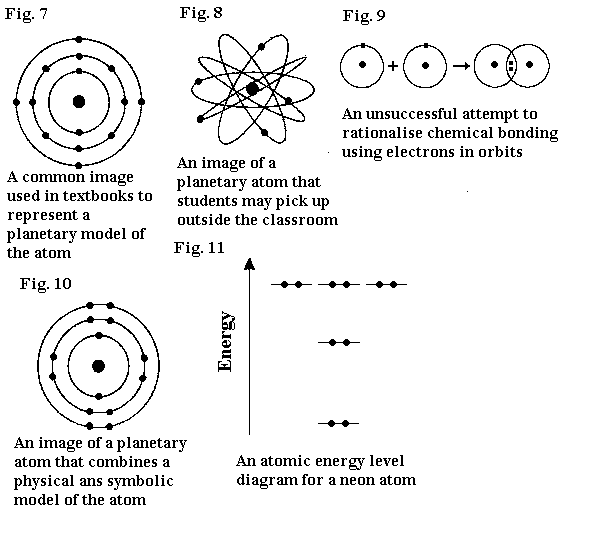
Fluorescent lamp: 38.8.3
Incandescent lamp: 33.4.65
SVP, Saturation Vapour Pressure: 12.5.1
Experiments
Discharge of capacitor using a neon tube: 38.1.5
Electrophorus: 31.1.6, (See: 4. Neon discharge tube)
Piezoelectricity: 32.1.2.1
Spectroscope for materials analysis: 27.194
Neptunium, Np
Neptunium, Np
Neptunium, Table of the Elements
Neptunium, RSC
Neptunium, Np (Latin Neptunus god of the sea), like Tantalum, in tantalite mineral, radioactive lanthanide
Neroli oil
Neroli oil, an essential oil from bitter orange tree flowers (Citrus aurantium subsp. amara), scent sweet and like honey, is extracted by steam distillation, in Sour orange, (Citrus x aurantium subsp. amara), the sweeter Orange blossom, also from same flower, extracted by enfleurage.
Neutralization reactions
Acid-base neutralization: 12.11.4.1, titration
Acid-base reactions: 12.2.1
Neutralization reactions, Double replacement: 12.2.4
Nevadensin
Nevadensin, C18H16O7, Lysionotin, a trimethoxyflavone, antituberculostatic, source
It occurs in Iva nevadensis, Helianthus species leaves and glandular trichomes, iand n Ocimum canum leaves and flowers.
Niacin
Niacin, nicotinic acid, in vitamin B complex (vitamin B3), nicotinate, pyridine-3-carboxylic acid, C5H4NCOOH or C6H5NO2, a pyridinecarboxylic acid, odourless white crystalline powder, weak acid taste, soluble in water. source
Niacin is in most human tissue cytoplasm, in blood, urine, saliva.
It takes part in enzymatic reactions and metabolisms, can lower low density lipoprotein (LDL) cholesterol and raise high density lipoprotein (HDL).
Absence of niacin causes disease pellagra.
Niacin is needed for healthy skin, hair, eyes, and liver, helps make sex and stress-related hormones in the adrenal glands, and improves circulation.
Food additive Niacin: E375.
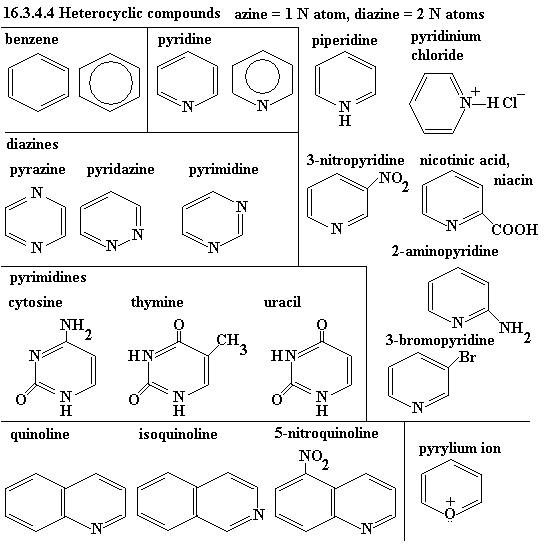
Niacin in: Celosia, Amaranthaceae
Vitamin B: 9.6.2
Nichrome
Nichrome alloy, Nichrome wire
Wire, nichrome, bare, 16 swg, reel 125g
Nichrome wire, 32 SWG, bare, 0.274 mm diameter, resistance 18.4 ohm / m (80% Ni, 20% Cr alloy), electric jug element
Conductivity, σ = 0.10 × 10⁷ ohm metre
Resistivity, ρ = 100 -150 × 10-8 ohm metre
Temperature coefficient per oC= 0.0004
Experiments
Energy from peanuts: 9.1.6
Galvanic cell, Voltaic cell, salt bridge: 33.1.7.3
Power surge circuit breaker, fuses: 32.3.2
Prepare silicon glass: 7.4.4
Resistance wire glass jar cutter: 2.3.11
Study a Bunsen burner flame: 22.1.8, (nichrome wire)
Tests for oxygen gas: 3.49.1, (nichrome wire)
12.8.27Niobium
12.8.27Niobium
Niobium Table of the Elements
Niobium, RSC
Niobium, Nb, (Greek Niobe 'daughter of god Tantalus'), Niobum, Nb, is associated with Tantalum, Ta)
12.8.30Nitration
12.8.30Nitration
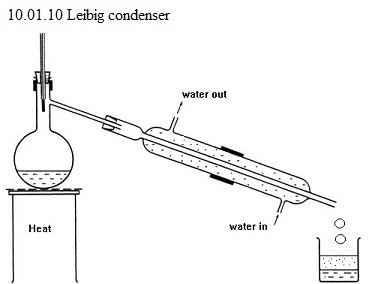
Substitution of a -NO2 group for a hydrogen atom in an arene ring, e.g. bromine source
The reaction substitutes a hydrogen atom in an arene ring by a -NO2 group. source
Experiment
Heat benzene with a mixture of nitric and sulfuric acid catalyst in a Liebig condenser at 330 K.
benzene + HNO3 → benzene-NO2 + H2O source
benzene + NO2+ → benzene-NO2 + H+ source
Also, some 1.3-dinitrobenzene may form.
Nitrogen dioxide
Nitrogen dioxide, NO2, nitrogen (IV) oxide, dinitrogen tetroxide source
Highly toxic gas that forms acids deep in the lungs
Nitrogen dioxide, < 0.1% Not hazardous, but use cross ventilation
Acid rain and nitrogen oxides, NOx: 12.8.11
Density of gases, Nitrogen dioxide, (Table)
Experiments
11.1.4 Copper cycle reactions (See 1.)
17.5.4 Heat nitrogen tetroxide
13.3.19 Prepare nitrogen dioxide:
12.11.2.0 Reactions of nitrates
12.11.1 Reactions of nitrites
Nitrous acid
Ionization of nitrous acid: 12.5.02
Nitrous acid as oxidizing agent or reducing agent: 15.4.8
Nitrous acid with amines: 12.8.39
Prepare / heat nitrous acid: 13.3.21
Nitriles
Nitriles, have a −C≡N functional group. (-CN is inorganic compound cyanide), (cyano group, cyanides, cyanide ion, CN-)
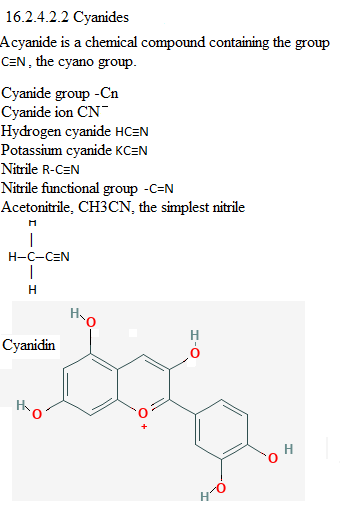
Acetonitrile, C2H3N, CH3CN, methyl cyanide, cyanomethane, ethanenitrile, the simplest nitrile, is a colorless liquid with an aromatic odour, and is used as a solvent, and in lithium batteries. source
It occurs in air from automobile exhausts and can cause irritation of mucous membranes, and more central nervous system effects after repeated exposure.
Isobutyl isothiocyanate, C5H9NS, 2-Methylpropyl isothiocyanate, occurs in (Sinapis alba) source
w Nitrile butadiene rubber, NBR, (chemical composition uncertain), resistant to oil and chemicals, but do not use gloves with fuming concentrated nitric acid.
Nitriles, acid nitriles, alkyl cyanides: 16.7.6
Chemical compounds in boiled brussels sprouts:
Butane nitrile, C4H7N, CH3CHCH3CN source
, 2-Phenylacetonitrile, C8H7N, C6H5CH2N, 3,3'-Diindolylmethane, C17H14N2, occurs in broccoli, cabbage, kale, and has anti-tumour properties. source
3-Butenylnitrile, C4H5N, occurs in brassicas, mustard oil. source
Ascorbigen, C15H15NO6, occurs in bitter melon, (Momordica charantia). source
Indole-3-acetonitrile
Indole-3-acetonitrile, C10H8N2, 3-indoleacetonitrile, (3-indolyl)acetonitrile, light induced inhibitory substance in light-grown cabbage source
It is used in pesticides
It occurs in Rorippa dubia, and Brassica oleracea
Nitrogen oxides
Nitrogen oxides, abbreviated as "NOx", are mainly as follows:
- colourless nitrogen oxide, NO (nitric oxide),
- brown-red nitrogen dioxide, NO2 [nitrogen (IV) oxide]
in equilibrium with dinitrogen tetroxide, N2O4 (2NO2 ⇌ N2O4), pungent irritating odour, and source
* colourless dinitrogen oxide, N2O (nitrous oxide). source
Nitrogen oxides are produced naturally by decomposition, bacterial nitrification and lightning.
They are produced artificially by coal-fired power stations from coal and by oil-fired power stations.
When fuel burns at high temperatures in internal combustion engines, the nitrogen and oxygen of the air combine to form nitrogen oxides.
These oxides dissolve in water to produce the dilute nitric acid that is one component of acid rain.
Rain water pH = 5.6, acid rain pH < 5. N2 (g) + O2 (g) → 2NO (g) nitric oxide source
2NO (g) + O2 (g) → 2NO2 (g) source
4NO (aq) + O2 (aq) + 2H2O → 4HNO3 (aq) source
2NO2 (g) + H2O (l) → HNO2 (aq) + HNO3 (aq) source
N2 (g) + 2O2 (g) → 2NO2 (g) nitrogen dioxide source
2NO2 (g) + H2O (l) → HNO2 (aq) + HNO3 (aq) nitrous acid + nitric acid source
HNO2 (aq) + heat → HNO3 + 2NO + H2O (l) source
4NO (g) + 3O2 (g) + 2H2O → 4HNO3 source
Acid rain and nitrogen oxides, NOx
Acid rain is rain made acidic by atmospheric pollution.
Nitrogen oxides are produced naturally by decomposition, bacterial nitrification and lightning.
They are produced artificially by coal-fired power stations from coal and by oil-fired power stations.
When fuel burns at high temperatures in internal combustion engines, the N2 and O2 of the air combine to form nitrogen oxides. source
These oxides dissolve in water to produce the dilute nitric acid that is one component of acid rain.
Rain water pH = 5.6, acid rain pH < 5. N2 (g) + O2 (g) → 2NO (g) nitric oxide source
This page was generated automatically from the original page on John Elfick's School Science Lessons website. If something looks wrong, please check the original.