Appendix A, Amines and Alkaloids
Last updated 2026-04-20 by Dr John Elfick
16.1.0 Amines
Amines, Functional groups
16.1.1 Amines
Amines, (C2H5NH2), are produced by the decay of organic matter, ammonia-derivative organic compounds of nitrogen. source
In amine molecules one or more hydrogen atoms has been replaced by a hydrocarbon radical, an alkyl or aryl group.
Amines are organic derivative of ammonia, where one, two or three hydrogen atoms are replaced by alkyl groups as a primary, secondary or tertiary amine.
For example: Trimethylamine (C3H9N). source
Amines usually act as weak bases that form ammonium salts that are more soluble in water than the original amine.
Cough medicines may contain cough suppressant dextramethorphan hydrobromide or decongestant and expectorant, pseudoephidrine hydrochloride and ephedrine.
Ethane is an important product of microbial metabolism.
Amines, RNH2 (amino, -NH2), amine, e.g. methylamine (CH3NH2) source
Plant amines occur in most plant cells, formed by decarboxylation of amino acids or by transamination of aldehydes.
There is no sharp distinction between plant amines and alkaloids.
Amines
16.1.2 Primary amines
In primary amines, one of three hydrogen atoms in ammonia is replaced by organic substituents.
Formula for primary amines: RNH2, where R = alkyl group:
16.2.18 Methylamine
16.2.12 Ethanolamine
16.2.27 Propylamine
16.2.0 Amine by name
16.2.5 Cathinone
16.2.6 Diethanolamine
16.2.7 Diethylamine
16.2.8 Dimethylamine
16.2.9 Dimethyltryptamine
16.2.12 Ethanolamine
16.2.14 Gramine
16.3.4 Norephedrine
16.2.1 Aniline
Aniline, C6H7N, C6H5NH2, primary amine, phenylamine, clear to yellowish liquid, musty fishy odour, slightly soluble in water, mixes with organic solvents. source
It is used to make many chemicals, e.g. polyurethane foam.
16.2.2 Cadaverine
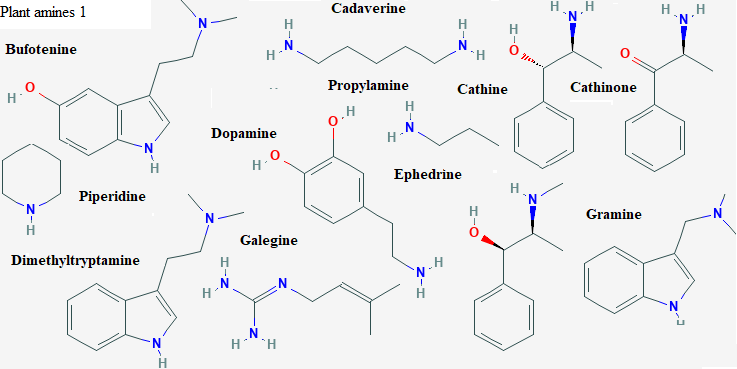
Cadaverine. [C5H14N2, NH2(CH2)5NH2], is a plant amine, pentane-1,5-diamine, 1,5-diaminopentane, colourless syrupy liquid produced in decaying flesh, foul odour, urine odour, bacterial vaginosis disease. source
It is formed by bacterial decarboxylation of the amino acid lysine, C6H14N2O2. source
16.2.3"> Candicine
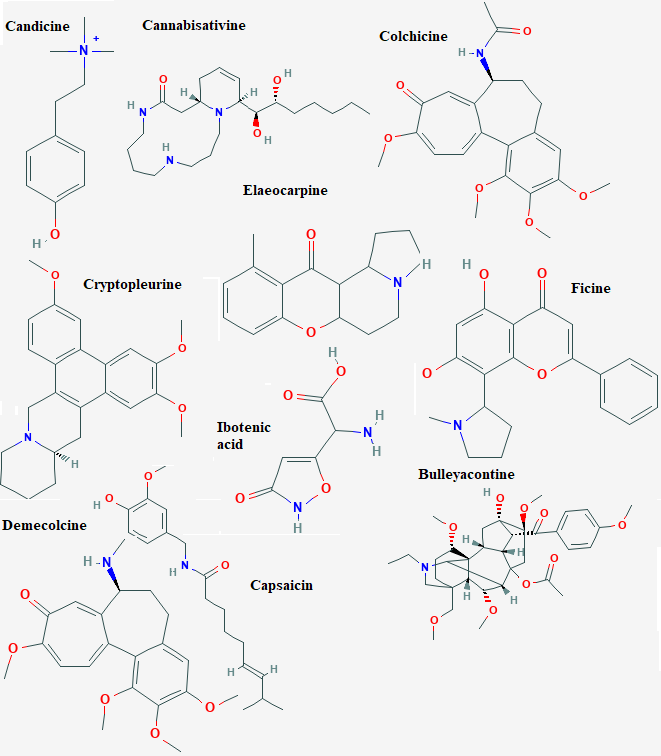
Candicine (C11H18NO), is a plant amine, and it occurs in Trichocereus root, Fagara, Philodendron, Magnolia, and in Lysichitum. source
16.2.4"> Cathine
Cathine (C9H13NO), pseudonorephedrine, norpseudoephedrine, is a plant amine, an amphetamine, sympathomimetic, monoamine alkaloid, psychoactive drug, euphoriant. source
It is a stimulant, used for khat chewing in Arabian peninsula, anorexic, causes release of norepinephrine, used as nasal vasoconstrictor and appetite suppressant.
It is not recommended in USA, and is a controlled substance in Australia.
16.2.5"> Cathinone
Cathinone (C9H11NO), benzoylethanamine, beta-keto-amphetamine, norephedrone, is a plant amine, monoamine alkaloid with nitrogen in the side chain (protoalkaloid). source
It is a controlled substance, causes mild stimulant euphoria effect, (WHO drug of abuse), central nervous system stimulant similar to Cathine.
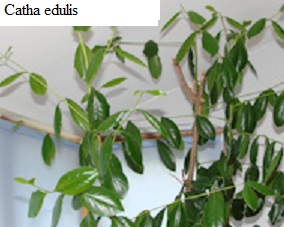
It is the active ingredient in Khat chewing, Arabian peninsula, and in (Catha edulis).
16.2.6"> Diethanolamine
Diethanolamine, [HN(CH2CH2OH)2], DEA, is a secondary amine. (two OH groups), weak base, oily colourless liquid or white crystals, fishy smell. source
It is denser than water, and is used to make soaps, surfactants, dishwashing detergents,and an anticorrosion agent.
Diethanolamine (photography developer), Irritates skin and eyes.
Diethanolamine, Solution < 10%, Not hazardous
Diethanolamine bisulfite (photography developer), Irritates skin and eyes.
16.2.7"> Diethylamine
Diethylamine, (C4H11N), [C4H11N(C2H5)2NH], (CH3-CH2-NH-CH2-CH3), a secondary amine, diethyl amine, and is toxic by all routes. source
It is an irritant to eyes, corrosive to eyes and skin, strongly alkaline, flammable, volatile, mixes with water and ethanol, colourless liquid (if pure).
It has a strong unpleasant odour, and combustion forms dangerous nitrogen gases.
Diethylamine, Solution <2%, Not hazardous.
16.2.8"> Dimethylamine
Dimethylamine, (C2H7N), [C2H7N(CH3)2NH], DMA, [NH = imino group], a secondary amine, is colourless, flammable gas, which has a fishy odour. source
It increases in human urine after a fish diet.
It is used in tanning dyes, soaps, and fungicides.
16.2.9"> Dimethyltryptamine
Dimethyltryptamine, (C12H16N2), (DMT), N,N-dimethyltryptamine, is a plant amine, non-isoprene indole alkaloid, and a tryptamine alkaloid. source
Protect from air and light in a freezer, pure white DMT crystals explosive, psychotropic drug, acts as agonist or antagonist of certain serotonin receptors.
It is used in South American shamanic practices, in yopo snuff and ayahuasca drink, serotonergic hallucinogen, powerfully psychoactive substance.
It causes hallucinacions and anxiety, autonomic hypetension, papillary dilation, illegal in many countries, prohibited in Australia and United States.
It is broken down by digestive enzyme monoamine oxidase, so inactive if taken orally unless combined with a monoamine oxidase inhibitor (MAOI).
It occurs in (Prestonia amazonica), (Psychotria viridis), (Arundo donax), (Piptadenia peregrina), (Mucuna pruriens), (Diplopterys cabrerana), and Phalaris.
Trace amounts occur in mammalian brain, blood, and urine.
16.3.1 Catecholamines
The catecholamines, epinephrine, norepinephrine and dopamine, are synthesized in the central nervous system, and central part of the adrenal gland.
Catecholamines function as psychoactive compounds, hormones or neurotransmitters.
Catecholamines are monoamines, which contain catechol (benzene with two OH side groups at carbons 1 and 2) and a side-chain amine.
Catechol may be a free molecule or part of a larger molecule, e.g. the 1,2-dihydroxybenzenes.
Catecholamines are derived from the amino acid tyrosine, C9H11NO3. source
Conversions activated by enzymes:
Phenylalanine → L-Tyrosine → L-DOPA -- → Dopamine - → Norepinephrine → Epinephrine source
C9H11NO2 → C9H11NO3 → C9H11NO4 → C8H11NO2 → C8H11NO3 -- → C9H13NO3 source
16.6.1 Amaryllidaceae alkaloids
It occurs only in this daffodil family, usually in the bulbs, but sometimes in the aerials.
Many are toxic if the bulbs are mistaken for onions.
The first alkaloid was the isolation of Lycorine from (Narcissus pseudonarcissus) in 1877.
Ambelline, Belladine, Candimine, Caranine, Galanthamine, Lycorine
Ambelline and Lycorine occur in (Crinum latifolium).
Belladine occurs in Nerium, and in (Apis cerana).
Candimine occurs in (Hippeastrum morelianum), and in (Apis cerana).
Caranine occurs in (Clivia miniata) and Orang River Lily (Crinum bulbispermum).
Galanthamine (Galantamine) occurs in Galanthus
.
16.3.2"> Dopamine
Dopamine, (C8H11NO2), (3-hydroxytyramine), (oxytyramine), is an aromatic amine, plant amine, protoalkaloid, and the precursor to norepinephrine and epinephrine. source
It is a catecholamine neurotransmitter in the brain for regulating movement, increases heart rate and cardiac output, stimulates smooth muscle leading to vasoconstriction.
Also, it increases renal blood flow, sodium excretion, and urine output.
Parkinson's disease occurs as a result of the death of dopamine-producing neurones in the substantia nigra of the midbrain, leading to tremor of limbs and facial rigidity.
Dopamune has a role as a cardiotonic drug, a beta-adrenergic agonist, a dopaminergic agent, a sympathomimetic agent, important in regulating movement.
A catecholamine neurotransmitter in the brain, derived from tyrosine and is the precursor to norepinephrine and epinephrine.
16.3.3"> Epinephrine
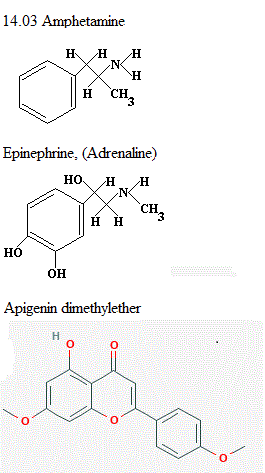
Epinephrine, C9H13NO3, adrenaline, plant amine, is an active sympathomimetic hormone from the adrenal medulla. source
It stimulates alpha- and beta- adrenergic autonomic nervous system, causes vasoconstriction, stimulates heart, dilates bronchi and cerebral vessels.
It is used to treat asthma, cardiac failure, and to delay absorption of local anaesthetics.
It is a nearly-white microcrystalline powder or granules, odourless, slightly alkaline aqueous solutions, with a slightly bitter numbing taste.
It is a hormone and neurotransmitter secreted by the adrenal glands resulting in the 'fight-or-flight' response.
It is an adrenergic agonist, vasodilator agent, bronchodilatort, vasoconstrictor agent, and a sympathomimetic agent.
It is produced by the adrenal glands that can also be used as a drug due to its various functions.
It has long been used in the treatment of hypersensitivity reactions, but in the auto-injector form (EpiPen) has been available since 1987 in the USA.
Many new products/biosimilars and dosage routes have been approved under various names over the last several decades.
Dosage delivery routes for epinephrine include intravenous, inhalation, nebulization, intramuscular injection, and subcutaneous injection.
The most common uses of epinephrine are to relieve respiratory distress, and to prolong the action of infiltration anesthetics.
Epinephrine is the primary drug administered during cardiopulmonary resuscitation.
16.3.4"> Norepinephrine
Norepinephrine (NE), noradrenaline (NA), noradrenalin, (C8H11NO3), aromatic amine, levarterenolalkaloid with nitrogen in the side chain (protoalkaloid), is a plant amine, catecholamine. source
It is used for vasoconstriction, pupil dilatation, and to treat cardiac infarction.
It occurs in Albizia, Musa (banana), Passiflora, Pisum, Phaseolus, Portulaca, and in Samanea.
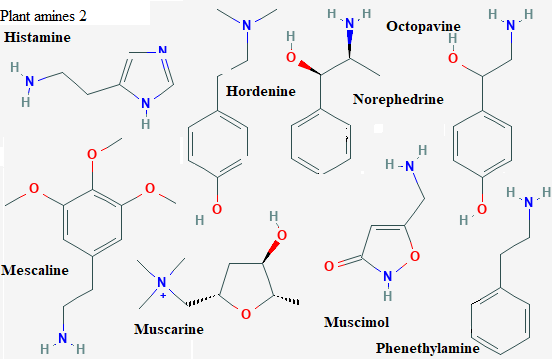
Norepinephrine is both a catecholamine and a phenethylamine.
It has a role as a vasoconstrictor agent, an alpha-adrenergic agonist, a sympathomimetic agent, and a neurotransmitter.
It is the precursor of epinephrine that is secreted by the adrenal medulla and is a widespread central and autonomic neurotransmitter.
It is the principal transmitter of most postganglionic sympathetic fibers and of the diffuse projection system in the brain arising from the locus ceruleus.
It occurs in plants and is used pharmacologically to stimulate sympathetic nerves.
16.2.10 Ephedrine
Ephedrine, (C10H15NO), is a plant amine, an alkaloid with nitrogen in the side chain (protoalkaloid), an hydroxylated form of phenethylamine C8H11N, stimulates sympathetic nerves so used as a nasal decongestant, relieves the symptoms of asthma, and lowers high blood pressure. source
It may increase release of norepinephrine, C8H11NO3, (noradrenaline), and is used to treat asthma, heart failure, rhinitis, urinary incontinence, and depression. source
It occurs in Chinese ephedra, (Ephedra sinica), ma huang.
Pseudoephredine, (C10H15NO). is an isomer of ephedrine. source
16.2.12"> Ethanolamine
Ethanolamine, (NH2CH2CH2OH), a primary Amine + primary alcohol, (usually called monoethanolamine, MEA), (2-aminoethanol) source
Ethanolamine is a toxic, flammable, corrosive, colourless, viscous liquid, odour like ammonia, weak base, harmful by ingestion or through the skin.
It is used to produce detergents and many other chemical products.
Monoethanolamine is the head group for phospholipids in biological membranes, formed by decarboxylation of serine.
[HOCH2CH(CO2H)NH2] → (NH2CH2CH2OH) + (CO2) source
serine → monoethanolamine + carbon dioxide. source
16.2.14 Gramine
Gramine, (C11H14N2), 3-(Dimethylaminomethyl)indole, donaxine, is a plant amine, an indole alkaloid, and is antiviral, and antibacterial. source
It occurs in Arundo, Acer, Hordeum, Phalaris, and in Cabbage (Brassica oleracea).
16.2.13 Galegine
Galegine, (C6H13N3), galegin, isopentenyl guanidine, (N-3,3-Dimethylallylguanidine), is a plant amine, a guanidine, toxic, and it affects mitochondria. source
It occurs in Galega, and in Verbesina.
16.2.16 Hordenine
Hordenine, (C10H15NO), is a plant amine, tertiary amine, N, N-dimethyltyramine, phenylethylamine alkaloid, antibacterial, antibiotic source
It occurs in peyote cactus (Lophophora williamsii), and in queen of the night cactus (Selenicereus grandiflorus).
It is prepared by barley germination, gives no advantage if taken in nutritional supplement, obtained from beer in diet.
Hordenine interfere with tests for opioid drugs.
16.2.15 Histamine
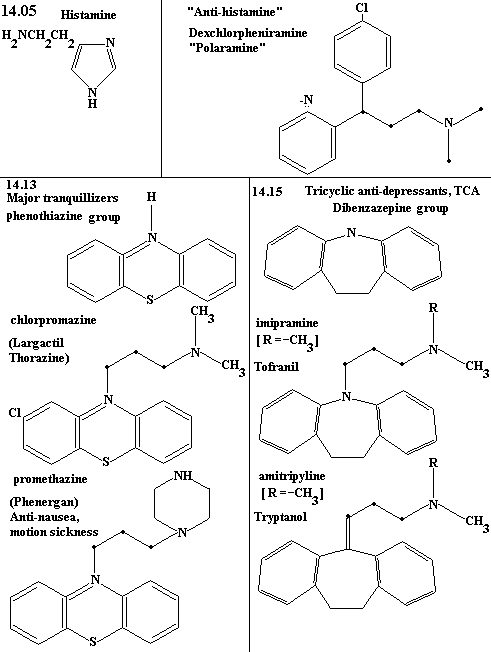
Histamine (C5H9N3), is a plant amine, biogenic amine, with many physiological functions, and immune responses. source
It is a stimulant of gastric secretion, constrictor of bronchial smooth muscle, centrally acting neurotransmitter, inflammatory response, itch, (from acid histidine), major tranquillizer, tricyclic anti-depressant.
Many plants and herbs contain natural anti-histamine compounds, e.g. Basil, Chamomile, Jewel weed, papaya, stinging nettle.
16.2.18 Methylamine
Methylamine, (CH3NH2), the simplest primary amine, monomethylamine, poisonous, noxious inflammable gas, explosive, anhydrous colourless gas or a liquid, fishy odour like ammonia, easily ignited, and heated containers may rupture violently. source
It is used to make pharmaceuticals, insecticides, paint removers, surfactants, and rubber chemicals.
It is sold as white deliquescent crystals of methylamine hydrochloride or as aqueous solution.
Methylamine is used in the illegal manufacture of the drug MDMA (ecstasy) and the addictive psychotropic drug methamphetamine, C10H15N. source
Methylamine is NOT permitted in schools.
Fish smell: Trimethylamine
Trimethylamine: Trimethylamine
Methylamine is usually prepared by reaction of ammonia with methanol with zeolites as catalyst.
CH3OH + NH3 → CH3NH2 + H20. source
16.2.19 Methyl bufotanine
Methyl bufotanine, (C13H18N2O), O-methylbufotanine, meO-DMT, methoxybufotenine, is a plant amine, hallucinogen, irritant, aromatic ether, toxic source
It is a tertiary amino compound, (from a bufotenine, C24H32O4), psychedelic of the tryptamine class, and a close relative of DMT, dimethyltryptamine, C12H16N2, and bufotenine,C12H16N2O, in toad skins. source
It causes delusions and delirium, and used for shamanic practices in South America.
It is a psychoactive ingredient of seeds of (Anadenanthera peregrina), and it is used to prepare Yopo snuff, 5-MeO-DMT.
It is used as a sacrament of the "Church of the Tree of Life".
It occurs in Phalaris pasture grasses, and in Desmodium, and it causes 'Phalaris staggers' disease in livestock.
16.2.20 Muscarine
Muscarine, (C9H20NO2), is a plant amine, is an alkaloid with nitrogen in the side chain, (protoalkaloid), occurs in Amanita muscaria (fly agaric), Inocybe and Clitocybe mushrooms, also in rotten fish. source
It binds to acetylcholine receptors to affect parasympathetic nervous system and cause convulsions and death if no atropine treatment.
16.2.21 Muscimol
Muscimol, (C4H6N2O2), agarin, pantherine, is a plant amine, (5-Aminomethyl-3-hydroxyisoxazole), isoaxole, hallucinogenic, causes delirium and muscular spasms, and has no medical use. source
It occurs in toxic Amarita mushrooms.
16.2.24 Octopamine
Octopamine, norsympathol, norsynephrine, (Hydroxyphenylethanolamine), is a plant amine, alpha-adrenergic sympathomimetic amine, (from tyramine, C8H11NO, in the CNS and platelets). source
It is used to treat hypotension, cardiotonic, biogenic phenylethanolamine, neurotransmitter.
It occurs in Coryphantha, (Capsicum frutescens), Citrus, and in Cyperus.
Octopamine hydrochloride (C8H12ClNO2), is used in weight loss supplements, but is possibly not effective. source
16.2.23 Norephedrine
Norephedrine, (C8H13NO), mydriatin, 2-Amino-1-phenyl-1-propanol, l-phenylpropanolamine, an amphetamine, sympathomimetic, causes release of norepinephrine, (C8H11NO3), the principal transmitter of most postganglionic sympathetic fibers. source
It is used as nasal vasoconstrictor and appetite depressant.
16.2.26 Piperidine
Piperidine, (C5H11N), [CH2(CH2)4NH], a secondary amine, colourless fuming liquid, pepper-like odour, less dense than water so floats on water, miscible with water, used as a solvent and to make pharmaceuticals and rubber, antibiotic, anti-hypertensive, flavouring agent, may be toxic by ingestion and inhalation, irritates skin and eyes. source
It occurs in black pepper (Piper nigrum), and in barley (Hordeum vulgare).
16.2.25 Phenethylamine
Phenethylamine, (C8H11NO2), C8H11N, (PEA), an aromatic amine, beta-phenethylamine, 2-phenethylamine, is a monamine alkaloid, primary aromatic amine, colourless liquid, and has a fishy odour. source
It is strongly basic and soluble in water, ethanol, ether, and is prepared by fermentation of sugar cane molasses.
It is a psychoactive substance, high concentration is corrosive, can cause burns and allergic skin reaction if ingested.
It is acutly toxic, skin irritant, sensitiser, and it occurs in bitter almonds, in banana, in Rhodophyceae algae, in dietary supplements, and in human urine.
It is used as bronchodilator, nasal decongestants, in human body excitatory action on skeletal muscles.
16.2.28 Pseudoephedrine
Pseudoephedrine, (C10H15NO), L-Ephedrine, is a plant amine, beta-phenylethylamine alkaloid with nitrogen in the side chain (protoalkaloid), isomer of ephedrine, stimulates sympathetic nerves. source
It is used to treat asthma, heart failure, rhinitis, urinary disorders, depression, and it improves release of norepinephrine, C8H11NO3. source
It occurs in (Ephedra sinaca), and in Cao Ma Huang, Chinese ephedra.
16.2.27 Propylamine
Propylamine, (C3H9N), a primary amine, propan-1-amine, (1-Aminopropane), corrosive, toxic. colourless liquid, soluble in water, less dense than water, colourless liquid, strong ammonia-like odour, highly flammable, explosive in air, harmful if swallowed, burns skin. source
It occurs in grapes and vegetables.
16.2.30 Pyrrolidine
Pyrrolidine, (C4H9N), (CH2)4NH], is a plant amine, 1-pyrrolidine, tetrahydropyrrole, tetramethyleneimine, cyclic secondary amine, saturated nitrogen heterocycle, 5-membered cyclic amine, in volatile amine fractions of brewing, odour like semen, colourless liquid, miscible with water. source
It occurs in carrot and tobacco leaves.
16.2.29 Putrescine
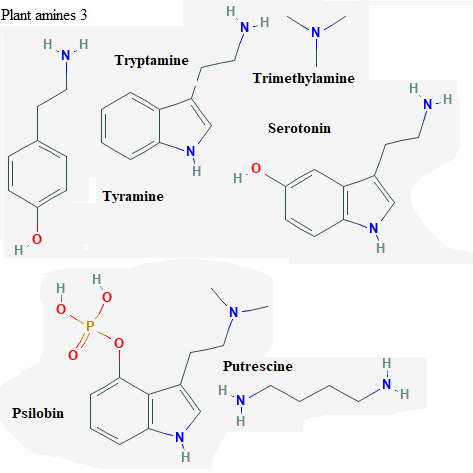
Putrescine, (C4H12N20), [NH2(CH2)4NH2], is a plant amine, butanediamine, is produced in decaying flesh, toxic in excess, and has the odour of semen. source
16.2.32 Trimethylamine
Trimethylamine (CH3-NCH3-CH3), (TMA), is a plant amine, has smell of hawthorn flower, cotoneaster, ammoniacal fishy smell, flammable source
Trimethylamine, Amines, aliphatic amines (RNH2 - ), R = alkyl group.
Trimethylamine solution, 50%, Harmful if ingested, highly irritant vapour, skin irritant, highly flammable
Trimethylamine solution, 25%
Trimethylamine solution, < 20% Not hazardous
Tests for trimethylamine
Trimethylamine, C3H9N, (CH3)3N, tertiary amine, colourless gas with fishlike odour at low concentrations changes to ammonia-like odour at higher concentrations. source
It dissolves in water to form flammable, corrosive clear to yellow aqueous solution, and unconfined liquid can cause frostbite or chemical burns.
Prolonged exposure to heat can cause the containers of gas to rupture violently.
Fish smell problem
Proteins in raw fish are denatured by citric acid, lemon juice.
Freshly caught fish have no odour.
However, the end products of enzyme reactions accumulate when the fish is to give the characteristic fish smell.
If fish is not fresh, it give off trimethylamine, N(CH3)3, the source of fish smell. source
The cooked fish is less tasty and the cooking smell is offensive.
Trimethylamine, CH3NCH3CH3, (TMA), volatile tertiary aliphatic amine, from food containing it or from precursors source
trimethylthamine-N-oxide, and L-Carnitine, C7H15NO3, an amino acid derivative. source
In humans, ingested TMA may convert to TMNO by N-oxidation, but this process and its importance is not well understood.
TMA is produced by bacteria in the human intestines, but it is broken down by oxidation in the liver.
The reaction requires a certain enzyme, but if people do not have the enzyme, due to a genetic fault, they may smell "fishy"!
They suffer from a metabolic disorder called Trimethylaminuria (TMAU).
They can be relieved of this embarrassing problem by avoiding foods rich in the amino alcohol choline, C5H14NO. source
Trimethylamine is found in beetroot and herrings, so some people say that beetroot has a "herring smell".
Experiment
Stopping fish smell when cooking fish
To stop fish smell, soak fish in soy bean paste or milk so that proteins in them absorb the smell.
Use ginger or green onion during cooking.
Lemon juice, vinegar, wine, and rice wine can neutralize fish fat, which contains trimethylamine.
Soak freshwater fish in vinegar water before cooking.
At the end of rigour mortis, bacterial action may decompose the fish protein and add to the offensive smell.
Fish should be eaten fresh and cooked for only a short time to denature tissue between the fibres and heat the fish to an acceptable temperature for eating.
16.2.33 Tryptamine
Tryptamine, (C10H12N2), a plant amine is a monoamine alkaloid, heterocyclic monamine, produced from amino acid tryptophan, (C11H12N2O2). source
It is an hallucinogenic drug and a precursor molecule to many hormones and neurotransmitters called tryptamines, e.g. serotonin, (C10H12N2O). source
It occurs in many plants, e.g. Acacia.
Tryptamine hydrochloride, (C10H12N2.HCl), antimalarial source
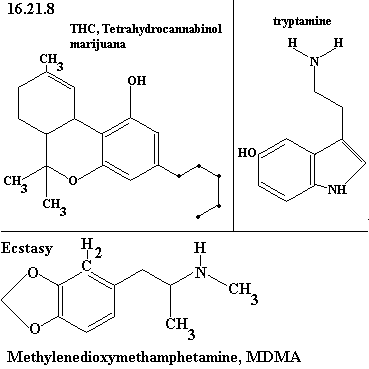
THC, Tetrahydrocannabinol, (C21H30O2), in marijuana, precursor of indoleacetic acid, (C10H9NO2). source
Tyramine (C8H11NO), a plant amine, is an oxazole alkaloid, monamine, from tyrosine, (C9H11NO3). source
It occurs in fermented or spoilt meat, chocolate, cheese, excess causes hypertension
It occurs in plants and animals, and in the body to help support blood pressure.
Hallucinogen, so large dietary intake or while taking MAO inhibitors can cause high blood pressure, and headaches.
High content in aged, smoked, fermented foods, aged cheeses, e.g. Stilton cheese, have the highest levels of tyramine.
Bacterial enzymes in some foods may convert amino acid tyrosine, C9H11NO3, to tyramine. source
People who eat aged cheeses, e.g. Stilton, might get nightmares from the excess of tyramine in such cheeses, e.g. Ebenezer Scrooge in "A Christmas carol" by Charles Dickens.
Monoamine oxidase inhibitors (MAOI), tyramine, (C8H11NO). source
16.1.3 Secondary amines
In secondary amines, two organic substituents bound to N together with one H, RR'NH
Formula for secondary amines: R2NH, where R = alkyl group:
Diethanolamine [HN(CH2CH2OH)2] source
Diethylamine (C4H11N) source
Dimethylamine (CH3)2NH, (C2H7N) source
16.1.4 Tertiary amines
In tertiary amines, all three hydrogen atoms are replaced by organic substituents. RR'R''N.
Formula for secondary amines: R3N, where R = alkyl group:
Trimethylamine (C3H9N) source
Cyclic tertiary amines:
Piperidine (C5H11N). source
16.1.5 Aromatic amines
Aromatic amines have the nitrogen atom connected to an aromatic ring, as in aniline. Aniline (C6H5NH2) source
Heterocyclic aromatics have one or more of the atoms in the aromatic ring + an element other than carbon.
Sometimes, aromatic amines are classified as alkaloids.
Polycyclic aromatic hydrocarbons, (PAH), have simple aromatic rings fused together by sharing two carbon atoms, e.g. Benzene, Toluene, Ortho-xylene, Para-xylene.
Most amines act as bases and are reasonably strong.
Because amines are basic, they neutralize carboxylic acids to form corresponding ammonium carboxylate salts.
Upon heating to 200 oC, the primary and secondary amine salts dehydrate to form corresponding amides.
Aromatic amines include:
16.3.2 Dopamine
16.3.4 Norepinephrine
16.2.25 Phenethylamine
16.2.17 Mescaline
Mescaline, (C11H17NO3), mescalin, (3,4,5-Trimethoxyphenethylamine), is a plant amine, may be classified as a beta-phenylethylamine alkaloid with nitrogen in the side chain, (protoalkaloid), but Mescaline is not usually classified as an alkaloid, hallucinogen, and has no medical use. source
It occurs in Mescal buttons flowering heads (Lophophora williamsii).
16.2.31 Serotonin
Serotonin, (C10H12N2O), 5-HT, (5-Hydroxytryptamine), is a plant amine, is acutely toxic, primary amino compound, a phenol, neurotransmitter, biochemical messenger and regulator, in CNS, in gastrointestinal tract, in blood platelets, (from essential amino acid 5-hydroxytryptophan). source
It occurs in banana fruit Musa, tomato (Solanum lycopersicum), Urtica (nettle stinging hairs), and in cowhage Mucuna.
16.6.2 Betalain alkaloids
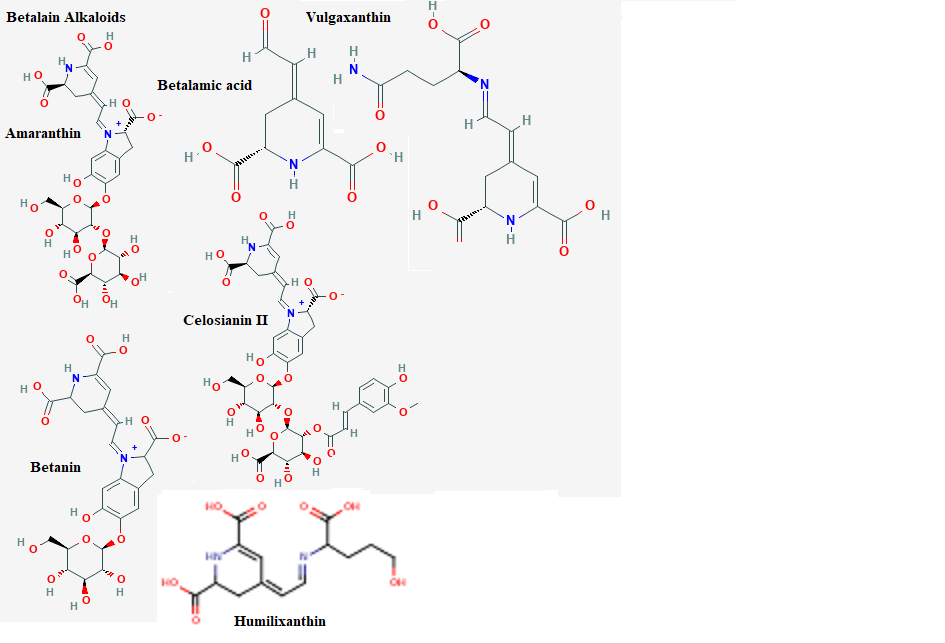
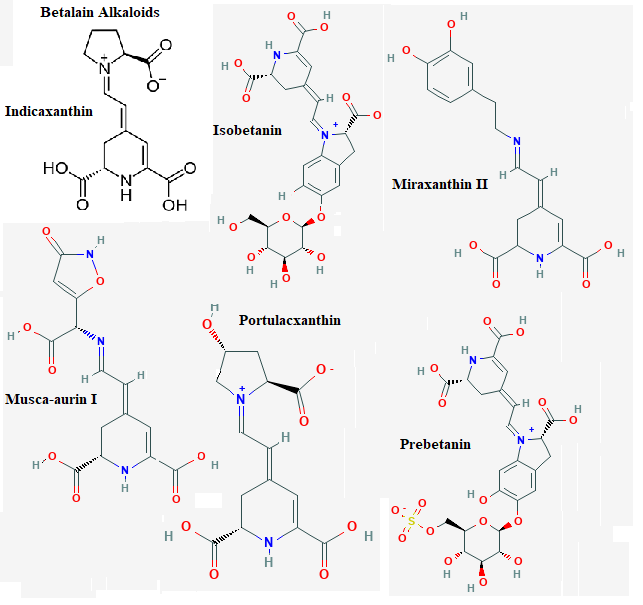
Betalain alkaloids are coloured yellow pigments and purple pigments alkaloids in plant vacuoles of nine plant families, divided into betacyanins and betaxanthins.
They occur in all Cactaceae, (Beta vulgaris), Mirabilis, and in Portulaca.
16.6.3 Diterpene alkaloids
Similar structure to terpene and including the toxins: aconitine, barbitine, lycoctinine, delphine, heteratisine.
(Terpenoid alkaloids), pseudoalkaloids, C19-diterpenooid alkaloids, cryptoalkaloids, mainly in Ranunculaceae, Aconitum and Delphinium
Also in Garrya, Icacina, Inula, Spiraea, Anopterus, Erythrophleum bark (Leguminosae)
Types of diterpenoid alkaloids: aconitine-type, lycoctonine-type, pyro-type, lactone-type, 17-seco-type, rearranged-type.
16.6.4 Indole alkaloids
Alkaloids with nitrogen heterocycles from amino acids + peptide fragments
They can be called "true alkaloids", from the protein amino acid tryptophan (C11H12N2O2). source
1. Non-isoprene indole alkaloids, 2. Semiterpenoid indole Alkaloid
Indole alkaloids occur in plants.
Ergometrine group occurs in (Claviceps purpurea).
Gelsemine occurs in (Gelsemium sempervirens).
Harmine, harmaline, occurs in Banisteriopsis.
Physostigmine occurs in (Physostigma venenosum).
Reserpine occurs in (Rauvolfia serpentina).
Strychnine occurs in (Strychnos nux vomica).
Vinblastine, vincristine occurs in (Catharanthus roseus).
Yohimbine occurs in (Pausinystalia yohimbe).
16.6.5 Isoquinoline alkaloids
Alkaloids with nitrogen heterocycles from amino acids, so they can be called "true alkaloids".
Alpinine, Amurensine, Amurine, Annolobine, Annonaine, Berberine, Bracteoline, Cancentrine, Carnegine, Cassythicine, Cephaeline, Codeine, Cularidine, Cularine, Cepharanthine, Demethylcoclaurine, Dihydrosanguinarine, Emetine, Erythroidine, Glaucine, Glaziovine, Hydrastine, Isocorydine, Laudanidine, Laudanosine, Macarpine, Magnoflorine, Mecambrine, Morphine, Narceine, Narcotoline, Neopine, Noscapine, Obaberine, Oxyacanthine, Papaverine Pronuciferine, Protopine, Reticuline, Salutaridine, Sanguinarine, Sinomenine, Thebaine, Tubocurarine
16.6.6 Lycopodium alkaloids
Alkaloids with a unique ring system and were first studied as the alkaloids of the club moss (Lycopodium serratum var. serratum), the serratezomines.
Huperzine A, isolated from the club moss (Huperzia serrata), has been used in the treatment of Alzheimer's disease.
Huperzine A is a potent inhibitor of acetylcholinesterase (AChE), the key brain enzyme responsible for the rapid degradation of the neurotransmitter acetylcholine.
Huperzine A is also used as a dietary supplement for the correction of memory impairment.
16.6.7 Monoterpenoid and sesquiterpenoid alkaloids
Acanthicifoline, Actinidine, Arenaine, Boschniakine Cantleyine, Dendrobine, Gentianadine, Gentianaine, Gentianine, Gentioflavine Jasminine, Valerianine
16.6.8 Peptide alkaloids
Frangulanine, Zizyphine
16.6.9 Piperidine and pyridine alkaloids
1. Alkaloids chemically derived from piperidine.
Coniine occurs in (Conium maculatum), (Sarracenia flava), and in (Aethusa cynapium).
Lobeline occurs in (Lobelia sessilifolia), and in (Lobelia inflata).
Pelletierine occurs in (Sedum alpestre), and in (Sedum annuum)
Piperine occurs in (Piper boehmeriifolium), and in Macropiper.
Sedamine occurs in (Sedum acre), and in (Phedimus aizoon).
2. Alkaloids chemically derived from pyridine.
Anabasine occurs in Nicotiana.
Lobeline occurs in (Lobelia inflata).
Nicotine occurs in (Nicotiana tabacum).
Nicotine molecule contains both pyridine (left) and pyrrolidine rings (right).
Piperine occurs in (Piper longum).
Ricinine occurs in (Ricinus communis).
Trigonelline occurs in (Trigonella foenum-graecum), and in (Hypoestes phyllostachya).
16.6.10 Purines and pyrimidines alkaloids
Purines and pyrimidines alkaloids are purine-like compounds not from amino acids, so called "pseudoalkaloids" or purine derivatives.
Methylated purines: Caffeine, Theobromine, Theophylline.
Purine alkaloids occur in plants
Caffeine occurs in (Camellia sinensis), (Coffea arabica), (Cola nitida), (Paullinia cupana), and in (Ilex paraguaensis).
Theobromine occurs in (Theobroma cacao). Theophylline occurs in (Camellia sinensis), (Coffea arabica), (Cola nitida), (Paullinia cupana), and in (Ilex paraguaensis).
16.6.11 Pyrrolidine and piperidine alkaloids
Pyrrolidine and piperidine alkaloids are alkaloids with nitrogen heterocycles from amino acids, so they can be called "true alkaloids".
1. Pyrrolidine alkaloids
Anabasine, Anatabine, Arecaidine, Arecoline, Carpaine, Cassine, Codonopsine, Coniceine, Coniine, Cucurbitine, Cuscohygrine, Dioscorine, Guvacine, Harzianopyridone, Hygrine, Isonitramine, Juliflorine, Lobelanidine, Lobelanine, Myosmine, Nicotine, Nicotyrine, Nornicotine, Piplartine, Prosopinine, Ricinine, Slaframine, Stachydrine, Swainsonine, Trichostachine
2. Piperidine alkaloids
Lobeline, Piperine, Sedamine, Pelletierine
16.6.12 Pyrrolizidine alkaloids
Pyrrolizidine alkaloids, (PAs), are alkaloids with nitrogen heterocycles from amino acids, so they can be called "true alkaloids".
Pyrrolizidine alkaloids (PAs) are a class of naturally-occurring plant toxins.
"Senecio alkaloids", most poisonous group of alkaloids for humans and farm animals, have fused five-member ring system with nitrogen bridge.
Most are esters of amino alcohols, e.g. diester Echimidine, ragwort (Senecio jacobaea), Borago, Crotalaria, comfrey Symphytum, toxic to liver, hepatic cirrhosis.
Betonicine, Clivorine, Echimidine, Glycyrrhizin, Heliosupine, Heliotridin, Heliotrine, Lasiocarpine, Lycopsamine, Monocrotaline, Retronecine, Riddelline
Senecionine, Supinidine, Symphytine
Pyrrolizidine alkaloids occur in plants
Glycyrrhizin occurs in (Glycyrrhiza uralensis), (Glycyrrhiza glabra), (Senecio symphytine), (Symphytum officinale), (Tussilago farfara), and in (Borago officinalis).
16.6.13 Quinoline alkaloids
Quinazolene derivatives, (from 2-aminobenzoic acid), bicyclic molecules - benzene ring + pyridine ring, are common in Rutaceae.
(Ruta graveolens) contains about 30 quinoline alkaloids.
Quinoline, Acronidine, Acronycine, Camptothecin, Cinchonidine, Echinopsine, Febrifugine, Peganine, Quinine
Quinoline alkaloids occur in plants.
Quinine, quinidine, occurs in Cinchona.
Cusparine occurs in (Galipea officinalis).
16.6.14 Quinolizidine alkaloids
Alkaloids with nitrogen heterocycles from amino acids, so they can be called "true alkaloids".
Quinolizidine derivative are all derived from: Lysine → Cadaverine → . source
Anagyrine, Argentine, Baptifoline, Caulophylline, Cinegalline, Cytisine, Hydroxylupanine, Lupanine, Lupinine, Matrine, Retamine, Rhombifoline, Sparteine.
16.6.15 Steroidal alkaloids
Steroidal alkaloids, pseudoalkaloids, Chaconine, Cyclovirobuxine, Jervine, Protoveratrine, Solamargine, Solanidine, Solasodine, Solanine, Solasodine, Tomatine, Tomatidine,Veracevine, Veratramine.
16.6.16 Tropane alkaloids
Alkaloids with nitrogen heterocycles from amino acids, so they can be called "true alkaloids".
Anisodamine, Anisodine, Apohyoscine, Calystegin, Convolvine, Darlingine, Littorine, Meteloidine, Phyllalbine, Tigloidine, Valeroidine
Atropine, Bellendine, Hyoscyamine, Scopalamine
Cocaine group: Cocaine, Ecgonine
Tropane alkaloids occur in plants.
Scopolamine occurs in (Datura stramonium), (Atropa belladonna), and in (Hyoscyamus niger).
Cocaine occurs in (Erythroxylum coca).
16.6.17 Unclassified alkaloids
Candicine, Cannabisativine, Colchicine, Cryptopleurine, Elaeocarpine, Ficine, Ibotenic acid, Lilaline, Pilocarpine, Securinine, Sirodesmin,Taxine, Taxol, Verruculotoxin
This page was generated automatically from the original page on John Elfick's School Science Lessons website. If something looks wrong, please check the original.