Chemistry Experiments, Carbon
Last updated 2026-07-13 by Dr John Elfick
Carbon C
12.1.11 Butyl chloride rainbow reactions
Butyl is an alkyl radical —C4H9, from butane, e.g."butyl acetate", C6H12O2, CH3COO(CH2)3CH3 source
Butyl chloride may be n-Butyl chloride (butan-1-chloride), 1-chlorobutane, C4H9Cl, sec-Butyl chloride (butan-2-chloride) source
Isobutyl chloride (1-chloro-2-methylpropane), tert-Butyl chloride (2-chloro-2-methylpropane)
1. Make a pH 12 solution by adding 10 drops of 0.1 M NaOH to 100 mL water, in a 250 mL beaker.
Add universal indicator to produce a distinct colour.
Start with universal indicator.
Use a second 250 mL beaker to mix by pouring the solution back and forth between the two beakers or put a magnetic bar into the solution.
Start the stirrer motor at a fast rate.
Add 15 drops of t-butyl chloride (2-chloro-2-methylpropane) to the solution and begin mixing.
Observe any colour changes.
After 40 seconds add universal indicator and observe any colour changes.
The full range of colour changes (purple, blue, cyan, emerald-green, lime-green, yellow, orange, orange-red, take about two minutes.
The changes in the middle are more rapid than the changes at either extreme.
Use different indicators to show different colour changes and different induction times.
2. Prepare two solutions, 0.1 M 2-chloro-2 methylpropane (t-butyl chloride) in ethanol (1 g per 100 mL) and 0.01 M sodium hydroxide.
Put 5 mL 0.1 M C4H9Cl in a test-tube. source
In another test-tube put 5 mL 0.1 M NaOH, 10 mL water and two drops of any one of the following indicators.
Mix the solutions back and forth once and observe for the colour change that occurs after an induction period.
With equal volumes 0.01 M sodium hydroxide and 0.1 M C4H9Cl the colour changes with universal indicator were: source
| Purple to blue (on mixing) | blue to green (after 12 seconds) | green to yellow (after 15 seconds) | yellow to orange (after 25 seconds total) |
Cooling the solutions greatly slows the reaction, increasing the induction period, e.g. with iced water, the methyl red change took more than 50 seconds.
16.1.0 Carbon
Carbon, C (Latin carbon 'coal'), lump, rods, powder, lamp black, acetylene black, wood charcoal, activated carbon / charcoal, activated charcoal, decolorizing charcoal, graphite, colloidal carbon, carbon mineral lump (coke is left when coal is heated without air), used for blowpipe work, charcoal may contain wood ash mainly potassium carbonate, in soft "lead" pencils), non-metal network solid, has two natural crystalline forms: diamond and graphite.
Atomic number: 6, Relative atomic mass: 12.011, RD 2.25 (graphite), MP: 3730 oC (sublimes), BP: 4830 oC, Specific heat capacity 711 J kg-1 K-1 (graphite), 519 J kg-1K-1 (diamond).
Carbon, black central electrode of torch (flashlight) batteries.
Carbon nanotubes, Activated carbon, Darco KB and KB-B activated carbon, for purifying highly coloured liquids.
Low cost: activated charcoal from pharmacies and stores selling pet fish, goldfish and aquariums.
Carbon
Carbon, Table of the Elements
Carbon, RSC
Carbon / nitrogen ratio: 9.14.3
Allotropes, sulfur, carbon: 7.4.4
Carbon, Burn to make carbon (Primary): 5.43
Carbon, Soot from a candle flame: 8.1.16
Coal seam gas: 37.1.2
Graphite: 7.4.4
Radioactive carbon dating: 2.10.1
16.1.5 Alkanes
Burn to make carbon Primary
16.1.5 Alkanes
Alkanes, CnH2n+2, paraffins
Alkanes (paraffins): aliphatic hydrocarbons with only single bonds, i.e. just C-C, C-H single bonds
Alkanes, cyclohexane, heptane, hexane, liquefied petroleum gas (LPG), octane, pentane, petroleum spirit
Alkanes: methane, ethane, propane, butane, pentane, hexane, heptane, octane, nonane
The first 10 unbranched alkanes and molecular formula: methane CH4, ethane C2H6, propane CH3H8, butane CH4H10, pentane CH5H12, hexane CH6H14, heptane CH7H16, octane CH8H18, nonane CH9H20, decane CH10H22 source
Alkanes burn in oxygen to give carbon dioxide and water.
Candle wax is a mixture of different alkanes that are solid at room temperature.
Alkanes are usually associated with natural petroleum deposits and can be distilled from petroleum.
1. Alkanes (paraffins) are saturated hydrocarbons, i.e. all single bonds between C atoms, have formula CnH2n +2 and names end in "ane".
The names of unbranched alkanes come from the number of carbon atoms.
The name of branched alkanes come from the longest chain of carbon atoms.
The hydrocarbon branches, alkyl groups, symbol R, are formed by removing one hydrogen atom from the alkane and named by changing the "ane" to "yl", e.g. methane, CH4 to methyl, CH3 - , also "Me". source
The carbon atoms of the longest continuous name are numbered starting at the end of the chain closest to the first branch, e.g. an eight carbon chain with an ethyl group attached to carbon 5 and a methyl group attached to carbon 3 and carbon 4 is called 5-ethyl-3, 4-dimethyloctane.
Saturated hydrocarbons, e.g. hexane C6H14, all carbons have either four or three hydrogens bonded to them and no double bonds, triple bonds or rings, react in almost the same way. source
Formation of alkanes:
* Hydrogenation of alkenes → alkanes source
CH2=CH2 + H2 → CH3-CH3 (Pt catalyst) source
ethylene + hydrogen → ethane source
CH3CH=CHCH3 + H2 → CH3CH2CH2CH3 (Pt catalyst) source
* Decarboxylation (remove CO2) from molecules that have -COOH group source
RCOONa + NaOH → R-H + Na2CO3 (dry distillation with soda lime) source
CH3COONa + NaOH → CH4 + Na2CO3 source
2. Paraffin, Paraffin oil
Paraffin, hard paraffin, petroleum wax, is the common name for high molecular weight alkane hydrocarbons, CnH2n+2, where n = 22 to 27. Paraffin is name for any alkane, but usually a linear, or normal alkane.
It is usually a white, odourless, tasteless, waxy solid, M P = 47 oC to 65 oC, insoluble in water, but soluble in ether and benzene, oxidizes readily, but unaffected by most common chemical reagents.
Paraffin oil, Kerosene, Highly flammable, toxic by all routes, avoid vapour inhalation, skin irritant
Use kerosene to clean chrome-plated taps, to soak greasy overalls before washing with soap powder.
Use kerosene-soaked cheesecloth left to dry for furniture dusters.
Paraffin, hard paraffin wax (chunks), alkane mixture, CnH2n+2), paraffin wax black 43 / 46.
The term "paraffins" was the former name for "alkanes".
Paraffin (Latin parum little, affinis connected), because of its low chemical activity.
The name invented by German chemist Karl Reichenbach in 1830.
3. Paraffin, FP 60 o C (UK paraffin oil) (USA, Australia, kerosene), (also kerosine, "kero"), is a petroleum fraction containing a mixture of about ten different hydrocarbons, 10 to 16 carbon atoms per molecule, depending on the origin of the original petroleum.
Kerosene has a flash point about 25 oC, so it is a relatively safe fuel.
Use paraffin oil, kerosene, in a well-ventilated space for kerosene lamps and domestic heaters, but do not use it as a degreaser of engines.
4. Paraffin wax is alkanes C20H42) to C40H82, and is used to make candles, polish, "wax" paper. source
16.8.1 Paraffin wax
5. Liquid paraffin, (petrolatum liquid, paraffin liquid), is a pure mineral white oil emulsion used as a medicine.
It is a colourless, tasteless, liquid form of petroleum jelly, mixture of >C12 alkanes, known as petrolatum jelly ("Vaseline").
White paraffin, is another kind of petroleum jelly.
Paraffin wax, MP. 45 to 65 oC (pastillated wax, 52 oC), relative density 0.9
16.8.8, Paraffin wax, fractional distillation
16.8.4, Kerosene, paraffin oil, distillation
19.3.2, Kerosene, for bath cleaning, Prepare
7.5.11,Temporary emulsions and permanent emulsions
7.5.1, Emulsions
10.3.8, Catalytic cracking of kerosene
12.4.0, Prepare soap
16.3.4 Graphite
Graphite models, inorganic, Graphite, three layer, 45 "atoms", (Commercial).
Blacklead: 1. Graphite powder (1-2 micron), colloidal, in oil solution to coat pith balls to give a conducting surface, dry lubricant.
Graphite has covalent bonds that are strong in one dimension, but weak between layers.
Graphite, has density 3.5, is soft and black, is slippery with lustre and is a good conductor only along its layers.
It is available as graphite mineral, graphite powder and colloidal graphite.
Graphite, consists of the crystallized carbon, C.
Graphite has metallic lustre, can mark paper, grey to black colour, black streak, cleavage in one direction, and RD 2.1.
It occurs in crystalline igneous and metamorphic rocks and is also made artificially by heating coke in a furnace.
The form of graphite called "blacklead", (black lead), is used in pencil "leads", and was used for polishing fire grates.
2. Graphite is a soft, black and opaque, shiny semi-metal, greasy to touch and leaves a grey dust on the fingers, so it is a good lubricant for machinery.
It has a hexagonal atomic structure with all atoms in the lattice strongly held in a bond with no free electrons, which allows graphite to conduct electricity.
It was used in the first light filaments, because it has a high melting point and glows white hot when electricity passes through it.
Also, it was used to cast cannon balls.
Graphite consists of planes of carbon atoms connected in an hexagonal way.
Each plane is a strong and stable structure, with strong bonds between the carbon atoms, but no strong bonds between the layers.
The weak bonds, van der Waals forces, make graphite a soft substance, easily broken when a pencil "lead" is pushed against paper.
Graphite is a good conductor of electricity, because outer electrons form a "sea of electrons" within it.
Graphite is also used as stove polish and dry lubricants in the electrical industry.
The central electrode of a dry cell battery is made of carbon.
Pencil leads, 0.7 mm diameter have about 1.3 Ω resistance.
When 15V AC is impressed across the ends, a current of 1A ensues and they get very hot (Joule heating).
Carbon composition resistors are made from a moulded carbon powder that has been mixed with a phenolic (or wax) binder to create a uniform resistive body.
It is then surrounded in a insulating case after attaching end leads.
The greater the % carbon the lower the resistance.
16.1.1 Charcoal
Charcoal, activated charcoal, charcoal powder, charcoal animal powder, charcoal blocks & drawing sticks
Animal charcoal, bone black
Construct a beverage-can charcoal burner: 22.3.2
Separate dirt from dirty water with charcoal: 10.1.13
Separate by absorbing impurities: 10.1.3
Separate litmus solution with charcoall: 10.1.1
Separate metals by reduction of metal oxides, charcoal blocks: 10.10.0
Pyrolysis (Charcoal production)
Test substances with heated charcoal and fusion mixture: 12.11.3.8
16.1.2 Activated charcoal
Activated carbon (industrial information)
(Non-SI unit "micron" = 1 micrometre)
Wood charcoal is formed by destructive distillation of wood.
Charcoals are used to purify gases and liquids, e.g. coconut shell charcoal.
Animal charcoal is made from bones and is used for sugar refining.
If more than 4000 mg per day taken as dietary supplement may cause stomach upset, diarrhoea, constipation or vomiting, blackened teeth and painful stools.
Industrial website information:
1. Activated carbon water filters are fast acting and very effective in removing unpleasant taste and odours from water.
They are made from coal, coconut, lignite and wood.
These materials are heated to extreme temperatures in the absence of oxygen, leaving millions of microscopic pores for contaminants to be absorbed.
There are three main types of carbon filters: Paper wound, Granular (GAC) Carbon Block.
The effectiveness of a carbon filter depends on the carbon used, the design and how slowly water is passed through the filter.
Cartridges are usually micron-rated and have different sediment holding capabilities.
As cartridges go from coarser to finer in their filtration rating, they become less efficient in sediment holding.
On fine or sub micron carbon filters a 5 to 3 micron sediment filter should be fitted before the carbon filter to prevent plugging.
The activated carbon works by adsorption.
So substances are attached to the surface of the carbon, not absorption where substances mix with the absorbing material, e.g. a beach towel.
It can be used to absorb unburnt gases from exhausts of motor cars, colours from products and harmful gases in the air, bad tasting chemicals from water.
Experiment
Put activated carbon in a filter paper in a filter funnel.
Add a few drops of difference substances to 100 mL of water and pour the solution onto the activated carbon.
Compare the colour of the original solution and the filtered solution.
The substance to be tested can include food colourings, pickle juice, vinegar, potassium permanganate (VII) crystals.
16.3.1 Charcoal blocks
Charcoal blocks are hazardous if they smoulder and burn for a long time after ignition and may cause fires if put away before they have been properly extinguished.
They have caused fires in schools.
If charcoal blocks are put in a drawer or cupboard after a laboratory class, they may smoulder for hours or days before either extinguishing themselves or flaring up.
At the end of a laboratory class, leave the blocks totally immersed in a bucket of water.
An alternative to charcoal is to mix equal volumes of metal oxide and charcoal powder in a test-tube and heat with a Bunsen burner with the test-tube horizontal.
Charcoal can be produced by charring bread with a Bunsen burner in a fume cupboard.
16.3.3 Diamond
Diamond, C, has strong covalent bonds in three dimensions to four other atoms, is colourless, transparent, brittle and non-conductor.
Diamond is crystallized carbon, but it is one of the hardest minerals.
It is used as gemstones, diamond dust abrasives and rock boring tools.
Diamonds are ground into a powder by micronization with a fluid that breaks down the solid diamonds into powdered form to produce tiny grains of the same size.
Diamond powder is graded from 0.25 microns to 50 microns.
Uniformity of the diamond particles are important for diamond powder super abrasives, because irregularly shaped diamond grains may scratch instead of polishing.
In synthetic diamonds, the spherical volume is similar to the calculated ellipsoidal volume, because the average length and width of the particles are nearly equal.
Diamond: 35.3.3, (Geology)
Diamonds (Total internal reflection): 28.6.4, (Physics)
Glass knife (ceramic impregnated with diamond dust)
Hardness, Mohs' scale of hardness: 34.10.0, (hardness 10. diamond)
Lustre, (metallic and non-metallic lustre): 35.1.9, (Geology)
Measure refractive index: 28.125, (Diamond n = 2.4173)
16.3.2 Coal
Coal is mainly carbon from woody material, algae and any plant debris that collected millions of years ago in swamps.
The heat and pressure caused by overlying deposits of sand and clay caused the formation of coal.
The older the coal the greater the percentage of carbon.
16.1.3 Heat glucose to form carbon
Use a small piece of barley sugar or "Glucodin".
Heat the glucose on a metal lid held in a pair of pliers.
The substance melts and turns brown then black.
Note the smell of burnt sugar.
The final black residue is carbon, sugar charcoal, a very pure form of carbon.
16.1.4 Heat starch to form carbon
Heat starch on a metal lid.
Decomposition occurs and inflammable gases, which smell like burning leather, forms.
A black residue of carbon remains on the lid.
16.3.5 "Lead pencils"
"Lead pencil, because graphite, (carbon), was formerly thought to be a type of lead, so graphite was called plumbago, black lead.
This is the origin of "lead pencils", which contain no lead, and the word "plumbers" who worked with lead pipes.
In a "lead pencil", the "lead", or "blacklead", is graphite (plumbago) + some iron, but no lead.
When graphite is put under stress, e.g. press down on a "lead" pencil, weak van der Waals forces break, leaving layers of graphite on the writing page to mark the paper.
The softest 9B pencil is 25% clay and 75% graphite, which changes in equal steps through HB to the hardest 9H pencil which is 75% clay and 25% graphite.
So the softer lead pencils, the "B" grade, contain more graphite in the "lead" than the harder H grade.
Use lead pencil "lead" to unstick a zip fastener.
16.2.2 Tannins
Tannins are derivatives of gallic acid, Gallic acid
1. Hydrolyzable tannins, 2. Condensed tannins, 3. Phlorotannins, 4. Flavono-ellagitannins
Condensed tannins occur in grape seeds, and may be used for sustainable food packaging.
Hydrolyzable tannins, include gallotannins (GTs), and ellagitannins (ETs), and occur in Castanea, Quercus, Caesalpinia sp..
Phlorotannins occur in algae, kelp, rockweeds, brown alga sp. (Ecklonia cava, Sargassum mcclurei), sea oak (Eisenia bicyclis, Fucus vesiculosus).
Flavono-ellagitannin is extracted from Mongolian Oak (Quercus mongolica).
Tannins, plant polyphenols.
1 Hydrolyzable tannins.
Ellagitannins, C44H32O27, e.g. emblicanin A, emblicanin B, punigluconin, pedunculagin. source
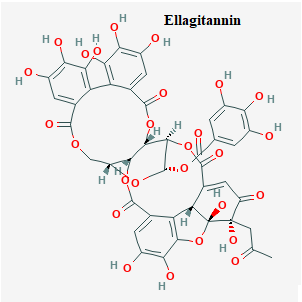
Gallotannins.
Gallic acid C7H6O5, hydrolysable tannin, pseudotannin. source
2 Condensed tannins.
Flavones condensed tannins, non-hydrolysable tannins, Anthoxanthins.
3 Phlorotannins.
Phloroglucinol C6H3(OH)3, a phlorotannin. source
Properties:
Tannins are polyphenolic compounds with large molecular weights that have enough hydroxyl groups for effective cross linking with other compounds, astringents.
Tannins are usually divided into hydrolyzable tannins and condensed tannins.
However, the term "tannins" has been applied to any compound or plant extract that could make skin collagen impervious to degradation, i.e make leather.
Tannins are any group of yellow-brown astringent compounds from gallic acid, in bark and galls, and used to convert animal hide to leather.
The word "tannin" is based on the Celtic word for oak tree.
Tannins occur in hemlock, oak galls, mangrove, wattle, chestnut, quebracho Schinopsi, sumacs hus, canaigre, and Rumex.
Tannin, i.e tannic acid, a polyphenol, is a yellow brown compound in coffee beans, oak galls, mahogany, tea leaves, tree bark, walnuts.
It reacts with proteins in skins to form leather.
It is used as a mordant, and for inks and dyeing.
E181 Tannic acid, is not an acid, but is usually shown as C75H52O46, decagallol glucose. source
It is probably a complex mixture of glucoses and esters.
Tannic acid (a polyphenol), in Caesalpinia, Rhus, does not occur in green tea or black tea.
Tannic acid is a light yellow to tan solid with a faint odour, which sinks and mixes with water.
Make a solution of tannic acid by boiling cut pieces of oak galls in water.
Tannic acid is sold as a brown powder and was used in tannic acid jelly for burns dressings.
Tea from Camellia sinensis, has a slightly bitter, astringent flavour.
Tea contains polyphenols, but tea does not contain tannic acid as previously believed.
Tannic acid is a dyeing mordant, slightly toxic if ingested.
Use tea solution to polish linoleum, windows and mirrors, remove fish smell and shine from seats of skirts or blue serge suits, deodorizes feet, dye greying white fabrics, highlight brown hair, treat sunburn
pain, with lemon treat sore throat, diarrhoea, sore eyes, burns, bleeding gums, broken finger nail, speed grass seed germination and house plant growth, with lemon deodorize stuffy rooms, clean and polish black lacquer and varnished woodwork, tenderize meat.
List of tannins:.
- Catechins: Catechins
- Chebulinic acid, C41H32O27, a gallotannin, may inhibit lipolysis, in Phyllanthus emblica fruit, in Terminalia tebula.
- Ellagic acid, C14H6O8: 16.3.6.16 from tree bark.
- Epicatechin gallate, C22H18O10, from green tea.
- Epigallocatechin, C15H14O7: Epigallocatechin from green tea.
- Epigallocatechin gallate, EPGC, C22H18O11.
- Gallocatechin gallate, C22H18O11, from green tea
- Punicalagin, C48H28O30, from pomegranate, Trigalloylglucose.
16.2.0 Carbon compounds
Carbon disulfide: 16.4.2
Carbon monoxide: 16.4.3
Carbonated beverages: 3.10.0
Carbonic acid: 3.9.0
Carbonyl, >C=O, is the organic compound functional group.
16.6.0 Hydrocarbons
16.5.0 Sugars
Experiments
Concentrated acids with a non-metal, carbon: 12.3.5
Dilute acids with non-metals, carbon, sulfur: 12.4.12
Feezing point depression of carbonated water: 24.4.3
Heat glycerine with sugar to form carbon: 12.1.7
Heat starch to form carbon: 16.1.4
"Lead pencils" contain graphite, not lead.
Organic carbon soil test: 6.10.6
Tests for carbonates / bicarbonates: 12.11.7
16.2.1 Carbonates
Carbonates, CO32-, are salts or esters of carbonic acid, H2CO3. source
Carbonated beverages, soft drinks3.10.0
Carbonated water, carbonic acid, H2CO3, soda water: 3.9.0 source
Carbonates, mineral carbonates: 16.2.18
Decomposition of carbonates: 3.7.3
Dilute acids with carbonates, common carbonates: 12.4.5
Heat carbonates of Cu, Mg, Na, Pb, Zn: 12.16.6
List of carbonates: 1.11
Reactions of carbonates: 12.15.0
Tests for carbonates / bicarbonates: 12.11.7
16.3.0 Carbohydrates
Carbohydrates were compounds such as aldoses and ketoses, stoichiometric formula Cn(H2O)n, so "hydrates of carbon".
Nowadays, carbohydrates include monosaccharides, oligosaccharides, polysaccharides, and substances from monosaccharides.
1. by reduction of the carbonyl group, >C=O (alditols), Carbonyl, >C=O, organic compound functional group.
2. by oxidation of one or more terminal groups to carboxylic acids, e.g ethanoic acid, CH3COOH. source
3. by replacement of hydroxy groups by a hydrogen atom, amino group, thiol group, and other groups, derivatives of these compounds.
Carbohydrate acids: D-gluconic acid, CH2(OH)(CHOH)4COOH, produced by fungi. source
D-glucuronic acid, C6H10O7, occurs in gums, forms glucuronides. source
d-gluconic acid, d-glucuronic acid, is food additive E574, anti-caking agent, sequestrant.
Sold as: D-Glucuronic acid, Glucodiuronic acid, C6H10O7. source
Experiments
Burn carbohydrates, fats and proteins: 9.1.1
Reactions of carbonates: 12.15.0
Tests for carbonates: 2.11.7
Tests for carbohydrates, Molisch's test: 9.3.7
16.3.1 Aldoses and ketoses
| C Atoms. | Aldose sugars contain an aldehyde group, R-(CHO). | Ketose sugars contain a ketone group, R1R2>(C=O). |
| 3 C triose. | Glyceraldehyde |. | Dihydroxyacetone |. |
| 4 C tetrose. | Erythrose | Threose. |. | Erythrulose |. |
| 5 C pentose. | Arabinose | Ribose | Xylose | | Ribulose | |
| 6 C hexose. | Galactose | Glucose | Mannose | | Fructose | Sorbose |. |
.
16.3.6 "Aquadag"
"Aquadag" (trade name) (Aqueous Deflocculated Acheson Graphite) (colloidal graphite), oildag, plumbago, "black lead", pyrolitic graphite, black lead
It is a form of graphite that occurs as mineral deposits or is made from petroleum, used in the "lead" of soft "B" pencils, as a lubricant and electrical conductor.
16.4.0 Gases containing carbon at STP
Carbon dioxide CO2 source
16.4.2 Carbon disulfide
Carbon disulfide, CS2, is toxic by all routes and it is Not permitted in schools. source
Pure carbon disulfide, colourless liquid, pleasant odour like chloroform.
Laboratory carbon disulfide, colourless-yellow liquid, strong, disagreeable cabbage-like odour, highly refractive, slightly soluble in water.
It is miscible with anhydrous methanol, ethanol, ether, benzene, chloroform, carbon tetrachloride, and oils.
It has fat-solvent properties, and is highly flammable.
It has a very low flash point, forms explosive mixtures with air, catches fire very easily, dangerous when exposed to heat, flame, sparks, or friction.
Carbon disulfide reacts with strong oxidizers, sodium, potassium and zinc azides, rust, halogens, and amines.
It reacts violently with chlorine, nitric oxide, and zinc.
It burns in air with blue flame to form carbon dioxide and sulfur dioxide.
CS2 + 3 O2 → CO2 + 2 SO2 source
Carbon disulfide is used in manufacture of regenerated cellulose rayon by the viscose process and cellophane.
It was used as grain fumigant in USA until 1985.
16.4.3 Carbon monoxide
Carbon monoxide, C≡O, (note triple bond), (carbonyl, CO), monodentate, ligand, Toxic by inhalation.
Do not prepare in the laboratory!
Carbon monoxide, Solution < 3%, Not hazardous.
Catalytic conversion of nitric oxide: 3.44.1
Carbon monoxide, danger of vehicle exhausts, tailpipe gases: 18.6.10
Commonly occurring air pollutants, safe air and clean air: 18.6.0.1 (See: carbon monoxide).
Decomposition of oxalic acid: 3.7.14
Methanoic acid (formic acid) ionization reaction: 16.2.7
Nicotine, tobacco smoking and chewing: 5.5.21
Oxides, acidic oxides and basic oxides: 12.13.4
Phosphorus pentoxide: With formic acid forms highly toxic carbon monoxide gas.
Potassium ferrocyanide: Heating with concentrated sulfuric acid forms carbon monoxide gas.
Reaction of carbon with steam, water gas: 12.15.5
Tests for substances with hot concentrated sulfuric acid: 12.11.3.6 (See: 8 and 9).
Carbon monoxide
Carbon monoxide, CO, carbon oxide, carbonic oxide (carbonyl, CO), monodentate ligand
Be careful! Do NOT make carbon monoxide.
See 18.6.3: Danger of vehicle exhausts, tailpipe gases
1. Toxicity and air pollution
Carbon monoxide is very toxic.
It can cause unconsciousness due to combination of the gas with haemoglobin in the blood, and prevents the blood from acting as an oxygen carrier.
Death can occur from carbon monoxide inhalation.
Do not prepare carbon monoxide in an open room.
Carbon monoxide is particularly dangerous, because it is a colourless, odourless and tasteless gas.
It kills more people than any other gas.
The gas can form accidentally by leaving a car engine running in a closed garage, or by burning a gas fire with restricted ventilation.
When carbon or carbon compounds burn in a limited supply of air, the reaction forms carbon monoxide.
It is very flammable and forms explosive mixtures with air.
It forms when carbon in fuels (petrol, wood, coal, natural gas) is not burned completely.
It is soluble in some organic solvents, such as ethyl acetate, chloroform and acetic acid.
It forms toxic and flammable compounds when exposed to finely dispersed metal powders.
It may react vigorously with oxygen, acetylene, chlorine, fluorine and nitrous oxide.
2C (s) + O2 (g) → 2CO (g) source
carbon + oxygen gas → carbon monoxide source
2. Carbon monoxide is insoluble in water, but it is absorbed by potassium hydroxide solution.
Carbon monoxide burns with a pale blue flame forming carbon dioxide.
2CO (g) + O2 (g) → 2CO2 (g) source
3. Carbon monoxide can act as a reducing agent and is the main reducing agent in a blast furnace.
At high temperatures, carbon monoxide reduces the oxides of copper, lead and iron to the metal.
Metal oxides are reduced by passing carbon monoxide over the heated oxide.
CuO (s) + CO (g) → Cu (s) + CO2 (g) source
Fe2O3 (s) + 3CO (g) → 2Fe (s) + 3CO2 (g) source
4. Use fume cupboard to reduce metallic oxides to the metal by passing carbon monoxide over the heated oxide.
16.4.4, Trichloroethane
16.4.4, Trichloroethane
Trichloroethane, CH3CCl3, 1,1,1-trichloroethane, methyl chloroform, Toxic if ingested, do not inhale vapour source
Trichloroethane 1,1,1-trichloroethane), Solution < 25%, Not hazardous
ACS reagent (may contain 0.05% low alkyl epoxide as stabilizer), "Chlorothene", (E512), methyl chloroform, grease solvent
It is a safer alternative to tetrachloromethane (carbon tetrachloride, CCl4). source
It was the solvent in "white-out" correction fluids, but banned in many school systems, because of "sniffing".
Ozone-depleting chemical being phased out of use.
Mixed with active metals, e.g. Na, Mg, Al, forms metal chloride and carbon in highly exothermic reaction.
Substitute for non-chlorinating solvents, e.g. acetone or ethanol.
16.4.5, Trichloromethane, Chloroform
Do NOT store, or use trichloromethane in school science laboratories.
Chloroform, CHCl3, trichloromethane, colourless liquid, pleasant odour, sweetish taste. source
It was formerly used as an inhaled anesthetic during surgery, but is now used as a solvent and fumigant.
Trichloromethane, CHCl3, chloroform, methane trichloride, TCM, Freon 20, Refrigerant R20, Toxic by all routes, irritant, possibly carcinogenic source
Not permitted in schools, harmful, local purchase, vapour in flame may form poisonous gases, BP. 61 oC, Store in a dark, cool place.
Experiments
Methane with chlorine: 16.5.1.3 (Dangerous experiment!)
Prepare trichloromethane, (chloroform): 16.1.8
Reaction of ethyl alcohol with bleaching powder: 16.1.14.2 (Dangerous experiment)
16.4.11.1 Relative molecular mass of gases
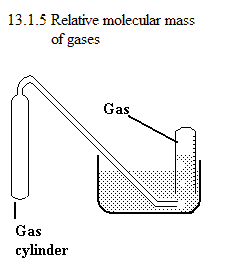
12.3.2: Saturated vapour pressure over water
The relative molecular mass, M, of a compound is the ratio of the average mass of molecules of the substance to 1 / 12 of the mass of one atom of C-12.
Number of moles = volume in litres / 22.4 litres / mol. At STP, 1 mol of most gases occupies 22.4 L at STP.
At 25 oC, 1 mol of most gases occupies 24.45 L.
Weigh a gas container.
Collect 1 litre of gas in an inverted measuring cylinder over water.
The levels of water inside and outside the measuring cylinder must be the same.
Weigh the gas container again.
Calculate the loss in weight (about 2 g).
Note the temperature and atmospheric pressure.
For propane, if loss in weight of gas container = 1.8 g, 1.8 × 24.45 = 44 = relative molecular mass of propane.
Use other sources of gas, e.g. a cigarette lighter.
Hold it under water below the measuring cylinder with the valve kept open with a rubber band.
16.5.0 Sugars
16.5.1 Sugars
Sugars are simple carbohydrates, one or more monosaccharide units, soluble in water, optically active, sweet to taste and fermentable.
However, the term "sugar" generally refers to monosaccharides and lower oligosaccharides.
"Reducing sugars" reduce copper (II) to copper (I) salts in Fehling's solution or other test solutions, show presence of aldehyde group.
Monosaccharides have a straight chain form or ring form, cannot be split into smaller molecules using dilute acids, cannot be hydrolysed to simpler compounds.
Table 16.3.1.3 Aldose sugars and ketose sugars
9.142 Fehling's test.
Monosaccharides, D and L sugars
9.3.6 Tests for breakdown of starch to sugars
9.3.17 Tests sugars
16.5.2 Monosaccharides
Monosaccharides, Cx(H2O)y, where x = 1 or 2 or 3, contain a single sugar unit, e.g glucose, fructose.
So they cannot be hydrolysed to simpler sugars.
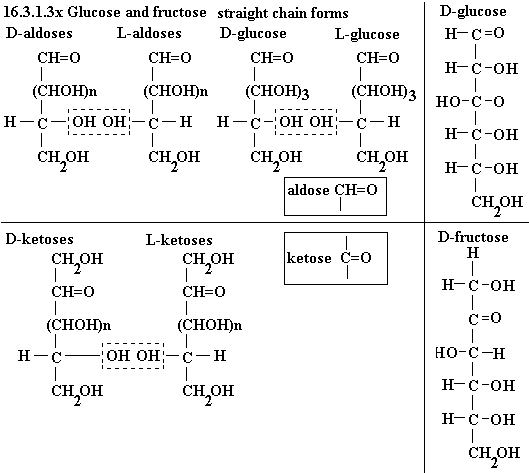
List of monosaccharides
| Apiose | Arabinose | Deoxyribose | Digitalose | Fructose | Galactose | Galacturonic acid | Glucosamine | Glucose | Glucuronic acid | Hamamelose | Mannose | Rhamnose | Ribose | Ribulose | Sorbose | Xylose |.
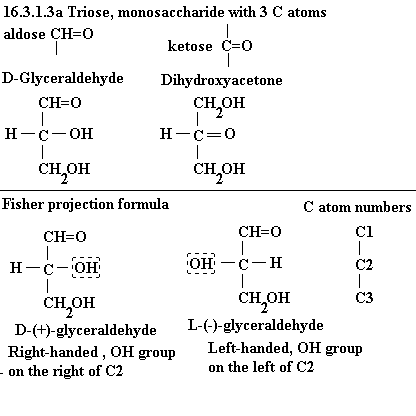
Ketose: dihydroxyacetone.
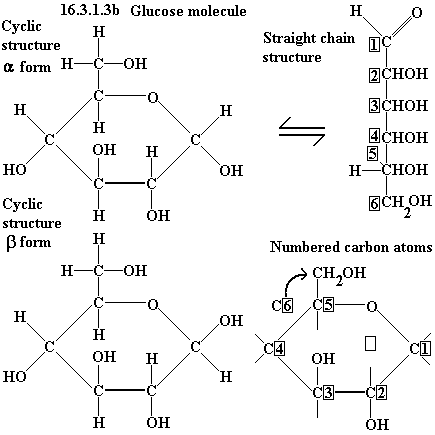
16.3.1.0 Aliphatic compounds
Arabinose, Deoxyribose, Digitalose, Fructose, Galactose, Glucose, Glucuonic acid, Mannose, Rhamnose, Ribose, Ribulose, Sorbose, Xylose
Classification: of monosaccharides.
1. Classification by number of carbon atoms.
Triose, 3 carbon atoms, C3H6O3, dihydroxyacetone, glyceraldehyde. source
Tetrose, 4 carbon atoms, C4H8O4, e.g. erythrose, threose, erythrulose. source
Pentose, 5 carbon atoms, C5H10O5, e.g. arabinose, lyxose, ribose, xylulose. source
Hexose, 6 carbon atoms, C6H12O6, e.g. allose, altrose, glucose, mannose, gulose, idose, galactose, talose. source
2. Classification by whether aldose or ketose.
Aldose
An aldose contains the aldehyde group (-CHO), i.e a carbonyl, group, C=O, with a hydrogen atom attached to the carbon atom, e.g glucose.
A monosaccharide bonded to an aldehyde chain, Cn(H2O)n, e.g. glyceraldehyde, CHOCHOHCH2OH, the simplest aldose. source
An aldose sugar is also an aldehyde which contains one aldehyde group per molecule.
Ketose
A ketose contains the ketone group (-CO-), at C2, monosaccharide sugar containing a ketone group or compound derived from a ketone.
A ketone group is a carbonyl group, C=O, with two single bonds to other carbon atoms.
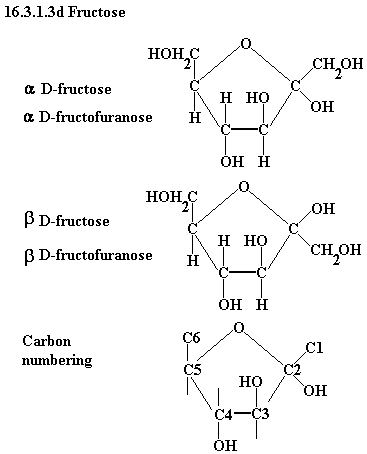
A ketose sugar contains one ketone group per molecule, e.g fructose, CH2OHCHOHCHOHCHOHC=OCH2OH. source
Ketose sugars include:
- Dihydroxyacetone
- Xyulose, C5H10O5, pentose, not used as a sweetener.
Sold as: D-Xylulose, D-threo-Pentulose, faint yellow syrup.
16.5.3 Monosaccharides, D-sugars and L-sugars
Left-handed and right-handed structural forms, D-sugars and L-sugars
The Fischer projection formula, Emil Fischer (1852 - 1919), allows 3-dimensional sugar and amino acid molecules to be represented by 2-dimensional diagrams.
Horizontal lines show groups projecting above the plane of the page towards you.
Vertical lines show groups projecting below the plane of the page away from you.
So D-glyceraldehyde has the hydroxyl group on C2 on the right and L-glyceraldehyde has the hydroxyl group on C2 on the left, (Latin: dextro = right, laevo = left).
In other carbohydrates, if the C atom farthest from the aldehyde or ketone group has the same arrangement as D-glyceraldehyde, hydroxyl on the right of C2, then the compound is a D-sugar.
Similarly, if this "remote carbon atom" has the same arrangement as L-glyceraldehyde, the compound is an L-sugar.
However, monosaccharides exist mainly as cyclic forms, not the aldo-forms or keto-forms.
16.5.4 Disaccharides
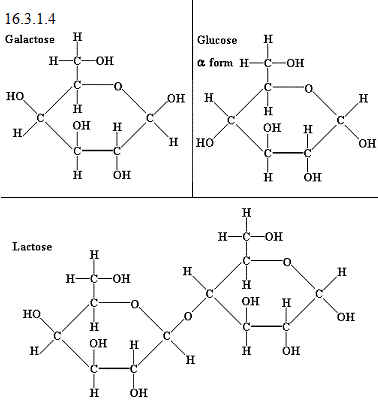
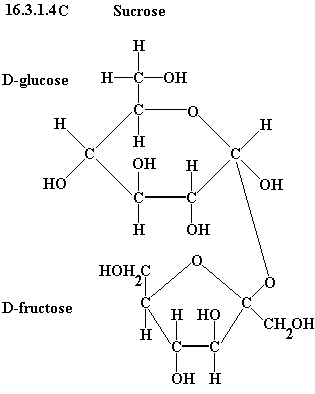
Disaccharides have 2 monosaccharide units.
Hydrolysis of disaccharides with acids or enzymes gives two molecules of monosaccharide.
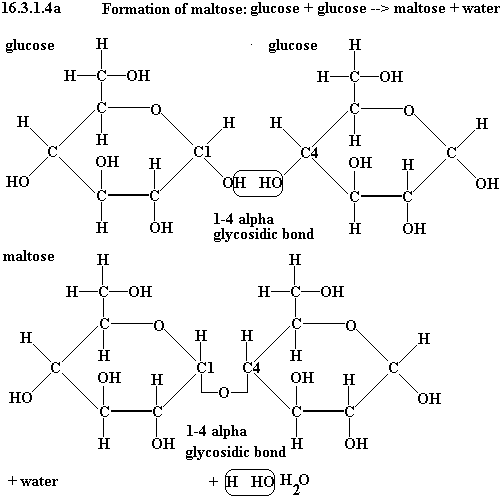
In a disaccharide, the two monosaccharide units are joined via the oxygen atom, a glycosidic linkage.
Disaccharides contain two sugar units:
16.5.5 Haworth projection
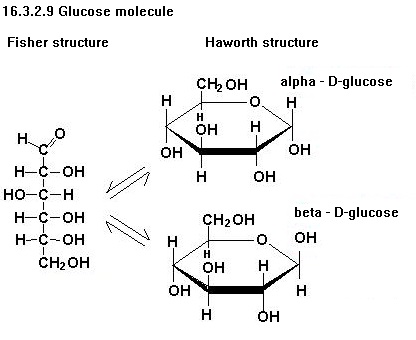
The cyclic structure of monosaccharides is shown by a "Haworth projection", invented by W N Haworth, 1813-1950, England.
The oxygen atom is at the upper right and the carbon atoms are arranged clockwise with C1 at the far right.
The hydroxyl groups on the right in the Fischer projection are down in the Haworth projection So the hydroxyl groups on the left in the Fischer projection are up in the Haworth projection.
The terminal -CH2OH group is up in the Haworth projection for D-sugars, and down for L-sugars. source
D-glucose can have α-or β-forms, depending on the position of the hydroxyl group attached to C1, down in the α-form and up in the β-form.
Most monosaccharides have a ring cycle of six atoms, one oxygen atom and five carbon atoms, called the pyranose form.
A ring cycle of 5 atoms, one oxygen atom and four carbon atoms is called a furanose form.
So D-fructose can exist as α-D-fructofuranose, -OH on C2 is down, and β-D-fructofuranose, -OH on C2 is up.
Glucose, Sold as: "D-(+)-Glucose, dextrose".
Fructose, D form, but laevorotatory, so "L-fructose", Sold as: "D-(-)-Fructose, D-Levulose, Fruit sugar".
16.5.6 Oligosaccharides
Oligosaccharides usually have 3 to 10 monosaccharide units, only sucrose occurs in all plants, raffinose and stachyose occur in most legume seeds.
Cellobiose, disaccharide
Lactulose, disaccharide
Trehalose disaccharide
Umbelliferose trisaccharide
Verbascose pentasaccharide
Ajugose
Ajugose, C36H62O31, hexasaccharide, sweet source
It occurs in Ajuga, verbascum, and seeds of Vicia, Vigna mungo.
Gentianose
Gentianose, C18H32O16, sweet, trisaccharide, reserve carbohydrate source
It occurs in Gentiana rhizomes.
Gentiobiose
Gentiobiose, C12H22O11, bitter, two beta-D-glucose residues linked, in plant glycosides, e.g. amygdalin. source
Inulin
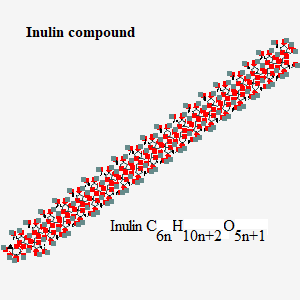
Inulin, C228H382O191, occurs in plant tubers and roots, is naturally occurring, indigestible and non-absorbable oligosaccharide fructan dietary fibre source
It is stored in roots or rhizomes instead of starch, and it is used in processed foods to replace sugar and fat.
It occurs in roots and tubers of | Common chicory (Cichorium intybus), Asteraceae | Jerusalem artichoke (Helianthus tuberosus), Asteraceae | Golden Dahlia, (Dahlia pinnata), Asteraceae | sunflower, wheat, rye, onion, bananas, garlic, asparagus, and barley kernels.
Inulin stimulates the growth of beneficial bacteria in the colon to protect against pathogens and toxins, which can cause inflammation and cancer.
Prebiotic fermentation of inulin leads to an increase in short-chain fatty acids and lactic acid production, reducing colonic pH and anticancer activity.
Lactose
Lactose, C12H22O11, milk sugar (disaccharide: glucose + galactose), occurs in human and cow's milk, milk sugar, but it iws not as sweet as sucrose source
Lactase decomposes lactose molecules to α-glucose and β-galactose, nutrient for infants and convalescents.
It occurs in Forsythia flowers and Achras fruit.
Lactose, C12H22O11.H2O, milk sugar lactitol, food additive E966, sweetener, texturizer, humectant, E279 source
Lactose, disaccharides: 16.3.1.4.0
Lactose intolerance: 19.2.4
Ice cream: 16.2.10
Tests for glucose, urine test: 19.1.20.4
Laminaribiose
Laminaribiose, C12H22O11, sweet, occurs in Colchicum petals, and some plant glycosides, made from seaweed polysaccharide laminaran, C18H32O16. source
antiseptic, formed from caramelization of glucose.
Lepidimoide
Lepidimoide, C12H17NaO10, sweet, in cress, sunflower and buckwheat seeds, Lepidium. source
Lychnose
Lychnose, C24H42O21, tetrasaccharide, reserve carbohydrate, sweet, in Lychnis, Dianthus, in Caryophyllaceae, woody plants, cucurbits and legumes. source
Maltose
Maltose Oligosaccharides
Maltose, malt sugar, disaccharide, produced by hydrolysis / digestion of starch, 2 glucose residues
Disaccharides: 16.3.1.4.0
Food additive, E965 Maltitol and maltitol syrup (from maltose) (sweetener, humectant, stabilizer)
Breakdown starch during germination: 9.112
Breakdown starch to sugars (laundry starch): 3.95
Hydrolysis of starch by salivary amylase): 9.5.4
Non-enzymatic browning, caramelization: 19.3.4.3
Sense of taste, the gustatory system: 9.246
Tests for activity of diastase: 9.3.9
Tests for glucose, urine test: 19.1.20.4
Tests for sugars: 9.3.17
Tests for starch with Fehling's solution: 9.142.3
Tests for hydrolysis of starch: 9.6.5
Yeast, fermentation, brewing, beer: 16.7.11
Yeast, Ferment sucrose with yeast: 12.1.20
Melezitose
Melezitose, C18H32O16, sweet, nonreducing trisaccharide sugar, in pine manna, Pinus, Pseudotsuga, aphids Cinara honeydew attracts ants, bees. source
Raffinose
Raffinose, C18H32O16, gossypose, trisaccharide, in plant leaves, Vicia, sugar beet, cotton seed, reserve carbohydrate. source
Stachyose
Stachyose, D-Stachyose, Lupeose, C24H42O21, sweet, a tetrasaccharide of two D-galactose units, an oligosaccharide source
It occurs in human milk, green beans, soybeans, Stachys roots, Jasminum, Lupinus, and in Fraxinus.
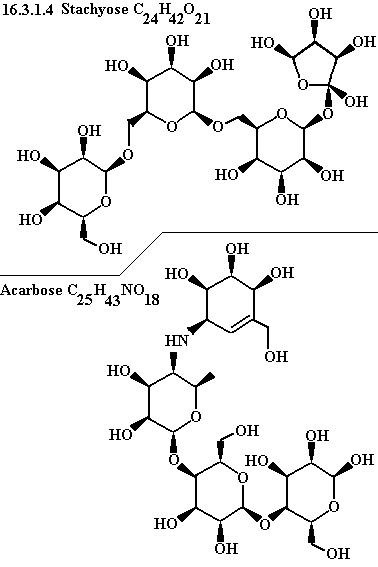
Stachyose (tetrose: fructose + galactose + glucose + galactose, i.e. raffinose + galactose)
Sucrose
3.1.2 Sucrose
Sucrose, D-Sucrose, cane sugar, "sugar", C12H22O11, sweet, disaccharide formed by glucose and fructose units source
It occurs in green plants especially nectars, sugar cane.
3.1.3 Sucrose octoacetate
Sucrose octoacetate, C28H38O19, acetylated derivative of sucrose, is used as a bitterant. source
It is used as a harmless aversive agent for methanol, (methylated spirits), to make an undrinkable denatured spirit, because methanol caused blindness in alcoholics who are determined to drink it.
3.1.4 Sucrose with borax
Sugar has a similar reaction to glycerine on borax and phenolphthalein, but different strengths of solutions are needed.
Dissolve half a 2 mL of borax in a test-tube nearly full of water and add one or two drops of phenolphthalein to obtain a rose red liquid.
Add solid sugar, at a time, and shake the test-tube.
The colour disappears.
Heat the test-tube, the colour reappears, only to vanish again when the test-tube is cooled under the tap.
3.1.5 Sucrose with sodium hydrogen sulfate
Sodium hydrogen sulfate, NaHSO4 (sodium bisulfate) source
Mix together a 2 mL of sugar and a 2 mL of powdered sodium hydrogen sulfate (sodium bisulfate).
Heat the mixture in a dry test-tube.
The contents of the test-tube swells up forming a black puffy mass of carbon.
3.1.6 Ferment sucrose with yeast
Fermentation is a chemical reaction caused by lowly forms of life, such as bacteria and moulds.
An example of this in the turning sour of milk.
Baker's yeast is a simple form of plant life, which, under suitable conditions, is able to turn sugar (and starch) into alcohol and carbon dioxide.
In bread making, it is the carbon dioxide gas that puffs up the dough and makes the bread light.
Dissolve 5 mL of sugar in a beaker of water and put the solution into a flask, fitted with a delivery tube dipping into limewater.
Add 5 mL of baker's yeast and leave the apparatus in a hot place, such as a shelf of the airing cupboard.
In an hour or two the contents of the flask begins to froth and the limewater turn milky, showing that carbon dioxide is being produced.
If the flask is left for two or three days and the contents are then filtered, alcohol can form from the filtrate by distillation.
The first few drops of the liquid formed by distillation burn with a blue flame, a characteristic of alcohol.
Trehalose
Trehalose, C12H22O11, disaccharide, mycose, mushroom sugar, sweet, in fungi, some prevent desiccation function. source
Umbelliferose
Umbelliferose, C18H32O16, trisaccharide, sweet, in Angelica, Aegopodium, reserve carbohydrate. source
Verbascose
Verbascose, C30H52O26, pentasaccharide (stachyose + alpha-D-galactopyranose), sweet, in green plants storage organs, Verbascum. source
Pentosans
Pentosans are polysaccharides composed of pentose sugars, in grains, fruits, and legumes, used to increase water holding capacity of flour so bread takes longer to go stale.
Pentosans contain long chains of 1,4-beta-d-xylopyranose and single 1,2- or l, 3-alpha-l-arabinofuranose side groups.
Pentosan polysulfate sodium is used to treat problems with horse joints.
Trehalulose
Trehalulose, disaccharide, reducing sugar, fructose + glucose, sucrose isomer in honey, especially of stingless bees in Australia.
16.5.7 Polysaccharides
Polysaccharides, e.g. amylose, usually have more than ten monosaccharide units linked by glycosidic bonds, between C1 on one sugar and C4 on other sugar by removal of water molecule, i.e. a condensation reaction.
16.5.9 Sugar acids
Sugar acids, acidic sugars, monosaccharides with a carboxyl group, [C(=O)OH], at one end of the chain or at both ends of the chain.
Sugar acids occur when a carbonyl group, C=O, or a hydroxyl group OH is oxidized to a carboxylic acid group, R–COOH.
Classes of sugar acids include:
Ascorbic acid Gluconic acid Glucuronic acid Tartaric acid
16.6.0 Hydrocarbons
16.6.1 Hydrocarbons
Aliphatic hydrocarbons
16.6.2 Butane, C4H10 source
16.6.3 Ethane, C2H6 source
16.6.4 Ethene, Ethylene, C2H4 source
16.6.5 Ethyne, Acetylene, C2H2 source
16.6.6 Heptane, C7H16 source
16.6.7 Hexane, C6H14 source
16.6.8 Octane, C8H18 source
16.6.9 Pentane, C5H12 source
16.6.10 Propane, C3H8 source
Aromatic hydrocarbons, arenes
Benzene, C6H6 source
Naphthalene, C10H8 source
Toluene, C7H8 source
Hydrocarbon solvents, Flammable: 7.9.26
Tests for gases from burning hydrocarbons: 16.6.6.0
Tests for unsaturated hydrocarbons: 9.3.20
See diagram 16.1.1chd: Alkanes, alkenes, alkynes
16.6.1 Hydrocarbons
Hydrocarbon compounds contain only hydrogen and carbon.
Hydrocarbons are usually colourless and have low solubility in water.
Crude oil is a mixture of hydrocarbons.
Hydrocarbons may be:
saturated, i.e. have only single bonds,
unsaturated, i.e. contain multiple bonds, e.g. double bond =,
triple bond, e.g. carbon monoxide, C≡O.
Hydrocarbons, hydrocarbon chains, -C-C-C-, bond angle 109.5o, -CH2-CH2-CH2- source
Hydrocarbyl groups, methyl -CH3. ethyl -C2H5, phenyl -C6H5 source
Short chain hydrocarbons are in flower scents and fruits and also bad smelling molecules, e.g diallyls and mercaptans.
Long chain hydrocarbons, especially alkanes, are in cuticle waxes.
Allicin, Diallyl sulfide, Diallyl disulfide, Dodecane, Hentriacontane, Methyl mercaptan, Naphthalene, Octan-1-ol, Pentadecane, Ranunculin
16.6.2 Butane
Butane gas, C4H10, n-butane, gas occurs in cigarette lighters and portable gas appliances, highly flammabl source
Butane gas, 93.2 MJm-3, a liquefied petroleum gas (LPG), liquefied gas, bottled gas, is liquefied butane
n-Butane, BP -0.5 oC, RD 0.60 at 0 oC, is stored as liquid under pressure in steel cylinders giving Calor gas and cigarette lighter gas.
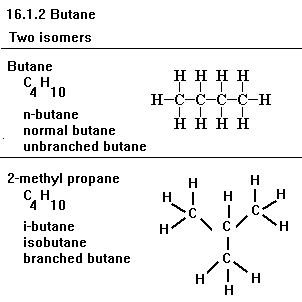
Butane isomer is 2-methylpropane, CH3CH(CH3)CH3, formerly called "isobutane" source
Packaging gases, E943a, Butane (propellant, solvent)
A mixture of butane and 2-methylpropane is used in disposable cigarette lighters
Butane is a highly flammable gas at room temperature, vapour pressure 2.4 atm.
Butane gas is stored as liquid under pressure in fire lighters.
If the lighter trigger is squeezed, the canister opens and the liquid forms a vapour.
Cigarette lighter fuel is 90% butane, isomer isobutane.
Sudden decompression in aircraft can cause butane cannisters to rupture.
Butane is Calor gas and cigarette lighter gas, used in cigarette lighters and portable gas appliances.
Butane is a Highly flammable gas at room temperature, vapour pressure 2.4 atm.
Butane gas is stored as liquid under pressure in fire lighters.
If lighter trigger is squeezed, canister opens and liquid forms a vapour.
Cigarette lighter fuel is 90% butane, isomer isobutane.
Sudden decompression in aircraft can cause butane cannisters to rupture.
Density of gases, Butane (Table)
Burn butane bubbles: 19.1.2.1
Butyl chloride rainbow reactions: 12.1.11
Combustion of butane: 16.6.4.2
16.6.3 Ethane
Ethane C2H6 | CH3.CH3 | H3C.CH3 source
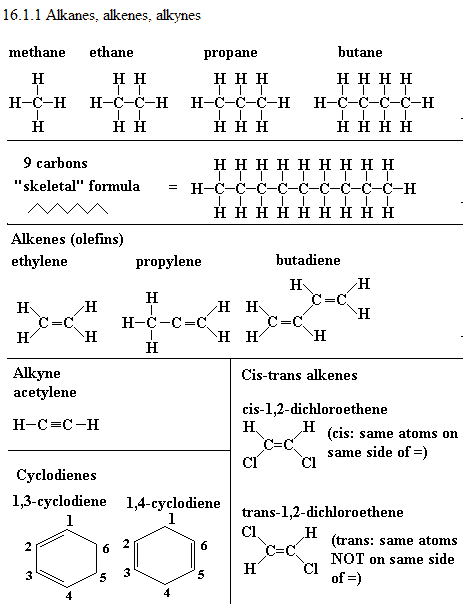
Ethane, methyl methane, is a colourless and odourless gas, which has properties similar to methane.
CFCs, chlorofluorocarbons, "Freons": 12.19.5.0
Density of gases, Ethane (Table)
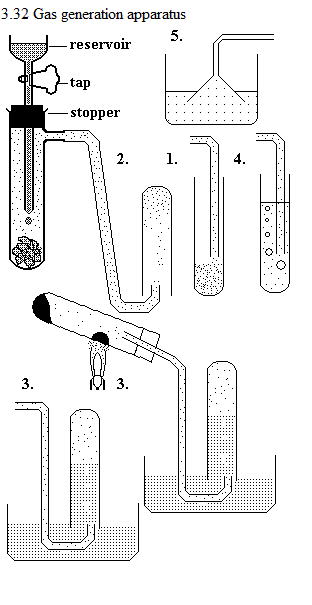
13.3.0: Prepare gases with gas generation apparatus
16.6.4 Ethene
Ethene, (ethylene), C2H4, CH2.CH2, H2C=CH2, is the simplest alkene, highly flammable, asphyxiating gas, can cause anaesthesia. source
Ethene gas is a plant growth substance produced in wounded, diseased and ripening tissues, reacting with auxins to induce fruit ripening and abscission of leaves or diseased parts
Alkenes CnH2n, olefins: 16.1.1.2.0
Aluminium oxide: 13.1.10
Auxins: 9.1.7.1 (2.)
Breakdown ethanol to ethene: 3.96
Burn ethylene in chlorine: 12.4.8.7
Chemical sources of polymer materials, ethylene (LD), ethylene (LLD), ethylene (HD)
Density of gases, ethene: 12.4.0 (Gas, Molecular weight, Density), (Table 1)
Ethylene gas, CH2, abscission: 9.1.7.3 source
Ethylene, used to ripen stored fruit artificially, e.g. bananas: 14.0 Banana ripening.
Ethylene compounds
Acrylamide: 16.1.5.6.1
EDTA, Ethylenediaminetetraacetic acid: 4.0
EDTA, Ethylenediaminetetraacetic acid disodium salt, EDTA: 9.10.0
EDTA, Mineral deficiency experiment, hydroponics: 9.9.18.5
EDTA, synthetic chelating agent: 16.4.4 (3.)
EDTA, Test for water hardness, Calmagite indicator: 12.3.5
EDTA, Tests for water hardness, Eriochrome Black T indicator: 12.3.6
Ethephon phosphonate, Plant growth regulators: 9.88.1
Ethylene chlorohydrin Yam project
Ethylene absorption by oxidation with sodium permanganate: 16.4.5.1
Ethylene aldehyde: Acrolein
12.7.4 Ethylene aldehyde, Tests for glycerine
Ethylene bisthiocarbamate, Mancozeb: 16.6.13
Ethylene bromide, Cassava project: 17. (9.)
Ethylene chlorohydrin, C2H5ClO, (2-chloroethyl alcohol), (2-chloroethanol), highly toxic, is used to break yam dormancy. source
Ethylene dibromide, Tests for unsaturated hydrocarbons, bromine water tests for unsaturation: 9.3.20
Ethylene dibromide, 1,2-Dibromoethane: 12.18.16
Ethylene dibromide: 4.13.9.2 Fumigants
Ethylene dibromide: Dibromo
Ethylene dichloride (1.2-dichloroethane, Freon 150), C2H4Cl2, ClH2C-CH2Cl, toxic, highly flammable source
Ethylene dichloride, 1,2-dichloethane, Solution < 1%, Not hazardous
Ethanediol C2H6O2, anti-freeze source
16.6.4.2 Combustion of butane
Butane / Oxygen combustion
2C4H10 + 13O2 → 8CO2 + 10H2O + energy source
16.6.5 Ethyne, (acetylene), C2H2
16.6.5 Ethyne, (acetylene), C2H2 source
Tests for acetylene: 16.6.6.2
Oxyacetylene welding: 34.9.0
Acetylene, C2H2, ethyne, Use Ethyne, (acetylene), C2H2, in a fume cupboard or use very small quantities in a well-ventilated area. source
Use eye and skin protection to avoid splashes.
Mixtures of ethyne and air may be dangerously explosive.
Explosive acetylides form when acetylene reacts with silver or copper (I) salts.
Formerly, bicycle "carbide lamps" used calcium carbide + water → acetylene + calcium hydroxide. source
However, the calcium carbide used to decompose in moist air to form the unpleasant odour of acetylene.
The gas has a foul smell, because of the presence of traces of phosphorus hydrides.
This decomposition could be lessened by pouring petroleum over the calcium carbide to exclude air and moisture.
Acetylene forms highly explosive mixtures with air, but is otherwise not toxic.
As prepared from the reaction of calcium carbide with water, it usually has an evil smell, because of the presence of small amounts of phoshpines, R3P.
Do not inhale the impure gas.
Handle acetylene cylinders with care.
Unplanned release of a large quantity of acetylene may result in a serious fire or explosion.
In acetylene cylinders, acetylene is dissolved in acetone supported on a porous diatomaceous earth base.
The pressure inside an acetylene cylinder is therefore lower than in other cylinders that contain compressed gases, e.g nitrogen.
16.6.6 Heptane
Heptane, C7H16, BP 98 oC, RD 0.68, nine isomers, normal heptane has similar properties to normal hexane. source
Heptane, n-heptane, heptane fraction, toxic by all routes, Highly flammable: 16.6.7.0
16.6.6.1 Prepare acetylene (ethyne)
CaC2 + 2H2O → Ca(OH)2 + C2H2↑ source
The main hazard with calcium carbide is the ignition of air / acetylene mixtures.
A violent explosion may occur, depending on the proportions of air and acetylene.
Acetylene, when undiluted with air, burns with a smoky flame.
Before igniting acetylene, be sure that it is not mixed with air.
Purchased calcium carbide usually contains sulfur and phosphorus compounds that react with water to form strongly smelling gaseous impurities that act as a convenient indicator for the presence of acetylene.
1. In a fume cupboard, put a 2 g lump of calcium carbide in a 250 mL beaker.
Add water drop-by-drop.
Calcium carbide reacts vigorously with water forming acetylene gas (ethyne) and releasing a considerable amount of heat.
Ignite the resulting bubbles of acetylene.
2. On a metal tray or shallow container in a fume cupboard, add water drop-by-drop to one lump of calcium carbide.
The water will hiss and the gas will be produced.
The lump will fall to pieces to form a powder of calcium hydroxide.
Do not attempt to ignite the acetylene produced.
3. Put a < 5 g lump of solid calcium carbide in 500 mL of water and ignite the ethyne produced.
Do this experiment outside, with the observers at least 2 metres away.
4. Formerly, bicycle "carbide lamps" used the following reaction.
Put sand in a dry test-tube and add pieces or lumps (not powder) of calcium dicarbide (calcium carbide).
Add water drop by drop.
Collect the gas over water.
CaC2 + 2H2O → C2H2 + Ca(OH)2. source
calcium dicarbide + water → ethyne (acetylene) + calcium hydroxide. source
5. Collect acetylene from oxy-acetylene equipment.
16.6.6.2 Tests for acetylene
Light the gas in the test-tube with a glowing splint.
The gas burns with a smoky flame.
16.6.7 Hexane
Hexane, C6H14, CH3(CH2)4CH3, n-hexane, normal hexane, hexane fraction, toxic by all routes, Highly flammable source
Hexane, BP 68.7 oC, RD 0.66, exists as five compounds with same formula, normal hexane, n-hexane, in petrol and petroleum ether solvent
It is a colourless liquid, with an ethereal odour.
"Shellite" (Australia) is 60% hexane and 40% heptane.
Stem name: hex-
Hexane, Solution < 5%, Not hazardous
Hexane, Cleaning agents, solvents: 2.20.4
Hexane-1,6-diamine, C6H16N2, 1,6-Hexanediamine source
Adipic acid (hexanedioic acid)
Alkanes CnH2n+2, paraffins (hexane): 16.4.1.1
Flammable: 7.4.26
Hexanedioicacid adipic acid, C6H10O4 or HOOC(CH2)4COOH source
Hexanedioyl dichloride, C6H8Cl2O2, adipoyl chloride, adipoyl dichloride, toxic by all routes source
Lactams (-NH(CO-), caprolactam: 16.3.4.0.3
Prepare nylon polymer: 3.4.7
Reactions of bromine water (bromine solution): 12.19.9.2 (See: 6.)
Size of carbon atom in stearic acid molecule: 11.6.5
Tests for iodides (hexane): 12.11.12 (See: 3.)
Tests for unsaturated hydrocarbons: 9.3.20
16.6.8 Octane
Octane, C8H18, CH3(CH2)6CH3, BP 126 oC, RD 0.702 at 20 oC, exists as eighteen compounds, in petroleum. source
Octane, C8H18, n-octane, colourless, normal octane, Harmful, stable, but highly flammable source
Isomeric with iso-octane, 2,2,4-trimethylpentane (CH3)3CCH2CH(CH3)2.
Spark plug, pre-ignition: 32.5.5.10
16.6.9 Pentane
Pentane, n-pentane, C5H12, CH3(CH2)3CH3, colourless liquid, highly flammable, so use other less volatile alkanes source
Pentane, BP 36.3 oC, RD 0.63, is made by distillation of petroleum.
Pentane : 16.6.5.0
Pentanedioic acid, glutaric acid (not glutamic acid!), COOH(CH2)3COOH source
16.2.8 Pentanoic acid (valeric acid)
16.6.10 Propane
Propane, C3H8, colourless liquefied petroleum gas, a bottled gas, BP -42.2 oC, catalytic cracking forms propylene, propellant, aerator source
It is used as a fuel for gas barbecue and blow torch
Oxidative dehydrogenation of propane, C3H8, to produce unsaturated organic compound propene, propylene, CH3CH=CH2 source
2CH3-CH2-CH3 + O2 → 2CH3CH=CH2 + 2 H2O source
propane + oxygen → propene + water source
Propane gas, a bottled gas, a liquefied petroleum gas (LPG)
propyl (C3H7-, Stem name: prop- source
Propane: 16.6.2.0
Density propane (Table)
Packaging gases, propellants, food additives: 19.4.22 propane-1,2,3-triol, glycerin, glycerine
Relative mass of gases, propane: 16.4.11.1
LPG Liquefied Petroleum Gas
Apiose
Apiose, D-Apiose, C5H10O5 monosaccharide, in parsley, (Petroselenum crispum) as the flavone glucoside Appiin source
It occurs in polysaccharides of aquatic plants, and in Lemna, Posidonia, Wolffia, and Zostera.
Arabinose
Arabinose, L-Arabinose, C5H10O5, pectinose, pectin sugar, in plant glycosides, hemicelluloses and gums. source
Sugar component of anthraquinone glycosides of Aloe.
Arabinose (Table).
Arabinose is sold as L-(+)-Arabinose.
L-Arabinose is found in or produced by (Saccharomyces cerevisiae).
Deoxyribose
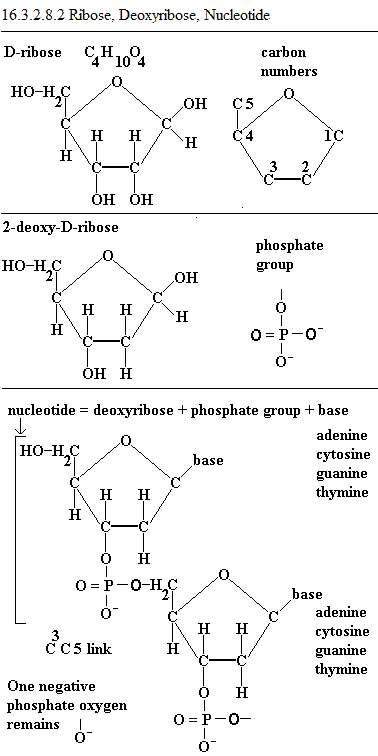
Deoxyribose, Deoxy-D-ribose, Desoxyribose, C5H10O4. source
Sugar component of desoxyribonucleic acid, DNA, prepared by acid hydrolysis of DNA.
16.1.8 Nucleosides, nucleic acids, DNA, RNA.
9.4.0H DNA and RNA.
Deoxyribose is found in or produced by (Saccharomyces cerevisiae).
Digitalose
Digitalose, C7H14O5, in cardiac glycosides, in common foxglove (Digitalis purpurea). source
Fructose
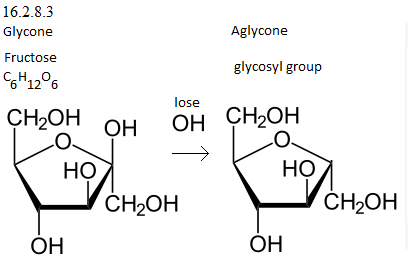
Fructose, C6H12O6, D form, but laevorotatory, so "L-fructose", sold as: "D-(-)-Fructose, D-Levulose, Fruit sugar", pure honey. source
Fructose (Table).
Fructose occurs as free sugar in phloem and nectar, in oligosaccharides, e.g. sucrose, twice as sweet as glucose.
Tests for reducing sugars gives no values for fructose.
D-Fructose, C6H12O6, D-Fructopyranose, sweetening agent, monosaccharide, in sweet fruits and honey and soluble in water and alcohol. source
It is used as a preservative and in intravenous feeding.
Galactose
Galactose, C6H12O6, L-Galactose, Brain sugar, Cerebrose, sold as: D-(+)-Galactose. source
Galactose (Table).
Galactose occurs in hemicelluloses of pectins, gums, mucilages, and in some glycosides, sugar of seaweed polysaccharides, Porphyra.
Repeating disaccharide unit, "poly β-galactose--β-acetylglucosamine-6-sulfate", occurs in bovine cornea.
(Bacteroides thetaiotaomicron) in the colon harvests additional energy from otherwise indigestible sugars, e.g. galactose and mannose.
Tests for reducing sugars gives no values for galactose.
Caramelization temperature of galactose is 160 oC.
D-Galactose, C6H12O6, D-Galactopyranose, is a naturally occurring sugar, and it occurs in dairy products. source
It is not commonly used as a sweetener, because it is only about 30% as sweet as sucrose.
It is used in some common vaccines and non-prescription products.
Galacturonic acid
Galacturonic acid, C6H10O7, occurs in polymers, in plant cell wall pectin, in saponins, and in Marchantia moss. source
Glucosamine
Glucosamine, C6H13NO5, (2-amino-2-deoxyglucose), is a sugar in animal chitin and mucoprotein source
It is a monosaccharide amino sugar, from fermentation of grain, anti-arthritic and may help relieve symptoms of arthritis.
However, scientific evidence is not conclusive and it may interact with warfarin, so large doses are not advised.
Glucosamine dietary supplements should be taken with food to avoid upset stomach, heartburn and diarrhoea.
Glucosamine occurs in bacteria and fungi cell wall, Aspergillus, in glycoproteins of plant seeds, Phaseolus.
Glucuronic acid
Glucuronic acid, C6H10O7, in plant gums and mucilage source
It occurs in Miquel's Wintergreen, (Gaultheria miqueliana), Ericaceae.
Hamamelose
Hamamelose, C6H12O6, with tannin source
Mannose
Mannose, C6H12O6, in plant polysaccharides, in natangura palm (Metroxylon warburgii). source
Mannose (Table).
Mannitol, CH2OH(CHOH)4CH2OH, from mannose or fructose, sugar in fungi and brown algae, food sweetener. source
Sold as D-Mannitol, Mannite, C6H14O6. source
Early purple orchid (Salep dondurma), fox testicle, ground tuber in turkish ice cream "dondurma" (glucomannams: glucose + mannose).
Sold as: D-(+)-Mannose from wood, D-Mannopyranose, L-(-)-Mannose.
Quercitrin
Quercitrin, C21H20O11, Fagopyrum, (Quercus → Quercetin and Rhamnose). source
Quercitrin, in allspice herb, a glycoside formed from the flavonoid quercetin and the deoxy sugar rhamnose, is in the dye quercitron.
Deoxy sugar rhamnose in alder buckthorn (Rhamnus frangula), frangula bark, a former laxative.
Rhamnose
Rhamnose, C6H12O5, deoxy sugar in many plant glycosides and polysaccharides, especially pectins, gums, very sweet taste. source
Ribose
Ribose, C5H10O5, D-ribose, in ribonucleic acids, and metabolic ATP, adenosine. source
Ribose (Table).
Ribose has all the hydroxyl groups on the same side in the Fischer projection.
Industrial: D-(-)-Ribose, 099%, CAS Number 50-69-1, Empirical Formula C5H10O5, Molecular weight 150.13. source
Adenosine, C10H13N5O4, (adenine + ribose), adenine riboside, adenine-9-β-D-ribofuranoside. source
Guanosine, C10H13N5O5, nucleoside, (guanine + D-ribose). source
Ribulose
Ribulose, C5H10O5, D-Riboketose, arabinoketose, in photosynthesis carbon cycle, sweet tasting. source
Ribulose (Table).
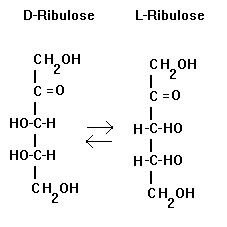
Ribulose is a ketopentose, so it has a ketone functional group.
It is an artificial sweetener, but not very sweet.
The enantiomers (mirror image molecules, pair of optical isomers), are D-ribulose and L-ribulose.
Ribulose-5-phosphate-3-epimerase, catalyses L-ribulose 5-phosphate ⇌ L-xylulose 5-phosphate. source
Ribulose is sold as: L-Ribulose, L-Adonose, also D-Ribulose.
RuBisCo C5H12O11P2 source
Rubisco
See: 6.5.1 Photosynthesis, 3 types of photosynthesus, RuBisCo
RuBisCo, rubisco, C5H12O11P2, ribulose-1-5 biphosphate carboxylase oxygenase, enzyme for first step in carbon fixation by plants. source
Ribulose bisphosphate carboxylase large chain (Gnetum parvifolium) catalyzes two reactions:.
1. Carboxylation of D-ribulose 1,5-bisphosphate, the primary event in carbon dioxide fixation.
2. Oxidative fragmentation of the pentose substrate in the photorespiration process.
Both reactions occur simultaneously and in competition at the same active site.
Sold as: Rubisco, powder from spinach.
Rubrofusarin
Rubrofusarin, rubrafusarin, C15H12O5, a benzochromenone, biological pigment, polyketide, aromatic ether, phenol, orange polyketide pigment, anti-cancer, anti-mycobacterial, mycotoxin, anti-estrogenic. source
It occurs in (Fusarium graminearum).
Sorbose
Sorbose, C6H12O6, in pectins of ripe passionfruit, (Passiflora edulis), in fruit of mountain ash (Sorbus aucuparia), in ascorbic acid metabolism. source
Sorbose (Table).
Xylose
Xylose, C5H10O5, D-Xylose, wood sugar, in mist plant polysaccharides called xylans, very sweet taste. source
Xylose is a sugar isolated from wood, and is used as a diabetic sweetener in food and beverages.
The common food additive sweetener substitute xylitol, C5H12O5, is produced by catalytic hydrogenation of xylose. source
Xylitol is added to some chewing gums to prevent tooth decay and dry mouth.
Arabinoxylans in cell walls, wood, and cereal grains is a combination of arabinose and xylose.
It occurs In Psyllium (Plantago ovata).
See: Xylose (Table).
6.6.5.1, Ethylene absorption
6.6.5.1, Ethylene absorption
Some products use zeolite particles coated with sodium permanganate to absorb ethylene and so prolong the storage life of fruit and vegetables in a refrigerator, e.g. "Blue Apple".
The chemical reaction is as follows:
3CH2CH2 + 2NaMnO4 + H2O → 2MnO2 + 3CH3CHO + 2NaOH source
3CH3CHO + 2NaMnO4 + H2O → 3CH3COOH + 2MnO2 + 2NaOH source
3CH3COOH + 8NaMnO4 → 6CO2 + 8MnO2 + 8NaOH + 2H2O source
Combining equations 1-3 generates:
3CH2CH2 + 12NaMnO4 → 12MnO2 + 12NaOH + 6CO2 source
Even if the reaction does not go all the way through to the carbon dioxide-producing step, many of the intermediate products formed either become irreversibly bound to the media or act as reactants themselves.
Such is the case of the sodium hydroxide, NaOH, formed in equation 1 and 2.
The NaOH will react with the acetic acid formed in equation 2 to produce the sodium acetate salt, NaCOOCH3, through a simple acid-base neutralization reaction. source
This is shown below.
/a> CH3COOH + NaOH → NaCOCH3 + H2O source
Combining equations 1, 2, and 5 generates:
3CH2CH2 + 4NaMnO4 → 3NaCOOCH3 + 4MnO2 + NaOH + H2O source
16.6.5 Ethyne, Acetylene, C2H2 source
This page was generated automatically from the original page on John Elfick's School Science Lessons website. If something looks wrong, please check the original.