Carbon dioxide
Last updated 2026-03-05 by Dr John Elfick
3.1.0 Carbon dioxide
Carbon dioxide (called "gas sylvestre" by Jan Baptist van Helmont, Belgium 1580-1644), is a gas that does not support life, so it is a simple asphyxiant.
Carbon dioxide and other gases that could accumulate in coal mines to cause choking and suffocation were called choke-damp, after-damp, foul-damp, black damp.
Miners used to keep a caged canary bird with them that would die before a concentration of carbon dioxide fatal to humans occurred.
Carbon dioxide is used in photosynthesis.
Excess carbon dioxide in the atmosphere from excess burning of fossil fuels causes a greenhouse effect so the temperature of the atmosphere rises, called global warming.
An increase of the concentration of carbon dioxide in the atmosphere may increase the rate of photosynthesis.
At standard temperature and pressure, the density of carbon dioxide is approximately 1.98 kg / m 3, i.e., about 1.5 X the density of air.
Carbon dioxide is not liquid at pressures below 5.1 standard atmospheres, 520 kPa.
At 1 atmosphere, approximately mean sea level pressure, the gas precipitates directly as a solid at temperatures below -78.5 C, and the solid sublimes directly to a gas above -78.5 C.
Liquid carbon dioxide forms only at pressures above 5.1 atm.
The triple point of carbon dioxide is approximately 518 kPa at -56.6 C.
The critical point above which distinct liquid and gas phases do not exist is 7.38 MPa at 31.1 o C.
3.1.1 Reduce carbon dioxide with burning magnesium
Attach a small piece of magnesium ribbon to the end of a wire.
Light the magnesium ribbon and put it quickly into a test-tube of carbon dioxide.
The magnesium continues to burn with a spluttering reaction.
White magnesium oxide and specks of black carbon form.
The magnesium reduces the carbon dioxide to carbon.
If you see no carbon specks, add sulfuric acid to remove the magnesium oxide and unburned magnesium so that the carbon becomes more visible.
2Mg (s) + CO2 (g) → 2MgO (s) + C (s) source
3.1.2 Frozen carbon dioxide, ("dry ice", "hot ice" "cardice")
Solid state carbon dioxide is commonly called "dry ice" and is used by travelling ice cream sellers.
Be careful! When handling dry ice in the laboratory, wear eye protection and wear gloves to avoid frostbite.
Store dry ice in an expanded polystyrene box.
If dry ice is touched, the moisture on the skin freezes and the dry ice sticks to the skin, causing frostbite.
When carbon dioxide is cooled under pressure, it becomes a solid.
Dry ice is used as a refrigerant by mobile ice cream sellers, in fire extinguishers, and for stage effects to produce artificial smoke or mist.
At atmospheric pressure dry ice sublimes at -78.5 o C.
The temperature of dry ice is always < 78.5 o C at atmospheric pressure, whatever the air temperature.
When heated, it changes directly from solid to gas, sublimes.
Experiments
1. Be careful! DO NOT LICK DRY ICE, because your tongue will stick to it!
Purchase dry ice from an ice cream stand.
Hold it in a gloved hand.
Watch it disappear as the carbon dioxide sublimes.
2. Dry ice in water
Fill a 10 cc measuring cylinder water and add universal indicator.
Add drops of sodium hydroxide solution.
Add a lump dry ice.
Note how the dry ice sinks to the bottom and gives off bubbles of carbon dioxide to make a fog at the mouth of the measuring cylinder.
The universal indicator slowly changes colour from blue, pH 9, to orange, pH 5, as the pH reaches about 4.5.
OH - (aq) + CO2 (g) > HCO3 - (aq) source
Repeat the experiment with ammonia solution.
The colour change of the universal indicator is more gradual, because of the reaction of weak acids with weak bases.
H2O (l) + NH3 (aq) + CO2 (g) > NH4 + (aq) + HCO3 - (aq) source
3.1.3 Weight of carbon dioxide
1. Compare the weight of carbon dioxide and air
Put two identical plastic bags on each pan of a scale or attach them to each arm of a simple beam balance.
The plastic bags should be open upwards and must balance perfectly.
Prepare carbon dioxide by adding vinegar to sodium bicarbonate in a beaker.
Hold the beaker above one of the plastic bags and pour the invisible carbon dioxide into the bag without pouring out any froth or chemicals.
The plastic bag containing the carbon dioxide sinks down showing that carbon dioxide is heavier than air.
The density of carbon dioxide is about 1.98 g per litre, which is about 1.5 × as heavy as air.
The fact that you can pour the carbon dioxide into the plastic bag shows that it is heavier than air.
2. Weight of carbon dioxide
Attach a drawing pin, sharp side up, to the corner of a flat table.
Attach a small plastic bag to each end of a wooden ruler.
Suspend the centre of the ruler with attached plastic bags over the point of the drawing pin so that the ruler balances horizontally.
Add vinegar to powdered sodium hydrogencarbonate in a small beaker.
Pout the gas above the mixture into on of the plastic bags.
This bag sinks, because of the weight of the transferred carbon dioxide gas.
3.2.0 Carbon dioxide in the atmosphere
Atmosphere, greenhouse gases: 37.42.1
Calcium carbonate dissolves in rain: 35.22.7.1
Carbon dioxide is a product of combustion: 8.6.3
Cloud seeding, rain making: 37.5.4, (dry ice)
Carbon dioxide, plant respiration: 9.1.0
Density of gases, Carbon dioxide, (Table)
Rain cycle: 37.8.8
3.2.1 Diffusion of heavier than air gas, carbon dioxide
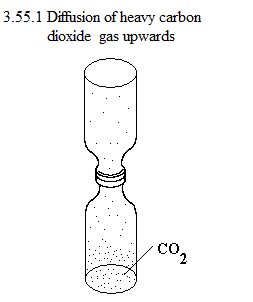
1. Fill a jar with carbon dioxide and invert it over a similar jar full of air.
After a few moments, separate the jars, pour a little limewater in the lower one and shake it.
The limewater will turn milky indicating that the carbon dioxide has fallen into the lower jar, because it is the heavier gas.
2. Repeat the experiment with the carbon dioxide in the lower jar and invert a jar of air on top of it.
If the jars are left for 5 minutes carbon dioxide will be carried into the upper jar by diffusion, in the same way air will be carried into the lower jar.
The limewater test will show the presence of carbon dioxide in the upper jar.
3.3.0 Carbon dioxide experiments
Alkalis with acidic oxides, carbon dioxide: 12.7.4
Baking soda, Sodium bicarbonate, sodium hydrogencarbonate
Caffeine, extraction with supercritical carbon dioxide, critical point: 9.2.2
Carbon dioxide, acidic oxides (non-metal oxides): 12.13.6
Carbon dioxide affects acid-base titration: 12.11.4.4
Carbon dioxide cartridge rocket, Dangerous experiment!: 17.7.4, (Safety)
Carbon dioxide soda siphon (syphon), bulbs: 3.6.1, (Safety)
Carbon dioxide through calcium carbonate suspension: 12.15.3
Carbon dioxide with barium hydroxide solution: 12.13.7
Carbon dioxide with sodium hydroxide solution: 12.13.8
Carbon dioxide with calcium hydroxide solution, whitewash, whiting: 12.15.4
Prepare self-leavened flour, "self-raising": 19.1.19H, (See: 7.)
Decompression of dilute solution of carbonic acid: 3.9.1
Diffusion of heavier than air gas, carbon dioxide: 3.2.1
Frozen carbon dioxide, ("dry ice", "hot ice" "cardice"): 3.1.2
Ionization reaction of carbonic acid: 3.9.2
Production of carbon dioxide during plant respiration: 3.7.1
Reactions of magnesium with carbon dioxide, sparkler experiments: 3.77
Reduce carbon dioxide with burning magnesium: 3.1.1
Simulated boiling, sodium hydrogencarbonate: 3.4.7
Soda-acid fire extinguisher: 3.3.1
Sparklers in carbon dioxide: 3.3.3
Weight of carbon dioxide: 3.1.3
Yeast cells convert glucose to carbon dioxide gas and alcohol: 3.8.1
3.3.1 Soda-acid fire extinguisher
Experiment
Use a plastic drink bottle with a one-hole rubber stopper fitted with a plastic tube.
Connect rubber tubing with a nozzle to the tube.
Use a test-tube that can fit inside the bottle.
Partly fill the bottle with sodium hydrogencarbonate solution.
Fill the test-tube with dilute sulfuric acid solution and lower it gently into the bottle so that it rests upright.
Fit the stopper and plastic tube.
Add a detergent to the acid to produce the blanketing effect of foam.
Aim the bottle at the fire and invert the bottle rapidly.
A strong reaction forms carbon dioxide.
The pressure of the gas pushes the liquid out through the jet to extinguish the fire.
2NaHCO3 (aq) + H2SO4 (l) → Na2SO4 (s) + H2O (l) + CO2 (g) source
To make a foam similar to the foam blanket produced by fire extinguishers, add sodium hydrogencarbonate to warm soapy water in a beaker.
Add concentrated aluminium sulfate solution and note the mass of white bubbles that looks like ice cream soda.
3.3.2 Dancing naphthalene mothballs
1. Vinegar contains up to 8% acetic acid. Mothballs consist of naphthalene, which is flammable, so newer mothballs contain other chemicals that are not flammable Mix vinegar with bicarbonate of soda in a glass jar.
Drop some naphthalene mothballs into the solution.
The carbon dioxide formed by the reaction of the vinegar (acetic acid) with the sodium hydrogencarbonate forms bubbles of carbon dioxide on the mothballs.
The mothballs rise to the surface, lose the bubbles and sink again, so this experiment may be called "dancing mothballs". NaHCO3 + CH3COOH → CH3COONa + H2O + CO2 (g). source
2. Mix vinegar (acetic acid) with sodium hydrogencarbonate in a big container.
Drop naphthalene mothballs into the solution.
The carbon dioxide formed by the reaction of the vinegar with the sodium hydrogencarbonate forms bubbles of carbon dioxide within the rough surface of the mothballs at the bottom of the container.
When enough bubbles are attached to a mothball, it becomes less dense than the surrounding liquid and mothballs rises to the surface.
At the surface, the carbon dioxide is released into the atmosphere, the mothball becomes more dense than the surrounding liquid and sinks again.
2NaHCO3 (s) → Na2CO3 (s) + CO2 (g) + H2O (l) source
NaHCO3 (s) + HC2H3O2 (aq) → NaC2H3O2 (aq) + CO2 (g) + H2O (l) source
3.3.3 Sparkler in carbon dioxide
Be careful! The wire of an extinguished sparkler may still be very hot.
Arrange for extinguished sparklers to be dropped in a safe place, e.g. a container of sand.
Sparklers may be illegal in some countries and are not allowed in some school systems.
Use Plasticine to stick a small birthday candle to the bottom of a cut-off plastic drink bottle and light the candle.
Mix one teaspoon of bicarbonate of soda in half a cup of water.
Mix one teaspoon of cream of tartar (tartaric acid) in another half a cup of water.
Pour both solutions into the drink bottle, but not enough to cover the candle!.
Bubbles of carbon dioxide appear and then the candle goes out.
You cannot relight the candle with a lighted match, because of the carbon dioxide around the candle and carbon dioxide is heavier than air.
So the match goes out before you can light the candle.
Some people can blow a soap bubble with a bubble pipe and sit the bubble on top of the layer of carbon dioxide, but doing this is not easy.
Light the sparkler and hold the sparkling end in the drink bottle.
The sparkler does not go out, because the sparkles come from burning magnesium powder and magnesium reacts with carbon dioxide.
You can now relight the candle with a match, because all the carbon dioxide has reacted with the magnesium in the sparkler and oxygen has returned to the cut-off drink bottle.
Have a dish of sand nearby to take the hot end of the sparkler.
Teachers refuse to do this experiment with some classes, because undisciplined children may burn themselves or children, or leave the hot sparkler on the desk.
You may see some black bits of carbon form on the side of the bottle.
They come from the carbon dioxide.
2Mg + CO2 → 2MgO + C source
3.3.4 Baking powder
Washing soda (sodium carbonate decahydrate, Na2CO3.10H2O), allows sodium ions to displace calcium ions in clay particles so that clay particles in mud can be dispersed and held in suspension in the washing water. source
Baking soda (sodium hydrogencarbonate, bicarbonate of soda, baking powder), is used in cooking to form bubbles of carbon dioxide to expand bread dough, cake mix and pastry dough, to make them light and pleasant to eat.
Baking powders often contain a solid acid that reacts with the sodium hydrogencarbonate only when moist.
Baking powder contains sodium hydrogencarbonate (sodium bicarbonate), which reacts with an acid, e.g. 2-hydroxypropanoic acid, (lactic acid), from sour milk, to form carbon dioxide.
The heat from the oven helps the decomposition of sodium hydrogencarbonate to form carbon dioxide.
Yeast cells convert sugar to carbon dioxide gas and alcohol to make bread rise.
Baking powder, or sodium bicarbonate, NHCO3, reacts with an acid such as lactic acid from sour milk to produce carbon dioxide. source
Baking powder often contains a solid acid that reacts with the sodium bicarbonate only when moist, e.g. tartaric acid or hydrogencarbonates.
Experiments
1. Put baking powder into water and note whether carbon dioxide gas forms.
Put sodium bicarbonate into water and note whether carbon dioxide forms.
Put baking powder in a test-tube containing vinegar (acetic acid, ethanoic acid), or lemon juice (citric acid), and note whether carbon dioxide forms.
2. Make a sugar solution and half fill a container with this solution.
Add a spoonful of dry yeast and leave to stand for two days.
Construct a bubbler to fit on the top of the container.
Note whether the yeast forms a gas.
Note whether carbon dioxide gas collects in the upper part of the container.
Yeast breaks down sugar into ethanol using enzymes that act as catalysts in the conversion.
C6H12O6 → 2C2H5OH + 2CO2 (g) source
glucose → ethanol + carbon dioxide source
3.4.0 Prepare carbon dioxide
Prepare carbon dioxide gas only in a fume cupboard!
"Bomb Bags", citric acid + sodium bicarbonate, Be careful!
Prepare carbon dioxide, acids with carbonates or bicarbonates: 3.4.1
Prepare carbon dioxide, alum with baking soda: 3.4.2
Prepare carbon dioxide, heat carbonates: 3.4.3
Prepare carbon dioxide, heat hydrogencarbonates: 3.4.4
Prepare carbon dioxide with a "Mentos" spearmint candy: 3.4.5
Prepare carbon dioxide with vinegar and sodium hydrogencarbonate solution: 3.4.6
3.4.1 Prepare carbon dioxide, acids with carbonates or bicarbonates
Experiment
1. Add dilute hydrochloric acid to carbonates, e.g. calcium carbonate, (marble chips), sodium carbonate, (washing soda), sodium hydrogencarbonate, (baking soda), basic copper (II) carbonate, CuCO3.Cu(OH)2.H2O. source
Carbon dioxide is slightly soluble in water so it can be collected over water or by upward displacement of air in dry containers.
Apply stoppers on the receiving test-tubes to prevent diffusion of the gas into the room.
2. Add 5 M hydrochloric acid to 10 g marble chips.
Collect the gas by upward displacement of air in a fume hood.
CaCO3 (s) + 2HCl (aq) → CaCl2 (aq) + H2O (l) + CO2 (g) source
carbonate + hydrochloric acid → salt + water + carbon dioxide source
3. Add vinegar (acetic acid) or lemon juice, (citric acid), to sodium hydrogencarbonate. (bicarbonate of soda).
The neutralization reaction with these acids forms carbon dioxide.
HC2H3O2 (s) + NaHCO3 (s) → NaC2H3O2 (aq) + H2CO3 (s) source
acetic acid + sodium bicarbonate → sodium acetate + carbonic acid source
H2CO3 (s) → H2O (l) + CO2 (g) source
carbonic acid → water + carbon dioxide source
3.4.2 Prepare carbon dioxide, alum with baking soda
Experiment
Add alum solution (Al2(SO4)3.K2(SO4).24H2O, potash alum) to baking soda or washing soda. source
The reaction forms carbon dioxide.
3.4.3 Prepare carbon dioxide, heat carbonates
Lime burning is the thermal decomposition of calcium carbonate as minerals, e.g. limestone and shells to form calcium oxide (quicklime).
Lime burning is an important industry with a long history.
Sodium carbonate cannot be decomposed by a burner.
Experiment
Heat zinc carbonate or basic copper (II) carbonate
ZnCO3 (s) → ZnO (s) + CO2 (g) source
CuCO3.Cu(OH)2.H2O → 2CuO (s) + 2H2O (l) + CO2 (g) source
3.4.4 Prepare carbon dioxide, heat hydrogencarbonates
Baking powders often contain a solid acid that reacts with the sodium hydrogencarbonate only when moist.
Baking powder contains sodium hydrogencarbonate (sodium bicarbonate) that reacts with an acid, e.g. 2-hydroxypropanoic acid, (lactic acid), from sour milk, to form carbon dioxide.
The heat from the oven helps the decomposition of sodium hydrogencarbonate.
Experiment
Heat sodium bicarbonate, sodium hydrogencarbonate
2NaHCO3 (s) → Na2CO3 (s) + CO2 (g) + H2O (l) source
3.4.5 Prepare carbon dioxide with a "Mentos" spearmint candy
Cola-Mentos Fountain Kit
Experiment
Put a candy, e.g. a spearmint candy, "Mentos", into a test-tube.
Add aerated water, e.g. cola, diet cola.
Observe the bubbles of carbon dioxide coming from the surface of the candy.
The grainy surface of the candy provides nucleation sites for the formation of carbon dioxide gas from carbon dioxide in the cola solution.
It snags small dissolved bubbles that coalesce to form large bubbles, which in turn coalesce to form gigantic bubbles that break off and move upwards like rockets, whooshing through any nozzle.
"Diet colas" usually works better than other colas, because they usually contain corn syrup that inhibits bubble formation.
Be careful! Too many Mentos tablets in a cola bottle may injure people from the resulting explosion!
The geyser effect is caused by the uncoloured, unglazed version of Mentos that provides nucleation sites for the dissolved carbon dioxide in the cola to escape as a gas.
Other active ingredients in the cascade effect reaction include the artificial sweetener, aspartame, the preservative, potassium benzoate, and caffeine in the diet cola.
Also, Mentos contains gum arabic and gelatin.
The ingredients add to the nucleation, to create a chemical reaction that forces the soda to release immediately all of its dissolved carbon dioxide, causing a more violent eruption than only carbonated water (soda water).
By using a nozzle, the geyser can reach 9.1 m.
However, it may extend to 10 m by using rock salt, which is more porous and provides even more nucleation sites per unit area than Mentos.
3.4.6 Prepare carbon dioxide with vinegar and sodium hydrogencarbonate solution
Add vinegar, or acid buttermilk or sour unpasteurized milk or fruit juice to sodium bicarbonate (sodium hydrogencarbonate) solution.
The reaction forms carbon dioxide.
3.4.7 Simulated boiling, sodium hydrogencarbonate
Heat about 2 cm depth of sodium hydrogencarbonate in a test-tube.
Carbon dioxide gas is given off and the sodium carbonate powder left behaves like a liquid.
The cushion of gas between the particles allows them to move independently of each other.
3.5.0 Tests for carbon dioxide
3.5.1 Test for carbon dioxide as a greenhouse gas
The carbon dioxide level decreases during the day through the photosynthesis of green plants, and increases at night when these plant respire and release it.
So the blanketing effect on heat movement would increase at night impeding radiation of heat away from the surface of the earth and cause higher surface temperatures.
If the concentration of carbon dioxide was stable at all times it would impede as much incoming heat to the surface of the earth as outgoing heat.
When a cloud cover forms at the end of a clear day, it blankets the movement of heat from the lower atmosphere to the upper atmospheres so the night temperature does not drop as much as on a clear night.
If the cloud cover is there in the day and the night sky is clear, the same clouds become the opposite of a greenhouse gas.
Experiment
Make a calorimeter from a 4 L bottle.
Drill a small hole bottom to install a heat source, e.g. a torch bulb or a heating element.
Fix a thermocouple in the neck and link it to a recording device, e.g. a device that can draw a graph of the heat changes over a few minutes.
Drill another hole in the side of the bottle to add extra carbon dioxide from a hypodermic syringe.
Add only about 1.4 cc of carbon dioxide to double the concentration from the ambient level to 700 parts per million, then seal the hole with adhesive tape.
Insulate the apparatus with styrofoam and locate it out of direct sunlight and away from moving air.
Investigate the effects of the nature of the cooling surface, e.g. sand, soil, water, plants, effects of ambient temperature, effects of levels of carbon dioxide and free air.
3.5.2 Tests for carbon dioxide with bromothymol blue
Bromothymol blue solution is used to show the presence of carbon dioxide.
1. Fill four test-tubes three-quarters full of water.
Add 25 drops of bromothymol blue to each test-tube.
Put a sprig of (Elodea canadensis) or other small water plant in two of the test-tubes.
Using a pipette to make bubbles in the solution in one test-tube not containing a plant, and then in a test-tube containing a plant.
Note the colour change that shows the presence of carbon dioxide.
Put stoppers in the four test-tubes and note the changes within 15 minutes to an hour.
Repeat the experiment, but put the test-tubes in a dark place.
2. Fill 4 test-tubes 3 quarters full of water.
Add 25 drops of bromothymol blue to each tube.
Put a sprig of Elodea or other small water plant in 2 of the tubes.
With a drinking straw, blow bubbles into one tube not containing a plant, and then into one with a plant.
Note the colour change that shows the presence of carbon dioxide.
Put stoppers in the 4 test-tubes and note the changes within 15 minutes to an hour.
Repeat the experiment, but put the tubes in a dark place, a closed desk.
3.5.3 Tests for carbon dioxide with burning charcoal
Put limewater into a container with a lid.
Attach charcoal to the end of a wire.
Ignite the charcoal with a Bunsen burner.
Hold the burning charcoal in the container above the surface of the lime water.
Remove the burning charcoal.
Close the container and shake it.
The solution turns a milky colour.
The formation of this white solid in limewater is a test for carbon dioxide.
No other gas does this.
3.5.4 Tests for carbon dioxide with lighted splints
Carbon dioxide extinguishes a lighted splint.
Carbon dioxide does not support combustion.
Lower a lighted splint into a dry container of carbon dioxide.
The level where the flames are extinguished shows the level of carbon dioxide in the container.
3.5.5 Tests for carbon dioxide with limewater
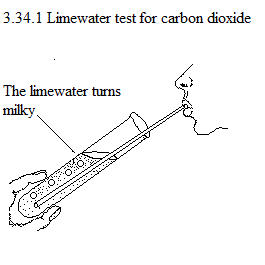
Limewater test A The limewater turns milky.
1. Prepare the weak alkali calcium hydroxide solution, limewater, by adding solid calcium hydroxide, slaked lime, to demineralized water.
Shake the solution vigorously and leave to stand.
Calcium hydroxide solid is only slightly soluble in water.
When a white solid has settled as a fine white sediment, decant the clear limewater above the sediment.
To replenish the limewater, add more demineralized water to the sediment in the stock bottle, shake and allow to settle.
The settling process may take several days.
2. Prepare limewater by adding calcium oxide (quicklime) to water to form calcium hydroxide.
CaO (s) + H2O (l) → Ca(OH)2 (s) source
calcium oxide + water → calcium hydroxide source
Then the calcium hydroxide dissolves in water to form a weak alkaline solution.
Limewater is a saturated solution of calcium hydroxide.
Ca(OH)2 (aq) ⇌ Ca 2+ (aq) + 2OH - (aq) source
When testing for the presence of carbon dioxide, make a fresh solution of limewater, otherwise the surface turns milky on standing, because of the reaction with the carbon dioxide in the air.
Store limewater in a container with a rubber or plastic stopper.
If you use a screw top container, calcium carbonate may form in the screw of the lid, so you cannot open the container.
3. Pass carbon dioxide through limewater or blow through it.
Carbon dioxide turns limewater milky.
A fine suspension of calcium carbonate causes the milky colour in the Ca(OH)2 (s) + CO2 (g) → CaCO3 (s) + H2O (l) source
Pass more carbon dioxide through the solution.
The solution becomes clear again, because soluble calcium hydrogencarbonate forms.
CaCO3 (s) + CO2 (g) + H2O (l) → Ca(HCO3)2 (aq) source
The reaction can be reversed to form the calcium carbonate precipitate once again, either by boiling the solution or bubbling air through it.
4. Pass air through freshly made limewater.
After a long time may see a faint cloudy precipitate.
The air contains about 0.4% carbon dioxide.
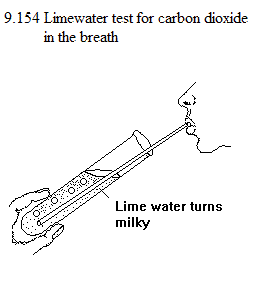
5. Use a drinking straw to exhale into the limewater.
A cloudy precipitate soon forms, because exhaled breath contains about 4% carbon dioxide.
6. Pass carbon dioxide into water to form carbonic acid.
CO2 (g) + H2O (l) → H2CO3 (aq) source
Add limewater to neutralize the carbonic acid to form the carbonate ion
H2CO3 (aq) + 2OH - (aq) → CO3 2- (aq) + 4H2O (l) source
Calcium carbonate is insoluble and precipitates
Ca 2+ (aq) + CO3 2- (aq) → CaCO3 (s) source
Pass more carbon dioxide into the solution to use up the OH - and make the solution acidic, so the carbonate ion is converted into the soluble bicarbonate ion.
CaCO3 (s)+ H2CO3 (aq) → Ca 2+ (aq) + 2HCO3 - (aq) source
7. Prepare limewater.
Calcium hydroxide is only slightly soluble in water.
Prepare the weak alkali calcium hydroxide solution, limewater, by adding solid calcium hydroxide, slaked lime, to demineralized water.
Shake vigorously and leave to stand.
Calcium hydroxide solid is only slightly soluble in water.
When the white solid has settled as a fine white sediment, decant the clear limewater above the sediment.
To replenish the limewater, add more demineralized to the sediment in the stock bottle, shake and leave to settle.
The settling process may take several days.
8. Pass carbon dioxide from a gas cylinder or experiment through the clear limewater.
The solution becomes milky, because of a fine precipitate of calcium carbonate.
Ca(OH)2 (aq) + CO2 (g) → Ca(CO3)2 (s) + 2HCl (l) source
Pass more carbon dioxide through the limewater.
The solution becomes clear again, because of the formation of soluble calcium hydrogencarbonate.
CaCO3 (s) + CO2 (g) + H2O (l) → Ca(HCO3)2 (aq) source
9. Pass air through freshly made limewater.
After a long time you may see a faint cloudy precipitate.
The air contains about 0.4% carbon dioxide.
10. Pass the breath through freshly made limewater.
Use a drinking straw to exhale into the limewater.
A cloudy precipitate soon forms, because your exhaled breath contains about 4% carbon dioxide.
3.5.6 Tests for carbon dioxide with litmus paper
See 12.3.0: Properties of acids.
Carbon dioxide does not change the colour of moist litmus paper.
Carbon dioxide dissolves in water to form weak carbonic acid that does not affect moist litmus paper.
H2O (l) < → H + (aq) + OH - (aq) source
2H + (aq) + CO3 2- (aq) < → H2CO3 (aq) carbonic acid source
CO2 + H2O < → H3O + + HCO3 - source
HCO3 - + H2O < → H3O + + CO3 2- source
3.5.7 Tests for carbon dioxide with phenol red indicator
Put 125 cc of ethanol in a beaker and add 2 drops of phenol red indicator.
Add drops of dilute sodium hydroxide solution until the solution turns red.
Blow through a tube into the solution until it becomes yellow.
CO2 (g) + H2O (l) → H2CO3 (aq) < → H + (aq) + HCO3 - (aq) source
CO2 (g) + 2NaOH (aq) + CO2 (g) → Na2CO3 (aq) + H2O (l) source
The sodium hydroxide is added to make the solution slightly alkaline at the beginning of the experiment, and to absorb any initial carbon dioxide or any other acid.
Na2CO3 is less basic than NaOH. source
3.5.8 Tests for carbon dioxide with "pouring tests"
1. Test whether carbon dioxide gas is heavier than air by "pouring" the gas into a test-tube, held either above the first test-tube or below it.
Use a lighted taper to investigate where the carbon dioxide has gone.
2. Test the density of the carbon dioxide by "pouring" the gas into a container containing a short lighted candle, e.g. a happy birthday candle.
The carbon dioxide extinguishes the lighted candle.
3.5.9 Tests for carbon dioxide with thymolphthalein indicator
Thymolphthalein, C28H30O4, acid-base indicator, pH 9.4 colourless, pH 10.6 blue. source
Thymolphthalein, pH RangepH: 9.4-10.6, Quantity per 10 ml: 1 drop 0.1% solution in 90% alcohol, Colour change: colourless blue
Put 125 mL of ethanol in a beaker and add 5 drops of thymolphthalein indicator.
Add drops of dilute sodium hydroxide solution until the solution turns blue.
Blow through a tube into the solution until it becomes colourless.
CO2 (g) + H2O (l) → H2CO3 (aq) < → H + (aq) + HCO3 - (aq) source
CO2 (g) + 2NaOH (aq) + CO2 (g) → Na2CO3 (aq) + H2O (l) source
The sodium hydroxide is added to make the solution slightly alkaline at the beginning of the experiment and to absorb any initial carbon dioxide or any other acid.
Na2CO3 is less basic than NaOH. source
3.6.0 Carbon dioxide from photosynthesis
nCO2 + nH2A → (CH2O)n + nO2 source
carbon dioxide + hydrogen donor → carbohydrate + oxygen gas source
Water is the most common hydrogen donor.
nCO2 + nH2O + → (CH2O)n + nO2 source
carbon dioxide + water (+ light energy) → carbohydrate + oxygen (dioxygen) source
Chlorophyll molecules in green plants absorb red and blue light from the visible range of the electromagnetic radiation from the sun to form higher energy electrons.
These excited electrons pass to an electron acceptor to cause a series of reactions resulting in the formation of carbohydrates, e.g. glucose.
The electrons removed from the chlorophyll molecules are replaced from the reaction of splitting the water molecule.
The protons (H + ) combine with carbon in the photosynthesis reaction.
2H2O ⇌ 2H + + 2OH - → 4H + + O2 + 4e - source
Summary equations
6CO2 (g) + 12H2O (l) + light energy → C6H12O6 (aq) + 6O2 (g) + 6H2O source
carbon dioxide + water + light energy → glucose + oxygen + water source
(This equation shows water on both sides of the equation.)
6CO2 (g) + 6H2O (l) + light energy → C6H12O6 (aq) + 6O2 (g) source
(This equation may be preferred, because it shows water only on one side of the equation.)
Experiment9.5.1
3.7.0 Carbon dioxide from respiration
Carbon burns to form carbon dioxide.
Carbon dioxide is a colourless, odourless gas with a slight smell of soda water, and is about 0.03% of the air.
Carbon dioxide is denser than air.
Carbon dioxide is slightly soluble in water and the solubility increases with pressure.
Carbon dioxide extinguishes a lighted splint.
Fermentation or anaerobic respiration
C6H12O6 → 2C3H4O3 + 4H (combined with other groups) source
glucose → pyruvic acid source
Aerobic Respiration
(CH2O)n + nO2 → nCO2 + nH2O source
carbohydrate + oxygen → carbon dioxide + water source
C6H12O6 + 6O2 → 6CO2 + 6H2O source
glucose + oxygen → carbon dioxide + water + energy source
Experiments
Carbon dioxide is produced during respiration: 9.1.3
Carbon dioxide hazards, (respiration): 3.8.2
Production of carbon dioxide during plant respiration: 3.7.1
Respiration, aerobic respiration: 9.2.0
Respiration is a form of combustion: 8.2.4
Tests for carbon dioxide in the breath with limewater: 9.1.18
3.7.1 Production of carbon dioxide during plant respiration
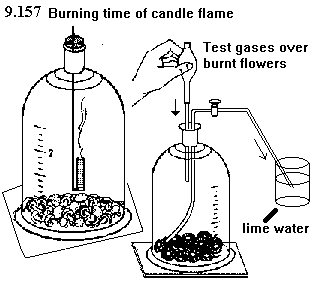
1. Plant respiration can only be observed where no photosynthetic activity occurs.
So use fungi or parts of plants that have no chlorophyll necessary for photosynthesis, e.g. mushrooms or the white flowers of the Compositae family, e.g. daisy.
Remove the green leaflets of the calyx to prevent photosynthesis.
Use the burning time of a candle in an enclosed known volume of air to prove the presence of oxygen.
Smear the bottom edge of a big jar with petroleum jelly then put it on a glass plate.
Open the neck of the jar then put a lighted candle down the neck on to the glass plate.
Be careful! Melting wax from a burning candle can cause severe skin burns so use safety glasses and insulated heat-proof gloves.
Close the neck of the jar immediately.
Record the burning time of the candle.
Put mushrooms or white flowers in the jar.
Close the neck of the jar.
Two hours later, put the lighted candle into the jar.
Record the burning time of the candle.
The candle burns a shorter time, because plants extract oxygen from the air during respiration.
2. Repeat the experiment by pumping air from the jar through limewater.
Continue pumping until the limewater becomes milky to show the presence of carbon dioxide.
3.8.0 Carbon dioxide and fermentation for brewing
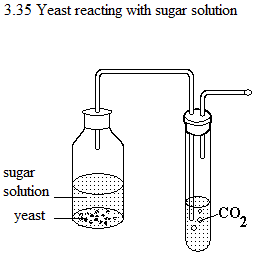
Carbon dioxide is made in large quantities by the brewing industry.
The yeast fungus, Saccharomyces. forms enzymes that act as catalysts.
Carbon dioxide forms in bread dough, but the fermentation is slower.
Experiment
Add 5 g of powdered brewer's yeast to 50 mL of 10% sucrose (cane sugar) solution or molasses or treacle.
Collect the carbon dioxide over water.
After leaving the fermentation for 2 days in a warm place the smell of alcohol is obvious.
invertase enzyme C12H22O11 + H2O → C6H12O6 + C6H12O6 source
sucrose + water → (+) glucose + fructose source
zymase enzyme C6H12O6 → 2C2H5OH + 2CO2 source
(+) glucose → ethyl alcohol + carbon dioxide source
3.8.1 Yeast cells convert glucose to carbon dioxide gas and alcohol
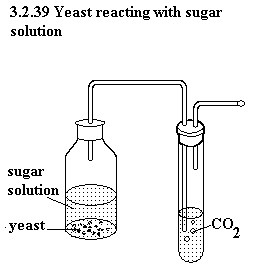
1. Make a sugar solution and half fill a container with this solution.
Add a spoonful of dry yeast and leave to stand for two days.
Construct a bubbler to fit on the top of the container.
Note whether the yeast forms a gas.
Note whether carbon dioxide gas collects in the upper part of the container.
Yeast breaks down sugar into ethanol using enzymes that act as catalysts in the conversion:
C6H12O6 → 2C2H5OH + 2CO2 (g) source
glucose → ethanol + carbon dioxide source
Soda bread is leavened with baking soda, not yeast
3.9.0 Carbonic acid
Carbonic acid, aerated water, carbonated water, club soda, soda water, H2CO3 source
Carbonation, dissolving CO2 in water under pressure to become effervescent, fizzy. source
Carbonated water, carbonic acid, H2CO3, soda water source
Carbonation, dissolving CO2 in water under pressure to become effervescent, fizzy. source
Carbon dioxide is an acidic oxide that dissolves in water to form the weak acid carbonic acid (H2CO3), pH about 4, and the carbonate ion. source
H2O (l) + CO2 (g) < → H2CO3 (aq) source
Carbonation is the dissolving of carbon dioxide in water under pressure to become effervescent, fizzy.
Do not store carbonic acid, because it easily decomposes to carbon dioxide and water.
Soda water is carbon dioxide dissolved in water under pressure that makes the gas more soluble.
Carbonic acid is the basis for all aerated waters, e.g. fizzy lemonade or cola, gaseous natural spring waters and sparkling wines.
If a glass of cold fizzy drink is left on the table, as the temperature of the drink increases, carbon dioxide is lost from the drink as bubbles of carbon dioxide escape, effervescence, and the drink becomes "flat".
Carbonic acid soon decomposes, but it can form stable sodium carbonate, potassium carbonate and hydrogencarbonate salts.
Aerated water, carbonated water, soda water, club soda, "soda", sparkling water, seltzer water, dissolved CO2 by carbonation to prepare effervescent fizzy drinks, soft drinks. source
Carbonic acid, H2CO3 is the basis for all aerated waters, e.g. fizzy lemonade, cola, bottled gaseous natural spring waters and sparkling wines. source
Carbonation is the dissolving of CO2 in water under pressure to become effervescent, "fizzy" source
In 1772, Joseph Priestly published "Directions for Impregnating Water with Fixed Air", passing gas from sulfuric acid on chalk through water.
The process was developed to produce soda water by the Swiss chemist Jacob Schweppe in London.
His company still functions to produce aerated water.
Seltzer water was first produced in 1775 from water at Seltz in France on the Rhine River, but nowadays it is soda water.
Soda water and club soda may also contain sodium salts.
In USA, "soda" is any soft drink.
Beverage can, drink-can
Carbon dioxide soda siphon (syphon), bulbs: 3.6.1
Cola: 19.6.0
Ionization reaction of carbonic acid: 3.9.2
Polyprotic acids: 12.3.8
Soft drinks, carbonated beverages, fizzy drinks, sports drinks: 3.10.0
Experiments
1. Open a bottle of soda water or fizzy lemonade.
Bubbles of carbon dioxide appear as the gas leaves the solution under the lower atmospheric pressure.
Carbon dioxide leaves the solution.
- Test for carbon dioxide by putting a lighted splint in the bottle above the lemonade.
- Test the pH of soda water at room temperature with drops of methyl red, (red below pH 4.2, yellow above pH 6.3).
- Boil the soda water and test the pH.
3.9.1 Decompression of dilute solution of carbonic acid
Reducing the pressure causes carbon dioxide to come out of solution, because carbon dioxide is weakly soluble in water.
H2CO3 (aq) → . H2O (l) + CO2 (g) source
Equilibrium 1 moves to the left, then Equilibrium 3 moves to the left, removing hydrogen ions from the solution making the solution less acidic.
Equilibrium reactions:
Equilibrium 1: CO2 (g) < → CO2 (aq) source
Equilibrium 2: CO2 (aq) + H2O (l) < → H2CO3 (aq) < → H + (aq) + HCO3 - (aq) carbonic acid source
Equilibrium 3: H2CO3 (aq) + OH - (aq) < → H2O (l) + HCO3 - (aq) (hydrogencarbonate ion) source
or
Equilibrium 3: H2CO3 (aq) < → H + (aq) + HCO3 - (aq) (hydrogencarbonate ion) source
Equilibrium 4: HCO3 - (aq) + OH - (aq) < → H2O (l) + CO3 2- (aq) (carbonate ion) source
or
Equilibrium 4: HCO3 - (aq) < → H + (aq) + CO3 2- (aq) (carbonate ion) source
or
Equilibrium 4: CO2 + H2O < → H3O + + HCO3 - source
Equilibrium 4: HCO3 - + H2O < → H3O + + CO3 2- source
or
Summary: CO2 + H2O → H2CO3 source
3.9.2 Ionization reaction of carbonic acid
H2O (l) < → H + (aq) + OH - (aq) source
2H + (aq) + CO3 2- (aq) < → H2CO3 (aq) carbonic acid source
CO2 + H2O < → H3O + + HCO3 -, K1 = 4.4 × 10 -7 source
HCO3 - + H2O < → H3O + + CO3 2-, Ka = 4.7 × 10 -11 source
3.10.0 Soft drinks, carbonated beverages, fizzy drinks, sports drinks
Carbonation is the dissolving of CO2 in water under pressure to become effervescent, fizzy. source
A "soft drink" is a drink that contains no alcohol.
A "soft drink" is a general term for a non-alcoholic drink, but in some countries it may contain < 0.5% by volume of alcohol, if more it is called a "hard drink".
The US term "hard liquor" refers to distilled alcoholic drinks, e.g. whisky.
Soft drinks are commonly called fizzy drinks, because of the effervescent carbon dioxide, or soda or pop, e.g. cola, ginger ale, lemonade.
Soft drinks usually contain the following:
1. carbonated water,
2. a sweetener, e.g. sucrose, fructose, or an artificial sweetener, e.g. saccharin C7H5NO3S, sucralose C12H19Cl3O8, in diet drinks. source
3. flavouring, flavour enhancing agents
Sports drinks, e.g. "Gatorade" and energy drinks, e.g. "Red Bull" may not be carbonated, but they are usually just soft drinks containing caffeine and perhaps other stimulants.
Sports drinks contain high sugar content and electrolytes, and are designed to quench the thirst and rehydrate the body after exercise.
Some sports drinks are used for oral rehydration therapy.
They contain potassium, sodium, sugars, water, citric acid, citrus and food colouring to replaces electrolyte and fluid for ingestion after strenuous exercise.
Also, sports drinks have been used to treat morning sickness, diarrhoea, heat exhaustion, and dehydration after vomiting.
However, these conditions require proper medical attention, because high intake of sports drinks may cause obesity, dental caries and type-2 diabetes.
The UK government is introducing a tax on drinks containing excess sugar and some manufacturers of soft drinks have reduced the sugar contents of their products.
Energy drinks contain high sugar content and stimulants, usually caffeine.
These drinks cause rapid increase in alertness, attention and energy, followed by drowsiness and a slump in attention, causing problems in school classrooms.
Perhaps the combination of high sugar content with caffeine causes behavioural problems not associated with drinks containing only caffeine.
Some countries have banned the sale of energy drinks to people under 18 years of age.
| Red Bull energy drink (250 mL) | 80 mg Caffeine, 27 g Sugar |
| Coca Cola (330 mL) | 32 mg Caffeine, 35 g Sugar |
| Orange juice (250 mL. | 23 g Sugar |
| Tea (220 mL) | 50 mg Caffeine |
| Filter Coffee (200 mL) | 90 mg Caffeine |
| Lucozade Sport (38 mL) | 13.77 g Sugar |
This page was generated automatically from the original page on John Elfick's School Science Lessons website. If something looks wrong, please check the original.