Chemistry Experiments, Ci to Cy
Last updated 2026-07-13 by Dr John Elfick
Chemistry, Ci to Cy
Cod liver oil (vitamins A and D food supplement)
Coquelicot, red-orange poppy colour
Quick links — A–Z index
Cis-trans fatty acids, Hydrogenation
Citric acid cycle, Kreb's cycle
Citrine, Quartzite
Classify substances, pure substances, mixtures, solutions
Clinistix strip, Test for glucose
Clinitest tablet, (Benedict's test for glucose)
Clot on boiling test for milkt
19.3.1 Coconut cooking
19.3.2 Coconut milk
19.3.3 Colloids in food
Conjugated, Unsaturated fatty acids
Constant boiling mixture, azeotrope
Consumablesbr> Contamination of groundwater
Continuous phase / outer phase
19.1.3 Cooking fats
12.6.1 Prepare citric acid crystals with lemon juice
Squeeze a lemon with the help of a lemon squeezer and transfer the juice to a beaker.
Add an equal amount of water and boil the liquid gently over a gauze and tripod for quarter of an hour.
Filter the liquid while still hot into an evaporating basin.
The filtrate is a solution of citric acid.
Evaporate the solution on the gauze and tripod until only one third of it remains.
Then put it on one side to cool and crystallize.
The crystals of citric acid obtained in this way are not very pure.
They are usually coloured brown.
To obtain purer crystals, dissolve the impure substance in water and boil the solution with powdered charcoal, (preferably "decolorizing" charcoal), for ten minutes.
Then filter the liquid and leave it in a hot place to evaporate and crystallize.
12.11.3.18 Tests for cobalt
Organic reagent: Nitroso-beta-naphthol, 1-nitroso-2-naphthol, C10H7NO2, 1 g in 50 mL acetic acid source
Dilute to 100 mL Add reagent to neutral or slightly acid solution.
A brown colour indicates the presence of cobalt.
Use in Group IV when in solution after treatment with KClO3 and acid, or use the solution after Group III. source
Cu, Fe, Sn, Ag, Cr, Bi, all interfere with the test.
Cinnamic acid
Cinnamic acid, C9H8O2, C6H5CHCHCOOH, 3-phenylpropenoic acid, monocarboxylic acid, toxic if ingested, white crystals, odour like honey, soluble in water. source
It may cause contact dermatitis, and may relieve smooth muscle spasms.
It occurs in (Myroxylon balsamum), The inner bark for cinnamon sticks (Cinnamomum verum), (Styrax benzoin), and (Styrax balsam).
It occurs in Cinnamon bark oil, Coca Cola, Cinnamon leaf oil, (Liquidambar styraciflua), (Aloe vera), and (Alpinia calcarata).
Ethyl cinnamate, C11H12O2, cinnamic acid ethyl ester, an alkyl cinnamate, 4-methyl cinnamic acid, stain, dyestuff, Toxic if ingested. source
It is used in flavorings, perfume industry, to produce the sweetener aspartame, C14H18N2O5. source
It occurs in Alpinia caerulea), (Mandragora autumnalis), and (Kaempferia galanga).
Cinnamyl acetate
Cinnamyl acetate, C11H12O2, CH3CO2CH2CH=CH(C6H5), (from condensation of cinnamyl alcohol + acetic acid), is a fragrance ingredient, in chewing gum. source
It occurs in Chinese cinnamon leaf oil, and Nicotiana.
Ethoxyethanol C4H10O2 source
Sodium acetate Ethyl ethanoate as a salt
3.7.36 Polyvinyl acetate
12.11.1 Tests for acetates
Cineole
Cineole, C10H18O, (1,8-cineol), Eucalyptol, monoterpene, cyclic ether, colourless liquid, smells like camphor, has spicy cooling taste. source
It is used as a flavouring agent, anti-inflammatory cough suppressant and airways mucuos controller.
Eucalyptol is used as a paint stripper, adhesive, solvent, sticky spot remover.
It is added to cigarettes to improve the flavour, and used as fragrance, mouthwash, and is anti-inflammatory.
It releases vapours for medical use, useful for getting chewing gum out of children's hair and turning stuck nuts and bolts Some deaths was reported after ingestion of essential eucalyptus oil.
Eucalyptus odour occurs in (Eucalyptus globulus).
Zedoary Oil, essential oil from rhizome of (Curcuma zedoaria), "zedoary" contains eucalyptol, and used to treat digestive disorders.
Zedoary has cytotoxic effects on non-small cell lung carcinoma and causes cancer cell apoptosis.
It occurs in E zhu (Curcuma zedoaria), Zingiberaceae.
Citral
Citral, C10H16O, geranial, a monoterpenoid, clear yellowish liquid, smells like lemons, volatile oil, toxic by ingestion. source
It has a bittersweet taste, less dense than water, about 0.9 g/cm3, and insoluble in water.
It is a flavouring ingredient, in laundry and dish-washing products, anti-microbial, irritant if heated to combustion, apoptotic, pain reliever and anti-inflammatory.
It occurs in Lemon myrtle, (Backhousia citriodora), and is the principle constituent of Lemon grass, (Cymbopogon citratus) oil and oil of (Litsea cubeba).
It occurs also in African tree basil, (Ocimum gratissimum), Pectis, Boesenbergia lemon, orange, and lemon balm.
Citral is the collective term for two terpenoid double bond isomers:
E-isomer, Geranial, Citral A, C10H16O. source
Z-isomer, Neral, Citral B, C10H16O. source
Geranial, (Citral A), (Citral E-isomer of citral, geranialdehyde, C10H16O, strong citrus lemon odour source
Neral, (Citral B, cis-citral, lemonal, neroli aldehyde, Citral Z-isomer of citral, monoterpenoid, C10H16O, sweeter lemon odour source
Citranaxanthin
Citranaxanthin, C33H44O, carotenoid pigment, yellow food dye, (apocarotenoid from cleavage of carotenoid). source
E161g: Citranaxanthin food additive.
Citronellal
Citronellal, C10H18O, monoterpenoid, rhodinal, in (Citrus depressa) Taiwan mandarin, (Melissa officinalis) lemon balm, 85% of oil of Citronellol source
Citronellol, C10H20O, acyclic monoterpenoid, in citronella oils: source
Constantan
Constantan, constant resistance wire, Eureka wire, CrAl (Kranthal) and NiCrm
Constantan wire 15.6 ohm / m, 6.9 ohm / m, 0.98 ohm / m
Constantan is an alloy, about 40% nickel and 60% copper, having high volume resistivity and negligible temperature coefficient.
Resistance hardly changes with change in temperature.
It is used for resistance wire.
Also Eureka wire, CrAl (Kranthal) and NiCrm (Nichrome wire) have very high resistivity.
An optical pyrometer is used to measure very high temperatures from the colour of the radiant heat source.
Experiment
Attach a piece of copper and a piece of constantan to two wires.
Heat lead to above its boiling point of 327 oC.
Attach the wires to a galvanometer and insert the copper and constantan into the boiling lead.
The galvanometer can be calibrated to read temperature and act as a thermocouple to read the temperature of the molten lead.
Citric acid
Citric acid, C6H8O7 (anhydrous), HOC(CO2H)(CH2CO2H)2, CH2COOH-C(OH)COOH-CH2COOH source
"Bomb Bags", citric acid + sodium bicarbonate → carbon dioxide, (toy product) source
Citric acid, tricarboxylic acid, is a colourless to white crystalline powder, orthorhombic crystals or granules, soluble in water, odourless, sharp taste, translucent.
Citric acid, "2-hydroxy propane-1, 2, 3-tricarboxylic acid", MP about 100oC, slightly deliquescent in moist air, loses water of crystallization in dry air.
Store in tight containers, very weak acid with little corrosive action.
Citric acid is an acid compound in citrus fruits.
Sour taste of lemons, grapefruit, other citrus fruits, gooseberries and raspberries, caused by citric acid, so it is an ingredient in artificial lemonade powder.
In health salts, citric acid acts with sodium bicarbonate in the mixture to produce the fizz when the mixture is added to water.
Citric acid is used for making up buffer solutions and forming citrate salts.
It is used as an acidulant to control pH and as an anticoagulant by chelating calcium in blood.
Also "2-hydroxy-1, 2, 3-propanetricarboxylic acid", is about 10% dry weight of lemons.
Low cost in supermarkets a pure form of citric acid is sold as "sour salt".
Lemon juice is used as a deodorizer, mild bleach, and cleaner.
Experiments
Acids with baking soda: 12.1.18
Browning reactions of fruits and vegetables: 19.2.3.1
Citric acid cycle: 16.9.5, Krebs cycle
Citric acid solubility and temperature: 12.6.5
Citric acid with sodium hydrogen carbonate solution: 12.6.6
Heat citric acid to form carbon: 12.6.2.
Lemons, lemon juice 5-8% citric acid
Prepare citric acid crystals with lemon juice: 12.6.1.
Prepare hydrogen gas with citric acid: 13.3.15, (See: 2.).
12.6.2, Heat citric acid to form carbon
12.6.2, Heat citric acid to form carbon
Put 2 mL of citric acid crystals in a metal spoon.
Hold the end of the spoon in a paper holder and heat the citric acid crystals over a flame.
The first melt and then give off a vapour that ignites and burns with a yellow flame.
A black deposit of carbon remains on the spoon after the reaction, showing that citric acid is an organic substance.
The carbon can be burned off the spoon by continuing the heating.
12.6.5, Citric acid solubility and temperature
12.6.5, Citric acid solubility and temperature
The solubility of solid substances in water usually increases with rise of temperature.
However, calcium citrate is less soluble in hot water than in cold water.
Put 2 mL of calcium carbonate in a test-tube and add drops of citric acid.
Carbon dioxide forms.
When the reaction stops, add more drops of the acid solution until the calcium carbonate has completely dissolved.
The clear liquid is a solution of calcium citrate.
Hold the test-tube in a paper holder and heat the solution over a flame.
A white precipitate of calcium citrate forms in the liquid, because of the lower solubility of calcium citrate at higher temperatures.
12.6.6, Citric acid with sodium hydrogen carbonate solution
12.6.6, Citric acid with sodium hydrogen carbonate solution
C6H8O7 + 3NaHCO3 → C6H5Na3O7 + 3CO2 + 3H2O source
citric acid + sodium hydrogen carbonate → sodium citrate + carbon dioxide + water source
Experiment
Lemon juice with sodium bicarbonate
Do not use a glass container.
Put lemon juice into a plastic or tin plate container that can be sealed with a lid, e.g. coffee powder tin, film canister.
Squash absorbent paper, e.g. toilet tissue, newspaper, into the container so that it is wedged against the sides of the container, but does not touch the lemon juice.
Sprinkle sodium bicarbonate powder over the paper.
Seal the container, then invert it.
The citric acid in the lemon juice reacts with the sodium hydrogen carbonate to form CO2, which increases the gas pressure in the container and blows off the lid. source
Such reactions have been used to make simple rockets.
If the container is attached to a rocket stick, by Newton's third law the force with which the lid is blown off (down), is equal to an equivalent upward force up.
So the rocket moves up.
Be careful! Do the experiment outside with a small amount of reactants.
Stand well away from the container after inverting it and do not look down from directly over the container.
Citrulline
Citrulline, C6H13N3O3, L-citrulline, delta-Ureidonorvaline, amino acid, nitric oxide synthase inhibitor, protective agent, micronutrient, irritant source
It occurs in watermelon Citrullus, and in sesame (Sesaman indicum).
Cigarette
Butane gas, (in cigarette lighters)
Cellulose triacetate: 3.5.8, (in cigarette filters)
Cerium: , Ce, with Lanthanum, in cigarette lighter ignition flints
Microbial decomposition of thin paper, cigarette paper: 4.2.8, (See 2.)
Nicotine, C10H14N2 source
Nicotine spray: 4.7.3, (Agriculture)
Tests for cigarette smoke: 16.5.6
Tobacco plant, (Nicotiana tabacum), Solanaceae
Cinnamaldehyde
Cinnamaldehyde, C9H8O, trans-cinnamaldehyde, cinnamaldehyde flavonoid. yellowish oily liquid, cinnamon odour, sweet taste, cinnamon flavour and odour. source
It is a skin irritant, toxic in large doses, excreted in urine as cinnamic acid.
Cinnamaldehyde is not soluble in water, main component in cassia oil, cinnamon bark oil, flavouring compounds for cinnamon flavour.
Cinnamon bark has cinnamon and cassia aroma.
Cinnamaldehyde can be made synthetically, but is more commonly obtained from the steam distillation of the oil of cinnamon bark.
Cinnamaldehyde is hypoglycemic, vasodilator, antifungal, sensitiser, insecticide, scent repels cats and dogs.
It is used as a corrosion inhibitor for steel and other ferrous alloys in corrosive fluids.
Clay
7.6.1 Clay soils in water
11.3.2 Clay soil suspension
7.6.2 Clay suspensions in a centrifuge
7.6.3 Aluminium sulfate with clay suspensions
35.2.39 Kaolinite
6.4.5 Soil particle size, sand, silt, clay
34.2.10 Tests for strength of mud, clay, and sand bricks
Clenbuterol
Clenbuterol, C12H18Cl2N2O, a substituted aniline, bronchodilator agent, an amino alcohol. source
It has been used with beta-2 adrenomimetic properties at very low doses, as a bronchodilator in asthma treatment.
It is approved for medical use in some countries.
It is a performancing-enhancing drug banned by the International Olympic Committee.
It has been illegally used to build skeletal muscle and increase metabolism, but may cause heart attacks.
Collagen
Anatomy and physiology of meat: 19.2.1, (See: 2.)
Aniline blue: 7.7, (stains collagen), Prepare
Cooked collagen changes into gelatine: 19.2.8.5
Fibrous proteins and globular proteins: 16.6.0 (See: 1.)
Gels: 7.8.5, (See 2.), (Collagen is denatured.).
Prepare gelatine gel: 7.8.8
Roasting meat: 19.2.8.1, (slow cooking)
Collagen
Collagen is an insoluble fibrous protein in connective tissue, e.g. tendons, skin, bone.
Collagen is about one third of the protein in mammals is collagen.
Collagen is used sutures, leather substitutes, and food casings.
Vitamin, C is a water-soluble vitamin essential for the formation of collagen in connective tissue.
Columbianetin
Columbianetin, C14H14O4, dihydro-oroselol, zosimol, a furanocoumarin. a tertiary alcohol, irritant source
It occurs in celery stalks (Apium graveolens), (Xanthoxylum arnottianum), and (Heracleum sprengelianum).
Clove oil
Clove oil, eugenol: 16.3.6.9
Clove plant, (Syzygium aromaticum), Myrtaceae
Eugenol, C10H12O2, (in oil of cloves, cinnamon leaf oil, West Indian Bay oil) source
Clove oil, oil of cloves, is used for microscopy.
Use cloves in shelf corners to get rid of ants.
Use oil of cloves solutions for removing fungus infections from households.
Coal
Coal, coal tar, solid, lumps, peat, lignite (brown coal) bituminous coals, anthracite, coke
Coal: 35.3.2
Coal tar products: 16.4.0, creosote
Coal seam gas: 37.1.2
E102, Tartrazine (coal tar dye)
Fuchsine, fuchsin (magenta)
Jet black, jet, is a type of hard coal, which can be polished to make "jet black" beads to be used for mourning attire.
Jet from fossilized monkey puzzle trees has similar triboelectric properties to amber, generate static charge, so it may be called "black amber".
Prepare gases from coal: 16.1.2
Prepare ammonia, Haber process: 3.01, coal tar
12.6.0.2 "Sulfur" in coal, iron (II) sulfide (pyrite).
Coal gas
Coal gas (approximately 88 MJ / kg), is approximately 50% hydrogen gas, 35% methane, 8% carbon monoxide (poisonous gas).
+ hydrogen cyanide and hydrogen sulfide, used for a "safety smell"
Lately, "synthetic natural gas", SNG, is synthesized from coal or petroleum.
Coamidopropyl betaine
Coamidopropyl betaine, C19H38N2O3, surface-active agent, used for hair washing and foam booster in shampoos, may cause dermatitis. source
Coamidopropyl betaine is a mixture of compounds derived from coconut oil and dimethylaminopropylamine, C5H14N2, (CH3)2NCH2CH2CH2NH2. source
Cobalt, Co
Cobalt, Co
Cobalt, Table of Elements
Cobalt, RSC
See: Cobalt and compounds. Gov.
Cobalt, Co (German Kobalt demon, which interfered with silver mining!)
Cobalt ion Co 2+, Cobalt (II) AAS Solution, pellets, powder.
Cobalt, (German kobold, goblin of the mines), was associated by miners with arsenic and sulfur health-damaging impurities.
Cobalt salts colour glass blue, plant and animal nutrition, trace element, transition hard, grey metal.
Cobalt forms complex ions, e.g. CoH2O)6] 2+, magnetic below 1075oC, essential element, but toxic in excess.
It is used in alloys radiography, magnets, steel.
Cobalt (II) oxide used to colour glass blue.
Occurs in the body only as Vitamin B12, (cyanocobalamin), (C63H88CoN14O14P), produced by the bacterium (Escherichia coli). source
Cobalt (German kobold, goblin of the mines), was associated by miners with arsenic and sulfur health-damaging impurities.
Atomic number 27, Relative atomic mass 58.9332, RD 8.90, MP = 1492oC, BP = 2900oC.
Specific heat capacity 435 J kg -1 K -1
Atomic number 27, Relative atomic mass 58.9332, RD 8.90, MP = 1 492oC, BP = 2 900oC
Specific heat capacity 435 J kg -1 K -1
Cobalt has 28 radioisotopes, including:
Cobalt-60, (60Co), is used for sterilizing and for treating cancer patients.
Cobalt-57, (57Co), is used in medical and scientific research.
Toxic salts: Cobaltous aluminate (cobalt blue), Cobalt magnesium borate (cobalt violet, violet 48), Cobaltous oxide (cobalt green)
Tests for cobalt: 12.11.3.18
12.6.9, Properties of cobalt salts
12.6.9, Properties of cobalt salts
Co(H2O)6 2+ = pink hexa aqua cobalt (II) ion, hexaaquacobalt (II) ion source
1. Heat cobalt carbonate in a small hard glass tube.
The brown residue is cobalt (II) oxide.
CoCO3 → CoO + CO2 source
Transfer the oxide to a crucible and heat to redness.
The black residue is cobalt (II) cobalt (III) oxide, Co2O4. source
2. Add excess of hot sodium hydroxide solution to 3 cm of a cobalt salt solution.
Note the pink precipitate of cobalt (II) hydroxide.
Note the change to brown cobalt (III) oxide, Co2O3 on exposure to air. source
Cobalt (II) hydroxide is soluble in ammonia solution, NH3 (aq) ("ammonium hydroxide"), because of the formation of the complex ion Co(NH)6 2+. source
Co 2+ + 2OH - → Co(OH)2 (s) source
3. Add a suspension of bleaching powder to a test-tube containing a cobalt (II) salt solution.
Note the black precipitate of cobalt (II) hydroxide.
The bleaching powder acts as an alkaline hydroxide and an oxidizer.
Divide the precipitate into two parts.
Add excess hydrochloric acid to one part to obtain a brown solution of the unstable cobalt (II) chloride.
Heat the second part to obtain oxygen gas and a residue containing cobalt (II) oxide.
Cobalt (II) hydroxide behaves as a weak base.
4. Evaporate cobalt (II) chloride solution to dryness and note the blue colour of the anhydrous salt.
Cobalt chloride is stable compare to hydrated iron (II) chloride.
Write on a piece of paper with dilute cobalt chloride solution.
Leave to dry and the writing becomes invisible.
Heat the paper from below and writing appears bright blue, because of dehydration of the salt.
So cobalt chlorine solution is a kind of "invisible ink".
5. Put drops of pink cobalt chloride solution on filter paper, hold it over a flame, see brilliant blue colour of the anhydrous salt.
A weather indicator can be made by soaking white paper in a concentrated solution of cobalt chloride.
6. Cobalt ions with carbonate ions.
Pink cobalt ions solution, Co(H2O)6 2+, reacts with carbonate ions solution to form gelatinous calcium carbonate precipitate in a pink solution. source
Co 2+ (aq) + CO 3 2- (aq) → CoCO3 (s) source
7. Add a dilute solution of ammonia to a cobalt chloride solution to form a green-blue precipitate.
Add excess ammonia to dissolve the precipitate to leave a light brown solution.
Leave to stand to allow oxidation in the air to form a deep red-brown solution.
The same colour change occurs if hydrogen peroxide is used.
Co(H2O)6 2+ + 2NH3 → Co(H2O)4(OH)2 + 2NH4 + source
(Hydrogen ions are detached from the complex ions to form a green-blue neutral complex precipitate).
Co(H2O)6 2+ + 2NH3 → Co(NH3)6 2+ + 6H2O source
(With excess ammonia, the neutral complex dissolves to form a green solution containing hexa amine cobalt (II) ions, hexaaminecobalt (II) ions).
Co(NH3)6 2+ + O2 in the air → Co(NH3)6 3+ source
(Leave to stand so that the hexaminecobalt (II) complex is oxidized to deep red-brown hexaminecobalt (III) complex).
2Co(NH3)6 2+ + H2O2 → 2Co(NH3)6 3+ + 2OH - source
(It is the same colour change as above reaction only faster).
8. Add limewater CaOH)2, or sodium hydroxide solution to cobalt chloride solution.
A light blue precipitate forms that on standing the solution turns pink.
Co(H2O)6 2+ + limewater → Co(H2O)4(OH)2 (neutral complex) source
9. Test for aluminium compounds
Put drops of red cobalt chloride solution on filter paper.
Add drops of aluminium sulfate solution.
Dry the filter paper over a flame then ignite it over a ceramic bowl.
The blue ash formed is a test for all aluminium compounds in solution.
10. Tests for heat, heat-sensitive paper
Add cobalt (II) chloride solution to ammonium chloride solution (sal ammoniac).
Dilute this solution until it is pale pink.
Soak absorbent paper in the solution and leave to dry and become almost colourless.
The paper turns bright green colour when heated.
Cobalt compounds
Cobalt (II) carbonate, CoCO3.xH2O source
Cobalt (II) oxide, CoO
Cobalt deficiency in soils: 6.13.3
Cobalt toxicity: 4.6.6
Concentration and temperature, cobalt (II) chloride-6-water: 17.1.2
Hydrogen peroxide with potassium sodium tartrate, cobalt (II) chloride catalyst: 17.7.18
Sodium hypochlorite decomposition, cobalt sulfate catalyst: 17.3.11
Properties of cobalt salts: 12.6.9
Tests for cobalt (nitroso-beta-naphthol test): 12.11.3.18
Tests for the presence of water with cobalt (II) chloride paper: 8.2.2
Cobalt (II) carbonate, CoCO3
Cobalt (II) carbonate, CoCO3 source
Cobalt (II) carbonate hydrate, CoCO3.xH2O source
Cobalt (II) carbonate (basic) (blue glaze for craft, for spectral analysis with flame test for cobalt), Harmful
Cobalt (II) carbonate, Low cost from pottery supplies stores
Cobalt (II) carbonate with hydrochloric acid forms cobalt (II) chloride
Cobalt (II) carbonate with with nitric acid forms cobalt (II) nitrate
Cobalt (II) chloride
Cobalt chloride, CoCl2, cobalt (II) chloride, CoCl2.6H2O cobalt (II) chloride hydrated, cobalt (II) chloride-6-water, harmful if ingested, environment danger source
Cobalt (II) chloride decahydrate, cobalt (II) chloride-6-water: 17.5.1
Cobalt (II) chloride-6-water, For 0.1 M solution, 23.8 g in 1 L water
Cobalt (II) chloride solution, crystals CoCl2.6H2O, invisible writing ink 3.2.5.2 source
Concentration and temperature, cobalt (II) chloride-6-water: 17.1.2
Tests for heat, heat-sensitive paper: 5.3.10
Cobaltous chloride AAS Solution
Glycerine with cobalt chloride solution: 12.1.8
Tests for water with cobalt (II) chloride paper: 8.2.2
Cobalt (II) nitrate hexahydrate
Cobalt (II) nitrate hexahydrate, Co(NO3)2.6H2O, cobalt (II) nitrate hydrated source
Harmful if ingested, red-brown, deliquescent, monoclinic crystals, is soluble in water and other solvents.
Cobalt nitrate, For 0.1 M solution, 29 g in 1 L water
Cobalt (II) oxide
Cobalt (II) oxide, CoO, cobalt oxide, cobaltous oxide, green orange to pink solid, craft blue glaze, do NOT inhale.
Cocaine
Cocaine, C17H21ON4, benzoylmethylecgonine, alkaloid ester, benzoic acid ester, local aneasthetic, vasoconstrictor, has powerful CNS effects like amphetamines. source
It is a drug of abuse, causes inhibition of dopamine uptake, high doses mood elevating effects and toxic reactions, in the cocoa plant (Erythroxylum coca).
Cobalt (II) thiocyanate, Co(SCN)2, Harmful, Environment danger, in Scott's reagent test for cocaine source
Copolymer, Polymer from linking different monomer types, e.g. cocaine, curare, caffeine, piperine
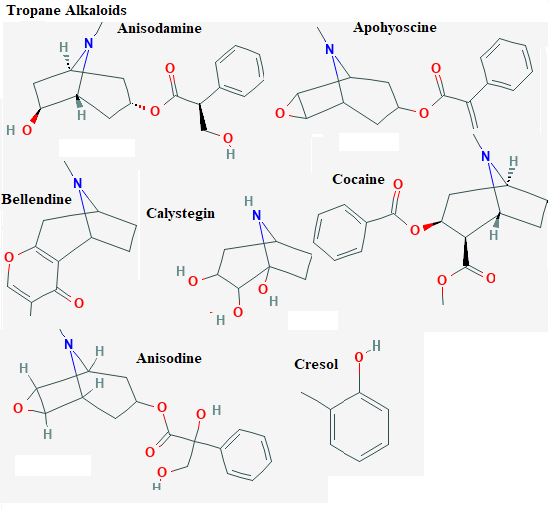
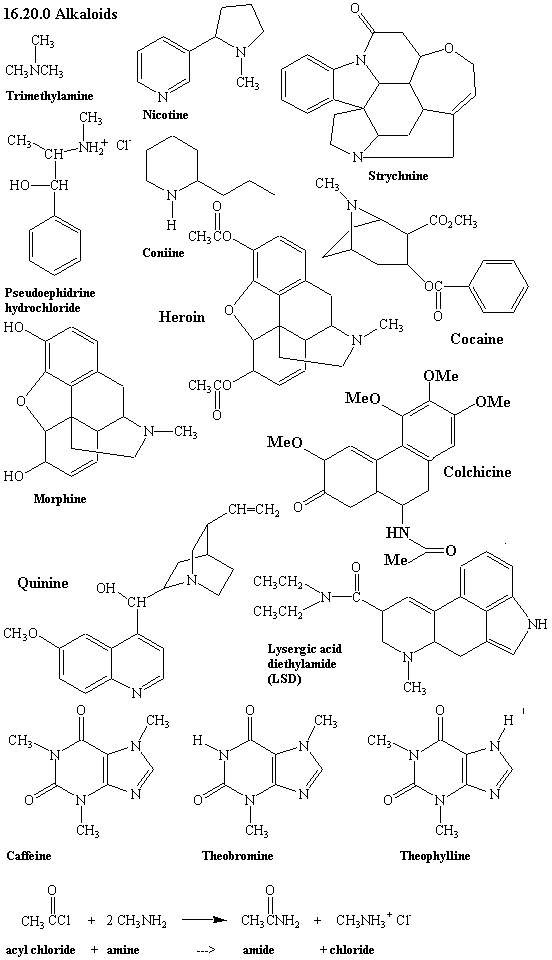
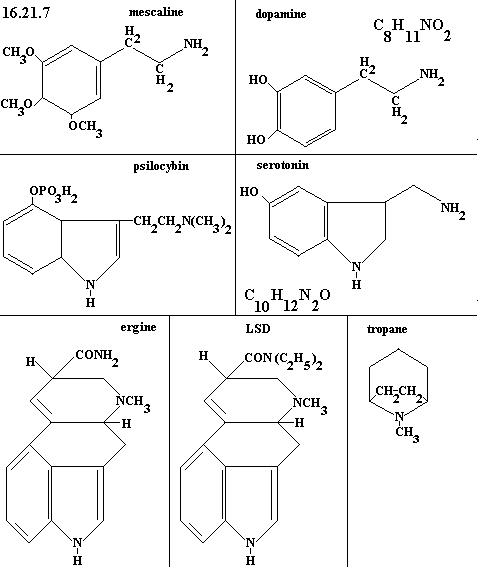
Tropane Alkaloids: 16.6.16
Cocaine and amphetamines: 5.7.0
Cocaine and crack cocaine: 5.7.0
It occurs in Cocoa (Erythroxylon coca), Erythroxylaceae.
Hallucinogenic drugs, hallucinogens: 5.5.15
Cola
"Cola-Mentos Fountain Kit" (toy product)
Cola tree (Cola acuminata), Goora nut, (Abata cola), Sterculiaceae
Giant cola (Cola gigantea), Sterculiaceae
Kola nut, Cola nut (Cola nitida) (C. acuminata), [theobromine, caffeine alkaloid], Sterculiaceae
Kola nuts (Cola vera), herbal medicine, Sterculiaceae
The recipe for the beverage Coca-Cola is said to be a commercial secret.
The Coca-Cola product Coke Zero, now rebranded Coca-Cola Zero Sugar, contains the artificial sweeteners aspartame and acesulfame potassium (Ace-K).
Caramel is used as a flavouring and food colouring E150 in candy and Coca Cola.
Cinnamon bark oil (contains cinnamaldehyde, eugenol, benzyl benzaldehyde, pinene), occurs in Coca Cola.
Contraception, Cola put into the vagina after having sex does not work as a contraceptive.
Methyl imidazole, 4-methylimidazole, 4-MEI, is a caramel colouring in cola drinks.
Cola drinks contain phosphoric acid.
Beverage can pressure: 12.2.4
Cola: 19.6.0
Soft drinks, carbonated beverages, fizzy drinks, sports drinks
Carbonic acid: 3.9.0
Density of cola and diet cola: 11.2.5
Freezing point depression of carbonated water, cola: 24.1.05
Colour
18.7.9 Tests for colour of water
35.1.4 Color of rocks and minerals
18.2.0 Colorimetric tests, Total dissolved solids and suspended solids in water
11.3.3 Colour change of diluted potassium permanganate
12.2.4.02 Coloured precipitates, double decomposition reactions
19.1.7 Colours, food colours, food additives
Physics
Colorimetric tests Total dissolved solids...
Colour of water Tests
Colour spectrum
Colours blue sky and sunset
Fifth field (Map colouring topology), (Mathematics)
Combustion
Combustion: 8.2.0
Combustible solids: 3.5.6
Combustion of butane: 16.6.4.0
Combustion of gasoline, Distil crude oil and collect the fractions: 10.3.9
Burning sugar cube, combustible cube: 17.3.12
Fire safety and fire equipment: 3.5.0
Heat sources, candles, heat substances, thermal decomposition: 8.3.0
Composition of
Composition of edible oils: 3.9.3
Composition of the atmosphere and greenhouse gases: 37.2.2
Prepare sea water crystals, composition of sea water: 3.1.14
Compounds, Chemical compound
Compounds, Chemical compound
A chemical compound contains two or more atoms of different elements that share a chemical bond.
Direct union of elements to form compounds: 7.4.20
Synthesis reactions (combination reactions, direct union of elements): 12.2.2.0
Decomposition reactions: 12.2.2
Pure substances and impure substances, elements and compounds: 7.2.0
Contact explosives
Acetone peroxide, TATP (triacetone triperoxide), C9H18O6, high explosive, white powder, bleach smell source
Lead azide, Pb(N3)2, contact explosive, in detonators source
Mercury (II) fulminate, Hg(CNO)2.H2O, Hg(ONC)2, initiator in detonator and percussion source
Nitrogen triiodide, NI 3: 12.19.6.13
Nitroglycerine: 16.6.10
Potassium chlorate in pyrotechnic flash powders: 15.2.13.2
Silver fulminate, AgCNO, contact explosion, extremely sensitive, tiny amounts are used in children's noise-making toys.
Silver nitride, Ag 3 N, contact explosive unstable, is an occasionally unwelcome occurrence in silver experiments.
Tetrasulfur tetanitride, S4N4 source
TNT, trinitrotoluene, CH3C6H2(NO2)3 source
Conservation
Conservation of mass: 11.3.0
Conservation of energy: 9.2.0
Soil conservation: 6.5.0
Copernicium, Cn
Copernicium, Cn
Copernicium, Table of the Elements
Copernicium, RSC
Copernicium named by IUPAC in 2010 after Nicolaus Copernicus (1473 -1543), Prussia, now Poland.
copnericum, Table of Elements
Corrosion
Corrosion,: 15.1.0
Corrosive substances: 3.4.4, (Chemical safety)
Corrosive sublimate, Mercury (II) chloride
Corrosive to metals: 4.16
Cotton
It occurs in Cotton bush (Gossypium barbadense), Malvaceae.
Card and cotton reel spool, lifting plate: 13.2.4, (Physics)
4.2.4, Cotton, burning test for natural fabrics: 4.2.4
Glass transition temperature (Tg), chewing gum, cotton: 3.4.0
Flaming and cotton wool plugs: 4.4.3, (Microbiology)
Fluorescent whitening agents in washing powders: 12.12.03.3a
Tests for cellulose, iodine tests for cellulose: 9.3.8
Cotton
Cotton buds, double -ended, pack / 100
Cotton cord, 2.5 mm
Cotton Blue (aniline blue, methyl blue, Helvetia blue, acid blue 93), C.I. 42780, C37H27N3Na2O9S3, histology and fungus stain source
Cotton Red (Gossipmine, CI 50240) CI22120, CI Direct Red 28, Congo Red source
Cotton reels, pack 144
Cotton seed oil, cottonseed oil Gossypium, meal for chickens
Cotton wool, pack 450 g, Cotton wool is almost pure cellulose.
Cotton wool balls, Dove Swisspers, 25 g, pack / 60
Cotton wool squares, Dove Swisspers, box / 80
Coumaric acid, C9H8O3
Coumaric acid, C9H8O3 source
Coumaric acid, p-Coumaric acid, 4-Hydrocinnamic acid, yellow-green crystalline powder, in flavours and pharmaceuticals
Cracking
Thermal cracking is the use of heat and pressure for controlled breakdown of naphtha, C 10, to form smaller hydrocarbon molecules and light olefins (alkenes).
For example ethylene, propylene butylene, which can later be polymerized.
The process increases the yield of petrol (gasoline), C 6-10, from crude oil and increases the octane rating.
Catalytic cracking: Si or Al catalysts to lower temperature to break down crude petroleum hydrocarbons or LPG or natural gas to form monomers, e.g. ethane, propane.
The smaller molecules formed by cracking often have branch chains.
Crocetin
Crocetin, C20H24O4, xanthophyll carotenoid pigment, (apocarotenoid), Trans-Crocetin, Natural Yellow-6, croceic acid, precursor of Safranal, C10H14O. source
It occurs in Gardenia (Gardenia jasminoldes), and in Saffron (Crocus sativus).
Crocin
Crocin, C44H64O24, carotenoid pigment, alpha-crocin, Gardenia Yellow, crocin digentiobiose ester, water-soluble (apocarotenoid), diterpene, gentiobiose diester of crocetin, from deep red forms orange solution, antioxidant, possibly anticancer. source
It occurs in Gardenia, (Gardenia jasminoldes), and Saffron, (Crocus sativus).
Cryptoxanthin
Cryptoxanthin, C40H56O, a carotenol antioxidant, a provitamin A, occurs in papaya and orange fruit, and in the cyanobacterium (Planktothrix rubescens). source
Crystals
"Crystal" may refer to soda-lime glass containing lead monoxide, often called "lead crystal" and use in wine glasses and ornaments
Breaking strains, brittleness: 34.5.2.0
Cleavage, fracture, twin crystals, crystal faces: 35.9
Condy's crystals: , KMnO4 source
Crystal growth on overhead projector
Crystal faults, crushing salt: 34.8.6
Crystal growth in a film: 34.8.5
Crystal systems, crystal habit, crystal form: 35.8
Crystals of different salts, storm glass: 12.10.1.0
Elasticity (Tension, Compression, Shear): 34.5.01
Fractional crystallization of sea water: 7.7.14
Ice model: 34.8.2
Ice nuclei: 34.8.4
Materials from the Earth: 34.3.0
Mechanical properties of materials, elastic, ductile, malleable: 34.5.0
Phenyl salicylate, C13H10O3 source
Poisson's ratio, v: 34.5.06
Prepare crystal violet, microscopy stain: 7.21
Prepare crystal violet solution: 22.01
Prepare crystals: 3.0.0
Prepare crystals, Water of crystallization, (List)
Rocks and minerals, definitions, mineral classification and origin: 35.4
Separate by recrystallization: 10.9.0
Shape memory alloy, Nitinol: 34.8.7
Shape or form (crystals): 35.19
Solid models, sphere packing: 34.8.8
Transparency (transparent, translucent, opaque, refraction): 35.7
Water of crystallization: 3.6.0
Cubebin
Cubebin, C20H20O6, tetrahydro-3,4-dipiperonylfuran-2-ol, lignan, benzodioxole, secondary alcohol, lactol, analgesic, anti-inflammatory, antimicrobial source
It is extracted from leaves of (Piper nigrum).
Curium, Cm
Curium, Cm
Curium, Table of Elements
Curium, RSC
Curium, Cm, radioactive metallic actinide
Curium is named after Marie Curie, 1867-1934, Poland / France.(br)
Cubebene
Cubebene, beta-Cubebene, C15H24, tricyclic sesquiterpenoid, in leaf oil cubebene from flowering plants source
Cucurbitacins
Cucurbitacins are oxygenated tetracyclic triterpenes mainly in seeds and roots of cucurbits, cucumbers, squash, melons and gourds, Cucurbitaceae.
All Cucurbitacins are related to Cucurbitacin A, C32H46O9. source
Curbitacins A to S, bitter taste, some cytotoxic, antitumour, some toxic, in Cucumis.
Some cucurbits can be toxic if eaten in great amounts, causing "toxic squash syndrome".
Diners are advised to stop eating excessively bitter cucurbits.
Cucurbitane, C30H54, triterpene. source
Cuminaldehyde
Cuminaldehyde, C10H12O, (4-isopropylbenzaldehyde), cuminal, flavouring agent, suppresses melanin formation in melanoma cells. source
It occurs in seed oil of Cumin (Cuminum cyminum), and is possibly antidiabetic.
Curcumene
Curcumene, C15H22, sesquiterpene, alpha-curcumene, (Curcuma xanthorrhiza), Javanese turmeric, wild tomato (Solanum phlomoides), insecticide, insect repellent in turmeric, bright yellow. source
Cyanide, CN
Cyanide, CN
A cyanide contains the cyano group C≡N.
An inorganic cyanide is a salt or ester of hydrocyanic acid, containing the group -CN or the Cyanide anion −C≡N.
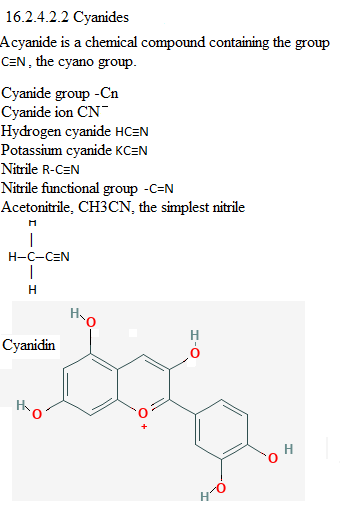
Cyanide, CN, cyanides CN -, nitriles, cyanide reagent test kit
Cyanide (cyano), CN-, monodentate ligand
Cyano -CN
A nitrile is an organic compound in which an alkyl group is directly attached to the carbon of a cyanide group.
Nitrile: 16.7.6
Hydrocyanic acid, hydrogen cyanide, Extremely Toxic: 16.2.4.2
Amygdalin, C20H27NO11, cyanogenic glucoside source
Cyanide compounds, Cyan-
Cyanic acid, C3H3N3O3 fulminic acid (salts fulminates) source
Cyanidin, C15H11O6 source
Cyanoacetic acid, C3H3NO2 source
Cyanocrylates, (CH2)C(CN)COOR, "Superglue": 16.2.4.7 source
Cyanogen, (CN)2
Cyanamide, CH2N2
Cyanamide, CH2N2 source
Cyanamide, CH2N2, NH2CN, carbimide, cyamamide, colourless, deliquescent crystal, soluble in water, alcohol and organic solvents, fertilizer, defoliant source
Cyanamides, inorganic salts, CN2 2- : 16.2.4.2.1 source
Calcium cyanamide, CaCN2, often called "cyamamide" or "nitrolime", fertilizer source
Cyanidin, Anthocyanin, C15H11O6 +
Cyanidin, Anthocyanin, C15H11O6 + source
Cyanidin, anthocyanidin cation, neuroprotective, antioxidant, red-purple pigment in berries, apple, plum, red cabbage, red onion
Cyanidin 3-O-glucoside, 3G, kuromanin, C21H21O11+ source
Cyanidin-3-rutinoside, C27H31ClO15, decrease blood sugar levels source
Hydroxycyanidin, in Alstroemeria
Cyanidin glucoside, C21H21O11+ source
Cyanidin glucoside, Cyanidin 3-O-glucoside, Cyanidin galactoside, Kuromanin, anthocyanin cation, a beta-D-glucoside
It occurs in American cranberry (Viburnum trilobum), cherries, olives, and in grapes.
Cyanidinrutinoside, C27H31O15+
Cyanidinrutinoside, C27H31O15+ source
Cyanidinrutinoside, Cyanidin 3-O-rutinoside, Cyaninoside, Sambucin, rutinoside, anthocyanin cation, disaccharide derivative, a benzene
It occurs in asparagus, and in blackcurrant.
Cyanin, C27H31O16 +
Cyanin, C27H31O16 + source
Cyanin, Cyanidin 3, 5-O-diglucoside, a beta-D-glucoside, anthocyanin cation, red plant pigment
It occurs in Sambucus.
Cyanine dyes
Cyanine dyes, R2N-(CH=CH)n-CH=N + R2, fluorophore labels for proteins and nucleic acids
Cyanine acid blue R dye
Cyanoacetic acid
Cyanoacetic acid, C3H3NO2, yellow-brown liquid, unpleasant odour, mixes with water. source
Cyanocobalamine
Cyanocobalamine, C63H88CoN14O14P, Vitamin B12, water-soluble vitamin, necessary for haematopoiesis (blood cells and plasma production) source
Deficiency causes anemias.
Cyanocrylates
Cyanocrylates (CH2)C(CN)COOR, e.g. "Superglue": Me or Et ester source
Ethyl cyanoacrylate, "Superglue", BE CAREFUL! Do not squirt in the eye! Toxic by all routes
Chemical suppliers: Ethyl 2-cyanoacrylate, liquid, C6H7NO2 source
GBL, γ-butyrolactone is a naturally occurring colourless oily liquid with a characteristic odour.
It is used as a stain remover and stripper, (including "Superglue").
Cyanogen
Cyanogen, (CN)2, (i.e. two joined "CN"s), NC≡CN, (note triple bond), colourless, nasty smell, Toxic
Cyanuric acid
Cyanuric acid, C3H3N3O3, (CNOH)3, conditioner, stabilizer, 18.7.14 source
Cyanuric acid CNOH)3, H3C3N3O3, is used in for swimming pools, purifying tablets, white soluble crystals, solution converts to urea. source
Cyanamides: 16.2.4.2.1
Cyanuric acid, conditioner, stabilizer: 18.1.6, conditioner, stabilizer, (Swimming pools)
Cyanuric chloride
Cyanuric chloride, C3Cl3N3, colourless crystalline, strong pungent odour, slightly soluble, toxic by ingestion and inhalation source
Cyasterone
Cyasterone, C29H44O8, phytosterol, a steroid lactone, a hydroxy steroid, a phytoecdysteroid, insect moulting hormone activity, inhibits insect ovary development. source
It occurs in Ajuga.
Cycasin
Cycasin, C8H16N2O7, a carcinogenic and neurotoxic glycoside source
. It occurs in the seeds of all cycas genera, e.g. (Cycas revoluta) and (Zamia pumila), causes the fatal nervous disease "Zamia staggers" in herbivores.
Indigenous Chemistry
Detoxification of cycasin
The development of complex detoxification processes by the rainforest Aboriginal peoples of North Queensland was driven by the food needs of that society.
Data, gathered from experiments that attempted to remove toxins, allowed this cultural group to modify and perfect the detoxification processes.
Europeans survived a near-fatal experience after consuming under-processed cycad kernels on the first voyage to Australia by Cook and his party in 1770.
Many of the detoxification processes of poisonous plant foods employed by Aboriginal peoples throughout Australia have been documented.
These detoxification processes provide evidence of Australia's First Nations peoples’ extensive scientific knowledge of chemical and physical processes.
Cycads are a source of carbohydrates, but they contain toxic cycasin, which causes vomiting, nausea and abdominal pains, damage to the nervous system and liver.
Cycasin has been linked to various types of cancer.
Cycasin consists of glucose chemically bound to the active toxic substance, methylazoxymethanol (MMA), C2H6N2O2. source
In water, cycasin is broken up into these two parts, thus facilitating the removal of the toxic and water soluble MMA - Methoxymethanol.
This is a slow reaction, so Aboriginal peoples had to discover measures to speed up the reaction, increasing the contact surface with water and the temperature.
If the untreated cycad kernels are consumed, the same reaction happens at a much greater rate in the body due to β-glucosidase), causing acute symptoms.
Cyclo-
Cycloalkanes, CnH2n: 16.4.1.2
Examples of cycloalkanes
Cycloartenol, C30H50O source
Cyclopropane, C3H6 source
Cyclobutane, C4H8 source
Cyclopentane, C5H10 source
Cycloheptane C7H14 source
Cyclooctane C8H16 source
Cyclovirobuxine, alkaloid
Cycloartenol
Cycloartenol, C30H50O, pentacyclic triterpenoid, a 3beta-sterol, a phytosterol source
Cycloastragenol
Cycloastragenol, C30H50O5, sapogenin, pentacyclic triterpenoid, tetrol, oxolane source
It is extracted from root of (Astragalus membranaceus).
Cyclodiene
Alkenes, CnH2nolefins: 16.1.1.2
Cyclodiene pesticides, aldrin, chlordane, dieldrin, endrin, heptachlor: 16.4.01
Cyclohexyl alcohol, HOCH(CH2)5, cyclohexanol, precursor to manufacture of nylon source
Cyclohexene, 3,4,5,6-tetra hydrobenzene, (old stock may form unstable peroxides), Toxic, Flammable
Cyclonite CH2N.NO2)3, Hexogen, cyclothrimethylene trinitramine, explosive, used with TNT source
Cyclosilicates, Be3Al2(SiO3)6: Beryl source
Cyclohexane
Cyclohexane, C6H12, flammable organic chemical: Cyclohexane source
Cyclohexane, hexamethylene, hexahydrobenzene, colourless liquid, ethereal petroleum-like odour, Highly flammable, Toxic, occurs in kohlrabi
It is used as a solvent, oil extractant, paint and varnish remover, and in solid fuels.
Cycloalkanes: 16.4.1.2
Cyclohexane, aromatic hydrocarbons, e.g.: Benzene, C6H6 source
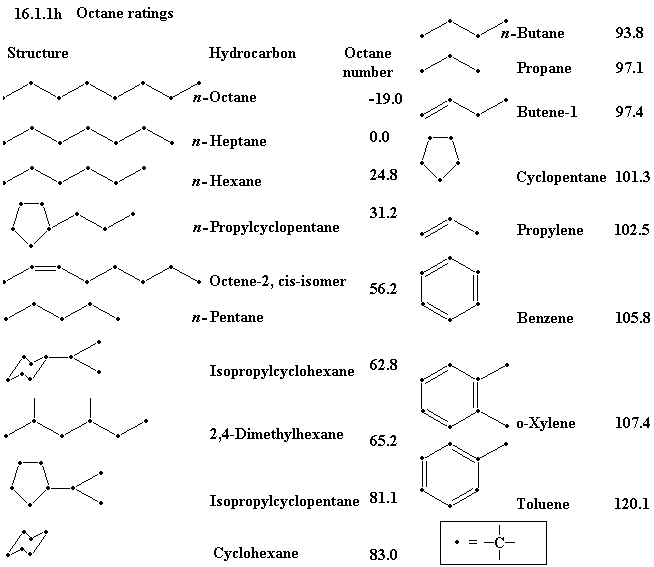
Flammable liquids, cyclohexane: 3.5.8
Prepare nylon polymer: 3.4.7.
Steam distillation to measure water and fat content of food: 10.5.5
Cyclohexanol
Cyclohexanol, C6H11OH, hexahydrophenol, cyclohexyl alcohol, hexahydrobenzene, hexalin, Toxic source
Cyclohexanol, Solution < 20%, Not hazardous
Cyclohexanol, oily colourless liquid, Molal freezing point constant of cyclohexane solvent: 24.1.14
Cyclohexanone
Cyclohexanone, C6H10O, 2,4-DNP Hydrazone, Toxic by all routes, flammable, used in skin and eye protection source
Cyclohexanone, Solution < 1%, Not hazardous
Cyclohexanone, colourless liquid, odour like propane, cellulose lacquers, solvent
Cymene
Cymene, C10H14, monoterpene-relative hydrocarbon, p-cymene, p-isopropyltoluene, p-cymol, cuminal, alkylbenzene, colourless liquid, pleasant odour, floats on water, in oil of | Cumin, (Cuminum cyminum) | source
Cyperene
Cyperene, C15H24, sesquiterpene, alpha-cyperene, occurs in Nutgrass (Cyperus bulbosus), and in Burdock (Arctium lappa). source
Cytosine
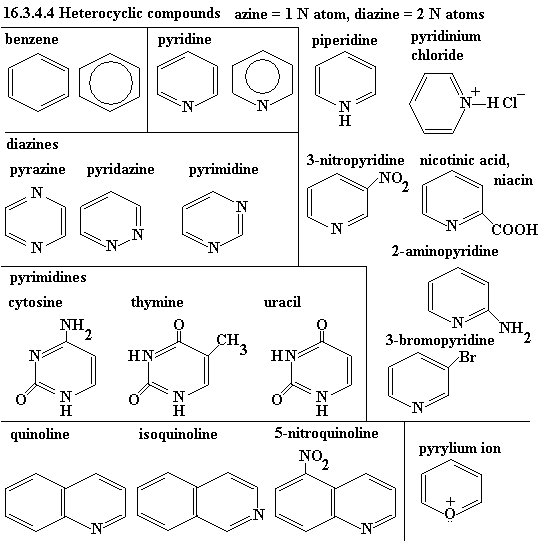
Cytosine, C4H5N3O [4-Amino-2-hydroxypyrimidine], cytosinimine source
It is pyrimidine base that is a fundamental unit of nucleic acids, is found in DNA and RNA that pairs with guanine.
Cytosine, C4H5N3O, DNA and RNA: 9.4.0 source
Cytosine, Nucleic acid nitrogenous bases 3.0.0
Cysteine
Cysteine, C3H7NO2S, L-cysteine, a thiol-containing non-essential amino acid that is oxidized in humans to form cystine. source
It is used as a flour treatment agent.
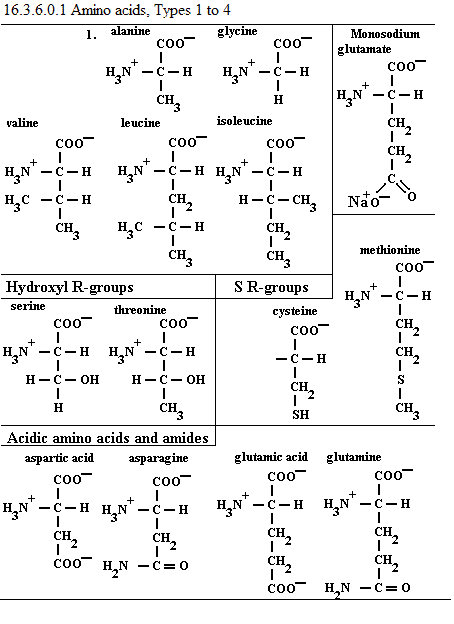
E920, L-cysteine monohydrochloride
Cysteine, (Table of amino acids)
Cysteine, DNA codons
Cystine
Cystine, C6H12N2O4S2, L-cystine, (mirror image cystine), nonessential amino acid source
It is formed by the oxidation of cysteine, (two molecules of cysteine are joined by disulfide bridge).
It is used as a flour treatment agent.
Cytochromes
Cytochrome C, CYP, myohematin, hematin-protein, C42H52FeN8O6S2 source
CYP: enzymes in liver and small intestines that use iron to oxidize harmful substances and drugs by making them more water-soluble.
This process is called "Phase I metabolism".
They may add a hydroxyl group then conjugation to groups such as glucuronide to increase the solubility even further
This process is called "Phase 2 metabolism".
Cytochrome P450 catalysed reaction NADPH+ H + + O2 + RH → NADP + + H2O + R-OH source
(Where NADPH is a protein in the endoplasmic reticulum).
Also, CYP affects vascular autoregulation, in the brain and the formation of cholesterol, and steroids.
About 50 CYPs occur in humans.
Just as plants develop new alkaloids to limit their consumption by animals, animals develop new enzymes to metabolise the plant toxins.
Most CYP is anchored to membranes of the microsomal portion of the cell.
After adding an agent to reduce haem, part is exposed to carbon monoxide and if it strongly absorbs light at 450nm wavelength.
compared with the original solution, it must contain CYP, a process called "difference spectroscopy".
This page was generated automatically from the original page on John Elfick's School Science Lessons website. If something looks wrong, please check the original.