Australian native foods
Last updated 2026-10-13a by Dr John Elfick
5.1 Scientific names of Australian native foods
The term "Australian native foods" refers to Australian native plants known to be used by Australian aboriginal people for food.
Similarly, the term "bushfood", "bush foods", "bush tucker foods" refers to Australian native plants that Australians use or were known to use for food.
However, "bushfood" may refer to plants supplied by plant nurseries and labelled "bushfood", without evidence that they were Australian native foods.
Also, they may be hybrids subject to plant breeders' rights (PBR).
The Queensland Herbarium does not use the term "bush foods" in any publications and there is no agreed list of "bush foods".
However, in the list below, the common name preferred by the Austrlian National Herbarium or the Queensland Government is usually used.
Botanists avoid using the term "bush foods", because it refers to all of the indigenous foods for Australian indigenous peoples, including the protein component.
Botanists may prefer to use the term "Australian native foods" to differentiate between the foods the Aboriginal people used and the foods we daily use,
because we use their foods in a different way, and we use less of those foods available to them.
The term "Australian native foods", excludes any food that need processing to remove toxin, because their methods have been lost
The term "bushfoods" includes foods that need processing, and can be toxic.
See: Common names of plants , A to Z.
See: Australian native plants societies
See: Australian native foods suppliers
5.2 List of Australian native foods
The species below may not have been studied to determine the level of possible toxicity and
the method of preparation, or cooking needed to ensure no harm.
African violet, (Streptocarpus ionanthus), Gesneriaceae
Aibika, (Abelmoschus moschatus subsp. 'moschatus'), Malvaceae
Aniseed myrtle, (Syzygium anisatum), Myrtaceae
Apple dumplings, (Billardiera scandens), Pittosporaceae
Apricot satinash, (Syzygium fibrosum), Myrtaceae
Atherton oak, (Athertonia diversifolia), Proteaceae
Atherton raspberry, (Rubus probus), Rosaceae
Australian cashew nut, (Semecarpus australiensis), Anacardiaceae
Australian cypress, (Callitris columellaris), Cupressaceae
Australian nutmeg, (Myristica insipida), Myristacaceae
Australian raspberry, (Rubus parvifolius), Rosaceae
Australian sandalwood, (Santalum spicatum), Santalaceae
Baobab tree, (Adansonia gregorii), Malvaceae
Beach bird's-eye, (Alectryon coriaceus), Sapindaceae
Bernie's tamarind, (Diploglottis berniana), Sapindaceae
Billy buttons, (Pycnosorus globosus), Asteraceae
Bitter quandong, (Santalum murrayanum), Santalaceae
Black apple, (Pouteria australis), Sapotaceae
Black bean, (Castanospermum australe), Fabaceae
Black plum, (Diospyros australis), Ebenaceae
Black sheoak, (Allocasuarina litoralis), Casuarinaceae
Blue flax-lily, (Dianella brevipedunculata), Aspodelaceae
Blue lilly pilly, (Syzygium oleosum), Myrtaceae
Blue mallee, (Eucalyptus polybractea), Myrtaceae
Blue quandong, (Elaeocarpus grandis), Elaeocarpaceae
Blue tongue, (Melastoma affine), Melastomataceae
Bolwarra, (Eupomatia laurina), Eupomatiaceae
Boonjee tamarind, (Diploglottis bracteata), Sapindaceae
Brahmi, (Bacopa monnieri), Plantaginaceae
Bramble wattle, (Acacia victoriae), Fabaceae
Broad-leaved lilli pilly, (Syzygium hemilamprum), Myrtaceae
Brush pepperberry, (Tasmannia insipida), Winteraceae
Bulbine lily, (Bulbine bulbosa), Asphodelaceae
Bunya pine, (Araucaria bidwillii), Araucariaceae
Burdekin plum (Pleiogynium timorense), Anacardiaceae
Bush currant, (Carallia brachiata), Rhizophoraceae
Bush mint, (Mentha satureioides), Lamiaceae.
Bush nutmeg, (Horsfieldia australiana), Myristaceae
Bush onion, (Cyperus bulbosus), Cyperaceae
Bushy bluebell, (Wahlenbergia multicaulis), Campanulaceae
Cape gooseberry, (Physalis peruviana), Solanaceae
Cape York tamarind, (Diploglottis macrantha), Sapindaceae
Cape York turmeric, (Curcuma australasica), Zingiberaceae
Cedar Bay cherry, (Eugenia reinwardtiana), Myrtaceae
Cherry satinash, (Syzygium luehmanii), Myrtaceae
Chinese water chestnut, (Eleocharis dulcis), Cyperaceae
Chocolate lily, (Arthropodium strictum), Liliaceae
Cinnamon myrtle, (Backhousia myrtifolia), Myrtaceae
Coastal saltbush, (Atriplex cinerea), Amaranthaceae
Coastal wattle, (Acacia sophorae), Fabaceae
Conkerberry, (Carissa spinarum), Apocynaceae
Coolamon lilly pilly, (Syzygium mooreii), Myrtaceae
Corduroy tamarind tree, (Mischarytera lautereriana), Sapindaceae
Curara, (Acacia tetragonophylla), Fabaceae
Currantbush, (Carissa ovata), Apocynaceae
Currantwood, (Antidesma bunius), Phyllanthaceae
Curry leaf myrtle, (Backhousia angustifolia), Myrtaceae
Cut-leaf mintbush, (Prostanthera incisa, Lamiaceae
Davidson’s plum, (Davidsonia pruriens), Cunoniaceae
Desert raisin, (Solanum centrale), Solanaceae
Dodder laurel, (Cassytha filiformis), Lauraceae
Dryander tamarind, (Diploglottis obovate), Sapindaceae
Dusky coral pea, (Kennedia rubicunda)
Emu apple, (Owenia acidula), Meliaceae
Emu foot grass, (Cullen tenax), Fabaceae
False sandalwood, (Eremophila mitchelli), Scrophulariaceae
Finger lime, (Citrus australasica), Rutaceae
Flinders Island celery, (Apium insulare), Apiaceae
Fraser Island "apple", (Acronychia imperforata), Rutaceae
Giant speargrass, (Heteropogon triticeus), Poaceae
Golden wattle, (Acacia pycnantha), Fabaceae
Grass-tree, (Xanthorrhoea australis), Asphodelaceae
Green plum , (Buchanania obovata), Anarcardiaceae
Grey mangrove, (Avicennia marina), white mangrove, Verbenaceae
Hard quandong, (Elaeocarpus obovatus), Elaeocarpaceae
Heath banksia , (Banksia ericifolia), Proteaceae
Jam wattle , (Acacia acuminata), Fabaceae
Jelly bush, (Leptospermum polygalifolium), Myrtaceae
Johnstone River almond, (Elaeocarpus bancroftii), Elaeocarpaceae
Johnstone River satinash, (Syzygium erythrocalyx), Myrtaceae
Kakadu plum, (Terminalia ferdinandiana), Combretaceae
Kangaroo apple, (Solanum aviculare, Solanum laciniatum), Solanaceae
Kankong, (Ipomoea aquatica), Convolvulaceae
Kapok bush, (Cochlospermum fraseri), Bixaceae
Large pigweed, (Portulaca intraterranea), Portulacaceae
Lawyer vine, (Smilax australis), Smilacaceae
Leek lily, (Bulbine semibarbata), Asphodelaceae
Lemon myrtle, (Backhousia citriodora), Myrtaceae
Lemon-scented ironbark, (Eucalyptus staigeriana),Myrtaceae
Lilly pilly, (Syzygium smithii), Myrtaceae
Lilly Pilly 'Sour cherry', (Syzygium corynanthum), Myrtaceae
Little gooseberry tree, (Buchanania arborescens), Anacardiaceae
Macadamia nut, (Macadamia integrifolia), Proteaceae.
Magenta lilly pilly, (Syzygium paniculatum), Myrtaceae
Mangrove, (Avicennia officinalis), Verbenaceae
Manna gum, (Eucalyptus viminalis), Myrtaceae
Manuka tea tree, (Leptospermum scoparium), Myrtaceae
Midgen berry, (Austromyrtus dulcis), Myrtaceae
Mikania vine, (Mikania micrantha), Asteraceae
Milkmaids, (Burchardia umbellata), Colchicaceae
Millaa millaa vine, (Elaeagnus triflora), Elaeagnaceae
Molucca bramble,, (Rubus moluccanus), Rosaceae
Mountain pepper, (Tasmannia lanceolata), Winteraceae
Mulga wattle, (Acacia aneura), Fabaceae
Muntries, (Kunzea pomifera), Myrtaceae
Murnong, (Microseris lanceolata), Asteraceae
Native apricot, (Pittosporum angustifolium), Pittosporaceae
Native bush mint, (Prostanthera rotundiflora), Lamiaceae
Native cranberry, (Astroloma humifusum), Epacridaceae
Native currant, (Acrotriche depressa), Ericaceae
Native finger lime, (Citrus australasica), Rutaceae.
Native gardenia, (Atractocarpus fitzalanii), Rubiaceae.
Native ginger, (Alpinia caerulea), Zingiberaceae.
Native gooseberry, (Physalis minima), Solanaceae
Native grape, (Ampelocissus acetosa), Vitaceae
Native lily, (Alocasia brisbanensis), Araceae
Native lychee, (Dimocarpus australianus), Sapindaceae
Native millet, (Panicum decompositum), Poaceae
Native mint, (Mentha diemenica), Lamiaceae
Native mulberry, (Pipturus argenteus), Urticaceae.
Native pepper vine, (Piper hederaceum), Piperaceae
Native pigface, (Carpobrotus rossii), Aizoaceae
Native potato, (Ipomoea costata), Convolvulaceae
Native raspberry, (Rubus rosifolius), Rosaceae
Native rosella, (Abelmoschus moschatus), Malvaceae
Native sarsaparilla, (Hardenbergia violacea), Fabaceae
Native tamarind, (Diploglottis australis), Sapindaceae
Native thyme, (Ozothammus obcordatus)
Native tobacco, (Nicotiana sauveolens), Solanaceae
Native violet, (Viola banksia), Violaceae.
Native wampee, (Murraya crenulata)
Nitre bush, (Nitraria billardierei), Nitrariaceae
Nodding saltbush, (Einadia nutans), Chenopodiaceae
Noni, (Morinda citrifolia), Rubiaceae
Olive tea tree, (Leptospermum liversidgei), Myrtaceae
Oval leaf mint bush, (Prostanthera ovalifolia), Lamiaceae
Peanut tree, (Sterculia quadrifida), Malvaceae
Pencil yam, (Vigna lanceolata), Fabaceae
Pigface, (Carpobrotus glaucescens), Aizoaceae
Pink lime berry, (Glycosmis trifoliata), Rutaceae
Pink satinash, (Syzygium malaccense), Myrtaceae
Plum pine, (Podocarpus elatus), Podocarpaceae.
Potato bush, (Solanum ellipticum), Solanaceae
Prickly currant bush, (Coprosma quadrifida)
Purple apple-berry , (Billardiera longiflora), Pittosporaceae
Purslane, (Portulaca oleracea), Portulacaceae
Queensland blue flax-lily, (Dianella atraxis), Aspodelaceae
Red bopple nut, (Hicksbeachia pinnatifolia), Proteaceae
Red maids, (Calandrinia balonensis), Portulacaceae
Red-flowered kurrajong , (Brachychiton megaphyllus), Sterculiaceae
River mint, (Mentha australis), Lamiaceae
Rock lily, (Bulbine glauca), Asphodelaceae
Rock orchid, (Thelychiton speciosus), Orchidaceae
Rose myrtle, (Archirhodomyrtus beckleri), Myrtaceae
Rosella, (Hibiscus heterophyllus), Malvaceae
Rough-shell Queensland nut, (Macadamia tetraphylla), Proteaceae
Rough tree-fern, (Cyathea australis), Cyathaceae
Ruby saltbush, (Enchylaena tomentosa), Amaranthaceae
Running postman, (Kennedia prostrata), Fabaceae
Saltbush, (Atriplex nummularia), Amaranthaceae
Samphire, (Salicornia quinqueflora)
Sandpaper fig, (Ficus coronata), Moraceae
Sandplain wattle, (Acacia murrayana), Fabaceae
Sarsaparilla, (Smilax aristolochiifolia), Smilacaceae
Sawsedge, (Gahnia aspera), Cyperaceae
Scrambling lily, (Geitonoplesium cymosum), Asphodelaceae
Screwpine, (Pandanus odifer), Pandanaceae
Scrub nettle, (Urtica incisa), Urticaceae
Scurvy weed, (Commelina cyanea), Commelinaceae
Sea celery, (Apium prostatum), Apiaceae
Sea purslane, (Sesuvium sportulacastrum), Azoiaceae
Seaberry salt-bush, (Rhagodia candolleana), Amaranthaceae
Seablite, (Suaeda australis), Amaranthaceae
Sheoak, (Casuarina equisetifolia), Casuarinaceae
Silky myrtle, (Decaspermum humile), Myrtaceae
Silky wattle, (Acacia holosericea), Fabaceae
Small-leaved tamarind, (Diploglottis campbellii), Sapindaceae.
Smith's tamarind, (Diploglottis smithii), Sapindaceae
Sneezeweed, (Centipeda cunninghamii), Asteraceae
Spiny-head mat-rush, (Lomandra longifolia)
Swamp wattle, (Acacia retinodes), Fabaceae
Sweet apple-berry , (Billardiera cymosa), Pittosporaceae
Sweet white kunzea, (Kunzea ambigua)
Tanjong tree, (Mimusops elengi), Sapotaceae
Tasman flax-lily, (Dianella tasmanica), Aspodelaceae
Tasmanian blue gum, (Eucalyptus globulus var. globulus), Myrtaceae
Tasmanian snow berry, (Gaultheria hispida), Ericaceae.
Tea tree, (Leptospermum petersonii)
Tropical banksia , (Banksia dentata), Proteaceae
Vanilla lily, (Arthropodium milleflorum), Liliaceae
Walking stick palm, (Linospadix monostachya), Arecaceae
Warrigal greens, (Tetragonia tetragonioides), Aizoaceae.
Water lily, (Nymphaea macrosperma), Nymphaeaceae
Wattleseed, (Acacia aneura, A. pycnantha, A. retinodes, A. longifolia, A. victoriae), Fabaceae
Weeping paperbark, (Melaleuca leucadendra), Myrtaceae
White aspen (Acronychia oblongifolia), Rutaceae
White correa, (Correa alba), Rutaceae
White elderberry, (Sambucus gaudichaudiana), Adoxaceae
Wild currant, (Antidesma erostre), Phyllanthaceae
Wild orange, (Capparis mitchellii), Capparaceae
Wild parsnip, (Trachymene incisa), Araliaceae
Wild passionfruit, (Capparis spinosa subsp nummularia), Capparaceae
Winter apple, (Eremophila deblis), Scrophulariaceae
Wirewood, (Acacia coriacea), Fabaceae
Witchetty bush, (Acacia kempeana), Fabaceae
Wombat berry, (Eustrephus latifolius), Asparagaceae
Yellow plum, (Ximenia americana), Olacaceae
Yellow tulipwood, (Drypetes deplanchei), Euphorbiaceae
Youlk, (Platysace deflexa), Apiaceae
Zamia fern, (Bowenia spectabilis), Stangeriaceae
Zig zag vine, (Melodorum leichhardtii), Annonaceae
5.3 Dried Australian herbs
Dried Wattleseed Powder
Dried Strawberry Gum Leaf Powder
Dried Old Man Saltbush leaf
Dried Lemon Myrtle Leaf
Dried Cinnamon Myrtle Leaf
Dried Anise Myrtle Leaf
Herbs
Bush currant, (Carallia brachiata), corky bark, maniawiga, up to 25 m, opposite oval glossy leaves, grey rough corky bark, small cream-green flowers in clusters on old wood, small globular berries eaten raw, useful timber, resistant to salt spray and saline soils, Australian native food, Rhizophoraceae.
Carallia brachiata, Territory Native Plants.
Currantbush, (Carissa lanceolata), erect shrub, up to 3 m, cliff faces and flood plains, creek margins, narrow leathery leaves, wood contains | Carissone, C15H24O2 | Dehydrocarissone C15H22O2 | Carindone C31H44O6 | Australian native food, Apocynaceae. source
Corduroy tamarind tree, (Mischarytera lautereriana), rainforest tree, edible tart fruits, "corduroy" because ridges in the wood below the bark, Australian native food, Sapindaceae.
Cape York tamarind, (Diploglottis macrantha), small tree with large furry leaves, attractive new growth, multiple trunked, fruiting at 2.5 m high, orange fruit, Australian native food, occurs in seasonal rainforest with a marked monsoonal period, grows well in Queensland sub-tropics, Sapindaceae.
Conkerberry, (Carissa spinarum), bush plum, multi-stemmed shrub, up to 3 m, glossy green opposite leaves, branches bear thorns, white, star-shaped flowers, ovate green berries turn black-purple when ripe, Australian native food, Africa, Southern Asia, Australia, Apocynaceae.
Australian cypress, (Callitris columellaris), sand cypress pine, white cypress pine, Murray pine, (not a "pine", Pinus), conifer, light tan to darker brown heartwood, resistant to insect attack, used for flooring and light construction, Australia, Cupressaceae.
Australian Aboriginal people on the Murray River made a combined canoe pole and fish spear from the wood, and its resin was used as a cement for fastening barbs to spears.
Callitris trees, Australian Forests.
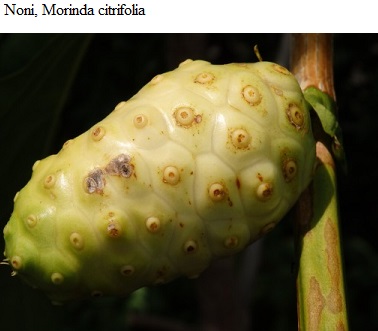
Noni, (Morinda citrifolia), Indian mulberry, beach mulberry, cheese fruit, used in noni soap, traditional herbal medicine, source of antioxidants | Vitamin C | potassium, phytonutrients, anti-inflammatory, anti-viral, and anti-bacterial compounds, boost immune system, repair cellular damage, stone-fish wounds, digestive problems, when ripe fruit skin becomes translucent, flesh turns soft with unpleasant odour then called "starvation fruit", Southeast Asia and Pacific region, Australian native food, Rubiaceae.
5.4 Examples of uses of native plants
Orange Thorn (Citriobatus pauciflorus) has round yellow edible fruits with a leathery skin and large seeds.
Cherry Ballart, (Exocarpos cupressiformis), native cherry, wood was used for spearthrowers and for bull-roarers, and the sap was applied to snakebites.
Austral Mulberry, (Hedycarya angustifolia) straight sticks were used for fire-drills, twirled between the hands while resting on another flat piece of wood, to produce fire.
Austral Indigo, (Indigofera australis) and Wild Indigo, (Tephrosia purpurea) were crushed and put into pools to kill or stun fish so that they could be easily caught.
Mountain Devil, (Lambertia formosa) flowers were sucked for the copious nectar, which may have caused nausea and headache after consuming large amounts
Spiny-headed Mat-rush, (Lomandra longifolia) long smooth leaves were used to make baskets and mats, and by beating and soaking the leaves, fibre was separated to make string for net-bags, baskets, and eel-traps.
Burrawangs, (Macrozamia spp. ), poisonous seeds of these and other cycads are borne in a large cone and have an orange outer coat.
Aboriginal people knew how to treat them to remove the poison, and so take advantage of the large amount of food provided by a single plant.
One of the ways was to cook the seed, break it up, and then soak it for up to three weeks in running water.
Nardoo fern , (Marsilea drummondii), which grows in shallow seasonal waters.
When the water dried up, the hard spore-cases were collected.
They were broken up on grindstones, and the spores were separated from the outer cases.
The spores swell when moistened, and were made into damper.
Murnong, (Microseris lanceolata), yam-daisy), radish-shaped tubers were cooked in baskets in an earth oven, to produce a dark sweet juice.
Antarctic Beech, (Nothofagus moorei), had an orange fungus, (Cyttaria septentrionalis), growin on this tree, which was eaten raw.
Geebung, (Persoonia pinifolia) had an edible the sweet pulp, and an inedible hard stone, which was discarded.
All Persoonia species are called gebung.
Common Reed, (Pragmites australis), had tall bamboo-like stems used spears, and were also cut into short lengths to make necklaces, or to stick through the septum of the nose as an ornament.
The leaves were used to make bags and baskets.
Brown Pine, (Podocarpus elatus), had sweet but mucilaginous seed borne on a purple-black fleshy stalk, which was eaten.
Thorny Saltbush, (Rhagodia spinescens), fruits were used to make a red paint for the face.
Kangaroo Apple, (Solanum laciniatum), egg-shaped orange fruits are poisonous if eaten unripe, so were eaten only when they were ripe enough to fall from the bush, or were picked earlier, and buried in sand-heaps to ripen.
Bluebell Creeper, (Sollya heterophylla), dark blue fruits were eaten.
Pepper Tree, (Tasmannia insipida), flesh of the purple-black fruit is edible, but the few black seeds are very peppery.
Cumbungi, (Typha spp), Bulrushes, underground rhizomes were steamed in an earth oven, the outer layer was stripped off, and the starchy fibrous inner part was tied in a knot to be chewed to remove the starch and leave the remaining fibre to be dried, soaked, scraped with mussel shells, and then rolled on the thigh to give very strong string for making large nets.
Finer string was made from the leaves.
The young shoots which appear in early summer were eaten raw.
This page was generated automatically from the original page on John Elfick's School Science Lessons website. If something looks wrong, please check the original.