Chemistry Experiments, D
Last updated 2026-07-13 by Dr John Elfick
School Science Experiments
Chemistry, D
dm3 = 1 litre
Quick links — A–Z index
Dalton's law of partial pressures
Diffusion, particles of matter
12.3.0 Dilute acids with
Dinitrogen tetroxide, N2O4 source
Direct union of elements to form compounds
Diterpenoids, List of Diterpenoids
Drugs test for toxic drugs on water fleas
Dry ice, CO2 source
12.19.4.1 Daguerreotype
A daguerreotype is a direct positive image from silver amalgam particles forming on the surface of a highly polished sheet of silver after exposure to light.
The process requires mercury vapour, so it should not be done in schools.
Daguerreotypes are made in three stages:
1. Expose a silver plate to iodine or bromine vapour to form a light-sensitive layer of silver halide.
When exposed to the light, photons dislodge the halides to leave silver.
So the halide remains on the plate only where the image is dark.
2. Expose the plate to mercury vapour so that the mercury forms silver-mercury crystals.
3. Wash the plate in sodium thiosulfate to remove the halogen from the plate.
To leave a silver surface that reflects back as black and silver-mercury crystals that refract light as white.
Then the daguerreotypes were soon sealed in glass plates to protect them from tarnishing of the silver.
Old daguerreotypes may be damaged by salts from sea air and spotlights.
DEHP
DEHP, C24H38O4, di-(2-ethylhexyl)phthalate, is a polyvinyl chloride resin plasticiser. source
Deidaclin
Deidaclin, C12H17NO6, cyanogenic glycoside, occurs in (Tetrapathaea tetrandra), (Kiggelaria africana), and (Passiflora foetida). source
Demineralized water
Demineralized water, "demi water", minerals or salts removed, is used to replace expensive distilled water.
Depression
Freezing point depression and boiling point elevation: 24.4.1
Freezing point depression of carbonated water, cola: 24.4.3
Diazepam
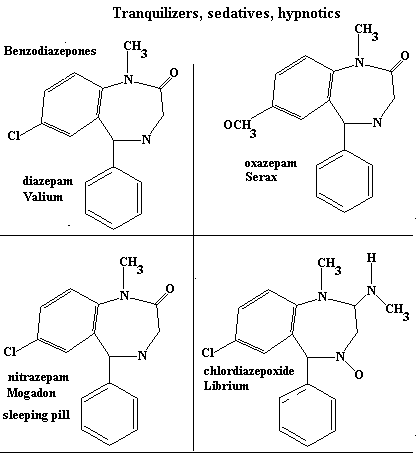
Diazepam, C16H13ClN2O, (Valium), 1,4-benzodiazepinone, white-yellow crystalline powder, is almost odourless, tasteless then bitter aftertaste. source
It is an anti-anxiety drug, anticonvulsant, sedative, and it has a low potential for drug abuse.
Dibutyl phthalate
Dibutyl phthalate, C16H22O4, DPB, is a plasticiser, food contaminant, colourless, oily liquid, with a weak odour. source
It is used to make plastics more flexible, is not a natural product and is regarded as an environmental contaminant.
Dichlorvos
Dichlorvos, C4H7Cl2O4P, CCl2=CHOPO(OCH3)2, was once used widely, but is now banned for plant protection product in the EU. source
It is an insecticide, dense colourless liquid, sweet smell, mixes with water and was used for insect control in food storage areas and on pets.
If heated to high temperatures, emits toxic chloride fumes and phosgene gas, and is toxic by inhalation.
Diginatin
Diginatin, C41H64O15, Diginatigenin 3-O-tridigitoxoside, cardenolide glycoside. source
It occurs in woolly foxglove (Digitalis lanata).
Digitalis lanata was used to treat heart conditions, but it comes with severe side effects.
The plant is poisonous in all parts and is a declared weed in many countries.
Dihydrocubebin
Dihydrocubebin, C20H22O6, glycol, lignan, butanediol, benzodioxole, is a antimicrobial. source
It occurs in (Podolepis rugata), (Horsfieldia irya) bark, leaves, and wood.
Dihydrokarvain
Dihydrokarvain, C14H16O3, kavalactone, anxiolytic. source
It occurs in kava, (Piper methystichum).
Dihydromethysticin
Dihydromethysticin, C15H16O5, 2-pyranone, quinone, aromatic ether, spasmolytic source
It occurs in (Piper methysticum), (Piper majusculum), and in (Aniba hostmanniana).
D-Glucose
D-Glucuronic acid | D-Glutamic acid | D-( -)-Fructose | D-(+)-Glucose | D-Tartaric acid |
D-Xylose | D-Mannitol | D-Sorbitol | D-Serine | D-Tryptophan | D-Ribose |
Danielone
Danielone, C10H12O5, an acetophenone, aromatic ketone, phytoalexin, antifungal activity source
It occurs in Papaya species fruit, (Cestrum parqui), and in (Euglena gracilis).
Dantron
Dantron, C14H8O4, chrysazin, (1,8-dihydroxyanthraquinone), health hazard, former laxative source
It is an orange crystalline powder, odourless, tasteless, immunosuppressive, cathartic, purgative, antioxidant, and fungicide.
It is a possible carcinogen, but withdrawn from US markets due to genotoxicity, and it causes red urine.
It occurs in Cassia species, Rheum species, Xyris species leaves and stems, and in Cinchona species.
Darmstadtium
Darmstadtium, Ds ( German Darmstadt, where it was first produced in Germany), radioactive transuranic element.
Darmstadtium, Table of the Elements
Darmstadtium, RSC
Decomposition
12.2.2 Decomposition reactions
15.5.4 Electrolysis of water
12.11.3.4 Tests for substances, sublimation, melting, decrepitation
3.7.0 Thermal decomposition, List
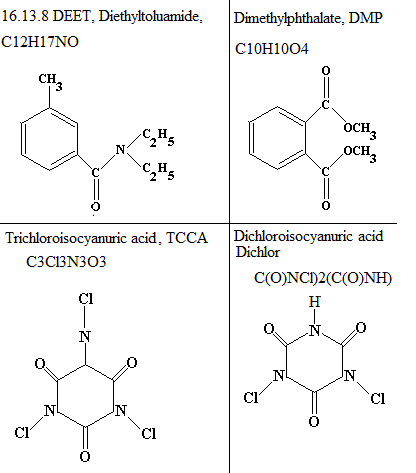
DEET
DEET, C12H17NO, N,N-Diethyl-meta-toluamide, diethyltoluamide, "PESTANAL", common in pesticides source
It gives short-term protection against Anopheles species mosquitoes, rather than Culicine mosquitoes.
Deliquescent
Be careful! Hygroscopic and deliquescent substances may absorb moisture from human tissue and so should be treated as potentially highly corrosive!
Deliquescent substances are hygroscopic substances that absorb much water to form a concentrated solution of the substance.
Deliquescent chemicals absorb water from the air and dissolve in it to form a concentrated solution:.
Citric acid C6H8O7, (slight), Cobalt (II) nitrate, Co(NO3)2.6H2O, Magnesium chloride, MgCl2, Potassium hydroxide, KOH, Potassium iodate, KIO3, (slight), source
Potassium iodide. KI, (slight), Sodium nitrate NaNO3, (if in moist air), Sodium thiosulfate Na2S2O3.5H2O, (if in moist air) source
Store deliquescent chemicals in an airtight container or in a desiccator.
When exposed to the air, sodium chloride neither gains nor loses water.
Pure sodium chloride NaCl, is not hygroscopic.
Sodium chloride as table salt in a salt shaker may become sticky and hard to shake out, because it contains deliquescent magnesium chloride as an impurity.
Add calcium carbonate or dry rice grains to table salt to stop deliquescence.
Delphinidin
Delphinidin, C15H11O7+, anthocyanin, hexahydroxyflavylium, antineoplastic, blue pigment source
It occurs in Viola species, Delphinium species, grape (Vitis vinifera), and cranberry Vaccinium.
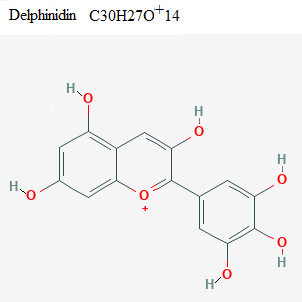
Delphinidin 3-O-glucoside, C21H21O12 source
Delphinidin chloride, C15H11ClO7, pigment, occurs in grape, cranberry, and in pomegranate. source
Delsoline
Delsoline, C25H41NO7, acomonine, is a diterpenoid, and may cause convulsions and respiratory depression. source
It occurs in (Delphinium consolida), and in (Aconitum monticola).
Demethyldeoxypodophyllotoxin
Demethyldeoxypodophyllotoxin, C21H20O7, is a lignan, gamma-lactone, a phenol, immunosuppressive, antioxidant, antineoplastic, antileukemic. source
It occurs in roots of (Polygala paena), and in (Hyptis verticillata).
Demethoxypiplartine
Demethoxypiplartine, C16H17NO4, (3'-Demethoxypiplartine), is a phenylpropanoid. source
Demethoxypiplartine has benused to traet diseases caused by the fungus (Cryptococcus neoformans). It occurs in (Piper tubercalatum) and other Piper species.
Deoxykaempferol
Deoxykaempferol, C15H10O5, (3,7,4'-Trihydroxyflavone), has a chemopreventive effect on UVB-induced skin carcinogenesis. source
It occurs in chickpea (Cicer arietinum).
Desacetoxymatricarin
Desacetoxymatricarin, C15H18O3, leukomisin, is a CoA reductase inhibitor, and a highly anti-hypercholesterolemic sesquiterpene lactone. source
It is contained in "Oligvon", which is used to prevent and treat artherosclerosis.
It occurs in (Artemisia princeps) and its derivatives occur in Achillea.
Detergents
Detergent, SYNDET, Synthetic Detergent: 7.4.19
Detergents, in rivers and lakes
Effect of detergents on freshwater organisms: 18.7.4
Hardness in water, water hardness: 12.2.0
Soaps and synthetic detergents: 12.5.0
Surfactants: 12.6.0
Water glass: : 7.8.9
Devardas alloy
Devardas alloy, AlCuZn, powder, 50% Cu, 45% Al, 5% Zn, tests for (NO3)- source
Experiment
Reduce nitrate to ammonia
Add 3 small crystals of sodium nitrate to 3 cm of dilute sodium hydroxide solution.
After the sodium nitrate dissolves, add Devardas alloy.
The reaction with NaOH is strongly exothermic.
Heat the solution and test for ammonia.
Dextran, H(C6H10O5)xOH
Dextran, H(C6H10O5)xOH
Dextran, straight chain and branched polysaccharide, in dental plaque, reduce blood viscosity and thrombosis.
Dextran, bacterium Leuconostoc mesenteroides + lactic acid bacteria convert sucrose to dextran, used to make sauerkraut.
Dextrins, (C6H10O5)n
Dextrins, (C6H10O5)n source
Dextrins, D-glucose polymers, low molecular-weight carbohydrates produced by the hydrolysis of starch or glycogen.
Dextrins are mixtures of polymers of D-glucose units linked by glycosidic bonds.
Tests for dextrins in toast: 19.2.14
Prepare glucose with starch: 16.7.15
Diamond
Diamond: 16.3.3
Diamond: 35.3.3, (Geology)
Diamonds (Total internal reflection): 28.6.4, (Physics)
Glass knife (ceramic impregnated with diamond dust)
Hardness, Mohs' scale of hardness: 34.10.0, (hardness 10. diamond)
Lustre, (metallic and non-metallic lustre): 35.1.9, (Geology)
Measure refractive index: 28.125, (Diamond n = 2.4173)
Dibromo
6.00 Bromocresol purple
7.01 Bromophenol red
8.00 Bromothymol blue
16.14.1 PBDE, pentabromodiphenyl ether, C12H5Br5O source
12.6.16 Ethylene dibromide, 1,2-Dibromoethane
12.6.17 Dibromomethane, methylene bromide
12.6.18 Dibromopropane
Dichloro
Dichlor, dichloroisocyanuric acid, dichloro-s-triazinetrione, (C(O)NCl)2(C(O)NH).
Dichlor: 18.1.7, swimming pools
Dichlorodifluoromethane, CCl2F2 source
(2,4-D), (2,4-dichlorophenoxyacetic acid): 4.4.1 (Weedicide))
Dichlorobenzene
1,2-dichlorobenzene, o-dichlorobenzene, toxic, avoid inhalation of vapour
1,2-dichlorobenzene. Solution < 5% Not hazardous
1,4-Dichlorobenzene, C6H4Cl2, MP. 53 oC , crystalline, p-DCB, para-dichlorobenzene, 1,4-dichlorobenzol, toxic if ingested, colourless strong odour source
It is used as a deodorant, (solid blocks deodorant in male toilets), pesticide, suitable replacement for naphthalene mothballs
Use ethanol to prepare dilute solutions
1,4-dichlorobenzene, Solution < 25%, Not hazardous
Reaction of chlorine with benzee: 12.4.6.1, Halogenation of benzene
Melting point of 1,4-dichlorobenzene: 3.3.7
(However, substitute hexadecan-1-ol for melting point curve experiments.)
Dichloroacetic acid
Dichloroacetic acid, dichloroethanoic acid, DCA, CHCl2COOH, toxic by all routes, Vapour irritates lungs source
Dichloroacetic acid, Solution < 1%, Not hazardous (in chlorinated drinking water)
Dichlorobiphenyl
Dichlorobiphenyl-4, (4'-diamine), (3,3'-dichlorobenzidine), toxic by all routes, Not permitted in schools, (2,2'-dichlorodiethyl) ether
Dichloroethane
Dichloroethane, Cl(C2H4Cl, (1,2-dichloroethane, ethylene dichloride, dichloroethylene, Freon 150, toxic
Highly flammable, clear, thick liquid that has a pleasant odour.
Used to make vinyl chloride, polystyrene, SBR latex and chlorinated solvents, e.g. trichloroethane, to remove grease, resins, glue and dirt, "anti-knock" compound in leaded petrol.
Dichloromethane
Dichloromethane, CH2Cl2, methylene chloride, methylene dichloride, Freon 30, toxic by all routes, possibly carcinogenic source
Dichloromethane, Solution < 1%, Not hazardous
Colourless liquid, BP 41 oC, (refrigerant, degreasing, cleaning fluid, paint strippers, solvent), ozone-depleting chemical so use very small amounts.
Instead use ethanol as solvent for dilute solutions.
Organic solvent, in paint strippers, low BP of 39.6 oC .
1.0 Poisons, First Aid, (See: Dichloromethane, CH2Cl2) source
24.3.6 Drinking bird heat engine
9.2.2 Caffeine, extraction with supercritical carbon dioxide
16.5.1.3 Methane with chlorine, (Dangerous experiment!)
14.21 Methylene chloride
19.3.4 Paints, safety advice for paints and paint strippers, (See: 7. Safety advice)
3.3.7 Prepare nylon polymer, (See: Experiment 3.)
DCPIP
DCPIP, C12H7NCl2O2, dichlorophenolindophenol, dichloro-indophenol, dichlorophenol solution, tablets, toxic source
2,4-Dichlorophenoxyacetic acid, 2,4-D, herbicide: 4.4.1
Prepare DCIP solution: 7.16
Tests for vitamin C (L-ascorbic acid): 9.3.21
Toxicity, Poisons and First Aid: 1.0H, (Table)
DDT, C14H9Cl5
DDT, C14H9Cl5 source
DDT, insecticide, New IUPAC name: 1,1'-(2,2,2-Trichloroethane-1,1-diyl)bis(4-chlorobenzene)
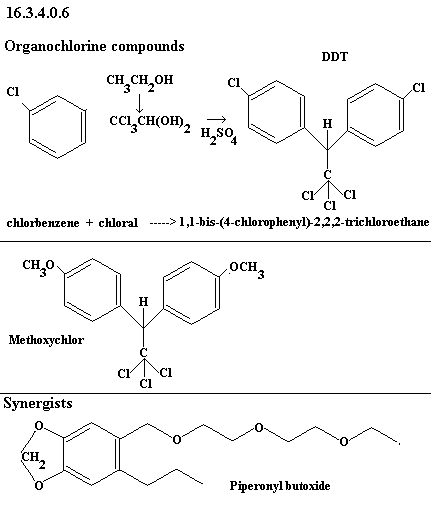
Synergists: piperonyl butoxide
Aromatic halogen compounds: 16.2.9
DDT: 4.8.1, Agriculture
Dioxins, Agent orange, PCBs: 16.15.0 (See 2.)
Pediculosis, lice, louse, infection, Phthirus pubis: 5.2.14
Decarboxylation
Decarboxylation, removing carboxyl group from compound
Deci
deci, one tenth, e.g. decilitre = 1/10 litre
Diamino
Diamino compounds contain 2 amino groups or substituted amino groups, e.g. Diaminoethane, C2H4(NH2)2 source
Diaminoethane
Diaminoethane, 1,2-Diaminoethane, NH2CH2CH2NH2, 1,2 Ethanediamine, ethylenediamine, polyamine, allergen, colourless liquid, ammonia smell, related to EDTA, chelate, fungicide, toxic by all routes, source
1,2-Diaminoethane, Solution < 1%, Not hazardous
Diaminobiphenyl
Diaminobiphenyl, C12H12N2, C6H4(NH2)2, (4,4'-diaminobiphenyl benzidine), toxic by all routes, Not permitted in schools source
Diaminobutyric acid
Diaminobutyric acid, C4H10N2O2, a diamino acid, non-proteinogenic alpha-amino acid, potent antitumoral activity against human glioma cells source
Diaminohexane
Diaminohexane, C6H16N2, H2N(CH2)6NH2, (1,6-hexanediamine), HMDA, hexamine, methenamine, urotropine source
Store in refrigerator, strongly alkaline (use < 25 mL 5% solution in water)
1,6-Diaminohexane is used to make nylon polymer, hexamine fuel tablets, (heat tablets, Esbit) (not approved, USA, Australia), Flammable, irritant
E239 Preservative food additive
Diammonium
Diammonium copper (II) sulfate (VI)-6-water, Cu(NH3)4SO4.H2O, ammonium cupric sulfate, fire extinguisher, Environment danger source
Diammonium hydrogen phosphate (NH4)2HPO4), ammonium hydrogen phosphate dibasic, in fertilizers, toxic
Diammonium thiosulfate (NH4)2S2O3, ammonium thiosulfate, photography rapid fixer, fertilizer, reducing agent, Environment danger
Diatoms
Diatoms, Phylum Bacillariophyta: 9.3.1
Diatomaceous earth absorbacide: 4.7.4)
Filters (Swimming pools): 18.4.7
Nitroglycerine (UK), Nitroglycerin (USA): 16.6.10
Dichlorodifluoromethane
Dichlorodifluoromethane, CCl2F2, Freon 12, CFCs, chlorofluorocarbons, "Freons": 12.19.5.0 source
Dichromates
Dichromate ion Cr2O72- source
Dichromates, ( - Cr2O7-), strong oxidizing agents, e.g. potassium dichromate K2Cr2O7, are usually orange-red salts. source
Sodium dichromate, red-orange crystals, SG 2.35, is soluble in water.
Sodium dichromate, is insoluble in alcohol, if heated to decomposition, emits toxic fumes of sodium monoxide.
Chromic acid, ionization reaction, H2CrO4: source
H2CrO4 + H2O → H3O+ + HCrO4-, K1 = 2 × 10⁻¹ source
HCrO4- + H2O → H3O+ + CrO42-, K2 = 3.2 × 10⁻⁷ source
Chromates, dichromates, hazards: 3.7.4
Chromic acid, Ionization reactions: 12.8.7
Oxidize chromium compounds to chromates: 12.8.5
Reactions of potassium dichromate: 12.8.3
Diesel fuel
Adiabatic change, thermodynamics: 20.4.4
Ammonium nitrate, diesel / ammonium nitrate mixtures, Not permitted in schools
Diesel oil: 16.8.1, Fractional distillation of crude oil
Fuels, fuel cell
Separate by fractional distillation: 10.1.5
Diethyl, -(C2H5)2
Diethyl, -(C2H5)2
Diethyl ketone, pentan-3-one
Diethyl sulfate, toxic by all routes, Not permitted in schools
Diethylaminopropylene, DMAPA, curing agent for epoxy resin adhesive, surface coating, irritant
Diethylphenylenediamine, C10H16N2 source
Diethylene glycol, C4H10O3, DEG (cosmetics, photography developer), toxic source
Diethylenetriamine, C4H13N3, NH2CH2(CH2)2NH, DTA, tridentate ligand, curing agent for epoxy resin adhesive, surface coating, Irritant source
Diethyl ether
Diethyl ether, C4H10O, ethoxyethane, ethyl oxide, ethyl ether, sulfuric ether, anaesthetic "ether", toxic by all routes, Not permitted in schools source
Commercial: Diethyl ether, ACS reagent, anhydrous, 99.0%, contains BHT as inhibitor
Diethyl ether forms dense vapour that flows along bench or floor to point of ignition
Diethyl ether, on standing forms diethyl peroxide, that is less volatile and remains an explosive residue
Diethylphenylenediamine
Diethylphenylenediamine, C8H12N2, toxic by all routes source
N,N-diethyl-p-phenylenediamine, Solution < 3%, Not hazardous
Digiferrugineal
Digiferrugineal, Digiferruginol, C15H16O5, an anthraquinone, cytotoxic to human nasopharynx carcinoma, phytoalexin, antimicrobial. source
It occurs in Streptocarpus, Digitalis, (Morinda parvifolia), and in Cinchona.
Dihydrocaffeic acid
Dihydrocaffeic acid, C9H10O4, 3,4-Dihydroxyhydrocinnamic acid, hydrocaffeic acid, a monocarboxylic acid, antioxidant source
It occurs in normal human biofluids, improves platelet function, in human plasma after coffee ingestion, and in artichoke leaf extract
Dihydroxyacetone
Dihydroxyacetone, C3H6O3, 1,3-Dihydroxy-2-propanone, irritant, a ketotriose, a primary alpha-hydroxy ketone, antifungal agent source
It is used in addition to blood preservation solutions to improve blood storage.
It is used with naphthoquinones as a sunscreening agent, because it stains skin brown, but no increase in melanin so is used in sunless tanning, i.e. fake sun tan.
Sold as: Dihydroxyacetone, 1,3-Dihydroxy-2-propanone, DHA, Glycerone
It occurs in (Arabidopsis thaliana), and in humans.
Dihydroxyacetophenone
Dihydroxyacetophenone, Acetopyrocatechol, C8H8O3, phenolic ketone, an acetophenone source
Amixture of dihydroxyacetophenone isomers used in food flavouring, inhibits platelet aggregation.
It occurs in(Ilex pubescens), Picea needles, and in coffee residues.
Dilution
Dilution equation: C1V1 = C2V2 source
Concentration (start) X Volume (start) = Concentration (final) X Volume (final)
Dilute solutions: 5.4.2
Colour change of diluted potassium permanganate: 11.3.3
Dilute acids with: 12.4.0
Particles: 11.6.0
Prepare dilute acids: 5.4.7
Prepare dilute acids and bases (Safety instructions): 3.4.10
Prepare dilute bases: 5.4.8
Prepare serial dilutions: 12.0
DIMBOA
DIMBOA, C9H9NO5, (4-benzoxazinone), an allelochemical (toxic plant defence chemical), aromatic ether, cyclic hydroxamic acid source
It occurs in cereals and cereal products.
It is an insecticide and fungicide.
Dimethyl sulfate
Dimethyl sulfate (DMS), (CH3O)2SO2, (CH3)2SO4, diester of methanol and sulfuric acid
Dimethylamine
Dimethylamine, (CH3)2NH or C2H7N, N-Methylmethanamin, secondary aliphatic amine, liquefied and flammable colourless gas source
DMA, [NH = imino group], fish odour, increase in human urine after fish diet
It is used in soaps, fungicides, dehairing of skin and hides, tanning, dyes, rubber accelerators, soaps, cleaning compounds, and agricultural fungicides.
Dimethyl-3-octanol, C10H22O, monoterpene, colourless liquid, flavouring ingredient, perfume, tetrahydrolinalool source
Dimethyl aminoazobenzene-4-sulfonate, C12H11N3, 4-aminoazobenzene, aniline yellow, orange powder, salts used for azo dyes source
Dimethyl aniline, C8H11N, (CH3)2C6H3NH2, C6H5N(CH3)2, (4-dimethylaniline) source
Dimethyl benzene C6H4(CH3)2, C8H10, one of 3 isomers is Xylene, 1,3-Dimethylbenzene source
Dimethyl disulfide, C2H6S2, DMDS, volatile, offensive garlic-like odour in bad breath, in municipal solid waste landfill source
Dimethyl formamide C3H7NO or HCON(CH3)2, DMF, (N,N,dimethylformamide), solvent, paint thinner, odourless, but fish smell if impure source
Dimethyl polysiloxane (C2H6OSi)n, polydimethylsiloxane, PDMS, food additive E900 source
Dimethyl sulfate, C2H6O4S, corrosive, oily, onion-like odour, heat fumes, toxic by all routes, Not permitted in schools source
Dimethyl sulfide, C2H6S, DMS, methylthiomethane, volatile, inflammable, offensive sweet smell, in flatus and smell of the sea source
Dimethyl sulfoxide, C2H6OS, (CH3)2SO), DMSO: 16.10.12 source
Dimethyl trisulfide, DMTS, CH3SSSCH3, volatile, bad odour from cooked Brassicaceae vegetables, boiled cabbage smell source
Diosmetin
Diosmetin, C16H12O6, Flavonol, (4'-methyl ether), Salinigricoflavonol, trihydroxyflavone source
It is a yellow, antioxidant, antineoplastic, antimicrobial, oestrogenic, anti-inflammatory, inhibits carcinogen activation enzyme CYP1A1.
It occurs in peel of lemon, and in other citrus fruits.
Dioxane
Dioxane, C4H8O2, 1,4-dioxane, cyclic ether, solvent miscible with water, toxic so use very small amounts source
Dioxane, Solution < 1%, Not hazardous
Diphosphane
Diphosphane, P2H4 (formerly diphosphine), very toxic, as impurity causes phosphine to ignite in air. source
Phosphine, PH3 source
Fluorophores: 14.26
Disodium orthophosphate
Disodium orthophosphate, disodium hydrogen phosphate, Na2HPO4, sodium phosphate dibasic, disodium phosphate, sodium hydrogen phosphate source
It has white monoclinic or rhombic crystals or granules, RD. 1.5, MP. 34 to 35 oC , easily loses H2O, E339. source
It is used as anticaking agent, and to retard boiler scale.
Dissolve
Total dissolved solids and suspended solids in water, Beer-Lambert law: 18.2.0
"Magnetic" sugar cube dissolves: 3.6.2
Shrinking volume: 3.5.0
Volume change when substances dissolve: 11.3.9
Tests for dissolved oxygen, DO (Winkler method): 18.3.2
Distillation
Coal tar products, creosote: 16.4.0
Distil crude oil and collect the fractions, combustion of gasoline, alkylation: 10.3.9
Distil wood: 16.10.4.1, (destructive distillation of wood)
Prepare distilled water: 2.2.14
Distilled water, deionized water: 6.3.1.3
Separation by distillation: 10.3.0
Steam distillation of eucalyptus leaves: 10.3.10
Steam distillation to measure water and fat content of food: 10.3.11
Water stills: 2.2.13 (Safety)
Diterpenoids
Ajugarin I, C24H34O7, diterpenoid, insect antifeedant, has anti-neuropathic pain activity, and occurs in leaves of (Ajuga remota). source
Andrographolide, C20H30O5, diterpenoid, bitter taste, anti-inflammatory, antioxidant, anti-cancer source
It is used in many traditional medicines to treat infectious diseases and cardiovascular poblems.
It occurs in (Andrographis paniculata).
Candletoxin A, C35H44O9, a diterpenoid, toxic, in (Euphorbia poisonii) latex. source
Caryoptin, C26H36O9, diterpenoid, bitter, insect antifeedant, in Caryopteris. source
Casbene, C20H32, diterpene, antifungal agent, in castor oil Ricinus communis. source
Geranylgeraniol, C20H34O, diterpenoid, in linseed oil Linum usitatissum, in wood oil Australian red cedar Toona ciliata. source
Gibberellin, (Gibberellin A3, GA, GA3, Gibberellic acid), Gibberellin, Gibreskol, C19H22O6 pentacyclic diterpenoid, irritant, a C19-gibberellin. source
monocarboxylic acid, white powder, potent plant hormone that regulates growth and cell elongation, stimulates cells of germinating seeds.
Ginkgolide, Ginkgolide A, C20H24O9, diterpenoid, irritant, bitter, Platelet Activating Factor antagonist, bronchdilator, anti-asthmatic source
It occurs in (Ginkgo biloba) root bark and leaves.
Gnidicin, Thymeleatoxin A, C36H36O10, diterpenoid, anti-tumour, in Gnidia. source
Grayanotoxin(GI), Rhodotoxin, Asebotoxin, Acetylandromedol, C22H36O7, tetracyclic diterpenoid, acetate ester, phytotoxin, antihypertensive. source
It occurs in Rhododendron and its honey, Kalmia, Leucothoe.
Labdane, C20H32O2, antifungal diterpenoid, and occurs in (Nicotiana glutinosa) epicuticle leaf wax. source
Mascaroside, C20H36O11, diterpenoid, naphthofuran, very bitter, in Coffea viyanneya beans. source
NeocembreneNeocembrene A, Cembrene A, C20H32, diterpene, macrocycle, occurs in Picea obovata. source
Palmarin, Tinosporide, Arcangelisin, Isochasmanthin, C20H22O7, diterpenoid, organo-oxygen compound, organic heterotricyclic compound, bitter. source
It was used in Radix columba tonic, in Jateorhiza roots.
Phorbol, C20H28O6, is a tetracyclic diterpenoid, acute toxic, cyclic ketone, a tertiary alcohol, an acyclic diterpene alcohol, white solid, irritant phorbol. source
Phorbol diesters may be anti-leukaemic and carcinogenic, occurs in (Croton tiglium) seed oil.
Phytol, trans-Phytol, (20H40O), diterpenoid, acyclic diterpene alcohol, irritant, environmental hazard, used to prepare vitamin E and vitamin K1, modulates transcription in cells, long-chain primary fatty alcohol, oily liquid, modulates transcription in cells, schistosomicide, decomposition product of chlorophyll. source
Dithizone
DithizoneH, C13H12N4S, C6H5NHNHCSN=N(C6H5), dithiozone, dithizon, diphenyl thiocarbazone, phenylhydrazine. source
It is a chelating agent used for heavy metal poisoning and assay, causes diabetes, toxic if ingested.
Dodecane
Dodecane, C12H26, CH3(CH2)10CH3, from (Zingiber officinale) essential oil source
Double decomposition
Double decomposition, double replacement, double exchange reactions
12.2.4.0 Double replacement reactions, metathesis
Prepare hydroxides with ammonia solution: 3.2.1
Prepare soap by saponification: 12.12.02
Double salt
13.1.13 Aluminium potassium sulfate
Fehling's test: 9.5.0, Rochelle salt is a double salt
Prepare copper (II) ammonium sulfate crystals: 12.7.4
Prepare double salt crystals: 3.1.11
Prepare iron (II) sulfate crystals with iron filings: 14.15.18
Prepare potash alum: 12.14.2
Rochelle salt, potassium sodium tartrate-4-water
Doxorubicin
Doxorubicin, Adriamycin, Doxil, Adriablastin, C27H29NO11, anthracycline antibiotic, antineoplastic, (from Streptomyces peucetius var. caesius), source
It prevents DNA replication, inhibits topoisomerase II.
It has cardiac and cutaneous vascular effects, and is used for lymphoma therapy.
Dyes
Dyes, pigments, reactive dyes, direct dyes, acid dyes, mordant dyes, metrolene dyes, dye intermediates, pigments
Dyes with a mordant: 19.4.2
Dyes, solvent-based, aniline, diazo, naphthol, water-based, fabric, wool
Leuco dyes, Thermochromism, Colour Changing Ducks: (Children's item)
Pigment names, C.I. numbers: 8.0 (Table)
Plant pigments
Anthocyanidins, Anthocyanins
Betalains, betains
Tetraterpenoids, (C40H64) source
6.6.1 Photosynthetic pigments, chlorophyll a and chlorophyll b
Mazari palm, India, kaki, plant roots,
Butternut tree, Colombia
Mingonette, weld, Europe, Middle east. yellow
Turmeric, sari robes, India
Saffron , vibrant yellow
Pale green, boil yellow fabrics in iron bowl
Light green, stinging nettle
Lincon green, woad blue + woad yellow
Green blue + yellow
Licen Lobaria oregana, Nw pacific, sofy purple
Muuberry, purple
Murex snails,Tyrian purple
Woad, blue, Europe
Mayo ondigo, anil. Colombia, indigo
Chinese indigo, buckwheat, blue
blue indigophora<
Kermes insects, crimson, Med
Madder, red. India Cochineal, crimson
Ochre, iron, haematitie
Dubnium, Db
Dubnium, Db
Dubnium, Table of the Elements.
Dubnium, RSC
Dubnium, Db (Dubna, Nuclear Institute, Russia), radioactive transuranic element.
Deuterium, 2H
Deuterium, 2H
Deuterium, D or Hydrogen-2, 2H, is a hydrogen isotope having a proton and a neutron in the nucleus.
Deuterium oxide, D2O, is water with H replaced by D.
Deuterium exchange, organic compound.
ROH +D2O → ROD +DHO, is used in NMR spectroscopy to identify position of H. source
Heavy water has the hydrogen in the water molecules replaced by the isotope deuterium, and is used as a moderator in nuclear reactors.
Dysprosium, Dy
Dysprosium, Dy
Dysprosium, Table of the Elements
Dysprosium, RSC
Dysprosium, Dy, (Greek dusprositos hard to find), (future supply shortfall, the Dy-Te-Fe alloy, TerfenolD)
Dysprosium is an essential component for magnets for turbines and electric motors, because by adding Dysprosium to the magnet allows the magnetism to be retained, even at very high temperatures.
Most Dysprosium is mined in China, but lately it is mined in Australia.
Dysprosium chips, foil, ingot, Dy
Dysprosium (III) acetate, C6H9DyO6.xH2O |Dysprosium (III) bromide hydrate, Br3Dy.xH2O | Dysprosium (III) carbonate hydrate, C3Dy2O9.xH2O | Dysprosium (III) chloride hexahydrate, Cl3Dy.H2O | Dysprosium (III) fluoride anhydrous, DyF3 | Dysprosium (II) iodide anhydrous, DyI2 | Dysprosium (III) nitrate hydrate, DyN3O9.xH2O | Dysprosium (III) oxide, nanoparticles, Dy2O3 | Dysprosium (III) perchlorate, Cl3DyO12 | source
Desiccants
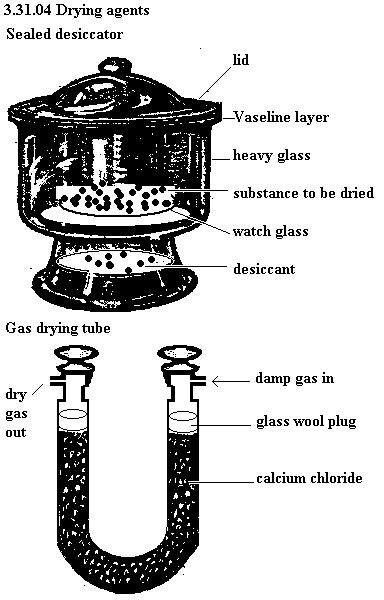
Desiccants are drying agents, e.g. anhydrous calcium chloride, anhydrous calcium sulfate, concentrated sulfuric acid, phosphorus (V) oxide
Also, sodium hydroxide lump, calcium oxide lump (lime), silica gel.
Glass desiccators used to dry chemicals in the laboratory may have a tap in the lid to increase evaporation by decreasing pressure in the desiccator.
Glass desiccators can also preserve organic materials by desiccation.
Desiccants, drying agents, are used where drying by heating may decompose the substance to be dried.
Drying agents, desiccants, may just absorb water into their surface structure, e.g. silica gel.
Dry silica gel is hygroscopic, absorbs water from the air, but does not dissolve in the water.
Little white bags containing silica gel desiccant are included in electrical equipment and other products just before the close of the manufacturing process.
Powerful desiccants may remove water by a chemical reaction, e.g. concentrated sulfuric acid.
Concentrated sulfuric removes the water of crystallization from blue copper sulfate crystals to form white anhydrous copper sulfate.
CuSO4.5H2O → CuSO4+ 5H2O source
Concentrated sulfuric acid removes water from the white to colourless sucrose molecules to leave black carbon.
C12H22O11 → 12C + 11H2O source
Be Careful! Concentrated sulfuric acid is a powerful acid and oxidizing agent, so it must be used with great care.
Laboratory desiccators are usually heavy glass containers sealed with a ground glass lid lubricated with Vaseline to make the container air tight.
The substance to be dried is placed on a watch glass on a shelf above the desiccant.
The base of the desiccator may contain various desiccants: | Anhydrous calcium oxide | Anhydrous calcium chloride | Anhydrous copper sulfate | Anhydrous magnesium sulfate | Anhydrous zinc chloride | Concentrated sulfuric acid, (it turns black with time) | | Melted caustic potash (potassium hydroxide) | Phosphorus pentoxide | Silica gel. |
Phosphorus pentoxide is a much more powerful drying agent then anhydrous copper sulfate.
The desiccator may be used as a suitable cooling vessel so that the substance can cool. yet not at the same time absorb water from the atmosphere.
Some liquids, e.g. organic compounds, may be dried by dropping in calcium chloride that is removed hours later by a glass wool filter.
Gases are dried by passing the gas through an U-tube or glass tower containing anhydrous calcium chloride between glass wool plugs with airtight taps at each end.
Gases can be dried by bubbling through concentrated sulfuric acid, but some acid droplets get carried into the dried gas.
To avoid acid droplets, the sulfuric acid can be absorbed into lumps of pumice, that are then used in a glass drying tower.
Drying gases is usually a very slow process.
Table: Desiccants, drying agents
| Gas to be dried | Drying agent |
| Ammonia | Calcium oxide |
| Carbon dioxide | Any in this column |
| Carbon monoxide | Phosphorus pentoxide |
| Chlorine | Concentrated sulfuric acid |
| Hydrogen | Calcium chloride |
| Hydrogen chloride | Concentrated sulfuric acid |
| Hydrogen sulfide | Calcium chloride |
| Nitrogen | Calcium chloride |
| Nitrous oxide | Concentrated sulfuric acid |
| Oxygen | Phosphorus pentoxide |
| Sulfur dioxide | Any in this column |
Darlingine, (C13H17NO2), Tropane Alkaloid
Darlingine, (C13H17NO2), Tropane Alkaloid source
Darlingine, oxacycle.
It occurs in (Darlingea ferruginea).
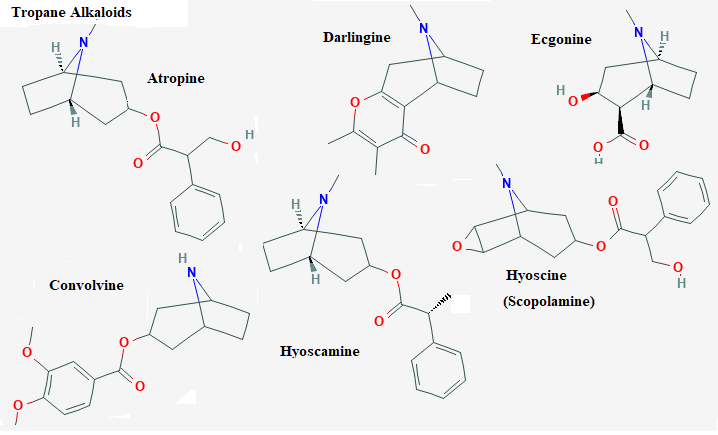
Delcosine, (C24H39NO7), Diterpenoid Alkaloid
Delcosine, (C24H39NO7), Diterpenoid Alkaloid source
Delcosine, Delphamine, Lucaconine, Delcosin, Iliensine, poisonous, insecticidal.
It occurs in Aconitum. and in (Delphinium consolida).
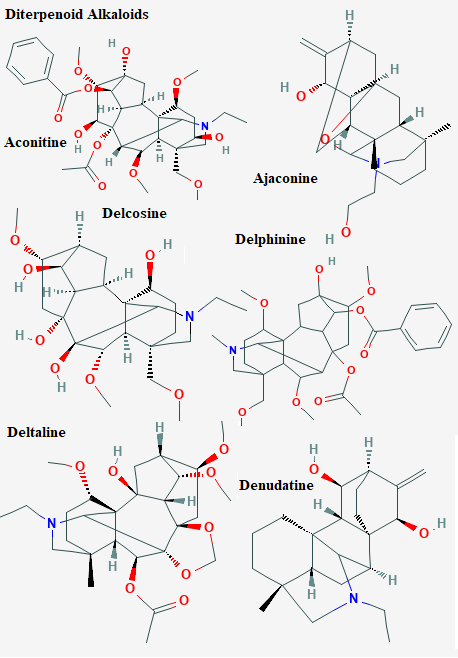
Delphinine, (C33H45NO9), Diterpenoid Alkaloid
Delphinine, (C33H45NO9), Diterpenoid Alkaloid source
Delphinine, diterpene alkaloid, lycoctonine type, cardiovascular toxicity, dangerous herbal medicine, causes low blood pressure
It is used to treat disordered heart rhythms.
It occurs in candle larkspur, (Delphinium elatum), Ranunculaceae, and in (Staphisagria macrosperma), Ranunculaceae.
Deltaline, (C27H41NO8), Diterpenoid Alkaloid
Deltaline, (C27H41NO8), Diterpenoid Alkaloid source
Deltaline, Delphelatine, eldeline, tertiary alcohol, tertiary amino compound, acetate ester, cyclic acetal, organic polycyclic compound
It occurs in (Delphinium cheilanthum) and in (Delphinium andersonii), Ranunculaceae.
Demecolcine, (C21H25NO5), Colchicine Alkaloid
Demecolcine, (C21H25NO5), Colchicine Alkaloid source
Demecolcine, Colcemid, Colchamine, Demecolcin, antineoplastic, arrests white blood cells in metaphase, mitosis spindle poison at metaphase, antitumour agent
It is less toxic than colchicine, and is used to inhibit growth of malignant cells.
It occurs in autumn crocus, (Colchicum autumnal), alpine autumn crocus (Colchicum alpinum), and in (Colchicum arenarium), Colchicaceae.
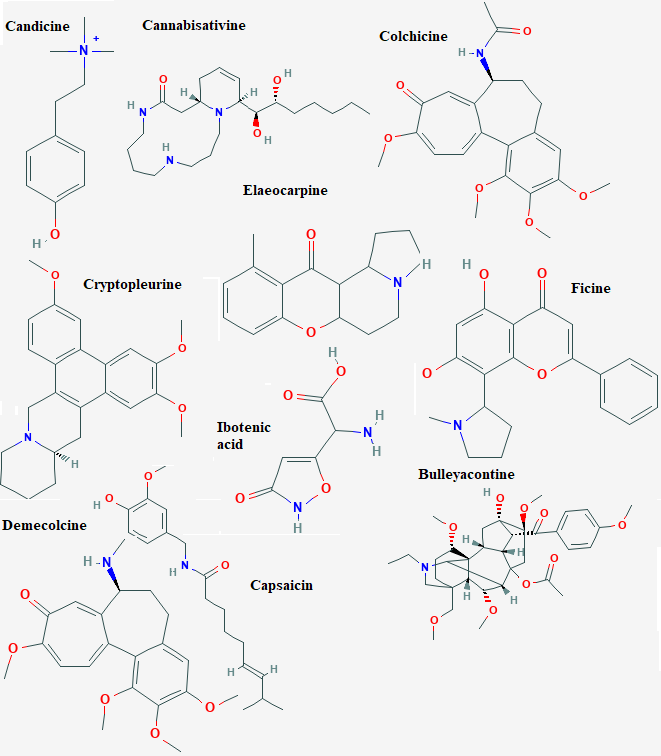
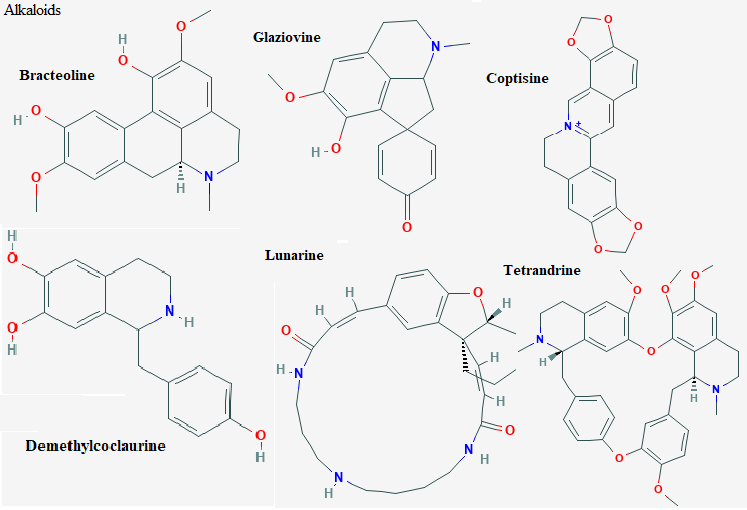
Demethylcoclaurine, (C16H17NO3), Isoquinoline Alkaloid
Demethylcoclaurine, (C16H17NO3), Isoquinoline Alkaloid source
Demethylcoclaurine, bisbenzylisoquinoline alkaloid, (norcochlorine, a conjugate base of a (RS)-norcoclaurinium), cardiac stimulant, "Higenamine"
It occurs in coffee and coffee products
It occurs in Aconitum Nelumbo nucifera, Delphinium caeruleum, in Berberis bealei
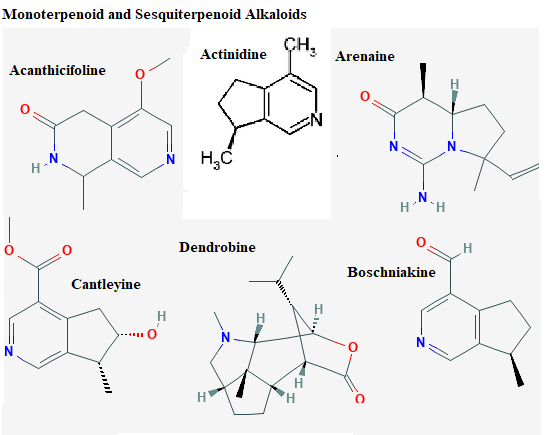
Dendrobine, (C16H25NO2), Monoterpenoid and Sesquiterpenoid Alkaloid
Dendrobine, (C16H25NO2), Monoterpenoid and Sesquiterpenoid Alkaloid source
Dendrobine, occurs in Dendrobium species, antiviral, antitumour, lowers blood pressure,and may cause death by convulsions.
Denudatine, (C22H33NO2), Diterpenoid Alkaloid
Denudatine, (C22H33NO2), Diterpenoid Alkaloid source
Denudatine, acute toxic, effects on action potential of ventricular fibres, inhibits arrhythmogenic action of aconitine
It occurs in Delphinium.
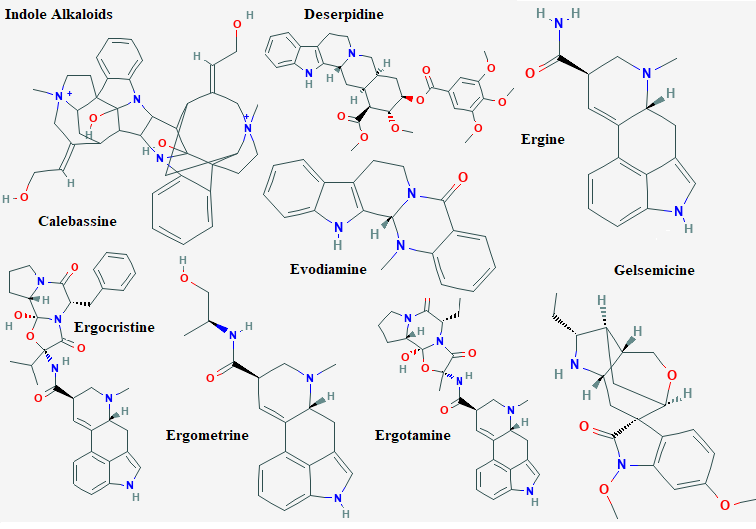
Deserpidine, (C32H38N2O8), Indole Alkaloid
Deserpidine, (C32H38N2O8), Indole Alkaloid source
Deserpidine, Raunormine, Recanescin, Deserpidin, alkaloid ester, methyl ester, benzoate ester, yohimban alkaloid, anti-hypertensive
It causes decrease in blood pressure, tranquillizer.
It occurs in (Rauvolfia canescens).
Diethanolamine, Secondary Amine
Diethanolamine, Secondary Amine
Diethanolamine, [HN(CH2CH2OH)2], DEA, secondary amine (also "dialcohol", because two OH groups), weak base, oily colourless liquid or white crystals source
It has a fish smell, is denser than water, and is used to make soaps, surfactants, dishwashing detergents, anticorrosion agent.
Diethanolamine (photography developer), Irritates skin and eyes.
Diethanolamine, Solution < 10%, Not hazardous
Diethanolamine bisulfite (photography developer), Irritates skin and eyes.
Diethylamine, (C4H11N), Secondary Amine
Diethylamine, (C4H11N), Secondary Amine source
Diethylamine, [C4H11N(C2H5)2NH], (CH3-CH2-NH-CH2-CH3), diethyl amine, Toxic by all routes, Irritant to eyes, corrosive to eyes and skin source
It is strongly alkaline, flammable, volatile, mixes with water and ethanol, colourless liquid (if pure), strong unpleasant odour, combustion forms dangerous nitrogen oxides
Diethylamine, Solution <2%, Not hazardous.
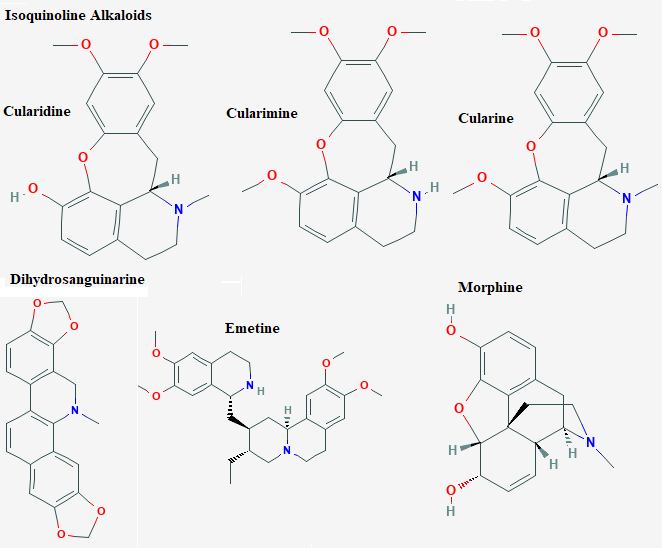
Dihydrosanguinarine, (C20H15NO4), Isoquinoline Alkaloid
Dihydrosanguinarine, (C20H15NO4), Isoquinoline Alkaloid source
Dihydrosanguinarine, Dihydroavicine, benzophenanthridine alkaloid, dihydroavicine, benzophenanthrodine, antifungal agent, antiseptic, anti-inflammatory
It occurs in Fumaria, Corydalis, Eschscholzia, Pteridophyllum, in arcocapnos baetica and in (Sarcocapnos saetabensis).
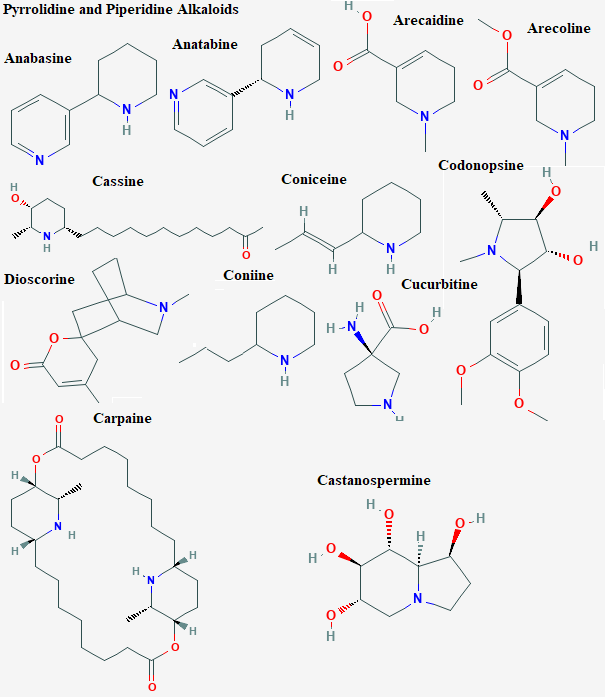
Dioscorine, (C13H19NO2), Pyrrolidine and Piperidine Alkaloid
Dioscorine, (C13H19NO2), Pyrrolidine and Piperidine Alkaloid source
Dioscorine, opalescent (yellow-red to blue), molecule, contains a non-aromatic pyran ring, neurotoxin, convulsant, arrow poison.
It occurs in Yam (Dioscorea hispids), in (Dioscorea dregeana), and in (Dioscorea bulbifera).
Digitogenin, C27H44O5, a sapogenin, a 2alpha-hydroxy steroid
Digitogenin, C27H44O5, a sapogenin, a 2alpha-hydroxy steroid source
It occurs in (Digitalis lanata).
Digitonin, Digitin, C56H92O29, a steroid saponin, toxic, it solubilizes lipids, and is a glycoside.
Digitonin, Digitin, C56H92O29, a steroid saponin, toxic, it solubilizes lipids, and is a glycoside. source
It occurs in (Digitalis purpurea).
Diosgenin, C27H42O3, a steroid sapogenin, nitogenin, a hexacyclic triterpenoid
Diosgenin, C27H42O3, a steroid sapogenin, nitogenin, a hexacyclic triterpenoid source
It occurs in bark of wild yam, (Discorea villosa
It is used to synthesise steroids, e.g. cortisone, pregnenolone and progesterone, and is an apoptosis inducer, antiviral, antineoplastic.
This page was generated automatically from the original page on John Elfick's School Science Lessons website. If something looks wrong, please check the original.