Chemistry Experiments, F
Last updated 2026-11-11 by Dr John Elfick
Chemistry, F
femtomole, 1 femtomole = 10-15 moles
Quick links — A–Z index
Fehling's tests for reducing sugars
"Fight or fright hormone", Epinephrine
"Fill water", (Swimming pools)
Trimethylamine Fish smell
See diagram 16.3.1.3ach: Fisher projection formula, D-, L- glyceraldehyde
Flour Wheat and flour
Froth flotation of heavy minerals
Froth flotation, (Geology)
Foaming agents, washing powders
Fractional distillation of crude oil
9.5.1 Fehling's solution
Rochelle salt (potassium sodium tartrate tetrahydrate, Seignette's salt), is a double salt, [KNa(C4H4O6).4H2O], that has a cooling saline taste and is piezoelectric. source
Fehling's solution (Herman von Fehling, 1812-1885, Germany), is an alkaline solution of copper (II) sulfate.
It reacts with aldehydes as a test for aldose sugars.
Benedict's test is more sensitive than Fehling's test, and is easier to do, because only one solution is needed, but it may be more expensive.
Fehling's test is the reaction of Fehling's solution with aldehydes.
It is used as an analytical test, especially for aldose sugars, i.e. any sugar, which is also an aldehyde.
Fehling's solution is an alkaline solution of copper (II) sulfate and a tartrate.
Fehling's test is used to test for water-soluble carbohydrates, ketone functional groups, and monosaccharides.
Fehling's Test is also used as a test for reducing sugars, but fructose gives a positive test.
Ketones (except α-hydroxy ketones) do not react with Fehling's solution.
Fehling's solution No. 2, COR, 1 litre
Fehling's solution No. 1, 1 litre
14.26 Fluorophores
Fluorophores are fluorescent chemical compounds.
(1.) 1-chloro-9,10-bis(phenyl ethynyl) anthracene emits green-yellow light in 30-minute high-intensity Cyalume sticks
(2.) 2-chloro-9,10-bis(phenyl ethynyl) anthracene emits green light in 12-hour low-intensity Cyalume sticks.
(3.) 1,8-dichloro-9,10-bis(phenyl ethynyl) anthracene emits yellow light in Cyalume sticks.
(4.) 9,10-diphenylanthracene (DPA), C26H18, emits blue light in light sticks, yellow powder. source
(5.) 1-chloro-9,10-diphenyl anthracene (1-chloro(DPA)) emits blue-green light.
(6.) 2-chloro-9,10-diphenyl anthracene (2-chloro(DPA)) emits blue-green light.
(7.) 9,10-bis(phenyl ethynyl) anthracene (BPEA), C30H18 emits "ghostly" green light in light sticks. source
(8.) 2,4-di-tert-butylphenyl 1,4,5,8-tetracarboxynaphthalene diamide emits deep red light, but with DPA emits white or hot-pink light.
(9.) Fluorescein isothionate, FITC, emits green light.
(10.) Rhodomine tetramethyl isothionate, TRITC, "Rhodominr Red-X", emits orange light.
(11.) Hydroxycoumarin, emits blue light.
(12.) Cyanine dyes, Cy2 cyanine, Cy3 indocarbocyanine, Cy5 indodicarbocyanine.
(13.) Biological fluorphores, e.g. green fluorescent protein, GFP, occurs from a jellyfish.
(14) Quantum dot nanocrystals.
16.3.3 Friedel-Crafts reaction
The reaction substitutes a hydrogen atom in an arene ring of a halogen alkane by an organic group, R, using aluminium chloride catalyst.
RCl + AlCl3 → R+ + AlCl4- source
For example, benzene with chloromethane forms methyl benzene.
benzene + CH3+ → benzene-CH3 + H+ source
CH3Cl +AlCl3 → CH3+ +AlCl4- source
19.1.5 Food acids, acids in foods
Ethanoic acid, acetic acid, vinegar
Benzoic acid, in cranberries, prunes and plums
Butyric acid, betanoic acid, in decomposition of butter, rancid butter
Citric acid, in citrus fruits, lemon, orange, cocoa, pepper, rhubarb
Tannic acid in tea
Tartaric acid in grapes, pineapples, potatoes, carrots.
Falcarinol, C17H24O
Falcarinol, C17H24O source
Falcarinol, carotatoxin, panaxynol, long-chain fatty alcohol, irritant, causes contact dermatitus, pesticide, fungicide It occurs in carrots (Daucus carota), red ginseng (Panax ginseng), and in ivy Hedera.
Farnesene
Farnesene, C15H24, sesquiterpene (six isomers), acylic sesquiterpene, alpha-farnesene, flavour and fragrance agent, green apple odour, oxidized to cause fruit skin scald, in oil or perilla, anti-viral. source
It occurs in perilla (Perilla frutescens), gardenia aroma, pheromone to deter aphisds.
Isomers occur in apple, orange, grapefruit, mandarin and lime peel, grape, pear ginger, nutmeg, basil.
Alpha- and beta-farnesene, occurs in citronella oil, from Cymbopogon.
Alpha-farnesene occurs in coating of apple and pears, used as flavouring ingredient.
Trans-beta-farnese is a hydrocarbon lipid molecule.
Farnesol
Farnesol, C15H26O, sesquiterpene, acyclic sesquiterpene alcohol, a farnesan. source
Colourless liquid, insoluble in water, miscible with oils, extracted from the oils of plants, flavouring, miticide.
It occurs in many essential oils, citronella, neroli, cyclamen, tuberose, bitter orange, ginger, jasmine, hops, beets, juniper, citronella, lemon grass, tuberose, rose, musk, balsam of Peru, tolu balsam.
It occurs in apricot, orange peel, grapefruit juice, cloves, ginger, thyme, basil, papaya, anise seed.
It occurs in sweet acacia (needle bush), flowers used for floral essence perfumes.
Farnesol is a colourless liquid extracted from oils of plants such as citronella neroli, and tuberose and is then used in perfumery.
Farnesol, hydrophobic, enhances perfumes, occurs in citronella, chamomile oil, oil of neroli petate, cyclamen, lemon grass, tuberose, rose, musk, and balsam, frankincense, biofuel.
Fats in food
9.9.1 Burn carbohydrates, fats and proteins:
3.9.4a Carboxylic acids
3.9.1 Cholesterol
3.9.2 Classification of fats
3.9.3 Composition of edible oils
19.1.3 Cooking fats
9.2.4 Digestibility of fats
3.9.4 Fats in animals and plants
3.9.5 Fatty acids
3.9.6 Fatty acids, ω-3 and ω-6 fatty acids
3.9.7 Heat fats
3.9.8 Hydrogenation, cis-trans fatty acids
12.4.0 Prepare soap
3.9.9 Rancidity of fats
10.3.11 Steam distillation to measure water and fat content of food
9.3.11 Tests for fats and oils
9.3.33.1 Tests for unsaturated fats
9.3.33.2 Tests for unsaturated fats, bromine water test
3.9.10 Trans fats, Omega-fatty acids
Fenchol
Fenchol, Fenchyl alcohol, (1,3,3-trimethyl-2-norbornanol), C10H18O, terpene, isomer of Borneol, flavouring ingredient with bitter lime-like flavour. source
It is used in perfumes, monoterpenoid, isomer of borneol, colourless or white solid, occurs widely, enantiopure (1R)-endo-(+)-fenchol can be oxidized to fenchone.
It occurs in volatile oils of Aster, in Basil (Ocimum basilicum), and in Fennel (Foeniculum vulgare).
Fenchone
Fenchone, C10H16O, monoterpene ketone, colourless oily liquid. source
It occurs in the alcoholic drink absinthe, bitter taste of wild Fennel, in oil of Fennel, (Foeniculum vulgare).
Fentanyl
Fentanyl, C22H28N2O, monocarboxylic acid amide, narcotic analgesic, strong and rapid opioid analgesic source
An intravenous anaesthetic, it is used to treat chronic cancer pain or in anesthesia.
It has high potential for drug abuse then dependence, adulterant in illicit drugs, e.g. heroin. commonly involved in opioid overdose deaths.
Fermentation
Alcoholic fermentation with yeast 9.1.1
Butyric acid fermentation with a potato 9.1.2
Carbon dioxide and fermentation for brewing 3.8.0
Glucose fermentation 9.1.4
Fermentation 4.1.9 (Safety)
Safety in the microbiology laboratory 4.1.12
Triple scale wine hydrometer 10.2.8
Fermium, Fm
Fermium, Fm
Fermium, Table of the Elements
Fermium, RSC
Fermium, Fm, (Enrico Fermi, 1901-1954, Italy), radioactive actinide element, produced by bombarding plutonium with neutrons, called Fermium in 1952
Fexofenadine
Fexofenadine, C32H39NO4, anti-histamine compound, which is used to treat allergic symptoms. source
It occurs in Bergamottin
Bergamottin, (C21H22O4), in grapefruit interferes with the action of drugs, e.g. Atorvastatin, ("Lipitor"), C33H35FN2O5, to lower bad cholesterol, by blocking the action of enzymes in the small intestine to increase the amount of drug absorbed and the action of fexofenadine. source
Ficin
Ficus protease; Higueroxyl delabarre, CH2FI2N, sulfhydryl proteinase, from ficus latex, It is used in alcoholic beverages, beer chillproofing agent, meat tenderiser, dough conditioner, rennet substitute, precooked cereals. source
Ficain (or ficin) is an enzyme from fig latex, an endopeptidase, used for differentiating many blood group antigens.
Fire Safety
Action in case of fire, evacuation 3.5.2
Action in case of fire, equipment 3.5.3
Fire blankets blankets
Fire safety and fire equipment 3.5.0
Fireproof, Asbestos 35.2.4
Fireproof, cloth, paper, wood 3.5.10
Fireproof, Talc 35.3.13
Fire extinguisher
Fire extinguisher, dry chemical powder, paper, wood, textile, oil, liquid and electrical fires, 2.5 kg, 4.5 kg
Fire extinguisher, soda acid fire extinguisher 3.3.1H
Fire extinguisher cart, water stream impulse 17.7.5
Feruloylputrescine
Feruloylputrescine, C14H20N2O3, (originally called Subaphylline), a methoxycinnamamide. source
It occurs in leaves and juice of grapefruit (Citrus paradisi), and in (Salsola subaphylla).
Flammable
FLAM, designates something that can readily burn or catch fire.
Flammable aerosols: 2.3
Flammable gases: 3.5.11
Flammable liquids: 3.5.12
Flammable solids: 2.7
Flammable substances: 3.5.13
Storing flammable liquids 3.7.5
1. The word "flammable" means "easily set on fire".
You can use "non-flammable", but in chemistry do not use "inflammable".
Flammability, explosion, limits outer limits for the ratio of fuel to air within which the mixture will burn.
The mishandling of flammable solvents has probably caused fires and personal injuries in chemical laboratories, e.g. burning of loose long hair.
Staff and students must have securely fixed and contained hair by tying back the hair or using caps or hair nets.
Flammable solvents become more difficult to ignite as their boiling points rise, so use the highest boiling point solvent possible.
Do not use water baths to heat volatile flammable solvents.
Solvents should only be used by staff with students after assessment of the risks, including flammability, toxicity, and possible allergic reactions.
2. Carbon disulfide has a greater flammability than ether and forms more dense vapours, with a low ignition temperature < 100 oC.
Carbon disulfide is not permitted in schools.
3. Diethyl ether evaporates readily to form a heavy vapour in air, which can travel along the bench or floor in an air current.
Diethyl ether is not permitted in schools.
4. Hydrogen forms violently explosive mixtures with air in almost any proportions and spontaneously combusts at concentrations greater than 4% in air.
Use this gas for demonstration purposes only in extremely small quantities or use soap bubble techniques.
5. Natural gas forms explosive mixtures with air, so turn off heaters, Bunsen burners, and equipment using natural gas and other flammable gases, e.g. acetylene.
6. Methylated spirit, ethanol and hydrocarbon solvents, e.g. petroleum spirit, hexane, pose the greatest risk in schools.
Mixtures of air with any of these materials are highly flammable, and ignition of vapour is usually followed by a fire in or around the solvent container.
Flavour
Flavourings, (Cooking)
The major flavour components are:
Flavoxanthin
Flavoxanthin, C40H56O3 a xanthophyll from buttercups, a yellow carotenoid pigment, E161A. source
It occurs in (Taraxacum officinale), (Ranunculus acris), and Oregon 'grape', (Berberis aquifolium).
Flocculent
A flocculent is usually a precipitate in cloud-like tufts, flocs.
In bacteriology, flocculation refers to the formation of floccules, (agglutinated bacteria), in a precipitin test, especially for antigens of Salmonella.
In mining, flocculation refers to coagulation of ore particles to form flocs and to remove excess water.
Flour
Flour treatment agents, food additives: 19.1.13
Experiments
Prepare flour glue: 9.1.1
Prepare self-leavened flour, "self-raising flour": 19.1.9, (See: 7.)
Prepare wallpaper paste: 9.1.3
Use flour to clean brass: 19.1.9, (See: 8.)
Use flour to make glue: 19.1.9, (See: 9.)
Use flour to make papier-mâché: 19.1.9, (See: 10.)
Use flour to make play dough: 19.1.9, (See: 11.)
Fluorescence, fluorescein
Fluorescence, fluorescein
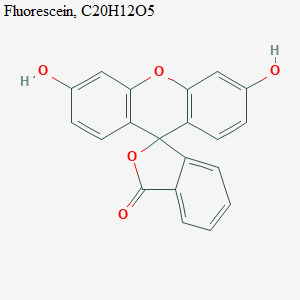
Fluorescein, C20H12O5, Solvent Yellow 94, Resorcinolphthalein, yellow solid or orange-red crystals that have green-yellow fluorescence by reflected light. source
It is insoluble in water, but soluble in dilute aqueous bases.
Very dilute alkaline solutions of fluorescein show strong green-yellow fluorescence by reflected light.
Fluorescein (lactone form) is a xanthene dye that is highly fluorescent.
It is used by detectives to detect traces of blood, and s an indicator in silver nitrate titrations.
It is a fluorescent dye, a xanthene dye, a gamma-lactone, a polyphenol, and is used to examine corneal injuries.
Fluorescent minerals absorb ultraviolet light and emit longer wavelength visible light, e.g. scheelite.
Fluorescence is luminescence that does not persist when the exciting cause is removed, e.g. a fluorescent light.
The rapid emission of light at longer wavelengths than that which is absorbed, e.g. adsorption of ultraviolet light can yield blue fluorescence.
Certain excited atoms emit a photon of lower energy than the incident photon that caused the transition.
If the process takes place rapidly, < 10-7 seconds, it is called fluorescence.
Experiment
Use a 1 500 alcoholic solution of eosin to demonstrate fluorescence
6.6.3 Chlorophyll fluorescence
28.6.2 Critical angle in ripple tank, refraction tank, aquarium (fluorescein)
16.3.27 Fluorescein
7.22 Fluorescence staining of cells and tissues
38.8.3 Fluorescent lamp (Electronics)
16.3.28 Fluorescent liquids
12.6.6 Fluorescent whitening agents in washing powders
14.26 Fluorophores, (Fluorescent chemical cmpounds)
Terbium, Tb, Phosphorescence
Flubendazole
Flubendazole, C16H12FN3O3, is used in human and veterinary medicine for nematode infections. source
Fluorine, F
Fluorine, F
Fluorine, Table of the Elements
Fluorine, RSC
Fluorine, F, (Latin fluere to flow), very reactive, halogen, pale yellow gas
Fluorine is a naturally occurring element, in fluorspar, CaF2. source
It is a yellow-green gas, strong, sharp odour (like pool chlorine), combines with hydrogen to form hydrogen fluoride.
Fluorine gas can cause irritation, muscle spasms, harm the lungs and heart and cause death.
It is a non-metal yellow-green poisonous gas at room temperature and pressure.
Fluorine is the most reactive corrosive and electronegative of all elements.
It never occurs as a free gas, but it occurs in many silicate minerals and the mineral fluorite, CaF2. source
Fluorine is the most electronegative non-metallic element, strong oxidizing agent.
Fluorine combines with carbon to form inert polymers, e.g. Teflon coated frying pans, and form low friction fluorocarbon polymers, e.g. PYFE.
'Freon'
'Freon' is the brand name for the refrigerant, CCl2F2, Dichlorodifluoromethane (R-12), a colorless gas usually sold under the brand name "Freon-12". source
In Australia. the Pharmacist only medicine "NeutraFluor 5000 Plus", Colgate, contains sodium fluoride 11.05 mg/g.
However, some natural water sources already contain the fluoride ion.
The enamel of teeth are formed from the crystalline mineral hydroxyapatite, Ca10(PO4)6(OH)2. source
Fluorine is used to make CFCs, chlorofluorocarbons, freon, that damages the ozone layer.
Fluorine compounds are added to toothpaste and drinking water, e.g. tin (II) fluoride, sodium monofluorophosphate (MFP), sodium fluoride and amine fluorides.
In some countries, sodium fluoride is added to drinking water to improve the hardness of tooth enamel apatite of children's teeth.
However, some people believe that sodium fluoride is too reactive to be put into drinking water and it may cause discoloration of teeth.
In Australia solid sodium silicofluoride is added to drinking water in some places.
However, some natural water sources already contain the fluoride ion.
The enamel of teeth are formed from the crystalline mineral hydroxyapatite, Ca10(PO4)6(OH)2. source
Boron trifluoride, BF3, colourless, pungent, toxic gas, white smoke in moist air source
Emitters of fluoride are metal cleaning operations, glass and enamel manufacturing and glazing, toothpaste, and fluoride enhanced water.
These emissions may be to the soil, water, or air.
Fluorourcil, C4H3FN2O2, 5-fluorourcil, cancer drug, Toxic by all routes, Not permitted in schools source
Fluoride compounds all contain fluorine.
Fluorine is found in nature as part of the mineral fluorspar.
Fluoride (fluorido), F-, monodentate ligand
SPADNS fluoride reagent solution, 500 mL, (HO)2(C10H3(SO3Na)2N=N(C6H4SO3Na, indicator for zirconium and thorium
Fluorides
Potassium fluoride, KF, corrodes glass
Calcium fluoride, calcium fluorite, fluospar, Harmful if ingested
Cryolite: 35.2.28
Elements in the Earth's crust: 34.5.1
Fluoridated toothpaste 9.3.13.4
Fluorspar: 35.2.32
12.19.5.0 Freons, CFCs, chlorofluorocarbons, "Freons"
Hydrofluoric acid, HF: 12.19.7.0
16.14.2 PFOA, perfluorooctanoic acid, CF3(CF2)6COOH, TeflonTM source
16.14.3 PFOS, perfluorooctane sulfonate, perfluorooctanesulfonic acid, C8HF17O3S source
Prepare hydrogen fluoride, HF 12.19.7.1
Prepare silicon tetrafluoride, SiF4 12.19.7.2 source
Folic acid
Folic acid, C19H19N7O6, "folate", Vitamin B9, is seen as odourless orange-yellow needles, which darkens and char. source
It is an N-acyl-amino acid, a form of the water-soluble vitamin B9, which is essential for nucleotide biosynthesis.
It is an important component of diet during phases of rapid cell division, e.g. infancy and pregnancy, and protects against cancer.
It occurs in green vegetables, avocado, and citrus fruits.
Folic acid derivative, tetrahydrofolic acid, C19H23N7O6, essential for synthesis of DNA and RNA, and purines, pyrimidines, and methionine. source
Folic acid may help reduce the risk of neural tube defects in babies and foods fortified with folic acid have been used by pregnant women.
However, recent research suggests that such fortified food increases the risk of cancer.
Food
Food and nutrition (cooking), Websites
Coconut cooking: 19.3.1
Coconut cream and coconut milk: 19.3.2
Cola: 19.6.0
Colloids in food: 19.3.3
Different kinds of food: 2.34 (Primary)
Digestion of food: 5.20 (Primary)
Electrophoresis, food dyes, marking pen ink: 19.4.2
Elements in food: 19.3.4
Fish oils: 19.3.5
Food acids, acids in foods: 19.1.5
Food allergies and intolerances, "hyperactive": 19.2.0
Food colouring liquids and detergents: 16.3.4
Food colouring: 19.2.5
Food preservation: 19.2.0
Food tests, tests for food: 9.3.0
Food used in plant respiration: 9.1.7
Glycaemic index (GI): 9.1.10
Heat of combustion, bomb calorimeter, energy values of food: 22.5.6
Margarine: 19.3.6
Micro-organisms and food spoilage: 4.3.10
Olive oil: 19.3.7
Prepare food, using microbiology: 4.4.0
Water content of food: 19.2.16
Formaldehyde, CH2O
Formaldehyde, CH2O source
Formaldehyde solution, methanal, formalin, Toxic by all routes, Corrosive (use < 2 mL only)
Formaldehyde, Solution < 1%, Not hazardous
Formalin, 40% solution of formaldehyde in water, forms toxic fumes
Formalin, paraform, methylene glycol, methyl aldehyde
Formalin, 40% solution of formaldehyde in water
Formaldehyde may contain 10-15% ethanol to prevent polymerization
Formaldehyde with hydrochloric acid may form carcinogenic bis(chloromethyl) ether
FAA, (formalin, acetic acid, alcohol), biology fixative, for plant material: 2.8
Formal saline, para formaldehyde: 2.10
Formalin, biology fixative: 4.4
Formaldehyde, formalin, biology fixative for animal material: 2.9
Formaldehyde, Indoor air pollution: 18.6.4
Prepare formaldehyde-acetic acid alcohol, FAA solution: 2.8
Prepare urea-formaldehyde resin: 3.3.12
Prepare formaldehyde-resorcinol resin: 3.3.6
Urea-formaldehyde, (urea-methanal), resin, thermoset plastic: 3.8.11
Formaldehyde solution
Formaldehyde solution, HCHO, CH2O (aq), gas readily soluble in water, methanal (+10% methanol), formalin 40% methanal solution source
Do NOT mix with HCl, because carcinogenic bis(chloromethyl) ether may form, so do NOT dispose formaldehyde and HCl in the same sink.
ACS reagent, 37 wt % in H2O, contains 10-15% methanol as stabilizer, (to prevent polymerization). source
Formaldehyde, (methanal), is highly poisonous and probably carcinogenic and should be handled with extreme care.
Formaldehyde is transported and stored as a concentrated aqueous solution called "formalin".
When a bottle of formaldehyde is opened, a large amount of gas may be released, but do NOT inhale the formaldehyde gas.
Do experiments with concentrated formaldehyde solutions in a fume cupboard.
However, dilute formaldehyde solutions produce little formaldehyde and can be safely handled in the open laboratory.
Preserve biological specimens in a solution of 50% ethanol and 50% water, instead of formaldehyde solution.
Do not mix hydrochloric acid and formaldehyde solution, because highly carcinogenic bis(chloromethyl) ether may form.
Do NOT store bottles of hydrochloric acid near formaldehyde, because the reaction might occur in the air.
Do NOT dispose of formaldehyde solutions and hydrochloric acid in the same sink system.
Formic acid, CH2O2
Formic acid, CH2O2 source
Formic acid, CH2O2, HCOOH, methanoic acid, Toxic by all routes, Corrosive, lung irritant source
Formic acid, (in insect stings, ants)
Formic acid, Solution < 2%, Not hazardous
Methanoic acid, ionization reaction 16.2.7
Formic acid
Formic acid, HCOOH, methanoic acid, conc 46 M, hydrogen carboxylic acid, in ants and stinging nettles, most simple carboxylic acid
Formic acid is highly poisonous and should be treated with care.
It is highly volatile and the vapour should NOT be inhaled.
Formic acid, the only simple aliphatic carboxylic acid to possess reducing properties, because of the presence of a (-CHO) component in the molecular structure.
Formic acid is both an aldehyde and a carboxylic acid.
HCOOH + H2O < → H3O+ + HCOO-, Ka = 1.8 × 10⁻⁴ source
Forskolin, C22H34O7, a cyclic ketone, anti-hypertensive, anti-HIV agent
Forskolin, C22H34O7, a cyclic ketone, anti-hypertensive, anti-HIV agent source
It occurs in (Coleus forskohlii), Apis and in (Plectranthus barbatus).
Forskolin occurs in the roots of the Indian coleus (Coleus forskohlii), a folk medicine used to treat cough, asthma symptoms, insomnia, and skin diseases.
Forsythiaside A, C29H36O15
Forsythiaside A, C29H36O15 source
Forsythiaside A, is a hydroxycinnamic acid
Forsythia, Oleaceae
Forsythia is used to treat swelling of small air passages in the lung, inflammation and fever.
However, the mechanism is not known.
Francium, Fr
Francium, Fr
Francium , Table of the Elements
Francium, RSC
Francium, Fr (France), radioactive, heaviest alkali metal element, from uranium ore decay.
It was the last "natural" element, discovered by Marguerite Percy, France, in 1939
Francium exists only as compounds, very rare, disintegration product of actinium, MP 300.15 K.
Friedelin
Friedelin, C30H50O, friedelan-3-one, a pentacyclic triterpenoid, cyclic terpene ketone, a major triterpenoid It is a non-narcotic analgesic drug, antipyreticm, anti-inflammatory diuretic, antipyretic. source
It occurs in many plants, Aesculus, Cannabis, Citrus, Diospyros, Ceratopetalum, algae, peat, and coal.
It is the main triterpenoid in cork, Quercus suber.
Fuchsine, C20H19N3.HCl
Fuchsine, C20H19N3.HCl source
Fuchsine, C20H19N3.HCl, (fuchsin), rosaniline hydrochloride, triphenylmethane dyestuff, magenta dye, dark green crystals source
In water forms a purple red solution, (the colour of flowers of Fuchsia, Onagraceae), It is used as a disinfectant for skin infections and to stain bacteria.
Basic fuchsine has variable contents including rosaniline and similar compounds, and is used in Schiff's reagent test for aldehydes.
Acid fuchsine is mixture of basic fuchsine + sulfonic groups to decolorize it.
Fuchsine (fuchsin) is sold as:
1. Basic Fuchsin, C19H17N3.HCl, dye, Basic Parafuchsin, Basic Red 9, Magenta O, Parafuchsin hydrochloride, Pararosaniline hydrochloride source
2. Basic Fuchsin, C20H20ClN3, for microscopy, indicator (pH 1.0-3.1), Basic Violet 14, Fuchsin basic, Magenta, Rosaniline source
3. Acid Fuchsin, C20H17N3Na2O9S3, for tissue staining, Acid Violet 19, Fuchsin S, Fuchsin acid, RubineS source
Fuchsine, Fuchsin, rosaniline hydrochloride, magenta dye, brilliant red aniline dye from coal tar.
Acid fuchsin, acid-base indicator: 1.00
Calberla's pollen stain: 7.11
Magenta colour: 27.8.0
Fucosterol, C29H48O
Fucosterol, C29H48O source
Fucosterol, Isofucosterol, Delta 5-avenasterol, phytosterol, associated with phytosterolemia an inborn error of metabolism, in brown algae in coconut
Fucoxanthin
The accessory pigment fucoxanthin is the brown pigment in brown algae and diatoms.
Fuels
A fuel cell is a device with a cathode and anode, which converts a fuel directly into electricity without burning.
The simplest case is hydrogen gas bubbled over a porous sintered nickel anode in alkali solution and oxygen is bubbled over a similar cathode separated by a porous membrane.
An electric current is produced in an external circuit.
A fuel cell is like a battery, except that fuels, e.g. methanol, rather than metals are consumed, and the reaction is not reversible.
Fuel cell: 7.4.30
Biogas, (Safety in school science)
Recommended maximum quantity of fuel to be stored in a schools:
1. Oil and grease 40 L, clean oil contains irritants, used oil contains contaminants, use gloves and eye protection with grease
2. Petroleum, Petrol (gasoline), highly flammable
3. Diesel 20 L, toxic fumes, irritates skin and eyes
4. Two stroke petrol mix, toxic fumes, irritates
5. Kerosene, 5 L, toxic fumes, irritates skin and eyes
Calorific value of fuel, heat transfer
22.2.1 Calorie
Biofuels
A biofuel is a fuel from renewable plant or animal material, (feedstocks), unlike fossil fuels, e.g. coal, natural gas, petroleum.
Solid biofuels include grass and wood, which can release heat when burnt.
First generation biofuels are produced from mostly plant-based starch, sugars and oils.
Sugar from sugarcane, sorghum and maize can be fermented into ethanol, which can be used as a motor fuel
Oil extracted from oil-seed crops, e.g. canola, soybean, oil palm, coconut, restaurant waste and animal-based tallow can be converted into biodiesel.
Second generation biofuels use lower-value biomass residues, from forestry, agriculture, municipal solid wastes or dedicated energy crops.
Biomass can be turned into biofuels through different processes.
Biochemical processes produce fermentable sugars from cellulose, as in paper.
Pyrolysis, in which organic material is decomposed at high temperatures without oxygen.
Algal oil production from large scale open ponds or closed algal photobioreactors.
Biogas, produced by wastes in an anaerobic digester, consists mainly of methane and carbon dioxide
Biomass is very resistant to breaking down, because the plant has to be pretreated to break open its fibre structure and access the sugars in cell walls.
Enzymes can be used to convert cellulose into glucose.
Questions
1. What is the the environmental impacts of growing the initial crop for the lower-value biomass residues?
2. Is more energy produced and taken ou than put in to growing the crop and producting the fuel?
3. What are the the greenhouse gas reduction benefits of the fuel, which takes the place of the fossil fuels?
Functional groups
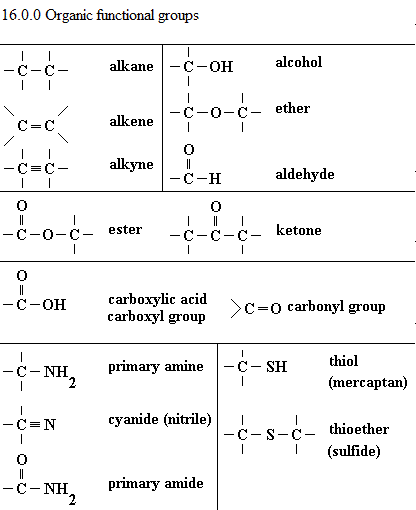
1. Alcohols, 2. Aldehydes, 3. Amines and Amides, 4. Carboxylic acids, 5. Cyclic compounds, 6. Esters, 7. Ethers, 8. Halogens (Alkyl Halides), 9. Ketones R = alkyl group
1. Alcohols, R-OH, -OH hydroxyl, Prefix hydroxy-, Suffix -ol (-OH alcohol) (alkanol, alkyl alcohol)
Multiple -OH groups suffixes -diol, -triol, -tetraol, e.g ethylene glycol = ethane-1, 2-diol, CH2OHCH2OH source
2. Aldehyde, R-CH=O, Prefix formyl-, Suffix -al
Cyclic aldehydes, Prefix formyl-, Suffix -carbaldehyde, attached to benzene benzaldehyde
3. Amines and Amides
Amines R-NH2, Prefix amino-, Suffix -amine source
Primary amine, R1NH2, Secondary amine, R1NHR2, Tertiary amine, R1NR2R3, e.g trimethylamine
Amide, RCONH2, (amine + acid), No prefix, Suffix -oic, amide, e.g, acetamide = ethanamide, CH3CONH2 source
R-C(=O)NR'R', Prefix carbamoyl, NH2CO, Suffix -carboxamide, RCONH2) source
4. Carboxylic acids, RCOOH, Prefix carboxy-, Suffix -oic acid, Multiple dicarboxylic acid, tricarboxylic acid
6. Esters, RCOOR', Prefix R-oxycarbonyl-, Suffix -alkyl, -oate, e.g. methyl formate = methyl ethanoate, HCOOCH3, (but "ethyl acetate", keeping old name) source
7. Ethers, ROR', (Alcohol names), -ether, Prefix -oxy-, e.g, dimethyl ether = methoxymethane, CH3OCH3 source
8. Halogens, (Alkyl halides), R-X, Prefixes fluoro-, bromo-, chloro-, dichloro-, trichloro-, iodo-, e.g chloroform, trichloromethane, CHCl3 source
Haloalkanes, halogenalkanes, alkyl halides, e.g. Acyl chloride, acid chloride, RCOCl, functional group -CO-Cl
Prefix halo-, formyl-, Suffix -oyl halide, e.g. chlorofluorocarbons, CFCs
9. Ketones, RCOR', keto-, -one, e.g. acetone = propan-2-one, C=OH2, Prefix oxo-, Suffix -one source
Furfural
Furfural, C5H4O2, (2-Furaldehyde), furan-2-carbaldehyde, acute toxic, irritant, health hazard, a heterocyclic aldehyde, A colourless or red-brown oily liquid, penetrating odour, denser than water, soluble in water, toxic by ingestion, skin absorption or inhalation, almond smell. source
It thermosets easily and resists corrosion.
It occurs in wheat bran, maize bran, vanilla, cinnamon and is a Maillard reaction product.
Also, it occurs in the peels of ripe Carica papaya (Papaya) and Ananas comosus (Pineapple) fruits show high yield of furfural.
Furfurol
Furfurol, C5H6O2, furfuryl alcohol, (2-Furanmethanol), primary alcohol, acute toxic, irritant, health hazard, clear colourless liquid, denser than water source
It irritates skin, eyes and mucous membranes, toxic by ingestion and skin contact
It occurs in (Perilla frutescens), and in (Zea mays).
Febrifugine, (C16H19N3O3), Quinoline Alkaloid
Febrifugine, (C16H19N3O3), Quinoline Alkaloid source
Febrifugine, quinazoline derivative, (3,4-Dihydro-4-quinazolone derivative), antimalarial.
It occurs in (Dicrroa febrifuga), (Hydrangea febrifuga), and in (Hydrangea macrophylla).
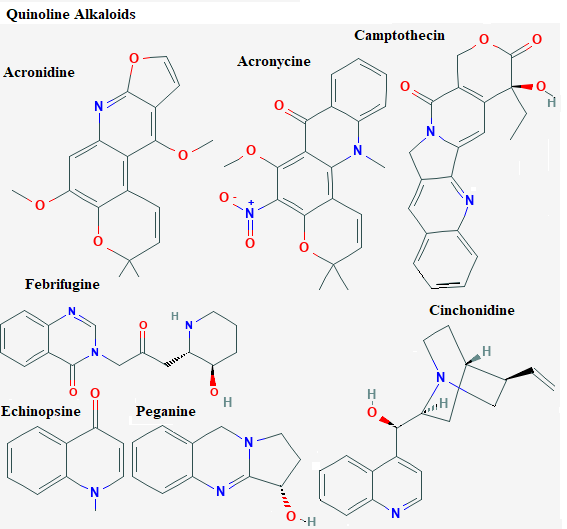
Ficine, (C20H19NO4), Unclassified Alkaloid
Ficine, (C20H19NO4), Unclassified Alkaloid source
Ficine, dihydroxyflavone, N-alkylpyrrolidine, occurs in wild fig (Ficus pantoniana).
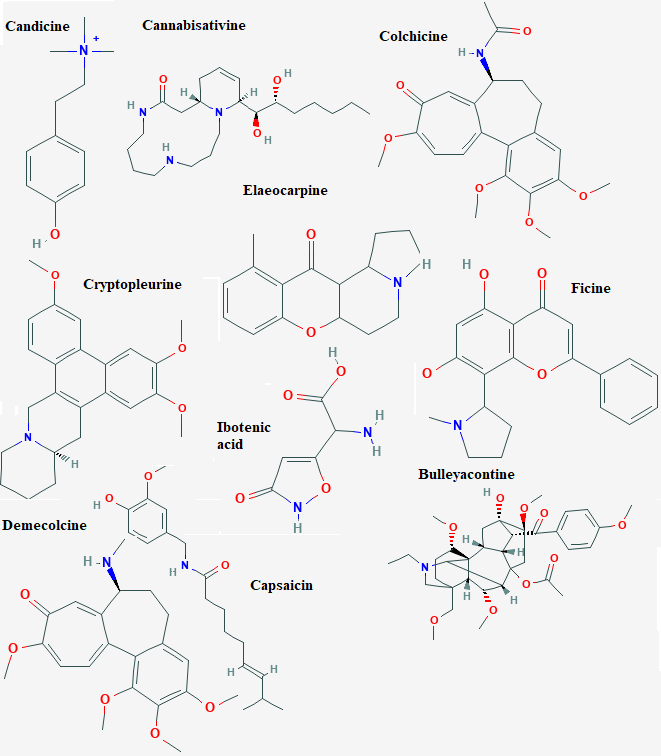
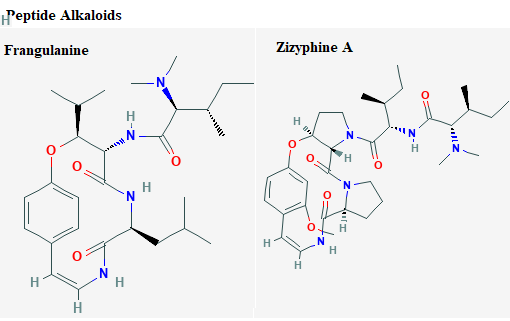
Frangulanine, (C28H44N4O4), Peptide and Cyclopeptide Alkaloid
Frangulanine, (C28H44N4O4), Peptide and Cyclopeptide Alkaloid source
Frangulanine, Ceanothamine A, frangula bark used as a purgative, weak antibiotic, occurs in Ramnus, Waltheria, New Jersey tea (Ceanothus americanus).
This page was generated automatically from the original page on John Elfick's School Science Lessons website. If something looks wrong, please check the original.