Chemistry Experiments, Calcium
Last updated 2026-07-13 by Dr John Elfick
Copper, Cu
6.12.1 Calcium deficiency in soils
The plants are small with unusually shaped leaves.
The shoot tips may die.
Chlorosis of young leaves along the veins, in birdsfoot trefoil and blueberry.
Bleaching of upper half leaf, then leaf tip curling, in black pepper and sugarcane.
Growing bud leaf chlorotic white, but leaf base remains green, and distortion of the tips of shoots, i.e. dieback, in peach seedlings.
Brown spots on leaves, reduced expansion and premature leaf senescence, in soybean.
Calcium stress during fruiting increases susceptibility to blossom end rot, in tomato.
Symptoms: bitter pit in apple, leaf tip burn in cabbage and lettuce, black heart of celery, cavity spot of carrots, vitrescence in melons.
Lime applications are used to prevent root rot, depending on the buffering capacity of the soil.
12.1.0 Copper properties
Copper, Table of the Elements
Copper, RSC
Copper, Cu (Latin cuprum copper), copper (I) ion Cu +, copper (II) ion Cu 2+, Aqueous copper ion, Cu 2+ is blue.
Copper, natural copper
Copper is an electrical and thermal conductor, corrosion resistant, diamagnetic, and an abundant free element.
Copper, element (cuprum), copper (I) Cu +, copper (II) Cu 2+ is red, lustrous, but brown-green if weathered.
Copper, essential element for human body for red blood cells and bone growth, folk medicine, (copper bracelet for arthritis?)
Copper sheeting, 900 mm width × 600 mm depth × 0.7 mm height, sheet
Copper, std (10.00 g Cu), ICP Solution, LR tablets, AAS Solution, precipitated
Copper, metal foil (0.13 mm), bronze powder (electrolytic), turnings, nails, filings, wire, sheet, malleable
Copper toxicity: 4.7
Copper wire, 18 SWG, bare, 1.22 mm diameter, 0.0418 Ohm / m
Copper wire connecting is PVC-covered
Copper is a metallic element used for coin alloys, electrical wiring, heating vessels, jewellery, roofing material, conducting electricity and lightning conductors.
Copper coins, alloy of zinc and tin in copper
Copper, former English penny coin was made of copper, but was discontinued in 1971.
Cupronickel alloys of Cu and Ni, "silver" coins, Local Purchase
Gold coins, e.g. the Australian $1 coin is an alloy of aluminium and nickel in copper.
Copper, Cu (cuprum) is a bright red-orange, ductile, malleable and ductile transition metal, with high electrical and thermal conductivity.
Copper deficiency may occur in infants fed only on cow's milk.
Copper bracelets may alleviate, but not cure, arthritis.
Copper bowls may be preferable for beating cream.
Copper poisoning may occur from water standing for a long time in copper pipes or copper hot water service.
It becomes dull when exposed to air, and in moist air becomes coated with verdis blue or green, basic copper carbonate.
It can be attacked by mineral acids, e.g. hydrochloric and sulfuric acids and organic acids, e.g. acetic acid.
It competes with zinc for entry from the intestines, so an increase in dietary zinc may result in copper deficiency.
It has reaction with dilute HCl or H2SO4 or with water. source
It is a cofactor for many enzymes and proteins, and is used in the development of nerve, bone, blood and connective tissue.
It is an excellent conductor of heat.
It is extracted from cuprite Cu2S, and malachite (basic copper (II) carbonate, Cu2CO3(OH)2. source
It is available as ingots, filings, foil, powder, turnings, nails, wire, turnings.
It is soluble in dilute ammonia.
It is incompatible with alkali solutions, sodium azide and acetylene.
It is the only red or red-brown metal.
It reacts with concentrated oxidizing acids, HNO3 or H2SO4 to produce high oxidation number ions, and sulfur dioxide SO2 or nitrogen dioxide, NO2. source
It reacts with strong oxidants, e.g. chlorates, bromates and iodates, to cause an explosion hazard.
Most Cu + compounds are white, but copper (I) oxide is brick red.
The heated powder forms an oxide.
The recommended daily allowance, RDA, is 1.5 to 3.0 mg.
Atomic number: 29, Relative atomic mass: 63.546, RD. 8.92, MP = 1083 oC, BP = 2595 oC.
Specific heat capacity: 385 J kg -1 K -1.
12.2.0 Copper compounds
Prepare copper compounds: 12.5.0
Azurite: 35.2.10
Bornite: 35.2.15
Chalcocite: 35.2.21
Chalcopyrite: 35.2.22
Coins, (Copper coins), Chemistry
Copper (II) acetate, copper (II) ethanoate, copper acetate, cupric acetate, copper (II) acetate monohydrate, Cu(CO2CH3)2.H2O source
Copper ferrocyanide, semipermeable membrane: 9.1.2
Copper (II) acetoarsenite, (II) arsenate, arsenite, Toxic
Copper (II) hydroxide, Cu(OH)2, cupric hydroxide, blue pigment source
Copper (II) sulfide, CuS, coins, electrical wiring, copper (II) sulfide 6, chalcocite, copper glance, redruthite, Harmful if ingested
Copper (II) sulfide, in electrical wiring, copper glance, redruthite, Harmful if ingested
Copper (I) sulfide, Cu2S, copper monosulfide, copper-glance mineral, chalcocite, grey to black, metallic lustre source
Copper (I) sulfide, Cu2S, indigo copper. (in luminous paints, catalyst), Harmful if ingested source
Copper 5.1.11, brass and bronze alloys
Copper, natural copper: 35.2.25
Copper alloys, CZ copper-zinc brass, PB phosphor bronze, LG leaded gunmetal, CT copper-tin bronze
Copper-chromium alloys5.1.7, Cupaloy
Copper deficiency in soils: 6.13.4
Copper ferrocyanide, Cu2Fe(CN)6, semipermeable membrane source
Copper oxychloride, ClCu2H3O3, is used in agriculture. source
Copper phosphide, copper (I) phosphide, insoluble in water, in phosphor bronze, fluorescent in UV light, Harmful if ingested
Copper plating (electroplating): 15.1.2
Copper pyrite, chalcopyrite: 35.2.22
Copper-aluminium alloys, bronze: 5.1.6
Copper-nickel alloys: 5.1.8
Copper-tin alloys, bronze: 5.1.9
Copper-zinc alloys, brass: 5.1.10
Copper (II) acetoarsenite Paris Green
Covellite: 35.2.25, copper sulfide mineral, CuS
Cuprite: 35.2.25, red oxides of copper, Cu2O source
Prepare copper (II) carbonate with vinegar: 12.7.24
Prepare cuprammonium sulfate: 12.7.5
Prepare verdigris with copper and vinegar: 12.11.1
Malachite, copper (II) carbonate: 35.2.44
Tetraamminecopper (II) sulfate monohydrate, Cu(NH3)4SO4.H2O source
12.3.0 Copper experiments
Bunsen burner flame can melt copper wire: 22.1.3
Burn copper in chlorine: 12.4.8.2
Concentrated acids with metals, sulfuric acid with copper: 12.3.10
Copper alloys: 5.1.5a
Copper coil candle snuffer: 23.7.6 (Physics)
Copper cycle reactions: 11.1.4
Copper oxide with sodium hydrogen sulfate: 12.3.11
Copper residues: 3.3.0 (disposal)
Dilute nitric acid with copper: 13.3.8
Effect of copper on the growth of algae: 9.3.1
Electricity from two coins: 33.4.51
Electroforming using copper: 15.1.7
Electrolysis of copper (II) sulfate solution: 15.5.15, Faraday's laws
Electroplating copper, copper flashing of iron: 15.1.10
Etchants: 7.4.25
Iodine displaces copper in copper sulfate solution: 12.2.3.1
Magnesium / copper cell: 33.1.3.6
Magnesium displaces copper from solution of copper ions: 12.4.13
Movement of copper ions and chromate ions 11.5.1
Movement of copper ions in ammonium nitrate solution: 11.5.2
Nitric acid with copper, (Dilute nitric acid): 13.3.8
Nitric acid with copper. (Concentrated nitric acid): 13.3.9
Oxidation of acetone vapour: 17.3.8, copper catalyst
Oxidize copper foil or a copper coin : 12.7.9
Prepare copper compounds: 12.5.0
Prepare iron sulfate with copper (II) sulfate solution: 12.7.18
Prepare lampblack: 8.1.25, (See: 2.)
Prepare lead sulfate with copper (II) sulfate solution: 12.7.19
Prepare nitrogen dioxide: 13.3.19
Prepare zinc sulfate with copper sulfate solution: 12.15.3.2
Prepare verdigris with copper and vinegar: 12.11.1
Reactions of copper: 12.6.0
Recycle copper: 12.7.8
Strong electrolytes: 15.2.5, (See: 2.)
Sulfuric acid with copper: 12.3.10
Sulfuric acid with copper: 12.3.3
Sulfuric acid with copper (II) sulfate crystals: 12.3.4
Sulfuric acid with filter paper: 12.3.5
Wood treated with copper chrome arsenate (CCA): 12.3.4
Zinc plating of copper: 15.1.6
12.4.0 Prepare copper compounds
Prepare copper from brass: 12.7.10
Prepare copper from copper oxide: 12.7.12
Prepare copper from copper sulfate: 12.7.15
Prepare copper (II) carbonate with distilled white vinegar
Prepare copper (I) chloride: 12.7.7
Prepare copper (I) oxide: 12.7.6
Prepare copper (I) oxide with golden syrup: 12.7.16
Prepare copper (II) ammonium sulfate crystals: 12.7.4
Prepare copper (II) carbonate: 12.7.22
Prepare copper (II) carbonate and copper (II) oxide: 12.7.20
Prepare copper (II) sulfate crystals with copper oxide: 12.7.13
Prepare copper (II) sulfate algicide 12.7.14
Prepare copper (II) oxide, Heat copper foil to form copper (II) oxide: 12.7.21
Prepare cuprammonium sulfate: 12.7.5
Prepare lead sulfate with copper (II) sulfate solution: 12.7.19
Prepare rayon, basic copper carbonate with ammonia solution: 3.3.8
Prepare verdigris with copper and vinegar: 12.11.1
Prepare zinc sulfate with copper sulfate solution: 12.15.3.2
Prepare sulfides: 12.18.2.0, (See: 1.)
12.4.1.1 Prepare chlorine with bleaching powder or bleach solution.
Bleaching powder is a mixture of calcium chloride, calcium hydroxide and calcium chlorate (I).
Bleaching powder is manufactured by the reaction of chlorine with solid calcium hydroxide.
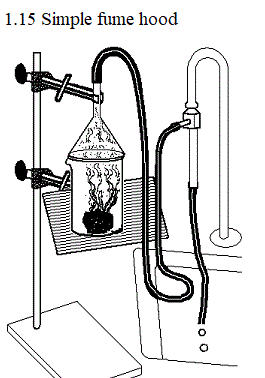
Be careful! Prepare chlorine gas only in a fume hood or fume cupboard.
Be careful! Do not prepare chlorine in an open room.
Use small quantities only.
1. With great care, warm bleaching powder and smell it until you notice a choking smell, because of chlorine gas being produced by the action of carbon dioxide in the air.
Test with wet red or blue litmus paper that becomes colourless, because of the bleaching action of chlorine.
2. Solutions of bleach (sodium hypochlorite), and solid bleaching powder produce small amounts of chlorine gas when exposed to the air, with its characteristic smell.
Adding acid causes a vigorous production of chlorine gas.
The most convenient ways to prepare chlorine gas are to use the reaction of dilute acid with bleaching powder or the reaction of potassium permanganate with concentrated hydrochloric acid.
Collect the chlorine gas by displacement of air.
3. Put 5 g of bleaching powder (calcium hypochlorite) into a test-tube.
Add drops of a weak acid, e.g. citric acid or vinegar.
Test with wet red or blue litmus paper.
Hold a piece of white paper behind the apparatus to note the green chlorine gas.
4. Add dilute sulfuric acid to bleaching powder.
After collecting a small amount of chlorine gas put a stopper in the receiving test-tube and put the end of the delivery tube into sodium thiosulfate solution to absorb excess chlorine.
CaOCl2 = H2SO4 (aq) → CaSO4 (s) = H2O (l) = Cl2 (g) source
Repeat the experiment with dilute hydrochloric acid.
CaOCl2 = 2HCl (aq) → CaCl2 (s) = H2O (l) = Cl2 (g) source
5. Domestic bleach is manufactured by mixing a solution of chlorine with sodium hydroxide solution
Cl2 (g) = 2OH- (aq) → Cl- (aq) = ClO- (aq) = H2O source
Add a dilute acid to bleach solution to form chlorine gas.
NaOCl (aq) = HCl (aq) → NaCl (aq) = H2O (l) = Cl2 (g) source
6. Prepare chlorine with bleaching fluid.
Do this experiment near an open window or in a fume hood.
Add drops of an acid solution, e.g. citric acid, tartaric acid, dilute sulfuric acid, to a few drops of bleaching fluid in a test-tube.
The green gas chlorine forms without any heating.
Sniff the gas very cautiously and test it with a piece of wet litmus paper.
The litmus paper is bleached by the chlorine.
12.5.0 Reactions of copper
Reactions of copper (I) compounds: 12.7.3
Reactions of copper (II) ions: 12.7.2
Reactions of copper (II) oxide, CuO: 12.7.1
Reactions of chlorine with copper: 12.4.14
12.6.0 Tests for copper
Tests for copper: 12.7.23
Tests for copper: 12.11.3.8 (See: 5.)
Tests for copper wire with a flame test: 12.7.11
Tests for oxidizing agents: 15.4.17
Tests for water with anhydrouscopper (II) sulfate: 8.2.1
12.7.1 Reactions of copper (II) oxide, CuO
1. Mix copper (II) oxide with fusion mixture and heat it on a charcoal block in the reducing flame of a blowpipe.
Brown scales of copper forms.
2. Add concentrated hydrochloric acid to copper (II) oxide on a watch glass.
Dip a platinum wire in the mixture for a flame test.
Note the intense blue-green flame.
3. Put a borax bead on a platinum wire.
Sprinkle copper (II) oxide on the bead and heat in the oxidizing flame of a Bunsen burner.
The bead is blue then green when hot.
4. Prepare copper from copper (II) oxide.
Mix 2 mL of copper (II) oxide crystals, 2 mL of sodium hydrogen carbonate or powdered washing soda, and 4 mL of sucrose sugar crystals.
Put 2 mL of the mixture into a small metal screw cap or on a metal lid.
Heat the mixture with a Bunsen burner flame.
The mixture will swell up and form a copper-coloured mass.
To obtain the copper from the mass let the screw cap or metal lid to cool and form a copper-coloured residue.
Put the residue into a test-tube and heat it for a few minutes with dilute sulfuric acid solution.
Pour away the contents of the test-tube leaving a small amount of solid at the bottom of the test-tube.
This solid consists of small particles of metallic copper.
5. Prepare copper sulfate crystals from copper oxide.
Half fill a test-tube with dilute sulfuric acid.
Hold the test-tube with a paper holder in a flame until the liquid nearly begins to boil.
Add a small amount of black powder copper (II) oxide and observe it dissolving in the acid.
Heat the test-tube again and add further small amounts of copper (II) oxide until a black sediment of copper (II) oxide remains at the bottom of the test-tube, even after warming for a further two minutes.
Filter the blue solution into an evaporating dish and leave it to evaporate in a cupboard.
Blue crystals of copper sulfate form.
12.7.2 Reactions of copper (II) ions, Cu 2+
. 1. Pass hydrogen sulfide into copper (II) sulfate solution.
Note a dark brown precipitate of copper (II) sulfide.
Cu 2+ + S 2- → CuS (s) source
Wash the precipitate and pour off excess water.
Add excess of dilute nitric acid and boil in an evaporating basin.
The copper (II) sulfide dissolves.
CuS + 2H + → Cu 2+ + H2S (g). source
2. Add potassium iodide solution to copper (II) sulfate solution.
A precipitate of white copper (I) iodide and iodine forms.
Add sodium thiosulfate solution to dissolve the iodine and note the white precipitate of copper (I) iodide.
2Cu 2+ + 4I - → CuI2 (s) + I2 (s). source
3. Add sodium hydroxide solution to copper (II) sulfate solution.
Note the blue jelly-like precipitate of copper (II) hydroxide.
Cu 2+ + 2OH - → Cu(OH)2 (s) source
Pour the jelly-like precipitate into a test-tube, add ammonia solution, NH3 (aq) and note the blue precipitate dissolving to form a deep blue solution. source
This solution contains the cuprammonium ion [Cu(NH3)4] 2+. source
Ammonia has a similar reaction with silver, copper (I) and copper (II) compounds.
Boil the remaining solution and note the black precipitate of copper (II) oxide.
Cu(OH)2 → CuO (s) + H2O. source
4. Add potassium ferrocyanide solution to copper (II) sulfate solution.
Note the brown precipitate of copper ferrocyanide.
2Cu 2+ + [Fe(CN)6] 4- → Cu2Fe(CN)6 (s). source
12.7.3 Reactions of copper (I) compounds, Cu +
. 1. Add drops of potassium iodide solution to copper (I) chloride solution in concentrated hydrochloric acid.
Note the white precipitate of copper (I) iodide.
Cu2Cl2 + 2KI → Cu2I2 (s) + 2KCl. source
2. Pour some of the solution of copper (I) chloride in concentrated hydrochloric acid into water.
Note the white precipitate of copper (I) chloride that is soluble in a high concentration of chloride ions, but is insoluble in water.
Cu2Cl2 + 4Cl - < → 2[CuCl3] 2-. source
3. Add dilute hydrochloric acid to 2 cc of copper (I) oxide, then heat.
Note the white precipitate of copper (I) chloride.
Cu2O + 2HCl → Cu2Cl2 + H2O. source
4. Add dilute sulfuric acid to 2 cc of copper (I) oxide.
Note the red precipitate of metallic copper in a blue solution.
Cu2O + H2SO4 → CuSO4 + Cu (s) + H2O. source
5. Add dilute nitric acid to 2 cc of copper (I) oxide.
Copper from the reaction reacts with excess dilute nitric acid to form blue-green copper nitrate + nitric oxide that turns brown on exposure to air, and water.
Cu2O + 2HNO3 → Cu(NO3)2 +H2O + Cu (s) source
3Cu + 8HNO3 → 3Cu(NO3)2 + 2NO + 4H2O. source
12.7.4 Prepare copper (II) ammonium sulfate crystals
Dissolve 5 g of copper (II) sulfate in 50 mL of boiling water.
Dissolve 2.6 g of ammonium sulfate in 10 mL of water.
Mix the solutions and evaporate until crystallization begins, then set aside to cool.
The crystals are a double salt.
CuSO4 (aq) + 4 NH4OH (aq) → Cu(NH3)4SO4H2O (s) + 3 H2O (l) source
Copper (II) ammonium sulfate crystals, (NH4)2SO4.CuSO4.6H2O source
12.7.5 Prepare cuprammonium sulfate
Cuprammonium sulfate, | Cu(NH3)4SO4 | [Cu(NH3)4]SO4·H2O | [Cu(NH3)4(H2O)]SO4|, tetraamminecopper (II) sulfate monohydrate source
Dissolve 10 g of copper (II) sulfate by boiling in 50 mL of water in a 200 mL flask and leave to cool.
Slowly add concentrated ammonia solution, NH3 (aq) ("ammonium hydroxide") until any precipitate redissolves, then leave to cool. source
Be careful!
Add 20 mL of ethanol to form a layer on top of the blue solution.
Stopper the flask loosely and leave undisturbed for a week.
Filter off the crystals of cuprammonium sulfate and transfer to a container with a stopper.
Cuprammonium sulfate is a complex salt in which the copper ion and ammonia form a single divalent ion [Cu(NH)] 2+ ].
12.7.6 Prepare copper (I) oxide
1. Use a 5 cm square of shiny copper foil.
Fold in the corners of the square then hammer the corners flat.
Use tongs to heat the pieces of copper foil in a Bunsen burner flame.
The heated foil turns black as a layer of black copper (I) oxide forms on it.
Use pliers to open the folded corners so that you have restored the 5 cm square again.
The area of copper foil where the corners were folded over is still shiny, because the copper had no access to the oxygen in the air.
2Cu (s) + O2 (g) → 2CuO (s) source
copper + oxygen → copper (I) oxide. source
2. Fill a boiling tube to the depth of 2 cm with copper (II) sulfate solution and add 2 cc of Rochelle salt, sodium potassium tartrate.
When the salt has dissolved, add sodium hydroxide solution.
The solution is now Fehling's solution.
Add 2 cc of glucose and boil.
An orange-red precipitate of copper (I) oxide forms by the reducing action of glucose on the copper (II) copper in solution.
2Cu(OH)2 - O → Cu2O + 2H2O source
Reduction by glucose
The precipitate is soluble in concentrated hydrochloric acid, but dilute sulfuric acid or nitric acid gives free copper and the copper (II) salt.
Excess nitric acid acts on the copper.
Cu2O + 2HCl → CuCl2 + H2O source
Cu2O + H2SO4 → Cu + CuSO4 + H2O. source
12.7.7 Prepare copper (I) chloride, CuCl
Copper (I) chloride, CuCl, cuprous chloride
Copper (II) chloride (CuCl2) source
Cuprous chloride, CuCl, was first produced by heating mercury (II) chloride with copper, leaving CuCl and Hg, dangerous experiment!
1. Use enough copper (II) oxide to cover the bottom of a test-tube.
Add five times that volume of concentrated hydrochloric acid then heat the solution.
Note the green copper (II) chloride solution.
CuO + 2HCl → CuCl2 + H2O source
Add copper filings of equal volume to the copper (II) oxide used, and boil for 2 minutes.
Filter the mixture through glass wool into a beaker of water.
Note the white precipitate of copper (I) chloride.
Cu + CuCl2 → Cu2Cl2 (s) source
(Cu2Cl2 is by joining two identical molecules by bonds between cuprous (I) chloride, CuCl) Pour off the supernatant liquid into two parts. source
Use part A to show that the copper (I) chloride is soluble in ammonia solution, NH3 (aq) ("ammonium hydroxide"), because of the formation of a complex ion. source
Cu2Cl2 + 4NH3 → 2[Cu(NH3)] 2+ + 2Cl - source
. Use part B to show that the copper (I) chloride is soluble in concentrated hydrochloric acid, because it forms of another complex ion with the chloride ion.
This complex ion is unstable and decomposes on dilution with water.
Cu2Cl2 + 4Cl - → 2[CuCl3] 2-. source
2. Prepare dry copper (I) chloride with a filter pump and Buchner funnel to get the white solid.
Wash it with sulfurous acid then glacial acetic acid, then dry it by heating on a water bath.
Keep the dry solid in a sealed container.
12.7.8 Recycle copper
1. Precipitate insoluble metal salts with sodium carbonate, sodium hydroxide or sodium sulfide.
Decant the clear solution above the precipitate and wash it down the sink.
Store the dried precipitate.
2. Add iron filings or steel wool or nails or any waste iron to displace copper from solution.
Decant the clear solution above the precipitate and wash it down the sink.
Store the dried precipitate.
12.7.9 Oxidize copper foil or a copper coin
In the UK, it is illegal to use the king's coinage for any purpose except that of currency.
So if you live in the UK and you want to be on the right side of the law, use a foreign coin for this experiment!
1. Hold the copper foil by the edge with pair of pliers and heat it at the tip of a hot flame.
The surface of the copper turns black, because the copper combines with oxygen in the air to form black copper (II) oxide, cupric oxide, CuO.
After heating for a few minutes, leave the copper to cool, then scratch it with a knife point.
A red layer below the black layer is copper (I) oxide, cuprous oxide, Cu2O. source
Below the red layer is unchanged copper, Cu.
Put the blackened copper in a beaker and warm it with dilute sulfuric acid.
The surface of the coin becomes clean and a blue solution of copper sulfate forms.
The surfaces of copper coins become black with age.
The blackening is because copper combines with oxygen and hydrogen sulfide gases in the atmosphere to form black copper oxide and black copper sulfide.
Remove the black coating with dilute nitric acid.
Dilute sulfuric acid dissolves the copper oxide, but not the copper.
2. Place the blackened coin in a beaker and warm it with a little dilute sulfuric acid, sodium bisulfate solution, or dilute nitric acid.
The surface of the coin will be cleaned, and a blue solution of either copper sulfate or copper nitrate forms.
The surfaces of copper coins in everyday use become black with age.
The copper in the coin combines with oxygen and hydrogen sulfide gases in the atmosphere to form copper oxide and copper sulfide, which are both black.
The black coating can be removed and the discoloured coin made bright and shiny by warming with dilute nitric acid.
Dilute sulfuric acid will dissolve the copper oxide, but not the copper sulfide.
12.7.10 Prepare copper from brass
1. Heat a piece of brass in a test-tube half full of dilute nitric acid.
Effervescence begins.
Observe the brown-yellow gas in the test-tube.
At the same time a green-blue solution of copper nitrate forms.
Let the action continue for five minutes and then pour the solution into an eggcup.
Put a clean penknife blade into the solution.
A deposit of pure copper forms on the blade.
The gas is a mixture of colourless nitrogen tetroxide, nitrogen peroxide, N2O4 with red-brown nitrogen dioxide, NO2. source
N2O4 < → 2NO2. source
2. This experiment can also be done with a small copper coin.
Warm a small piece of brass or a few bits of brass wire in a test-tube half full of dilute nitric acid, using only a small flame.
Soon effervescence will begin and a brown gas, nitrogen peroxide, will be seen in the tube.
At the same time a green-blue solution of copper nitrate forms.
Allow the action to proceed for about five minutes and then pour the solution into an egg cup.
Put a clean penknife blade into the solution.
A deposit of pure copper forms on the blade.
12.7.11 Tests for copper wire with a flame test
Dip the end of a copper wire into an iodine solution or tincture of iodine, then into the edge of a flame.
Observe a blue-green colour of the flame, a beautiful appearance in the dark.
12.7.12 Prepare copper from copper oxide
Mix one part of copper oxide, sodium bicarbonate or powdered washing soda, and two parts of sugar.
Put a small amount of the mixture into a small metal screw-cap or on to a tin lid.
Heat the mixture over a medium Bunsen flame.
The mixture swells up and forms a copper-coloured mass.
To obtain the copper from the mass allow the screw-cap or lid to cool and powder the copper-coloured residue.
Put the powder into a test-tube and warm it for a few minutes with a little dilute sulfuric acid or sodium bisulfate solution.
Pour away the contents of the tube except for the small amount of solid left at the bottom of the tube.
This solid contains small particles of metallic copper.
12.7.13 Prepare copper (II) sulfate crystals with copper oxide.
When black copper oxide is warmed with dilute sulfuric acid, it is converted into a blue solution of copper sulfate.
Half fill a test-tube with dilute sulfuric acid.
Holding the tube in a paper holder, warm it over a small flame until the liquid nearly begins to boil.
Then add a pinch of copper oxide from a salt spoon to the tube.
The black powder will dissolve.
Warm the tube again and add a further pinch of copper oxide.
This also will dissolve.
Continue the adding of small amounts of copper oxide and warming until a black sediment of copper oxide stays at the bottom of the tube, even after warming.
Filter the blue solution into an evaporating dish and leave it to evaporate in the bottom of the airing cupboard.
Blue crystals of copper sulfate will be deposited in a few hours on the bottom of the dish.
12.7.14 Prepare copper (II) sulfate algicide.
1. Copper (II) sulfate solutions are blue only at concentrations greater than about 50 ppm.
Copper ions at concentration 0.05 mg / L (0.05 ppm) of depress cell division and photosynthesis in common freshwater green alga, e.g. (Chlorella pyrenoidosa).
Copper (II) sulfate pentahydrate, CuSO4.5H2O, has a molar mass of 249.5 g / mol. source
Copper has a molar mass of 63.5 g / mol.
To make a 1000 mg / L of Cu 2+ solution (1000 ppm), use 249.5/63.5 = 3.929 g of copper (II) sulfate pentahydrate per litre of distilled water or deionized water.
Use this solution to prepare serial dilutions (1:10) to reduce this concentration to 100, 10, 1, 0.1 ppm Cu 2+.
Use a fluorescent tube of colour temperature 6500 K whiteness of colour.
See: 23.8.21 Colour temperature.
2. Effect of pH on the toxicity of copper
At pH below 7.0, the toxicity of copper is greatly enhanced.
Prepare solutions of desired pH by diluting some 0.1 M hydrochloric acid (pH 1).
Add standard copper solution to produce a 1 ppm concentration of copper.
3. Effect of other metals on the toxicity of a copper algicide
Toxicity of ionic copper on algal growth is reduced by trivalent (3+) metal ions, including those of Mn, Co, Al, Fe and Cr.
They form a layer of metal (III) hydroxide around the algal cell, adsorb copper and reduce the penetration of copper into the cell.
The degree of insolubility of the metal (III) hydroxide is related to its ability to protect against copper toxicity.
Test different metals while keeping the Cu 2+ concentration the same.
4. Effect of availability of copper on the toxicity of a copper algicide
The two types of algicides sold are 1. ionic copper, a 5% CuSO4 solution (5 g copper (II) sulfate / 100 mL) and 2. chelated copper (about 7% Cu). source
Chelated copper such as copper alkanolamine complex is more toxic to algae than ionic copper, because both the metal and the organic ligand enter the algae cell.
Also, chelated copper is more resistant to changes in pH.
Test the algicide ability of both forms of algicide at the same concentration of Cu 2+, and compare them at different pH.
Chelated copper remains active algicide for several weeks whereas copper (II) sulfate remains active only for a few days.
If pool water contains high concentration of carbonate ions, copper ions in copper (II) sulfate react with carbonate ions and form insoluble copper carbonate.
12.7.15 Prepare copper from copper sulfate
1. Shake iron filings with 2 cm of blue vitriol solution in a test-tube for a few minutes.
The colour of the solution will fade, and, if the shaking is continued long enough, will disappear.
Filter the contents of the tube.
Note the red-brown powder left in the filter paper.
copper sulfate + iron → copper + iron sulfate source
The red-brown powder is not pure copper, because excess of iron filings is a mixture of copper and excess iron filings coated with copper.
2. Repeat the experiment using a piece of lead instead of iron filings.
After cleaning the lead rub it with sandpaper and then immerse it in hot copper sulfate solution.
The heat is necessary, because the action is slow in the cold.
A film of copper will be deposited on the lead.
12.7.16 Prepare copper (I) oxide with golden syrup.
1. Add sodium hydroxide solution to 2 cm of copper (II) sulfate solution.
A blue jelly-like precipitate of copper hydroxide forms.
Stir golden syrup on the end of a spoon into a little hot water until it has dissolved.
Add 2 cm of this solution to the copper hydroxide precipitate in the test-tube.
Heat the test-tube gently.
A yellow precipitate of copper (I) oxide, CuO, forms in the test-tube.
The colour gradually changes to orange.
Filter off the precipitate.
The copper (I) oxide is left in the filter paper turns red, its usual colour.
2. Repeat the experiment with a solution of black treacle, or the sweet sold as "barley sugar".
These foods contain glucose.
This chemical action may be used as a test for glucose.
3. Use the solution to test on a cut apple for glucose.
Heat small pieces of the apple with water.
After filtering the liquid, use it in the same way as described for the golden syrup solution above.
2NaOH (aq) + CuSO4 (aq) → Na2SO4 (aq) + Cu(OH)2 (s). source
12.7.17 Copper (II) sulfate is insoluble in alcohol
Make a strong solution of copper sulfate by heating 1 cm of the powder with 2 cm of water in a test-tube.
When the powder has dissolved, cool the test-tube under the tap.
Pour drops of methylated spirits into the test-tube.
A shower of very small crystals of copper sulfate precipitates in the test-tube, because copper sulfate is insoluble in methylated spirit.
12.7.18 Prepare iron sulfate with copper (II) sulfate solution.
1. Shake 2 mL of iron filings with 4 cm of copper sulfate solution in a test-tube for a few minutes.
The colour of the solution will fade.
If the shaking continued for long enough the colour disappears.
Filter the contents of the test-tube.
A red-brown powder is left in the filter paper as the more reactive Fe, displaces Cu to form FeSO4 and Cu. source
Fe (s) + CuSO4 (aq) → FeSO4 (aq) + Cu (s) source
iron + copper sulfate → iron (II) sulfate + copper source
The red-brown powder is not pure copper, because the excess iron filings is a mixture of copper and excess iron filings coated with copper.
12.7.19 Prepare lead sulfate with copper (II) sulfate solution
After cleaning the lead, rub it with sandpaper, then immerse it in very hot copper sulfate solution.
The heat is necessary, because the action is slow in the cold.
A film of copper deposits on the lead.
Pb (s) + Cu 2+ (aq) + SO4 2- (aq) → Pb 2+ (aq) + SO4 2- (aq) + Cu (s) source
Pb 2+ (aq) + SO4 2- (aq) → PbSO4 (s) source
However, the lead sulfate is insoluble in the solution and rapidly forms a layer on the lead strip.
So most people think no reaction occurs.
12.7.20 Prepare copper (II) carbonate and copper (II) oxide
Add 2 cm of copper sulfate solution to 2 cm of sodium carbonate solution.
A blue-green precipitate of copper carbonate forms in the double decomposition reaction.
Filter the precipitate, and with a spill transfer it to a metal lid. Hold the lid in a pair of pliers and warm it gently over a small flame.
The green colour copper (II) carbonate will change to black, because of formation of black copper (II) oxide.
2Na + + SO4 2- + Cu 2+ + CO3 2 - → Na2SO4 + CuCO3 source
Na2CO3 + CuSO4 → Na2SO4 + CuCO3 source
sodium carbonate + copper sulfate → sodium sulfate + copper (II) carbonate source
Another explanation:
2Na2CO3 +2CuSO4 + H2O → 2Na2SO4 + Cu2(OH)2CO3 + CO2 source
sodium carbonate + copper sulfate + water → sodium sulfate + basic copper carbonate + carbon dioxide source
Cu2(OH)2CO3 = 2CuO + CO2+ H2O. source
12.7.21 Heat copper foil to form copper (II) oxide
Copper (I) oxide, Cu2O, cuprous oxide source
Copper (II) oxide, CuO, cupric oxide, copper oxide
Copper (I) oxide produced by the oxidation of copper metal
4 Cu + O2 → 2 Cu2O source
Cleaned copper is brown red.
In moist air the surface turns green due to oxidation.
The green surface is called a patina.
It also forms on old unpolished bronze.
1. Heat a narrow strip of copper foil, for half a minute, using the test-tube holder, so that only a small part of the foil is in the flame.
Describe what happens to the metal.
The metal does not melt.
The heated part turns black.
The spirit burner flame is not hot enough to melt the copper.
The part of the metal in the flame becomes covered with black copper oxide.
2. Tests for copper (II) oxide formation
Clean a piece of copper foil with steel wool.
Hold it in a flame with a pair of tongs.
The copper foil turns black.
The black copper (II) oxide looks like carbon.
To test the substance, drop dilute sulfuric acid on it, then heat it.
Blue copper (II) sulfate forms.
Test some powdered carbon.
No colour change occurs.
2Cu + O2 → 2CuO source
copper (s) + oxygen (g) → copper oxide (s). source
3. Clean a piece of copper foil with steel wool.
Hold it in a flame with a pair of tongs.
The black copper (II) oxide looks like carbon.
To test the substance, drop dilute sulfuric acid on it, then heat it.
Blue copper (II) sulfate forms.
Test some powdered carbon.
No colour change occurs.
4. Show that something is added to the copper from the air.
Use a sensitive balance to weigh the copper before and after heating.
5. Use two identical hard glass test-tubes with one-hole stoppers fitted with bent delivery tubes.
Fix both test-tubes to a stand so that the test-tubes slope down with the ends of the delivery tubes under water in a beaker.
Put copper foil in the first test-tube and heat with a hot burner flame.
After two minutes, heat the empty second test-tube.
Move the burner regularly between the two test-tubes until no more bubbles come out of the ends of the delivery tubes.
Stop heating both test-tubes.
As the test-tubes cool, they suck water up the delivery tube.
The test-tube containing the copper (II) oxide sucks up more water.
12.7.22 Prepare copper (II) carbonate
Dissolve a finger width of copper sulfate in a test-tube half filled with water.
Dissolve a finger width of sodium carbonate in another test-tube half filled with water.
Shake each test-tube to help the chemicals dissolve.
Add the two liquids by pouring one into the other.
A blue-green solid substance forms, copper carbonate.
Filter the mixture from the previous experiment that contains the blue-green solid.
Copper carbonate remains on the filter paper.
Pour half a test-tube of hot water onto the copper carbonate to wash away other substances.
Remove the filter paper from the filter funnel, open it and lay it on a flat surface and leave to dry.
Store and label the dry copper carbonate.
Na2CO3 + CuSO4 → Na2SO4 + CuCO3 source
sodium carbonate + copper sulfate → sodium sulfate + copper carbonate source
12.7.23 Tests for copper
1. Ammonium hydroxide gives a pale blue precipitate that dissolves in excess to give a deep blue solution.
2. Organic reagent: Rubeanic acid (ethanedithioamide, dithiooxamide), NH2.CS.CS.NH2, saturated 0.5% alcoholic solution source
Use 10 mL of neutral Cu solution + 1 mL 5M CH3COOH + drops of reagent. source
A green-black precipitate forms.
Test with Group II precipitate.
Ni and Co may interfere with the test.
Dissolve CuS in dilute HNO3 and neutralize with NaOH solution. source
12.7.24 Prepare copper (II) carbonate with vinegar
Do the experiment in a well-ventilated area or use a fume hood.
Add 50 g of copper sulfate crystals to 30 mL of deionized water, and heat the solution untill all the copper sulfate crystals are dissolved.
Add 100 g of barium carbonate.
Use a filter, to separate the insoluble precipitate.
Wash thoroughly with water and leave to dry overnight.
Transfer the copper carbonate to a clean beaker.
. Add excess of vinegar.
Observe the formation of purple copper acetate, and leave to dry.
(Quick drying will produce copper hydroxide!)
Add water and leave to allow the formation of crystals of copper carbonate.
12.7.25 Reduce copper (II) sulfate to copper sulfide, Cu2S
12.7.25 Reduce copper (II) sulfate to copper sulfide, Cu2S source
The yellow snowstorm reaction
The thiosulfate ion, S2O3 2-, is a reducing agent source
The cupric ion, Cu 2+, is an oxidizing agent
The blue cupric ion, Cu 2+, may be reduced to the colourless cuprous ion, Cu +
1. Prepare a strong solution of sodium thiosulfate by heating a dozen crystals with 2 cm of water in a test-tube
Cool the solution under the tap
Add 2 cm of copper sulfate solution drop by drop
The blue colour of the copper sulfate solution fades as it mixes with the sodium thiosulfate
Heat the mixture until it begins to boil
Remove the test-tube from the flame and observe the liquid turning yellow, then brown, and finally a heavy black precipitate of copper sulfide forms
2. Equimolar ratio of sodium thiosulfate solution with copper sulfate solution
Prepare 0.5 M copper (II) sulfate solution and 0.5 M sodium thiosulfate solution and observe their colours
Mix 2 mL of each solution
Stir the mixture, observe the sudden colour change to pale green, and leave to stand
After 15 minutes a precipitate begins to form and becomes a yellow copper-thiosulfate complex, e.g. [Cu(S2O3)3]5, after 24 hours source
Use a centrifuge to separate the precipitate and leave to stand separately the precipitate and the liquid
After a few days a dark layer forms on top of the yellow precipitate
Some of the thiosulfate reduces some of the copper (II) to copper (I)
3. Excess of sodium thiosulfate solution with copper sulfate solution
Add 1 mL of 0.5 M copper (II) sulfate solution to 3 mL of 0.5 M sodium thiosulfate solution
Stir the mixture, observe any colour change, and leave to stand
A dark precipitate of CuS forms after 48 hours with an iridescent coating on the inside of the test-tube
Leave for weeks and the iridescent coating becomes blue-black, thicker and darker
Test the precipitate for sulfide in a fume cupboard
Dry the precipitate, add a drop of nitric acid, hold a piece of lead acetate paper near it to become black in the presence of H2S source
Some of the thiosulfate reduces all of the copper (II) to copper (I)
12.15.3.2 Prepare zinc sulfate with copper sulfate solution
Zinc metal can displace copper ions from a solution of copper (II) sulfate.
Add excess zinc powder to copper (II) sulfate solution.
Zn (s) + CuSO4 → ZnSO4 + Cu source
Zn (s) + Cu 2+ (aq) → Zn 2+ (aq) + Cu (s) source
Zn (s) + Cu 2+ (aq) + SO4 2- (aq) → Zn 2+ (aq) + SO4 2- (aq) + Cu (s) source
[SO4 2- is a "spectator ion".] source
20.2.0 Calcium experiments
Chalk (lime) content of the soil: 6.9.02
Reactions of calcium and calcium compounds: 20.2.1
Heat calcium metal to form calcium oxide: 20.2.2
Heat calcium sulfate, gypsum: 20.2.3
Prepare chlorine with bleaching powder or bleach solution: 12.4.1.1
Test bleaching powder: 12.4.4
Weight of calcium in marble: 17.6.2
20.2.1 Reactions of calcium and calcium compounds
1. Heat a flake of calcium on wire gauze with a Bunsen burner flame.
The calcium burns brilliantly with a red flame and leaves a white residue of calcium oxide.
Add drops of water to the calcium oxide in a test-tube and note the vigorous exothermic reaction.
Test the solution with red litmus paper that turns blue.
Note that calcium oxide is not very soluble in water.
2Ca = O2 → 2CaO source
CaO = H2O → Ca(OH)2 (s) source
2. Drop a small piece of calcium (not old stock calcium) into a test-tube a quarter full of dilute hydrochloric acid.
Press your thumb over the mouth of the test-tube and when you can feel the pressure on your thumb test the gas for hydrogen with a lighted splint.
Repeat the experiment with a small piece of magnesium ribbon.
The same reaction occurs, but the calcium is obviously more reactive, because it slower down group 2 of the periodic table.
Usually, the lower an element in the same group of the periodic table, the more reactive it is.
Ca = 2HCl → CaCl2 = H2 source
Mg = 2HCl → MgCl2 = H2 source
3. Add ammonium carbonate solution to calcium chloride solution.
Note the white precipitate of calcium carbonate.
Ca2= = CO32- → CaCO3 (s.) source
4. Add ammonium oxalate solution to calcium chloride solution.
Note the white precipitate of calcium oxalate that is soluble in dilute hydrochloric acid, but insoluble in acetic acid.
Ca = C2O42- → CaC2O4 (s) source
5. Add solutions of calcium salts to potassium chromate solution and to calcium sulfate solution.
No precipitate forms with calcium sulfate solution and barium salts with potassium chromate solution.
6. Add sodium phosphate solution to calcium chloride solution.
Note the white precipitate of calcium phosphate that is soluble in dilute hydrochloric acid, nitric acid or acetic acid.
3Ca = 2PO43- → Ca3(PO4)2 (s) source
7. Add concentrated hydrochloric acid to dry calcium chloride and do the flame test.
Note the brick-red flame and observe the green colour when seen through blue glass.
20.2.2 Heat calcium metal to form calcium oxide.
Heat a shaving of calcium metal in a crucible and heat it with a Bunsen burner for 10-15 minutes, because it is difficult to ignite.
20.2.3 Heat calcium sulfate, gypsum.
CaSO4.2H2O = heat → CaSO4H2O = 1 H2O (steam) source
gypsum = heat → calcium sulfate hemihydrate (plaster of Paris, CaSO4.nH2O) source
20.3.0 Calcium properties
Calcium, Ca (Latin calx lime), alkaline earth metal, calcium ion Ca2=, occurs in many natural compounds and living organisms, and burns with brilliant light.
Calcium granulated, granules, shot, pieces, AAS Solution, Toxic if ingested or by skin contact
Decalcifying Solution is used for the decalcification microscopy sections and bone marrow core specimens is an alkaline earth metal, granules in liquid paraffin.
Reacts with dilute HCl or H2SO4 to form H2 and metal ion, occurs mainly as carbonates, e.g. calcium carbonate, CaCO3, gypsum. source
Calcium reacts with concentrated oxidizing acids, HNO3 or H2SO4 to produce high oxidation number ions, and sulfur dioxide, SO2, or nitrogen dioxide, NO2. source
It reacts with cold water and reacts with air to form peroxides.
Calcium is the most abundant mineral, and the fifth most abundant element, occurs mostly in bone tissue.
About 1% is used in nerve transmission, muscle contraction and other functions.
Atomic number: 20, Relative atomic mass: 40.08, RD 1.54 g cm-3| MP = 850 oC, BP = 1487 oC
Specific heat capacity: 653 J kg-1 K-1
6.12.1 Calcium deficiency in soils
4.4 Calcium toxicity
20.2.2 Heat calcium metal to form calcium oxide.
20.4.0 Calcium compounds
Calcium compounds, calcareous minerals, calcareous clay, marl, calcareous rock
Calcium acetate, H2O. CaC4H6O4, calcium acetate monohydrate, calcium diacetate source
Calcium bromide, CaBr2 source
Calcium carbide: 20.4.2, CaC2 source
Calcium carbonate: 20.4.1, CaCO3 source
Calcium chlorate, Ca(ClO3)2, white crystalline solid, accelerates burning of combustible materials, explosive contacts with sulfuric acid and other chemicals source
It is used in photography, pyrotechnics, and as a herbicide, and it is used in bleaching powder with calcium hypochlorite.
Calcium chloride: 20.4.3, CaCl2 source
Calcium chromate, CaCrO4, yellow powder, emits toxic Cr fumes if heated, strong oxidizing agent, and used as corrosion inhibitor and battery depolarizer. source
Calcium citrate, C12H10Ca3O14, food additive, food preservative, flavouring agent, maintains Ca balance, prevents bone loss. source
Calcium copper silicate, CaCuSi4O10, cuprorivaite, Egyptian blue, caeruleum, is an ancient pigment. source
Calcium cyanamide, CaCN2, is a nitrogen fertilizer. source
Calcium dicarbide, CaC2, calcium carbide, calcium acetylide, carbide source
Calcium dihydrogen phosphate, Ca(H2PO4)2, calcium diphosphoric acid, harmful if ingested in excess source
Calcium fluorophosphate dihydrate, CaFO3P.2H2O source
Calcium hydride, CaH2 source
Calcium hydride, CaH2, reducing agent to produce metals from metal oxides, hydrolith, Toxic if ingested or by skin contact. source
Calcium hydrogen carbonate, Ca(HCO3)2, calcium bicarbonate, exists only as ions in aqueous solution. source
Calcium dihydrogen phosphate: 20.4.4, CaH4P2O8 source
Calcium hydrogen phosphate, calcium hydrogen orthophosphate (dihydrate), dicalcium phosphate, Harmful
20.4.7Calcium hydroxide, Ca(OH)2 source
Calcium hydroxyapatite: 9.3.13.4
Calcium hypochlorite: 20.4.8, Ca(OCl)2 source
Calcium hypophosphite, H4CaO4P2 source
Calcium hydroxyapatite: 9.226
Calcium iodate, CaI2O6 source
Calcium iodide, CaI2 source
Calcium lactate, C6H10CaO6, baking powder E327, calcium lactate 5-hydrate, occurs in cheese, and prevents tooth decay. source
Calcium magnesium carbonate: 35.2.29 dolomite
Calcium magnesium carbonate, CaCO3MgCO3, dolomite, [but "dolomite" is any high Mg: Ca carbonate rock] source
Calcium malonate, C3H2CaO4, occurs in beetroot. source
Calcium manganese silicate: 35.3.3.1, bustamite
Calcium metaborate, B2CaO4.2H2O source
Calcium nitrate: 20.4.9, Ca(NO3)2 source
Calcium nitrite, CaN2O4 source
Calcium octadecanate, calcium stearate, Ca[CH3(CH2)16COO]2, occurs n the hard water scum on bath tubs. source
Calcium orthophosphate, Harmful if ingested
Calcium oxalate: 20.4.10, Ca(COO)2, CaC2O4 source
Calcium oxide: a href="#20.4.11H">20.4.11, CaO
Calcium phosphate: 20.4.12, Ca3(PO4)2 source
Calcium phosphide, solid, active phoshor, Ca3P2, in incendiary bombs, rat poison "Photophor", Toxic if ingested or by skin contact. source
Calcium phosphide, Solution < 0.1% Not hazardous
Calcium plumbate, formerly in lead-based priming paint, lead poisoning if children eat old paint scales.
Calcium polysulfide: 4.3.1, lime sulfur, CaS5, (Agriculture) source
Calcium propionate: 20.4.13, CaSO4 source
Calcium sulfite, food additive, preservative, firming agent E226
Calcium tetrahydrogen diorthophosphate, CaH4O8P2, agiculture fertiliser source
Calcium tetrahydrogen phosphate (V), calcium hydrogen orthophosphate, secondary calcium phosphate
Calcium thioglycollate, C4H6CaO4S2 source
Calcium trifluoromethanesulfonate, C2CaF6O6S2 source
Calcium tungstate, CaWO4 (in cathode ray tubes), scheelite: 35.20.38 source
Calcite: 20.4.1, CaCO3 source
Carbonates: 20.4.14, CO32- source
Superphosphate: 20.4.16, CaH6O8P2=2 source
20.4.1 Calcium carbonate,CaCO3
20.4.1 Calcium carbonate,CaCO3 source
Calcium carbonate, CaCO3, powder, almost insoluble in water unless dissolved CO2 present, calcite, chalk, limestone, Iceland spar, marble chips, whiting, calc-spar, pearl, coral, egg shells, whitewash, calcimine, seashells, (in antacid medicines to suppress reflux), Vienna lime, E170 firming agent, food additive, heated in a lime kiln to form lime CaO, powdered abalone or oyster shell used as folk medicine (school chalk, but usually school chalk is calcium sulfate). source
Calcium carbonate, marble chips, precipitated, aragonite, carbonate of lime, [calcite, Iceland spar]
Calcium carbonate, limestone (pea stone in hot springs), chalk (lime), with HCl forms CO2. source
Aragonite, CaCO3, calcium carbonate (pea stone in hot springs), Dimorphism source
Calcite, CaCO3, Calc-spar, Iceland spar: 35.19.0 source
Calcite, CaCO3 source
Calcination, plaster of Paris
Calcite crystals, Birefringence: 28.181
Calcium carbonate gel, Metallic salts gels: 7.8.5.4
Calcium carbonate, limestone, calcarenite, marble, hard water calcination deposit, tennis court marking lime
Calcium carbonate dissolves in rain water: 35.4.5
Carbon dioxide through calcium carbonate suspension: 12.16.1
Chalk: 35.22.3
Chalk (lime) content of the soil (Agriculture): 6.9.02
Dilute hydrochloric acid with calcium carbonate: 12.3.9.1
Dilute hydrochloric acid with marble chips, Particle size: 17.2.1
Dilute hydrochloric acid with marble chips (balloons to collect gases): 17.1.4
Dilute hydrochloric acid with marble chips, gas burette: 17.1.3
Langelier saturation index: 18.4.9, (swimming pools)
Lime, CaO
Lime, limewater, limestone
Low cost: whiting, from pottery supplies stores, in some antacid powders, building stores for crushed marble
Marble, marble chips, 4-6 mm, 9-12 mm: 35.23.3
Putty: 34.68.0
Tests for limestone: 35.31
Tests for carbohydrates, Molisch's test (α-naphthol test): 9.3.7
Tests for carbonates: 12.11.5.7
Weight of calcium in marble, calcium carbonate: 17.6.3
Plasticine "Plasticine", modelling clay, is said to contain calcium carbonate, stearic acid, petroleum jelly, whiting, ten pigments, formerly "Harbutt's plasticine", "Plastilina" is a similar product.
Common names: chunks: marble, limestone, powder: precipitated chalk
Calcium carbonate CaCO3 source
Carving stones, Limestone, stone dust and carving stones: 35.22.7
Dolomite, CaMg(CO3)2: 35.19.1 source
Drierite drying agent, with moisture indicator, CaO4S source
Fluorite, fluorspar, fluoride, CaF2 source
Gypsum, calcium sulfate, plaster of Paris, CaSO4.2H2O source
Hornblende: 35.17.0
Lime sulfur, CaSx: Lime sulfur, CaSx, (Agriculture)
Marble, CaCO3: 35.23.3 source
Montmorillonite (smectite), Fuller's earth, bentonite: 35.22.4.3
Plasticine, modelling clay
Scheelite crystals, calcium tungstate, CaWO4: 35.20.38 source
Tanzanite, Ca2(Al3)(Si2O7)(SiO4)O(OH): 35.20.52
Calcium carbonate: 7.8.12, Prepare metallic salts gels
20.4.2 Calcium carbide, CaC2
20.4.2 Calcium carbide, CaC2 source
Calcium carbide, calcium dicarbide, calcium acetylide, carbide, acetylenogen, ethnide dicarbide, Toxic by all routes
Calcium carbide, called "carbide", acetylenogen, was used in carbide lamps in cave explorer lamps, was in bicycle headlamps and underground mines.
Many fires and explosions resulted from these lamps and they are now rarely used.
The main hazard with calcium carbide is the ignition of air / acetylene mixtures.
A violent explosion may occur, depending on the proportions of air and acetylene.
Acetylene, when undiluted with air, burns with a smoky flame.
Before igniting acetylene, be sure that it is NOT mixed with air.
Calcium carbide usually contains sulfur and phosphorus compounds that react with water to form strongly smelling gaseous impurities.
20.4.3 Calcium chloride, CaCl2
20.4.3 Calcium chloride, CaCl2 source
Calcium chloride anhydrous, granular, CaCl2 source
Calcium chloride dihydrate, CaCl2.2H2O source
Calcium chloride, fused, dried calcium chloride (1.5-2.5 mm)
Calcium chloride hexahydrate, CaCl2.6H2O source
Calcium chloride monohydrate, CaCl2.H2O source
Calcium chloride, anhydrous, CaCl2, 0.l M solution, 11 g in 1 L water source
Calcium chloride, CaCl2.2H2O, For 0.1 M solution, 14.7 g in 1 L water source
Low cost: ice melt products, from brewing / wine making supply stores, garden stores as trace nutrient fertilizers
Soft water, low calcium content, can cause etching of swimming pool surfaces, increase with calcium chloride.
Calcium chloride
Calcium chloride, anhydrous, granular, CaCl2, white granules or lumps, very hygroscopic, MP 772 oC (drying agent, desiccant), E509 source
It is used to form calcium metal, sold as laundrybooster, de-icing chemical, Harmful if ingested
Calcium chloride dihydrate, CaCl2.2H2O source
Common names: Laundry aid, laundry salt, road salt (de-icing agent but must be pure calcium chloride)
20.4.4 Calcium dihydrogen phosphate, CaH4P2O8
20.4.4 Calcium dihydrogen phosphate, CaH4P2O8 source
Calcium dihydrogen phosphate (V), calcium tetrahydrogen di-orthophosphate, calcium dihydrogen phosphate, Calcium bis(dihydrogen phosphate), E341, leavening agent in baking powders
20.4.5 Calcium fluoride, CaF2
20.4.5 Calcium fluoride, CaF2 source
Calcium fluoride, fluorite, fluorspar, Blue John, white crystalline solid, thermoluminescent, for craft, fluoridated tooth paste, source of hydrofluoric acid and fluorine, in opal glass
Calcium fluoride, fluorspar, fluorite, blue john, Derbyshire spar, fluorspar, CaF2: 35.20.14 source
Prepare hydrogen fluoride, HF: 12.19.7.1
20.4.6 Calcium hydrogen carbonate, Ca(HCO3)2
20.4.6 Calcium hydrogen carbonate, Ca(HCO3)2 source
Calcium hydrogen carbonate, calcium bicarbonate, temporary water hardness, stable in solution
Calcium hydrogen carbonate, Temporary (water) hardness and permanent hardness: 12.2.13
Dilute acids with calcium hydrogen carbonate: 12.3.10.1
20.4.7 Calcium hydroxide, Ca(OH)2
20.4.7 Calcium hydroxide, Ca(OH)2 source
Calcium hydroxide, 0.02 M, saturated solution, 1.5 g Ca(OH)2 per litre source
Common names: slaked lime, garden lime, caustic lime, (hydrated lime, commercial product 90-98% Ca(OH)2 + Mg(OH)2) source
Calcium hydroxide, Ca(OH)2, slightly soluble powder, solution called "limewater" or "milk of lime", garden lime, E526. source
Calcium hydroxide solution, calcium hydroxide powder (limewater, lime), slaked lime, Harmful if ingested
Whitewash, calcimine, kalsomine, whiting, is a lime paint made from calcium hydroxide or calcium carbonate,.
It was much used in the army, institutions and as a poor man's house paint.
It may react with carbon dioxide in the air to form a hard coat.
Experiments
Carbon dioxide with calcium hydroxide solution: 12.16.1.1
Low cost, from garden supply stores, as hydrated lime, slaked lime, lime, may also contain CaO or CaCO3. source
Prepare calcium hydroxide: 34.18
Prepare limewater: 5.4.5
Prepare quicklime: 34.2.7
Prepare slaked lime: 34.2.8,/a>
20.4.8 Calcium hypochlorite, Ca(OCl)2
20.4.8 Calcium hypochlorite, Ca(OCl)2 source
Calcium hypochloride, Ca(ClO)2, CaCl2O2, (hypochlorous acid, calcium salt) source
Calcium hypochlorite is a white granular solid, or tablets compressed from the granules, with an odor of chlorine, toxic, irritating to the skin.
It is noncombustible, but will accelerate the burning of combustible materials.
Prolonged exposure to fire or heat may result in the vigorous decomposition of the material and rupture of the container.
Also, diluted samples may undergo the same reactions f they contain less than 39% available chlorine, but react less vigorously.
Calcium hypochloride is used for water purification, disinfectant for swimming pools, for bleaching paper and textiles.
Calcium hypochlorite: 18.1.4
Calcium hypochlorite, hydrated, bleaching powder, chlorinated lime, Toxic by all routes
Calcium hypochlorite, Solution < 5%, Not hazardous
Calcium hypochlorite dry, for swimming pools, "dry pool chlorine", Toxic by all routes
Calcium hypochlorite, Ca(OCl)2, bleaching powder (technical grade: available chlorine, 65%), bleaching agent, chlorinated lime, chloride of lime, calcium oxychloride grey-white powder, irritating odour, source
exothermic when dissolved in water, may explode if NOT stored securely (bleaching powder contains both calcium hypochlorite, [calcium chlorate (I), chlorinated lime] and calcium hydroxide, water sanitizing, whitening agent, "solid chlorine" is 70% chlorine for swimming pools.
Bleaching powder forms chlorine gas that is highly irritant to the lungs.
If acid is added to bleaching powder, large amounts of chlorine are produced.
The mixture becomes hot and may boil violently.
Do not add concentrated ammonia to bleaching powder, because nitrogen trichloride, NCl3, may form. source
This is a violently unstable liquid, liable to explode without apparent reason.
Bleaching powder is a convenient source of chlorine gas for other experiments.
Add dilute hydrochloric acid from a dropping funnel to a slurry of bleaching powder and water, in a conical flask fitted with a rubber stopper and gas collection system.
Keep a solution of sodium hydroxide nearby to stop the reaction.
Adding sodium hydroxide solution to the mixture does not pose any problems.
Dispose of the waste mixture by diluting it with water and washing it down the drain.
Prepare calcium hypochloride: Saturate calcium hydroxide (slaked lime) with chlorine.
Ca(OH)2 =Cl2 → Ca(OCl2) = H2O source
Prepare trichloromethane (chloroform): 16.1.8
20.4.10 Calcium oxalate, Ca(COO)2
20.4.10 Calcium oxalate, Ca(COO)2 source
Calcium oxalate, CaC2O4, Ca(COO)2, oxalate of lime, needle-shaped crystals, occur in kidney stones, and rhubarb. source
Raphides, are needle-shaped crystals of calcium oxalate monohydrate, usually in the mesophyll parenchyma of leaves.
20.4.11 Calcium oxide, CaO
Calcium oxide, CaO, lime, odourless, white or gray-white solid, occurs in hard lumps, strong irritant to skin, eyes and mucous membranes.
. Calcium oxide, CaO, lime, quicklime, lump lime, caustic lime, burnt lime, E529, thermoluminescent in oxy-hydrogen flame to cause "limelight".
It is used in agriculture for excess soil acidity, sold in building supplies shops, Toxic if ingested or by skin contact.
Calcium oxide does not occur naturally.
Calcium oxide 34.17
Decomposition of oxides: 3.7.15
Prepare quicklime: Calcium oxide
20.4.12 Calcium phosphate, Ca3(PO4)2
20.4.12 Calcium phosphate, Ca3(PO4)2 source
Calcium phosphate, Ca3(PO4)2, tricalcium diphosphate, odourless white solid, sinks and mixes with water. source
Calcium phosphate (V), occurs in bone mineral and tooth enamel, and used as an antacid food supplement.
Calcium hydroxyapatite, Ca10(PO4)6(OH)2, similar to bones, used in surgical implants. source
It is derived, from apatite mineral Ca5(PO4)3(OH,F,Cl), and rock phosphate, from animal bones and teeths.
It is used for fertilizer, facilitates uptake of DNA into cells, "bone ash" for craft.
Calcium phosphates (buffer, sequestrant), formerly called "calcium orthophosphate".
Calcium phosphate stones, CaHPO.4.2H2O, brushite, is a kind of human kidney stone. source
Prepare baking powder: 19.1.9
20.4.13 Calcium sulfate, CaSO4
20.4.13 Calcium sulfate, CaSO4 source
Calcium sulfate anhydrous, CaSO4, anhydrite mineral, alabaster statues, "snake alabaster" occurs in ore veins. source
Calcium sulfate, dihydrate, CaSO4.2H2O, gypsum, plaster, casting plaster (modroc), grout, plaster of Paris source
Calcium sulfate hemihydrate, plaster of Paris, quick-setting plaste, fine white powder
Calcium sulfate, hydrated, CaSO4.2H2O, selenite, satin spar, anhydrite, school chalk, blackboard chalk, is 3.5% of the earth's crust. source
It is an essential nutrient element for bones, teeth and muscle contraction in animals and middle lamella of plant cells, extracted by electrolysis of fused calcium chloride.
Calcium sulfate, hydrated, For 0.1 M solution, shake 10 g in 1 L water, leave to stand, decant the clear liquid.
Calcium sulfate, hemihydrate, CaSO4.H2O, hemihydrate, plaster of Paris source
Calcium sulfate, CaSO4, gypsum, CaSO4.2H2O, powder, calcium sulfate dihydrate, calcium sulfate (VI), calcium hemihydrate, anhydrite mineral source
Calcium sulfate occurs as potters' plaster, craft modelling powder, E516, which can be shaped before setting.
Calcium sulfate occurs in evaporating lakes, is used as a stain remover and has anti-inflammatory action in the human body.
Alabaster, CaSO4.2H2, "alabaster" may refer to gypsum, or calcite, called "onyx-marble". source
Anhydrite, CaSO4, calcium sulfate anhydrous, "snake alabaster", mineral source
Gypsum and bentonite, Al2H2O6Si mixtures provides low electrical resistance around anodes and earthing rods. source
Gypsum: 35.22.6
Gypsum: 35.4.11, CaSO4.2H2O source
Tests for gypsum added to the soil: 9.15.5
School chalk, blackboard chalk, safety: 20.5
School chalk, blackboard chalk with weak acids: 20.7
Solubility of school chalk, blackboard chalk, in water: 20.6
20.4.14 Carbonates, CO32-
20.4.14 Carbonates, CO32- source
Carbonate ion, CO3-2, carbonate is a carbon oxoanion, a conjugate base of a hydrogencarbonate, a polyatomic ion. source
Carbonates are readily decomposed by acids, and the carbonates of the alkali metals are water-soluble, all others are insoluble.
Carbonates, mineral carbonates: 35.2.18
Decomposition of carbonates: 3.7.3
Dilute acids with carbonates, common carbonates: 12.4.5
Heat carbonates of Cu, Mg, Na, Pb, Zn: 12.15.1
List of carbonates: 1.11
Prepare carbon dioxide, heat carbonates: 3.4.3
Prepare rayon, basic copper carbonate with ammonia solution: 3.3.8
Reactions of carbonates: 12.15.0
Tests for carbonates: 12.11.4
20.4.16 Superphosphate, CaH6O8P2=2
20.4.16 Superphosphate, CaH6O8P2=2 source
Superphosphate is a fertilizer made by treating phosphate rock with sulphuric or phosphoric acid.
Naturally occurring phosphate rock contains a high proportion of calcium phosphate, Ca(PO4)2. source
It is normally not sufficiently water-soluble to be used as a fertiliser..
The treatment of phosphate rock with sulfuric acid converts it to calcium dihydrogen phosphate Ca(H2PO4)2. source
It is a water-soluble form that plants are able to utilise and it also adds sulfur (S).
Sulfur is important in perennial legume based pastures.
Superphosphate is more correctly called single superphosphate (SSP).
Superphosphate fertilizer is a mixture of monobasic and dibasic calcium phosphate and calcium sulfate.
It is produced by concentrated sulfuric acid with phosphate rock.
Triple superphosphate (TSP) was the main phosphorus (P) source in many agricultural regions worldwide.
The production of TSP is by treating finely ground phosphate rock (PR) particles with phosphoric acid, then granulation.
This formulation performs well in storage and in the field.
Wear goggles if superphosphate dust is produced.
Dispose of superphosphate in the garbage to landfill.
Weight of one matchbox full of superphosphate:
Single superphosphate, "super" 22 g, Triple superphosphate, "super" 20 g
Single superphosphate is an approximate 1:1 mixture of Ca(H2PO4)2 and CaSO4. source
Double superphosphate is a mixture of triple and single superphosphate.
Triple superphosphate is mainly monocalcium phosphate, Ca(H2PO4)2. source
Continuous use of superphosphate can lead to soil acidification.
20.5.0 Calcium minerals
Actinolite, [Ca2(Mg,Fe2=)5Si8O22(OH)2] source
Anhydrite:, calcium sulfate anhydrous, CaSO4, "snake alabaster" source
Apatite: 35.2.2, Ca5(PO4)3(OH, F, Cl)
Aragonite: 35.6.2, CaCO3 source
Bustamite: 35.3.3.1, MnCaSiO6 source
Dolomite: 35.2.29, CaMg(CO3)2 source
20.6.0 Tests for calcium
Tests for calcium: 16.5.5
Tests for calcium (flame test): 12.11.3.16
Tests for milk fortificationm, with calcium carbonate16.2.11
Calcium nitrate, Ca(NO3)2
Calcium nitrate, Ca(NO3)2 source
Calcium nitrate, Ca(NO3)2.4H2O, calcium nitrate (V)-4-water, crystals source
Calcium nitrate tetrahydydrate, Ca(NO3)2.4H2O, calcium nitrate (V)-4-water source
Calcium nitrate tetrahydrate, CaN2O6.4H2O source
Calcium nitrate hydrated crystals
Calcium nitrate, Norwegian saltpetre, nitrogen fertilizer
Calcium nitrate, Ca(NO3)2, For 0.1 M solution, 16.4 g in 1 L water, Harmful if ingested source
Copper (I) oxide, Cu2O
Copper (I) oxide, Cu2O source
Copper (I) oxide, Cu2O, copper oxide, cuprous oxide, brown copper oxide, red copper oxide, ruby copper, cuprite source
It is used for craft, red solid, insoluble, deliquescent (used to make red glass).
Copper (I) oxide, cuprite, copper ore, "copper oxide", Harmful if ingested
Copper (I) oxide, Solution < 25%, Not hazardous
Alkalis with basic oxides, copper oxide: 12.1.6
Copper (I) oxide with hot dilute sulfuric acid: 12.2.6.5
Copper oxide with sodium hydrogen sulfate: 12.3.11
Heat copper foil to form copper (II) oxide: 8.2.12
Prepare copper (I) oxide, CuO: 12.7.6
Copper (II) carbonate, CuCO3
Copper (II) carbonate, CuCO3 source
Azurite: 35.2.10
Prepare rayon, basic copper carbonate with ammonia solution: 3.3.8
Copper (II) carbonate, CuCO3, cupric carbonate, blue-green powder, Harmful if ingested, low cost source
Copper (II) carbonate basic, CuCO3.Cu(OH)2, cupric carbonate basic, basiccopper carbonate (azurite, malachite), cupric carbonate, green precipitate, Bremen blue, green verditer, craft green glaze, verdigris on copper exposed to atmosphere source
Copper (II) chloride, CuCl2
Copper (II) chloride, CuCl2 source
Alkalis with salts, hydroxide ions: 12.1.8
Copper (II) chloride, cupric chloride, brown powder, Harmful, Environment danger
Copper (II) chloride, anhydrous copper chloride, cupric chloride, brown-yellow powder, Harmful if ingested
Copper (II) chloride, Solution < 25%, Not hazardous
Copper (II) chloride dihydrate, copper (II) chloride 2H2O, copper chloride, cupric chloride, Harmful source
Copper (II) chloride, CuCl2, cupric chloride, brown-yellow powder, covalent, green fireworks, copper (II) chloride dihydrate, CuCl2.2H2O source
Copper (II) nitrate, Cu(NO3)2
Copper (II) nitrate, Cu(NO3)2 source
Copper (II) nitrate, Cu(NO3)2, Copper (II) nitrate, Cu(NO3)2.3H2O, copper (II) nitrate 3H2O, cupric nitrate, Harmful source
Copper (II) nitrate, copper nitrate crystals, blue solid, deliquescent, anhydrous form probably covalent
Copper (II) nitrate hydrate, copper nitrate hydrated, cupric nitrate Std, blue crystal, deliquescent, Harmful
Copper (II) nitrate, For 0.1 M solution, 29.6 g in 1 L water
Copper (II) nitrate pentahydrate, Cu(NO3)2.5H2O source
Prepare Cu(NO3)2: copper (II) carbonate with nitric acid source
Copper (II) oxide, CuO
Copper (II) oxide, CuO
Copper (II) oxide, black copper oxide, cupric oxide, melconite, tenorite, black solid, soluble in dilute acids
Copper (II) oxide, used in craft, deep blue colour in glass
Copper (II) oxide (copper oxide), basic oxide (metal oxide): 12.13.9
Copper (II) oxide, "copper oxide", cupric oxide, Harmful if ingested
Dilute acids with basic oxides, (metal oxides), copper (II) oxide : 12.4.3
Heat food with copper (II) oxide: 9.1.8
Heat zinc with copper (II) oxide: 12.13.11
Prepare copper (II) sulfate crystals with copper oxide: 12.7.13
Prepare copper from copper oxide: 12.7.12
Reduce copper (II) oxide to copper with ammonia: 13.6.7
Reduce copper oxide with natural gas, methane: 16.5.1.4
Copper (II) sulfate, CuSO4
Copper (II) sulfate, CuSO4 source
Copper (II) sulfate, CuSO4.5H2O, hydrated copper (II) sulfate 5H2O, copper (II) pentahydrate source
Copper (II) sulfate solution, 0.5 M, Harmful / Slightly toxic / Poisonous if swallowed, contact with wounded skin
Copper (II) sulfate anhydrous, powder, CuSO4 source
Copper (II) sulfate pentahydrate, CuSO4.5H2O source
Copper (II) sulfate pentahydrate, cupric sulfate pentahydrate, bluestone, copper (II) sulfate
Copper (II) sulfate anhydrous, copper (II) sulfate, cupric sulfate anhydrous, Harmful if ingested
Copper (II) sulfate pentahydrate, CuSO4.5H2O, blue vitriol, cupric sulfate pentahydrate, copper (II) sulfate hydrated, copper (II) sulfate(VI)-5-water, blue triclinic crystals efflorescent in dry air, hold on to water of crystallization in hot dry air, but anhydrous at 250 o Blue copperas, chalcanthite mineral, (Greek chalkos + anthos, copper flower), CuSO4.5H2O, has sweet metallic taste, blue/green, water soluble source
Bordeaux mixture, copper (II) sulfate + lime, is used as a fungicide, wood preservative, "Root Eater", "Bluestone" algicide, harmful and slightly toxic
Copper (II) sulfate dissolves easily in water to form an acid solution.
The crystals contain water of crystallization, which forms as steam when the crystals are heated.
It is poisonous if ingested (swallowed), by skin contact, in contact with wounded skin.
Use eye and skin protection (safety glasses and gloves), where splashes may occur.
Do NOT breathe in copper (II) sulfate powder.
If swallowed or skin contact occurs immediately flush the eye or skin or wash out the mouth with plenty of water.
Some school systems do NOT allow primary children access to copper (II) sulfate solution.
Show children the beautiful blue crystals.
Harmful to organisms in the environment, but dispose small amounts down the sink with plenty of water.
The white anhydrous copper (II) sulfate is used to test chemically for water.
Copper (II) sulfate is poisonous and should not be put into vessels used in the household.
Use copper (II) sulfate, bluestone, to kill algae (< 30g in 35, 000 L potable water).
Common names: Blue vitriol, cupric sulfate, "Root Kill"
Low cost: from hardware stores for drain care, root killer, also from pottery supply stores
Copper (II) sulfate, CuSO4.5H2O, bluestone, [Chalcanthite, mineral copper (II) sulfate] source
Copper (II) sulfate, CuSO4.5H2O, For 0.1 M solution, 25 g in 1 L water + 5 mL conc. H2SO4 source
Ammonia with copper sulfate: 3.3.1
Copper (II) sulfate is insoluble in alcohol: 12.7.17
Copper (II) sulfate solution with ammonia solution, ligand substitution: 1.1
Copper (II) sulfate solution with concentrated hydrochloric acid, ligand substitution: 1.2
Coloured precipitates, double decomposition reactions: 12.2.4.02 (See 4. copper (II) sulfate)
Decomposition of sulfates: 3.7.17 (See: CuSO4) source
Distil copper (II) sulfate solution: 10.3.1
Electrolysis of copper (II) sulfate solution: 15.5.14
Electrolysis of copper (II) sulfate solution, electrochemical equivalent of copper: 15.5.19
Electrolysis of copper (II) sulfate solution, Faraday's laws: 15.5.15
Electrolysis of copper (II) sulfate solution, microscale electrolysis: 15.5.16
Electrolysis of copper (II) sulfate solution with copper and platinum electrodes: 15.6.4
Electrolysis of copper (II) sulfate solution with copper electrodes: 15.6.5
Exothermic reactions: 14.2
Green hair and faded hair from swimming pools: 18.2.19
Heat copper sulfate crystals: 12.2.2.4
Heat of displacement reaction, zinc with copper (II) sulfate solution: 14.6, (See: 1.)
Heat of reaction, anhydrous copper (II) sulfate with water: 14.3.3
Heat zinc with copper (II) oxide: 12.13.11
Iron and zinc with copper (II) sulfate solution: 12.14.12
Iron with copper (II) sulfate solution: 12.14.13
Magnesium, or zinc, with copper (II) sulfate solution: 12.14.14
Prepare copper (I) oxide with golden syrup: 12.7.16
Prepare copper (II) sulfate crystals with copper oxide: 12.7.13
Prepare copper from copper sulfate: 12.7.15
Prepare hydrogen gas: 13.3.4.2
Prepare preserving agents for cut flowers: 19.3.8
Prepare rayon, copper (II) sulfate with ammonia solution: 3.3.8
Prepare zinc sulfate with copper sulfate solution: 12.15.3.2
Reaction of copper (II) sulfate solution with magnesium: 14.19
Reduce copper (II) sulfate to copper sulfide, Cu2S, yellow snowstorm reaction: 12.7.25 source
Sodium chloride solution with copper (II) sulfate solution: 12.1.812.71.2
Tests for oxidizing agents: 15.4.17, (See: 2. and 3.)
Tests for water with anhydrouscopper (II) sulfate: 8.2.1
Zinc with lead nitrate solution, iron with copper (II) sulfate solution: 12.14.21
This page was generated automatically from the original page on John Elfick's School Science Lessons website. If something looks wrong, please check the original.